

Ambulance Services Market (By Transport Vehicle; By Emergency Services; By Equipment; By Region) - Industry Analysis, Share, Growth, Regional Outlook and Forecasts, 2026-2035
 Status Published
 Category Healthcare


Content
Ambulance Services Market Size and Growth 2026 to 2035
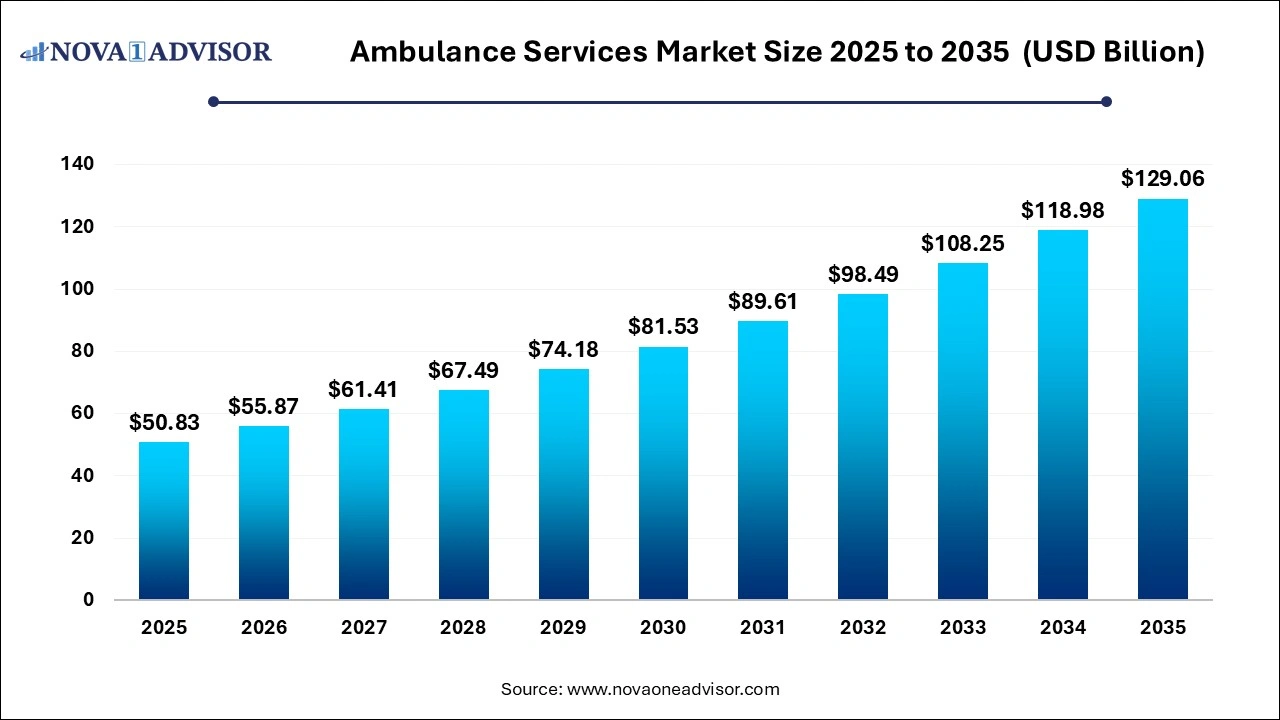
The ambulance services market size was exhibited at USD 50.83 billion in 2025 and is projected to hit around USD 129.06 billion by 2035, growing at a CAGR of 9.77% during the forecast period 2026 to 2035.
Ambulance Services Market Key Takeaways:
- Based on transport vehicle, the ground ambulance segment led the market with the largest revenue share of 72.39% in 2025.
- The air ambulance segment is anticipated to witness the fastest CAGR of 11.50% during the forecast period.
- Based on emergency services, the emergency services segment led the market with the largest revenue share of 62.09% in 2025.
- The segment is expected to witness the significant CAGR of 9.38% during the forecast period
- Based on equipment, the advance life support ambulance services segment held the market with the largest revenue share of 70.0% in 2025.
- The Basic Life Support (BLS) is anticipated to grow at the fastest CAGR of 8.63% during the forecast period.
- North America dominated the market with the revenue share of 48.31% in 2025.
Ambulance Services Market Outlook
- Market Growth Overview: The ambulance services market is expected to grow significantly between 2025 and 2034, driven by the rising chronic diseases and geriatric population, an increase in accidents and emergencies, and the growing popularity of specialized services.
- Sustainability Trends: Sustainability trends involve electric and hybrid ambulances, eco-friendly design, telemedicine and remote care, and intelligent route planning.
- Major Investors: Major investors in the market include Falck A/S, Acadian Ambulance Service, Envision Healthcare Corporation, Air Methods Corporation, and Babcock International Group PLC.
Ambulance Services Market Overview
The ambulance services market is a critical component of global healthcare systems, serving as the first point of medical assistance in emergencies and playing a vital role in patient transportation. Ambulance services ensure rapid access to healthcare for critical conditions such as trauma, cardiac arrest, stroke, respiratory emergencies, and obstetric complications. They also play a crucial role in non-emergency medical transport, including inter-facility transfers and patient mobility assistance.
Technological advancements, including GPS tracking, advanced life support (ALS) equipment integration, telemedicine capabilities, and real-time data communication, have significantly improved the efficiency and scope of ambulance services. Modern ambulances are not just transport vehicles but mobile treatment centers equipped to deliver essential pre-hospital care.
The rising incidence of road accidents, chronic diseases, geriatric populations, and lifestyle-related health issues are primary drivers fueling the demand for ambulance services globally. Furthermore, the COVID-19 pandemic highlighted the strategic importance of ambulance networks in patient triage, isolation transport, and intensive care logistics.
As healthcare systems shift toward integrated emergency care models and patient-centered approaches, the ambulance services market is poised for dynamic evolution, with increasing investments in air ambulances, automated dispatch systems, and specialized patient transport solutions.
How AI is Impaction on Ambulance Services Market
AI and ML are revolutionizing the ambulance service industry by significantly reducing response times and improving patient outcomes through real-time data analysis and predictive routing. Machine learning algorithms analyse traffic patterns, weather, and historical data to identify demand hotspots, allowing for strategic, proactive positioning of ambulances to minimize delays. During transit, AI-powered diagnostic tools and telematics continuously monitor patient vitals, transmitting actionable, high-acuity data to hospitals to prepare for incoming patients. AI-integrated 5G smart ambulance allows paramedics to receive remote guidance from specialists, transforming the vehicle into a mobile, high-efficiency treatment unit.
Major Trends in the Ambulance Services Market
-
Rise of Specialized Ambulance Services: Neonatal, bariatric, infectious disease, and psychiatric patient transport gaining prominence.
-
Adoption of Telemedicine and Remote Monitoring: Integration of real-time diagnostics in ambulances.
-
Expansion of Air Ambulance Networks: To overcome geographical barriers and ensure rapid access to tertiary care.
-
Private Sector Participation and Outsourcing: Growing privatization of ambulance fleets in many regions.
-
Smart Ambulances with IoT Integration: Real-time data sharing, predictive maintenance, and route optimization.
-
Emergence of Green and Electric Ambulances: Focus on sustainable and eco-friendly healthcare logistics.
-
Growing Demand for Non-Emergency Medical Transport (NEMT): Driven by the aging population and chronic disease management.
-
Government Initiatives to Expand Emergency Medical Services (EMS): Especially in emerging economies.
Report Scope of Ambulance Services Market
| Report Coverage | Details |
| Market Size in 2026 | USD 55.87 Billion |
| Market Size by 2035 | USD 129.06 Billion |
| Growth Rate From 2026 to 2035 | CAGR of 9.77% |
| Base Year | 2025 |
| Forecast Period | 2026 to 2035 |
| Segments Covered | By Transport Vehicle, By Emergency Services, By Equipment |
| Market Analysis (Terms Used) | Value (USD Million/Billion) or (Volume/Units) |
| Regional Covered | North America; Europe; Asia Pacific; Latin America; MEA |
| Key Companies Profiled | Babcock International Group PLC; London Ambulance Service NHS Trust; Acadian Ambulance Service; BVG India Limited; America Ambulance Services, Inc.; Falck Global Medical Response; Air Methods Corporation; Ziqitza Healthcare Limited; MEDIVIC PHARMACEUTICAL PVT LTD. |
Ambulance Services Market Dynamics
Driver
Rising Incidence of Road Accidents and Medical Emergencies
A critical driver of the ambulance services market is the rising incidence of road traffic accidents and medical emergencies worldwide.
According to the World Health Organization (WHO), approximately 1.3 million people die each year due to road traffic accidents, with many more suffering non-fatal injuries requiring immediate medical attention. Fast and effective pre-hospital care provided by ambulance services often determines patient survival and recovery rates.
Similarly, the increasing prevalence of non-communicable diseases like heart attacks, strokes, asthma attacks, and diabetic emergencies necessitates rapid medical intervention. Ambulance services equipped with advanced life support (ALS) systems enable critical early interventions that improve patient outcomes dramatically.
As urbanization intensifies and lifestyle-related health risks rise, the demand for timely, efficient ambulance services is projected to grow significantly.
Restraint
High Operational Costs and Infrastructure Challenges
One of the significant restraints facing the ambulance services market is the high operational costs and infrastructure challenges associated with service delivery.
Ambulance services require substantial investments in vehicles, medical equipment, communication systems, and trained personnel. Regular maintenance, fuel costs, insurance, and compliance with regulatory standards add further to operational expenses.
Air ambulance services, in particular, involve very high setup and running costs, including aircraft acquisition, aviation fuel, and pilot/medical crew salaries. In many developing regions, inadequate road infrastructure, traffic congestion, and limited funding hamper the efficiency and reach of ground ambulance networks.
Affordability issues also limit patient access, especially where ambulance usage is an out-of-pocket expense. Building sustainable, affordable ambulance ecosystems remains a key challenge for healthcare policymakers globally.
Opportunity
Technological Innovations in Smart Ambulance Services
An emerging opportunity lies in technological innovations transforming traditional ambulance services into smart healthcare delivery units.
The integration of IoT, AI, and 5G technology is enabling real-time monitoring of patient vitals during transport, remote consultations with hospital specialists, and seamless sharing of electronic health records (EHRs). GPS and AI-based route optimization reduce response times, while predictive analytics can forecast ambulance demand hotspots for better fleet management.
Furthermore, the emergence of electric ambulances and drone-based medical supply delivery systems aligns with global sustainability goals. Companies that invest in smart ambulance solutions stand to gain a competitive edge as healthcare systems increasingly prioritize connected, efficient, and eco-friendly emergency services.
Ambulance Services Market Segmantal Insights
By Transport Vehicle Insights
Ground ambulances dominate the transport vehicle segment, representing the most accessible and commonly used mode of emergency and non-emergency patient transportation globally. They form the backbone of emergency medical services (EMS), providing rapid response in urban and rural areas alike. Ground ambulances are continuously evolving with upgraded life support capabilities, GPS navigation, and integration with hospital networks.
Air ambulances are growing fastest, particularly in remote and inaccessible regions where timely ground transport is challenging. Air ambulance services both helicopters for shorter distances and fixed-wing aircraft for longer routes—have become indispensable for trauma care, organ transport, and critical care referrals, with governments and private players investing heavily in expanding aerial medical evacuation networks.
By Emergency Services Insights
Emergency services dominate the market, driven by their critical role in responding to accidents, cardiac arrests, strokes, childbirth complications, and other life-threatening events. Emergency ambulance services require highly trained paramedics and equipment to stabilize patients en route to hospitals.
Non-emergency services are growing fastest, propelled by the rising demand for scheduled medical transport among elderly patients, rehabilitation referrals, dialysis center visits, and hospital discharges. The aging population, along with an increasing emphasis on chronic disease management outside of acute settings, is fueling robust growth in non-emergency ambulance services, often provided through private NEMT companies.
By Equipment Insights
Advanced Life Support (ALS) ambulance services dominate the equipment outlook segment, equipped with paramedics trained in life-saving procedures like intubation, IV administration, cardiac monitoring, and medication delivery. ALS services are essential for critically ill patients and are a cornerstone of modern EMS systems.
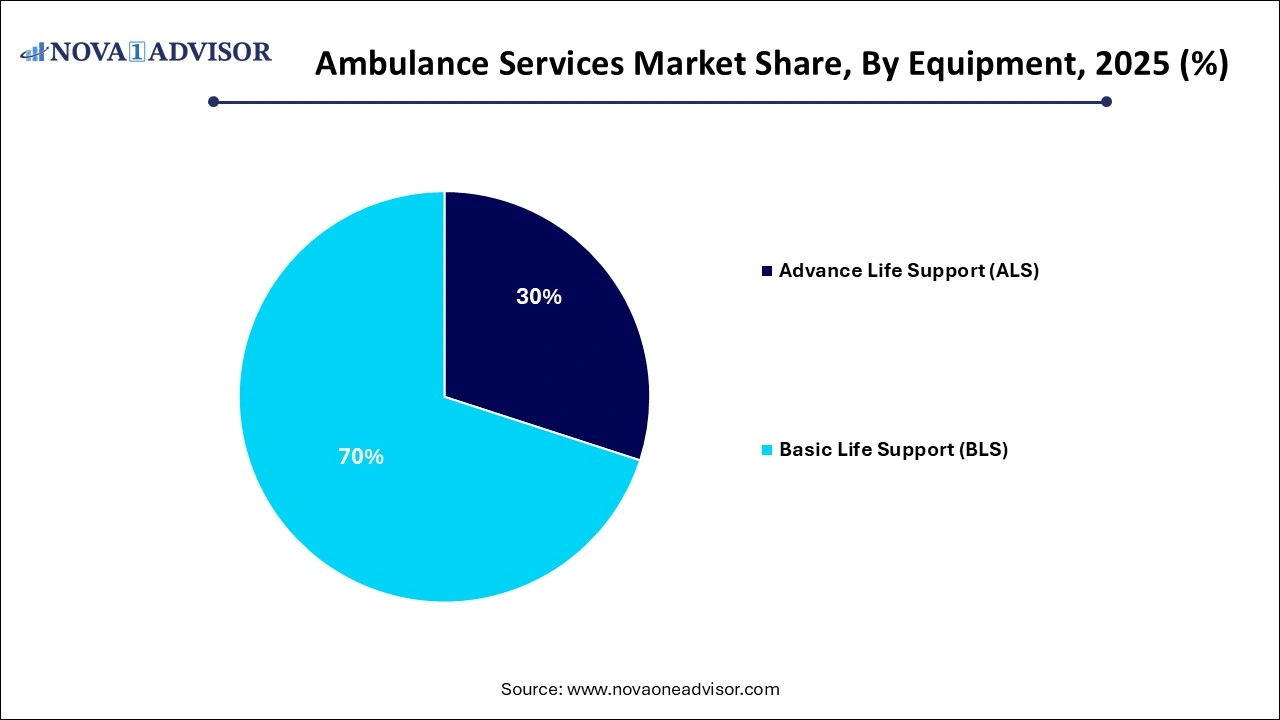
Basic Life Support (BLS) ambulance services are growing fastest, addressing the needs of patients requiring basic monitoring, oxygen administration, or non-invasive interventions during transport. BLS services are increasingly sought for inter-hospital transfers, elderly patient mobility, and post-operative care, offering cost-effective solutions for stable patients without acute medical needs.
Ambulance Services Market By Regional Insights
North America holds the largest market share, attributed to its highly developed healthcare infrastructure, strong insurance penetration, and well-established emergency medical services.
The United States, in particular, boasts an extensive network of public and private ambulance providers, advanced training programs for EMTs and paramedics, and a high adoption rate of technology-driven ambulance solutions. Regulatory frameworks like the Emergency Medical Treatment and Labor Act (EMTALA) ensure widespread access to emergency ambulance services, further boosting market growth.
Additionally, the rising incidence of cardiovascular emergencies and increasing investments in air ambulance services consolidate North America’s dominance in the ambulance services market.
Asia-Pacific is the fastest-growing region, driven by expanding healthcare access, urbanization, rising healthcare spending, and increasing road accident rates in populous countries like India and China.
Governments across Asia-Pacific are investing heavily in upgrading EMS infrastructure, including establishing centralized emergency call systems (e.g., India's 108 service), expanding rural ambulance coverage, and incentivizing private sector participation. The emergence of mobile health apps facilitating ambulance booking and the growing medical tourism industry in countries like Thailand and Malaysia further drive demand.
Moreover, partnerships between public agencies and private companies are enhancing service quality and geographic reach, ensuring Asia-Pacific's continued market outperformance.
U.S. Ambulance Services Market Trends
U.S.’s services are evolving into high-tech mobile clinics, leveraging 5G connectivity and 4K video to enable real-time remote consultations. While advanced life support (ALS) units continue to dominate the market by addressing high-acuity emergencies, the air ambulance and non-emergency transport segments are seeing the fastest proportional growth. Operational efficiency is being further refined through AI-optimized dispatch systems and specialized units tailored for inter-facility transfers.
China Ambulance Services Market Trends
China’s rapidly modernizing its emergency infrastructure to manage a surging demand from its aging population and high cardiovascular disease burden. Urbanization and rising road accident rates have made rapid response times a critical priority, leading to significant investments in high-tech, 5G-enabled ambulance fleets. Public expectations for high-quality pre-hospital care are shifting the market toward more sophisticated, medically equipped units.
Key Players in the Ambulance Services Market
- Babcock International Group PLC: Provides emergency medical services and ambulance fleet management, focusing on rapid response and specialized patient transport solutions. They enhance operational efficiency for public health services through expert logistics and specialized vehicle support.
- London Ambulance Service NHS Trust: Operates as a major public emergency service provider in Europe, covering a large, densely populated area to deliver 24/7 care. They contribute to the market by implementing advanced clinical care protocols and managing high-volume emergency calls.
- Acadian Ambulance Service: A prominent private ambulance service provider offering comprehensive emergency and non-emergency transport, often specializing in air medical services. They contribute through extensive coverage in the US, leveraging advanced life support capabilities.
- BVG India Limited: A major provider in India, focusing on expanding emergency medical access and public-private partnerships.
- America Ambulance Service, Inc.: American Ambulance Service, Inc. provides essential emergency and non-emergency medical transportation, including Basic Life Support (BLS), Advanced Life Support (ALS), and critical care transport, primarily serving as the exclusive EMS provider for specific regions in Connecticut.
- Falck A/S: Falck A/S is a global leader in emergency and healthcare services, operating over 3,000 ambulances and responding to 9-1-1 calls in multiple countries, including significant operations in the United States.
Ambulance Services Market Recent Developments
-
March 2025: American Medical Response (AMR) announced the deployment of a new fleet of eco-friendly electric ambulances across select U.S. cities, aiming to reduce carbon emissions in healthcare transportation.
-
February 2025: Air Methods Corporation launched a new telemedicine-integrated helicopter service to provide real-time remote specialist consultations during patient air transport.
-
January 2025: Ziqitza Health Care Limited expanded its partnership with state governments in India to operate emergency ambulance services under the public-private partnership (PPP) model.
-
December 2024: Falck A/S unveiled a smart ambulance prototype equipped with AI-assisted diagnostics and automated triage capabilities at the International EMS Conference.
-
November 2024: Global Medical Response (GMR) acquired a regional air ambulance operator in Latin America to strengthen its cross-border emergency medical evacuation services.
Segments Covered in the Report
This report forecasts revenue growth at country levels and provides an analysis of the latest industry trends in each of the sub-segments from 2021 to 2034. For this study, Nova one advisor, Inc. has segmented the ambulance services market
By Transport Vehicle
- Ground Ambulance
- Air Ambulance
- Water Ambulance
By Emergency Services
- Emergency Services
- Non-Emergency Services
- Equipment Outlook (Revenue, USD Billion, 2018 - 2030)
- Advance Life Support (ALS) Ambulance Services
- Basic Life Support (BLS) Ambulance Services
By Regional
- North America
- Europe
- Asia Pacific
- Latin America
- Middle East and Africa (MEA)
FAQ's

Proceed to Buy
Instant PDF delivery on confirmation

Ambulance Services Market Size to Worth Around USD 129.06 Bn by 2035
 Request Customization
 Download Sample

Get a Sample of this Report
Ambulance Services Market