

ADME Toxicology Testing Market Size, Share, and Trends 2026 to 2035
 Status Published
 Category Healthcare


Content
ADME Toxicology Testing Market Size and Growth 2026 to 2035
The global ADME toxicology testing market size was estimated at USD 7.10 billion in 2025 and is projected to hit around USD 18.75 billion by 2035, growing at a CAGR of 10.2% during the forecast period from 2026 to 2035.
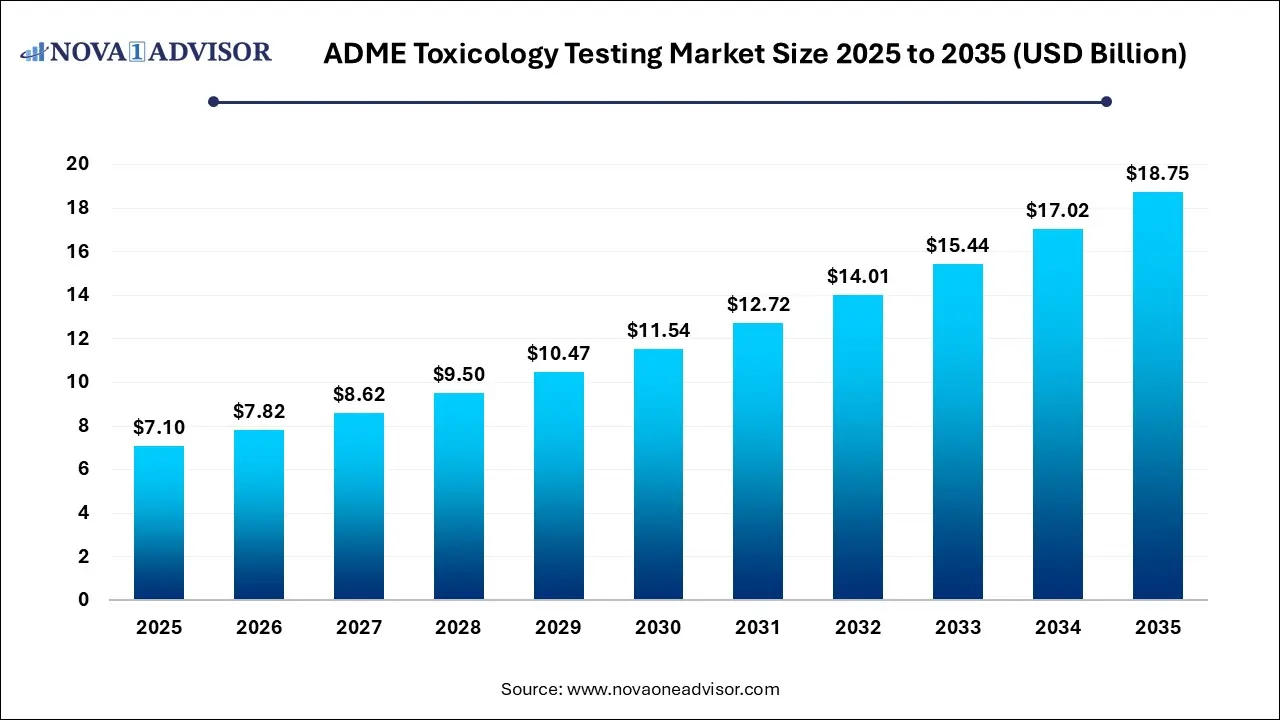
Market Key Takeaways
- The ADME (Absorption, Distribution, Metabolism, and Excretion) toxicology testing market is experiencing robust growth due to increasing drug development activities and regulatory requirements.
- Pharmaceutical and biotechnology companies are increasingly relying on advanced ADME testing to minimize late-stage drug failures.
- Cellular assays dominate the market owing to their physiological relevance and widespread adoption in early-stage drug screening.
- In silico methods are emerging rapidly as cost-effective and time-saving alternatives.
- High-throughput screening technologies are transforming testing efficiency and scalability.
- Hepatotoxicity remains the most critical application area due to the liver’s central role in drug metabolism.
- North America leads the market due to advanced R&D infrastructure, while Asia Pacific is witnessing the fastest growth.
- AI and machine learning are revolutionizing predictive toxicology and drug safety assessments.
Market Overview
The ADME toxicology testing market forms a cornerstone of the pharmaceutical and biotechnology industries, ensuring the safety, efficacy, and pharmacokinetic profiling of drug candidates. ADME studies evaluate how a drug is absorbed, distributed throughout the body, metabolized, and eventually excreted. Toxicology testing complements these studies by identifying potential adverse effects, helping researchers determine safe dosage levels and minimize risks before clinical trials.
In recent years, the complexity of drug molecules has increased significantly, particularly with the rise of biologics, gene therapies, and targeted treatments. This has heightened the need for advanced ADME toxicology testing methods capable of accurately predicting human responses. Regulatory authorities across the globe mandate rigorous ADME and toxicity testing to ensure patient safety, further driving market demand.
Pharmaceutical companies face substantial financial risks associated with late-stage drug failures, often caused by unforeseen toxicity issues. For instance, several drug candidates have been withdrawn during clinical trials due to hepatotoxicity or cardiotoxicity, leading to significant losses. As a result, there is a growing emphasis on early-stage ADME testing to identify potential risks sooner.
Moreover, the increasing prevalence of chronic diseases such as cancer, diabetes, and neurological disorders has led to a surge in drug development activities. This, in turn, has created a strong demand for comprehensive ADME toxicology testing solutions. The market is also benefiting from technological advancements, including automation, high-throughput screening, and AI-driven predictive models.
In addition to pharmaceuticals, ADME toxicology testing is gaining importance in other industries such as cosmetics, chemicals, and food safety, where regulatory compliance and consumer safety are critical.
Market Outlook
- Market Growth Overview: The global ADME toxicology testing market is expected to grow significantly between 2025 and 2035, driven by the high rate of late-stage drug failures, the shift from animal testing to in vitro methods, and the increased need for novel drug molecules.
- Sustainability Trends: Sustainability trends involve green toxicology and eco-friendly practices, in silico modeling and artificial intelligence, and stringent ESG and regulatory compliance.
- Major Investors: Major investors in the market include Charles River Laboratories, Thermo Fisher Scientific, Eurofins Scientific, Labcorp, and Agilent Technologies.
How is AI Transforming the ADME Toxicology Testing Market?
Artificial Intelligence (AI) is significantly reshaping the ADME toxicology testing landscape by enabling faster, more accurate, and cost-effective drug safety evaluations. Traditionally, ADME testing relied heavily on in vitro and in vivo experiments, which are time-consuming, expensive, and often limited in predictive accuracy. AI is addressing these challenges by introducing data-driven approaches that enhance predictive capabilities.
One of the key applications of AI in this market is predictive toxicology. Machine learning models analyze vast datasets from previous drug studies to identify patterns and predict potential toxicity issues. For example, AI algorithms can predict hepatotoxicity or cardiotoxicity based on molecular structure and biological interactions, allowing researchers to eliminate risky compounds early in the development process.
AI is also enhancing in silico modeling, which simulates drug behavior within the human body. These models can predict absorption rates, metabolic pathways, and excretion patterns without the need for extensive laboratory testing. This not only reduces costs but also accelerates drug development timelines.
Another significant impact of AI is in high-throughput screening. AI-driven systems can analyze large volumes of data generated from screening assays, identifying promising drug candidates more efficiently. Additionally, AI integration with robotics and automation enables real-time monitoring and optimization of testing processes.
Furthermore, AI is facilitating personalized medicine by enabling more accurate predictions of how different patient populations may respond to a drug. This is particularly important in the development of targeted therapies and precision medicine.
As AI technologies continue to evolve, they are expected to play an increasingly central role in ADME toxicology testing, driving innovation and improving overall drug development outcomes.
ADME Toxicology Testing Market Report Scope
| Report Coverage | Details |
| Market Size in 2026 | USD 7.82 Billion |
| Market Size by 2035 | USD 18.75 Billion |
| Growth Rate From 2026 to 2035 | CAGR of 10.2% |
| Base Year | 2025 |
| Forecast Period | 2026 to 2035 |
| Segments Covered | Method, Technology, Application, End-Users, Region |
| Market Analysis (Terms Used) | Value (USD Million/Billion) or (Volume/Units) |
| Regional Scope | North America; Europe; Asia Pacific; Central and South America; the Middle East and Africa |
| Key Companies Profiled | Agilent Technologies, Inc., Thermo Fisher Scientific, Inc., Bio-Rad Laboratories, Inc., Beckman Coulter, Inc., Cellartis AB, Cyprotex PLC., Life Technologies Corporation, Optivia Biotechnology, Inc., Accelrys, Inc., Molecular Discovery Ltd., Cyprotex PLC, MultiCASE, Inc., Caliper Life Sciences, Inc., Xceleron, Inc., ACEA Biosciences, Inc., Albany Molecular Research, Inc., CeeTox, Inc., and others. |
Market Driver
Increasing Drug Development and Regulatory Requirements
A primary driver of the ADME toxicology testing market is the rapid growth in drug development activities combined with stringent regulatory requirements. Pharmaceutical companies are under constant pressure to develop safe and effective drugs while minimizing risks associated with adverse effects.
Regulatory agencies such as the FDA and EMA require comprehensive ADME and toxicology data before approving new drugs for clinical trials and commercialization. These requirements ensure patient safety but also increase the demand for advanced testing solutions.
For example, before a drug candidate enters clinical trials, it must undergo extensive ADME studies to evaluate its pharmacokinetics and toxicity profile. Failure to meet these requirements can result in delays or rejection, leading to significant financial losses.
Additionally, the increasing complexity of modern drug molecules, including biologics and targeted therapies, has made ADME testing more challenging and essential. Companies are investing heavily in advanced testing technologies to meet regulatory standards and improve the success rate of drug development.
Market Restraint
High Costs and Technical Complexity
Despite its importance, the ADME toxicology testing market faces challenges related to high costs and technical complexity. Advanced testing methods, such as high-throughput screening and OMICS technologies, require significant investment in equipment, infrastructure, and skilled personnel.
Small and mid-sized pharmaceutical companies often struggle to afford these technologies, limiting their adoption. Additionally, the complexity of ADME testing requires specialized expertise, which can be a barrier for organizations with limited resources.
Another challenge is the variability in test results, particularly in in vitro and in vivo studies. Differences in experimental conditions and biological systems can lead to inconsistent outcomes, affecting the reliability of predictions.
While in silico methods and AI are helping to reduce costs and complexity, their adoption is still evolving, and they cannot fully replace traditional testing methods. As a result, cost and complexity remain significant restraints for the market.
Market Opportunity
Emergence of Alternative Testing Methods
The growing emphasis on reducing animal testing presents a significant opportunity for the ADME toxicology testing market. Regulatory authorities and ethical organizations are encouraging the adoption of alternative methods, such as in vitro assays, organ-on-chip technologies, and computational models.
For instance, organ-on-chip systems replicate human organ functions on a micro-scale, allowing researchers to study drug effects in a more physiologically relevant environment. These systems can provide more accurate predictions of human responses compared to traditional animal models.
Additionally, in silico modeling and AI-driven simulations are gaining traction as cost-effective and efficient alternatives to traditional testing methods. These approaches can significantly reduce the time and cost associated with drug development while improving predictive accuracy.
As these technologies continue to advance, they are expected to create new growth opportunities for market players, particularly those focusing on innovative and sustainable testing solutions.
Segmental Insights
By Method
How did the cellular assay segment dominate the Global ADME Toxicology Testing market?
The cellular assay segment is driven by providing the high-throughput, real-time data essential for early-stage lead optimization. The integration of 3D cell culture and organ-on-chip technologies has bridged the gap between laboratory results and human physiological responses, significantly reducing the risk of late-stage clinical failures. These methods offer a cost-effective and ethically superior alternative to traditional animal testing, aligning with global regulatory shifts toward in vitro methodologies.
How did the in silico segment expect to hold the fastest-growing Global ADME Toxicology Testing market in the coming years?
The in silico segment is driven by the integration of AI and machine learning to predict toxicity with unprecedented speed. As the FDA and EMA increasingly accept non-animal testing alternatives, computer-based materials, such as QSAR and PBPK, are becoming essential for high-throughput screening. This digital shift significantly reduces R&D costs and shortens development timelines by identifying potential hazards long before a compound reaches the lab.
By Technology
How did the cell culture segment account for the largest share in the Global ADME Toxicology Testing market?
The cell culture segment is driven by the superior physiological relevance of 3D models and organ-on-a-chip systems. By enabling high-throughput, automated screening, these technologies allow pharmaceutical companies to identify toxic compounds early, significantly reducing both preclinical costs and time-to-market. The cell culture provides the indispensable framework required to bridge the gap between laboratory discovery and human clinical success.
How did the high-throughput screening segment expect to hold the fastest-growing Global ADME Toxicology Testing market in the coming years?
The high-throughput screening segment is driven by the integration of 3D cell cultures and AI-driven analytics, which has further sophisticated this technology, providing high-resolution data that traditional manual methods cannot match. As global manufacturers, such as WuXi AppTec, scale these platforms, HTS is becoming the indispensable industry standard for high-volume, predictive safety assessments.
By Application
How did the systemic toxicity segment account for the largest share in the Global ADME Toxicology Testing market?
The systemic toxicity segment is driven by evaluating the holistic impact of compounds across all biological systems; these assessments provide the comprehensive risk profile necessary to prevent catastrophic late-stage clinical failures. The surge in biologics and complex small molecules has further intensified the need for advanced screening, now supported by AI-driven platforms and high-throughput techniques.
How did the hepatotoxicity segment expect to hold the fastest-growing Global ADME Toxicology Testing market in the coming years?
The hepatotoxicity segment is driven by the critical need to identify drug-induced liver injury, the leading cause of late-stage clinical failures. By utilizing advanced 3D liver cultures and organ-on-a-chip systems, researchers are now detecting toxic responses with significantly higher sensitivity than legacy 2D models. The focus on liver safety is a strategic priority that ensures only the most metabolically stable compounds advance through the development pipeline.
By End Users
How did the pharmaceutical and biotechnology companies segment account for the largest share in the Global ADME Toxicology Testing market?
The pharmaceutical and biotechnology companies segment is driven by the increasing complexity of biologics and novel drug candidates necessitates more extensive toxicological evaluations to satisfy stringent FDA and EMA mandates. By integrating high-throughput and in vitro technologies, these companies are successfully streamlining their R&D pipelines while ensuring comprehensive regulatory compliance. The segment's investment in advanced predictive safety data is the primary driver for reducing late-stage failures and optimizing the cost of drug development.
How did the contract research organizations segment expect to hold the fastest-growing Global ADME Toxicology Testing market in the coming years?
The contract research organizations segment is driven by the provision of specialized access to 3d cell culture, organ-on-chip models, and AI-driven platforms. CROs offer the technical agility required to navigate complex global regulatory mandates. This expansion is particularly robust in emerging markets, where high-throughput capabilities and cost-effective screening accelerate the "hit-to-lead" timeline for global drug developers.
By Region
North America dominates the ADME toxicology testing market due to its advanced pharmaceutical industry, strong regulatory framework, and significant R&D investments. The presence of major market players and technological advancements further support the region’s leadership.
Asia Pacific is the fastest-growing region due to expanding pharmaceutical manufacturing, increasing healthcare investments, and growing adoption of advanced technologies. Countries such as China and India are emerging as key players in the global market.
Key Players in the Global ADME Toxicology Testing Market
- Promega Corporation
Promega provides bioluminescence-based assay technologies (such as P450-Glo™) that enable high-throughput screening of drug metabolism and cytochrome P450 activity in cellular environments. Their assays are crucial for assessing drug toxicity and interactions early in the discovery process, offering sensitive, low-background data that enhances the prediction of human ADME properties.
- Agilent Technologies, Inc.
Agilent contributes high-throughput, automated mass spectrometry solutions, including RapidFire/MS systems, which accelerate drug metabolic stability studies by providing fast, accurate analysis of compounds.
- Thermo Fisher Scientific, Inc.
Thermo Fisher offers an extensive portfolio of tools for ADME-Tox studies, ranging from Gibco hepatocytes and cell culture media to advanced high-content imaging systems like the CellInsight CX7.
Recent Developments
- March 2025: A leading life sciences company launched an AI-powered ADME prediction platform to enhance drug safety assessments.
- January 2025: A major CRO expanded its toxicology testing facilities in Asia Pacific to meet growing demand.
- November 2024: A biotechnology firm introduced a new organ-on-chip platform for advanced toxicity testing.
- September 2024: A global pharmaceutical company partnered with a tech firm to integrate AI into its drug development pipeline.
- July 2024: A diagnostics company acquired a toxicology testing provider to strengthen its service portfolio.
ADME Toxicology Testing Market Segmentation
By Method
- Cellular Assay
- Biochemical Assay
- In Silica
- Ex-vivo
By Technology
- Cell Culture
- High Throughput
- Molecular Imaging
- OMICS Technology
By Application
- Systemic Toxicity
- Renal Toxicity
- Hepatotoxicity
- Neurotoxicity
- Others
By End-Users
- Hospitals and clinics
- Diagnostic centers
- Pathological Labs
- Others
By Region
- North America
- Europe
- Asia Pacific
- Latin America
- Middle East and Africa (MEA)

Proceed to Buy
Instant PDF delivery on confirmation

ADME Toxicology Testing Market Size to Hit USD 18.75 Billion by 2035
 Request Customization
 Download Sample

Get a Sample of this Report
ADME Toxicology Testing Market