

Air Quality Monitoring System Market (By Product; By End-user) - Global Industry Analysis, Share, Growth, Regional Outlook And Forecasts, 2026-2035
 Status Published
 Category Healthcare


Content
Air Quality Monitoring System Market Size, Growth and Trends 2026 to 2035
The global air quality monitoring system market size was estimated at USD 6.19 billion in 2025 and is expected to reach USD 12.52 billion by 2035, growing at a CAGR of 7.3% from 2025 to 2035.
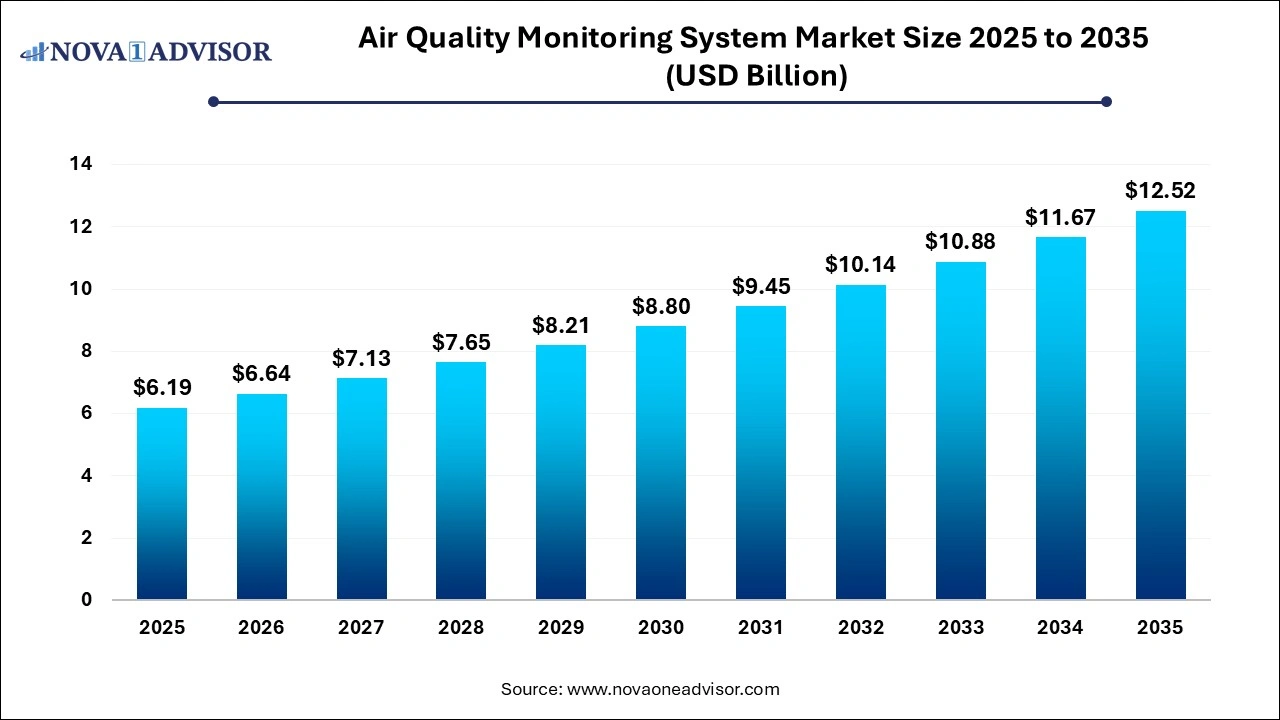
Air Quality Monitoring System Market Outlook
- Market Growth Overview: The air quality monitoring system market is expected to grow significantly between 2026 and 2035, driven by the rising public awareness and health concerns, the development of smart city initiatives and urbanization, and advancements in sensor technology and IoT.
Sustainability Trends: Sustainability trends involve affordable and portable sensor technologies, green building and indoor focus, and sustainable device manufacturing.
Major Investors: Major investors in the market include Thermo Fisher Scientific, Siemens AG, Teledyne Technologies, Horiba Ltd., and Honeywell International.
COVID-19 Impact Assessment on Market Landscape
The report comprises the scrutiny of COVID-19 lock-down impact on the income of market leaders, disrupters and followers. Since lock down was instigated differently in diverse regions and nations, influence of same is also dissimilar across various industry verticals. The research report offers present short-term and long-term influence on the market to assist market participants across value chain makers to formulate the framework for short term and long-lasting tactics for recovery and by region.
Air Quality Monitoring System market report empower readers with all-inclusive market intelligence and offers a granular outline of the market they are operational in. Further this research study delivers exceptional combination of tangible perceptions and qualitative scrutiny to aid companies accomplishes sustainable growth. This report employs industry-leading research practices and tools to assemble all-inclusive market studies, intermingled with pertinent data. Additionally, this report also emphases on the competitive examination of crucial players by analyzing their product portfolio, pricing, gross margins, financial position, growth approaches, and regional occurrence.
Air Quality Monitoring System Market Report Scope
| Report Coverage | Details |
| Market Size in 2025 | USD 6.64 Billion |
| Market Size by 2036 | USD 12.52 Billion |
| Growth Rate From 2026 to 2035 | CAGR of 7.3% |
| Base Year | 2025 |
| Forecast Period | 2026 to 2035 |
| Market Analysis (Terms Used) | Value (USD Million/Billion) or (Volume/Units) |
| Segments Covered | By Product, By Sampling Method, By Pollutant, By End User |
| Regional Scope | North America; Europe; Asia Pacific; Central and South America; the Middle East and Africa |
| Key Companies Profiled | Thermo Fisher Scientific, Emerson Electric, General Electric, Teledyne Technologies |
Air Quality Monitoring System Market Segmental Insights
By Product Insights
How did the outdoor monitors segment dominate the Air Quality Monitoring System market?
The outdoor monitors segment is driven by the stringent government mandates that require fixed, high-cost stations for national air quality enforcement and policy implementation. With the rapid urbanization in the Asia-Pacific region, these complex systems are increasingly integrated with IoT technology to provide real-time data for large-scale smart city projects. The high capital investment required for these industrial-grade stations ensures they maintain a leading revenue share over smaller indoor alternatives.
How did the indoor monitors segment expect to hold the fastest-growing Air Quality Monitoring System market in the coming years?
The indoor monitors segment is driven by the integration of smart, IoT-enabled sensors that provide real-time data for proactive environmental management. Rising global concerns over respiratory health and airborne allergens have shifted consumer and commercial focus toward indoor air quality as a primary wellness metric. By green building certifications and new government mandates for air quality standards in public and private workspaces.
By Sampling Method Insights
How did the active/continuous monitoring segment account for the largest share in the Air Quality Monitoring System market?
The active continuous monitoring segment is driven by providing instantaneous, high-precision data that allows for immediate corrective action in industrial and urban settings. Driven by stringent North American and European regulations, industries are increasingly adopting continuous emission monitoring systems (CEMS) to ensure 24/7 environmental compliance. The integration of AI-enhanced sensors has further improved data reliability, making these systems the preferred choice for large-scale operations.
How did the stack monitoring segment expect to hold the fastest-growing Air Quality Monitoring System market in the coming years?
The stack monitoring segment is driven by the growing worldwide emission norms for industrial stacks. Regulatory agencies now require industries to provide real-time, 24-7 air quality data, driving the adoption of continuous emission monitoring systems. The transition from manual stack testing to advanced CEMS, which utilize IoT for remote monitoring and AI for predictive analytics. As industries, such as power generation, petrochemicals, and manufacturing, expand, the need for stack monitors to measure pollutants, rapid industrialization, high-pollution levels, and government-led initiatives for better air quality monitoring, creating significant market for stack monitoring solutions.
By Pollutant Insights
How did the chemical pollutants segment account for the largest share in the Air Quality Monitoring System market?
The chemical pollutants segment is driven by the convergence of stringent government mandates and rapid industrial growth in emerging regions, necessitating the adoption of high-precision chemical monitoring systems. The heightened health and safety standards for volatile organic compounds and the expansion of smart city infrastructure for urban pollutant tracking. These drivers are synergizing to significantly expand the market share of specialized environmental and industrial monitoring networks.
How did the physical pollutants segment expect to hold the fastest-growing Air Quality Monitoring System market in the coming years?
The physical pollutants segment is driven by the surge in particulate matter from urban activities, and rising public health concerns are driving a critical need for advanced monitoring. The integration of real-time data analytics allows for more precise tracking of hazardous air pollutants. The robust government regulatory initiatives are further accelerating the adoption of these sensing technologies. Together, these drivers are modernising air quality management to safeguard urban environments and public well-being.
By End User Insights
How did the government agencies and academic institutes segment account for the largest share in the Air Quality Monitoring System market?
The government agencies and academic institutes segment is driven by strict regulatory compliance, and massive government investments are accelerating the modernization of large-scale outdoor air quality networks worldwide. This demand is further amplified by academic research needs and the critical requirement for real-time data to drive effective environmental policy. The synergy between mandatory monitoring and data-driven decision-making is fueling a surge in the acquisition of sophisticated monitoring equipment.
How did the commercial and residential users segment expect to hold the fastest-growing Air Quality Monitoring System market in the coming years?
The commercial and residential users segment is driven by the rising health awareness, and the integration of IoT and AI into smart home ecosystems is rapidly accelerating the adoption of indoor air quality monitoring. Due to stringent commercial safety regulations and the emergence of portable devices for personal exposure tracking. Additionally, the dual benefit of optimizing energy efficiency via HVAC integration is making these systems indispensable for modern building management.
Key Players in the Air Quality Monitoring System Market
- Thermo Fisher Scientific: Provides a comprehensive suite of regulatory-grade continuous emission monitoring systems (CEMS) and ambient gas analyzers, including advanced aerosol samplers. Their technology is heavily utilized for industrial fenceline monitoring and tracking air pollutants such as PM2.5, NO2, and SO2.
- Emerson Electric: Specializes in deploying IoT-enabled sensors and CEMS to provide real-time tracking of pollutant emissions for industrial, power generation, and oil and gas infrastructure.
- General Electric: Supplies Advanced Air Quality Control Systems (AQCS) designed to lower SOx and NOx emissions in industrial power generation facilities. Their digital solutions, such as Predix APM, are used for monitoring and diagnostic services to improve environmental performance and ensure compliance.
- Siemens AG: Leverages intelligent IoT systems and artificial neural networks to predict urban pollution levels and manage air quality in complex environments. Through their Building X platform, they integrate smart air quality sensors to monitor and improve indoor environments.
- Teledyne Technologies: Delivers advanced AQMS solutions with a focus on sensor integration, providing flexible, portable, and continuous monitoring platforms.
Unravelling the Critical Segments
This research report offers market revenue, sales volume, production assessment and prognoses by classifying it on the basis of various aspects including product type, application/end-user, and region. Further, this research study investigates market size, production, consumption and its development trends at global, regional, and country level for period 2017 to 2027 and covers subsequent region in its scope:
By Product
- Indoor monitors
- Fixed
- Portable
- Outdoor monitors
- Fixed
- Portable
- Dust & Particulate
- AQM Stations
- Wearable monitors
By Sampling Method
- Active/Continuous Monitoring
- Passive Monitoring
- Intermittent Monitoring
- Manual Monitoring
- Stack Monitoring
By Pollutant
- Chemical Pollutants
- NOX
- SOX
- COX
- VOCs
- Other Chemical Pollutants
- Physical Pollutants
- Biological Pollutants
By End User
- Government Agencies and Academic Institutes
- Commercial and Residential Users
- Petrochemical Industry
- Power Generation Plants
- Pharmaceutical Industry
- Smart City Authority
- Other End Users
By Region
- North America
- U.S.
- Canada
- Europe
- Germany
- France
- United Kingdom
- Rest of Europe
- Asia Pacific
- China
- Japan
- India
- Southeast Asia
- Rest of Asia Pacific
- Latin America
- Brazil
- Rest of Latin America
- Middle East & Africa (MEA)
- GCC
- North Africa
- South Africa
- Rest of Middle East & Africa

Proceed to Buy
Instant PDF delivery on confirmation

Air Quality Monitoring System Market Size to Reach USD 12.52 Billion by 2035
 Request Customization
 Download Sample
Warning: Trying to access array offset on value of type null in /home/multiwpmr/public_html/report-details.php on line 1145

Get a Sample of this Report
Air Quality Monitoring System Market