

Antiviral Drugs Market Size, Share, and Trends 2026 to 2035
 Status Published
 Category Healthcare


Content
Antiviral Drugs Market Size and Growth 2026 to 2035
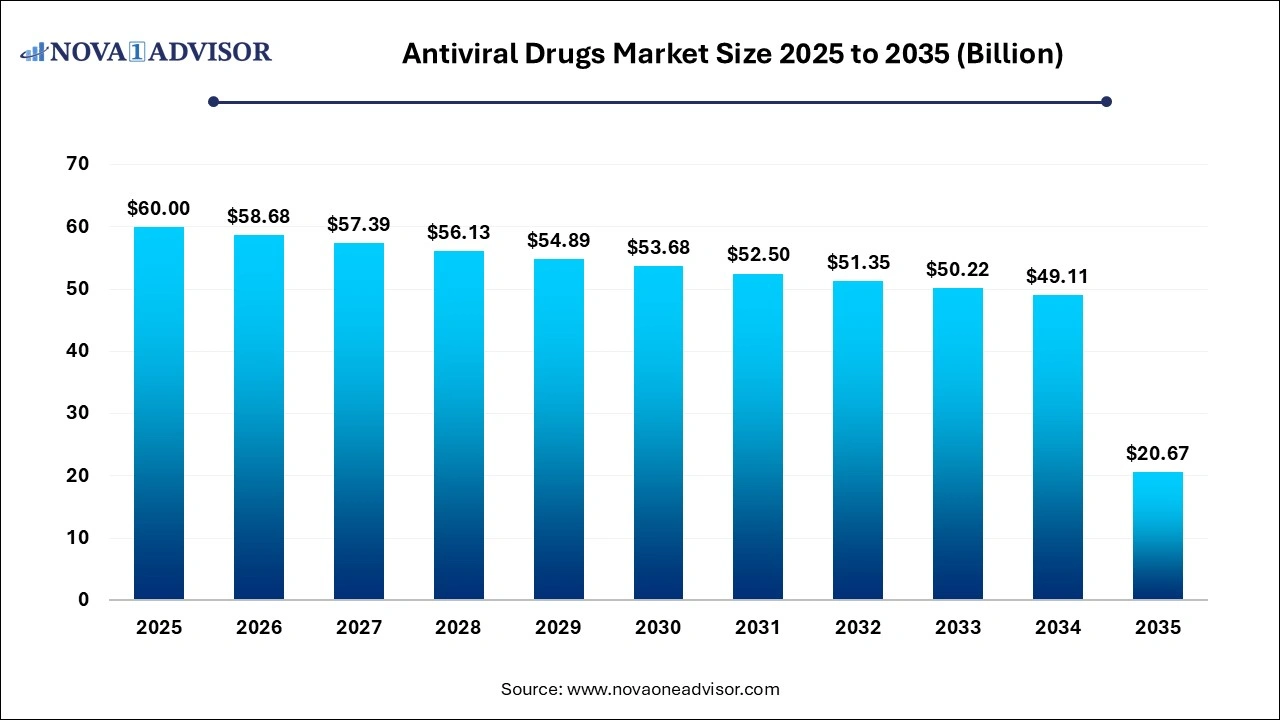
The global antiviral drugs market size was valued at USD 60.00 billion in 2025 and is projected to grow from USD 58.68 billion in 2026 to USD 49.11 billion by 2035, at a CAGR of -2.2% from 2026 to 2035.
Key Takeaway:
- By type, the branded segment dominated the market with the largest share in 2025.
- By type, the generics segment is expected to grow at the fastest CAGR over the forecast period.
- By drug class, the protease inhibitors segment dominated the market with the largest share in 2025.
- By application, the HIV segment dominated the market with the largest share in 2025.
- By region, North America dominated the market with the largest share in 2025.
Market Overview
The Antiviral Drugs Market includes pharmaceutical products used to prevent and treat viral infections such as HIV, hepatitis, influenza, herpes, and COVID-19. The market covers diverse drug classes, including polymerase inhibitors, protease inhibitors, reverse transcriptase inhibitors, neuraminidase inhibitors, capsid inhibitors, and combination therapies.
Market growth is supported by the continued need for long-term treatment of chronic viral diseases and rapid treatment of seasonal or emerging infections. Long-acting and simplified therapies are becoming increasingly important, particularly in HIV, as companies pursue less frequent dosing and improved treatment adherence.
Generic competition is also influencing the market by improving affordability and expanding access to established antiviral therapies. Overall, future growth will depend on new mechanisms, drug resistance management, convenient dosing, treatment accessibility, and the balance between innovation and cost.
Market Outlook
- Market Growth Overview: The global anti-viral drug market is expected to grow significantly between 2025 and 2035, driven by the increasing awareness about the availability of different vaccines.
- Sustainability Trends: Sustainability trends involve an ongoing adoption of green chemistry and waste reduction to lower environmental impact.
- Major Investors: Major investors in the market include Gilead Sciences, GlaxoSmithKline (via ViiV Healthcare), Merck & Co., AbbVie, and F. Hoffmann-La Roche.
How is AI Impacting The Global Anti-Viral Drug Market?
Artificial intelligence (AI) is reshaping the market by reducing development timelines, minimizing early-stage research costs, and allowing quick responses to emerging viral outbreaks. In addition, machine learning algorithms assist in analyzing viral sequence data to predict resistance mutations and guide the generation of cutting-edge multi-target drugs.
Major Trends in the Market
- Growth of long-acting antivirals: Pharmaceutical companies are increasingly pursuing formulations that reduce dosing frequency and improve adherence.
- Expansion of fixed-dose combinations: Combining multiple antiviral mechanisms into one regimen simplifies treatment and can improve patient convenience.
- Rise of resistance-focused drug development: New therapies are increasingly designed to address resistance and maintain activity against viral variants.
- Increasing generic penetration: Loss of exclusivity is creating opportunities for generic manufacturers while putting pricing pressure on originator products.
- AI-driven antiviral discovery: Machine learning is increasingly being incorporated into target identification, compound screening, resistance modeling, and clinical development.
Antiviral Drugs Market Report Scope
| Report Coverage | Details |
| Market Size in 2026 | USD 58.68 Billion |
| Market Size by 2035 | USD 49.11 Billion |
| Growth Rate From 2026 to 2035 | CAGR of -2.2% |
| Base Year | 2025 |
| Forecast Period | 2026 to 2035 |
| Segments Covered | By Type Scope, By Drug Class Scope, By Application Scope, By Region |
| Market Analysis (Terms Used) | Value (USD Million/Billion) or (Volume/Units) |
| Regional Scope | North America; Europe; Asia Pacific; Central and South America; the Middle East and Africa |
| Key Companies Profiled | F. Hoffmann-La Roche Ltd.; GSK plc; AbbVie, Inc.; Merck & Co., Inc.; Johnson & Johnson Services, Inc.; Bristol-Myers Squibb Company; Cipla Inc.; Aurobindo Pharma; Dr. Reddy’s Laboratories Ltd. |
Market Driver – Rising Burden of Viral Infections
The continued global burden of viral infections is driving demand for effective and convenient antiviral treatments. Chronic diseases such as HIV and hepatitis generate long-term demand, while influenza and emerging infections create seasonal or outbreak-related opportunities. Growing interest in easier dosing, improved efficacy, and antiviral preparedness further supports market growth.
Market Restraint – Antiviral Resistance and Development Complexity
Antiviral resistance can reduce treatment effectiveness and require the development of newer therapies. Rapid viral mutation, disease-specific mechanisms, drug interactions, and the need for strong resistance profiles increase R&D complexity and costs. These factors can also shorten the commercial lifespan of existing antiviral products.
Market Opportunity – Long-Acting and Next-Generation Therapies
Long-acting antivirals offer significant opportunities by reducing dosing frequency and improving treatment adherence. HIV is a key area of development, with companies pursuing weekly oral and extended-duration therapies. Additional opportunities exist in broad-spectrum antivirals, host-directed therapies, preventive treatments, and affordable generic medicines, particularly in emerging markets.
Segmental Insight
By Type Scope
Why did the branded segment dominate the global anti-viral drug market?
The branded segment dominated the market with the largest share in 2025. The dominance of the segment can be attributed to the increasing adoption of branded therapeutics because of their efficacy and safety profile. In addition, branded products undergo stringent clinical trials and secure regulatory approvals, which make them a key choice for primary prescriptions.
How did the generics segment expected to hold the significantly growing global anti-viral drug market in the coming years?
The generics segment is expected to grow at the fastest CAGR over the forecast period. The growth of the segment can be credited to the robust presence of many generic market players in emerging economies along with their enhanced affordability. Also, growing cases of chronic viral infections need continuous and long-term medication for ongoing patient compliance.
By Drug Class
Why did the protease inhibitors segment dominate the global anti-viral drug market?
The protease inhibitors segment dominated the market with the largest share in 2025. The dominance of the segment can be linked to the increasing incidence of chronic viral conditions such as HIV and hepatitis, along with increasing demand for their long-term management. Major market players are increasingly developing cutting-edge protease inhibitors with enhanced potency and fewer side effects.
How did the reverse transcriptase inhibitors segment expected to hold the significantly growing global anti-viral drug market in the coming years?
The reverse transcriptase inhibitors segment is expected to grow at the fastest CAGR over the forecast period. The growth of the segment can be driven by increasing volume of regulatory approvals for novel RTI formulations and their adoption. Heavy pharmaceutical investments and clinical trials focusing on cutting-edge nucleoside and non-nucleoside inhibitors impact segment growth further.
By Application
Why did the HIV segment dominate the global anti-viral drug market?
The HIV segment dominated the market with the largest share in 2025. The dominance of the segment is owing to the growing adoption of combination therapies and ongoing innovations in pharmaceuticals. Furthermore, novel drug delivery formats minimize pill fatigue and provide alternative dosing schedules, drawing more patient adoption and leading to segment growth shortly.
How did the herpes segment expected to hold the significantly growing global anti-viral drug market in the coming years?
The herpes segment is expected to grow at the fastest CAGR over the study period. The growth of the segment is due to increasing diagnosis rates and the need for innovative treatments. Moreover, growing patient preference for easy-to-use oral therapies and other injectable formats is likely to fuel segment growth over the forecast period.
By Region
Why did the North American region account for the largest share of the global anti-viral drug market?
North America dominated the market with the largest share in 2025. The dominance of the region can be attributed to the growing incidence of chronic diseases such as RSV, influenza A & B, and COVID-19, along with a rise in strategic partnerships among key players. In addition, strong private and public health insurance policies make branded antiviral drugs more accessible to the majority of consumers.
U.S. Global Anti-viral Drug Market Trends
The growth of the market in the country can be driven by the ongoing transition in post-pandemic demands and the rise in chronic disease incidence. Also, innovations in drug discovery, such as the integration of long-acting injectables and artificial intelligence, open new avenues in the country.
- In May 2026, Gilead Sciences, Inc. announced that the U.S. Food and Drug Administration (FDA) granted accelerated approval to its antiviral medication, Hepcludex (bulevirtide-gmod), for treating adults with chronic hepatitis delta virus (HDV) who present without cirrhosis or with compensated cirrhosis.
Why did the Asia-Pacific region become the fastest-growing global anti-viral drug market during the forecast period?
Asia Pacific is expected to grow at the fastest CAGR over the forecast period. The growth of the region can be credited to the growing healthcare budgets, increasing disease burdens, and growing population across emerging nations such as China and India. Furthermore, the firm local presence of generic pharmaceutical companies in these countries helps reduce drug costs and increase overall medicine availability.
China Global Anti-viral Drug Market Trends
The market in the country is growing due to the robust presence of domestic biopharmaceutical manufacturing and an increase in public health screening volumes. Moreover, a surge in public health emphasis on infectious disease outbreaks has propelled emergency approvals and local R&D for small-molecule oral viral treatments.
Key Players in the Global Anti-viral Drug Market
- Gilead Sciences, Inc. (U.S.): It dominates the global market revenue with blockbuster antiviral therapeutics targeting HIV (such as Biktarvy and Genvoya) and Hepatitis C (such as Harvoni).
- AbbVie, Inc. (U.S.): It maintains a strong footprint in the sector with prominent direct-acting antiviral medications for Hepatitis C.
- F. Hoffmann-La Roche Ltd. (Switzerland): It is known historically and currently for classic polymerase inhibitors and viral diagnostic-therapeutic integration.
Recent Developments
- In February 2026, The U.S. Department of Health and Human Services (HHS) has initiated the $100 million SMART Prize, an incentive program designed to accelerate the research and development of broad-spectrum, small-molecule antiviral therapeutics specifically targeting the Togaviridae and Flaviviridae viral families.
Segments Covered in the Report
This report forecasts revenue growth at country levels and provides an analysis of the latest industry trends in each of the sub-segments from 2021 to 2035. For this study, Nova one advisor, Inc. has antiviral drugs market.
By Type Scope
- Branded
- Generics
By Drug Class Scope
- DNA Polymerase Inhibitors
- Reverse Transcriptase Inhibitors
- Protease Inhibitors
- Neuraminidase Inhibitors
- Others
By Application Scope
- HIV
- Hepatitis
- Herpes
- Influenza
- Others
By Region
- North America
- Europe
- Asia-Pacific
- Latin America
- Middle East & Africa (MEA)
FAQ's

Proceed to Buy
Instant PDF delivery on confirmation

 Request Customization
 Download Sample

Get a Sample of this Report
Antiviral Drugs Market