

Artificial Intelligence In Animal Health Market Size, Share, and Trends 2026 to 2035
 Status Published
 Category Healthcare


Content
Artificial Intelligence In Animal Health Market Size and Growth 2026 to 2035
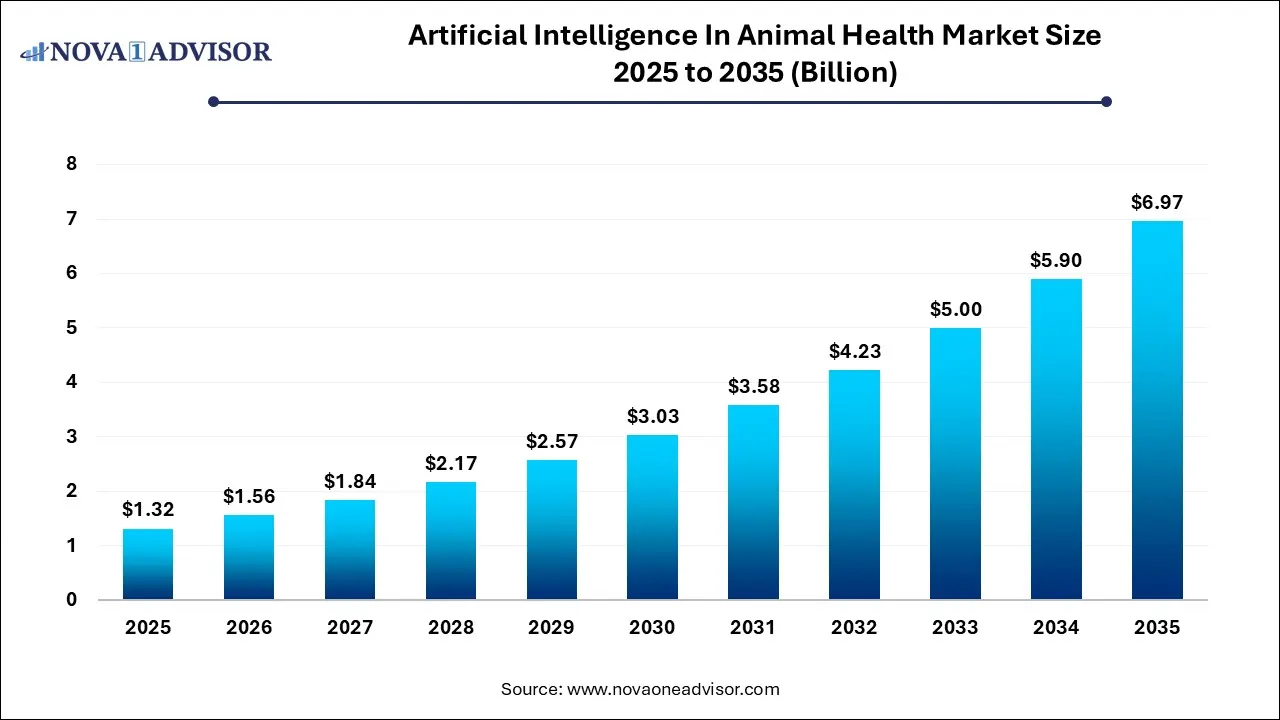
The artificial intelligence in animal health market size was estimated at USD 1.32 billion in 2025 and is projected to increase from USD 1.56 billion in 2026 to approximately USD 6.97 billion by 2035, growing at a CAGR of 18.11% from 2026 to 2035. The North America region held a dominant position in the market with a share of 39% in 2025. The artificial intelligence in animal health market is driven by the veterinary workforce shortage and remote telehealth, precision livestock farming and food security, and advanced diagnostics and personalized treatment that analyze vast genetic and health datasets to suggest personalized, highly effective treatment strategies for companion animals.
Key Takeaways
- By solution, the software & services segment held a dominant position in the market with a share of 55% in 2025.
- By solution, the hardware segment is the fastest growing between 2026 and 2035.
- By animal, the companion animals segment held a dominant position in the market with a share of 58% in 2025.
- By animal, the production animals segment is the fastest growing between 2026 and 2035.
- By application, the identification, tracking, & monitoring segment held a dominant position in the market with a share of 42% in 2025.
- By application, the diagnostics segment is the fastest growing between 2026 and 2035.
- By end use, the veterinary service providers segment held a dominant position in the market with a share of 36% in 2025.
- By end use, the veterinary pharmaceutical and medtech companies segment held a dominant position in the market with a share of 56.00% in 2025.
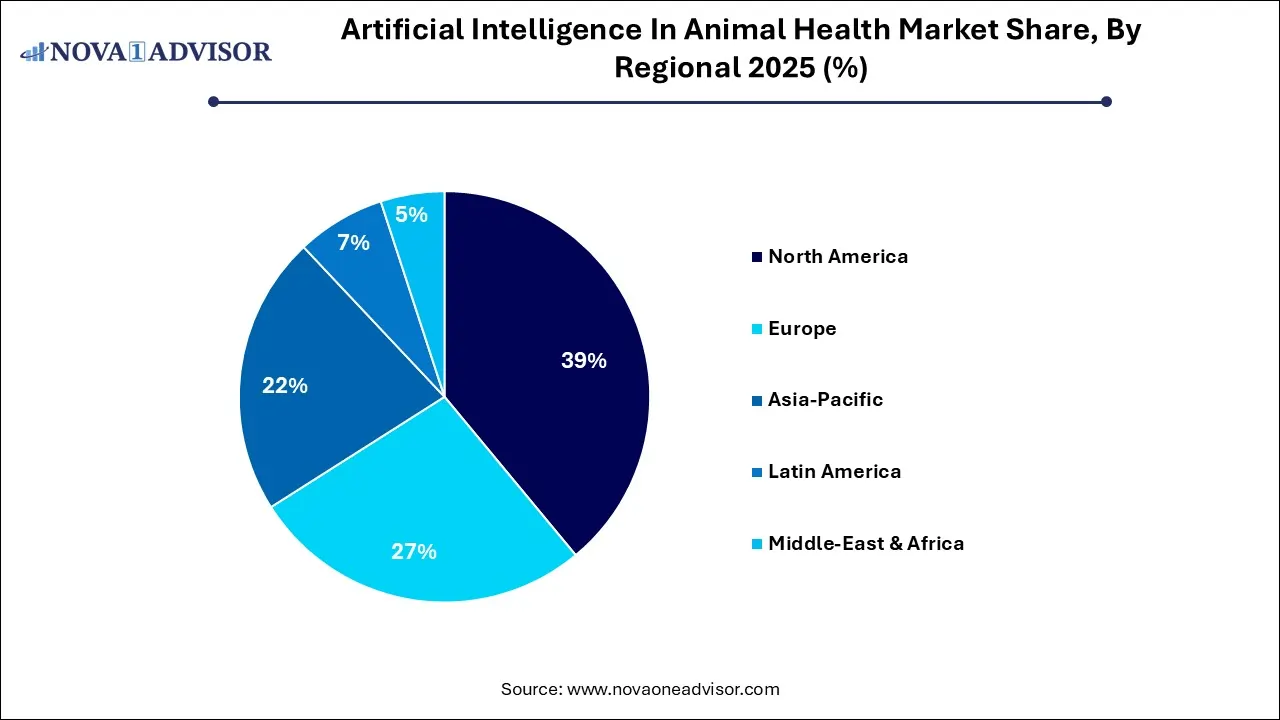
- By region, the North America region held a dominant position in the market with a share of 39% in 2025.
Innovation Driving Transformation in the Artificial Intelligence In Animal Health Market
Artificial intelligence in animal health comprises integrating machine learning and data analysis into veterinary care and livestock management. AI benefits this sector by delivering rapid disease diagnoses, real-time behavioral monitoring, and personalized treatment plans. The market growth is driven by the rising global demand for precision livestock farming, increased pet humanization, and a shortage of veterinary professionals.
Artificial Intelligence In Animal Health Market Trends
- IoT Telemetry and Biometric Sensor Integration
The adoption of IoT-enabled wearables and biometric sensors allows continuous tracking of companion animals and livestock. These devices monitor heart rate, temperature, and movement, generating real-time data that predicts illnesses before visible symptoms arise.
- Operationalization of Precision Livestock Farming
AI systems are revolutionizing farm management by optimizing feeding schedules, monitoring behavior, and automating livestock tracking. Technologies, such as virtual fencing and integrated feedlot software, help producers improve animal welfare while maximizing production efficiency.
- Predictive Data Analytics and Epidemiological Surveillance
By aggregating vast datasets, including genetic information, previous health records, and environmental factors, predictive analytics can forecast potential disease outbreaks on a herd or population level. This allows veterinary authorities and farmers to implement proactive preventative measures and contain contagions swiftly.
Artificial Intelligence In Animal Health Market Report Scope
| Report Coverage | Details |
| Market Size in 2026 | USD 1.56 Billion |
| Market Size by 2035 | USD 6.97 Billion |
| Growth Rate From 2026 to 2035 | CAGR of 18.11% |
| Base Year | 2025 |
| Forecast Period | 2026 to 2035 |
| Segments Covered | Solution, Animal, Application, End use, and Region |
| Market Analysis (Terms Used) | Value (USD Million/Billion) or (Volume/Units) |
| Regional Scope | North America; Europe; Asia Pacific; Central and South America; the Middle East and Africa |
| Key Companies Profiled | Zoetis, Inc.; IDEXX Laboratories, Inc.; Covetrus, Inc.; Merck & Co., Inc.; Mars, Inc.; ImpriMed, Inc.; Vetology LLC; Petriage; AI Superior GmbH; LifeLearn Inc.; PetPace, LLC; IVC Evidensia; Connecterra; ScribbleVet; Fi; Heidi Health; FidoCure (One Health Co.) |
Market Dynamics
Driver
Rising Pet Ownership and Premium Care
With a deep emotional bond, owners are increasingly investing in data-driven health monitoring and advanced diagnostic tools to ensure longer, healthier lives for their pets. In response, the Artificial Intelligence in Animal Health Market is expanding rapidly to meet this demand with precision. Machine learning algorithms and smart wearables are now widely used to analyze behavioral data, deliver custom wellness plans, and assist veterinarians in early disease detection.
Restraint
High Implementation Costs
The market growth is hindered by creating prohibitive financial barriers for small veterinary clinics and individual farmers. The substantial upfront capital required for advanced diagnostic hardware, software licenses, and cloud infrastructure for advanced diagnostic hardware, software licenses, and cloud infrastructure places these revolutionary technologies out of reach for smaller operations with limited margins. Furthermore, continuous expenses related to model maintenance, software upgrades, and specialized staff training significantly increase the total cost of ownership.
Opportunity
Veterinary Telehealth and Remote Monitoring
By generating vast, continuous streams of real-time patient data from IoT wearables and smart sensors. AI algorithms then process this streaming data, such as vital signs and behavioral patterns, to enable early disease detection, automated triage, and personalized chronic disease management. By feeding these data points into virtual platforms, veterinarians can deliver precise remote diagnoses and proactive care without triggering stressful in-clinic visits.
Segment Insights
By Solution Insights
Why Did the Software & Services Segment Hold a 55% Share for the Artificial Intelligence In Animal Health Market?
The software & services segment held a dominant position in the market with a share of 55% in 2025. Owing to the growing demand for AI-driven diagnostics, predictive analytics, and data management solutions. Dominates because software offers scalability, recurring revenue opportunities, and continuous performance improvements through machine learning. To maximize market penetration, developers are increasingly deploying scalable, cloud-based software-as-a-service architectures that lower capital expenditure barriers for both small animal clinics and enterprise-scale livestock operations.
The hardware segment held a 45% share of the market in 2025, with the veterinary and agricultural hardware sector remaining a primary revenue engine, heavily bolstered by the premium capital expenditure required for advanced diagnostic equipment, such as digital X-rays and ultrasound machinery. The rapid deployment of automated agricultural infrastructure, where robotic milking systems and computer vision feeders generate continuous data streams via smart collars and biometric tags to fuel advanced analytical models.
By Animal Insights
Why Did the Companion Animals Segment Hold a 58% Share for the Artificial Intelligence In Animal Health Market?
The companion animals segment held a dominant position in the market with a share of 58% in 2025. Owing to the rising pet ownership and increasing spending on advanced veterinary care, strong demand for AI-enabled diagnostics, monitoring, and personalized healthcare solutions for pets. The rise of AI-driven wearable sensors and video analytics allows owners and veterinarians to continuously monitor a pet’s vital signs, behavioral, and activity levels from home, ensuring early detection of health issues.
The production animals segment held a 42% share of the market in 2025, with surging global demand for animal protein compelling commercial livestock operations to maximize meat and dairy yields through resource-efficient, technology-driven management practices. This optimization is heavily enabled by precision livestock farming architectures, where advanced AI platforms, such as OneCup AI and Connecterra, leverage facial recognition, biometric wearables, and data analytics to continuously monitor herd behavior, nutrition, and breeding cycles.
By Application Insights
Why Did the Identification, Tracking, & Monitoring Segment Lead the Artificial Intelligence In Animal Health Market?
The identification, tracking, & monitoring segment registered its dominance over the market with a share of 42% in 2025, owing to its broad applicability in disease prevention, productivity optimization, and animal welfare management. The rapid advancement in component manufacturing and the widespread availability of cost-effective, AI-enabled hardware ensure these high-utility monitoring solutions remain highly scalable and commercially viable.
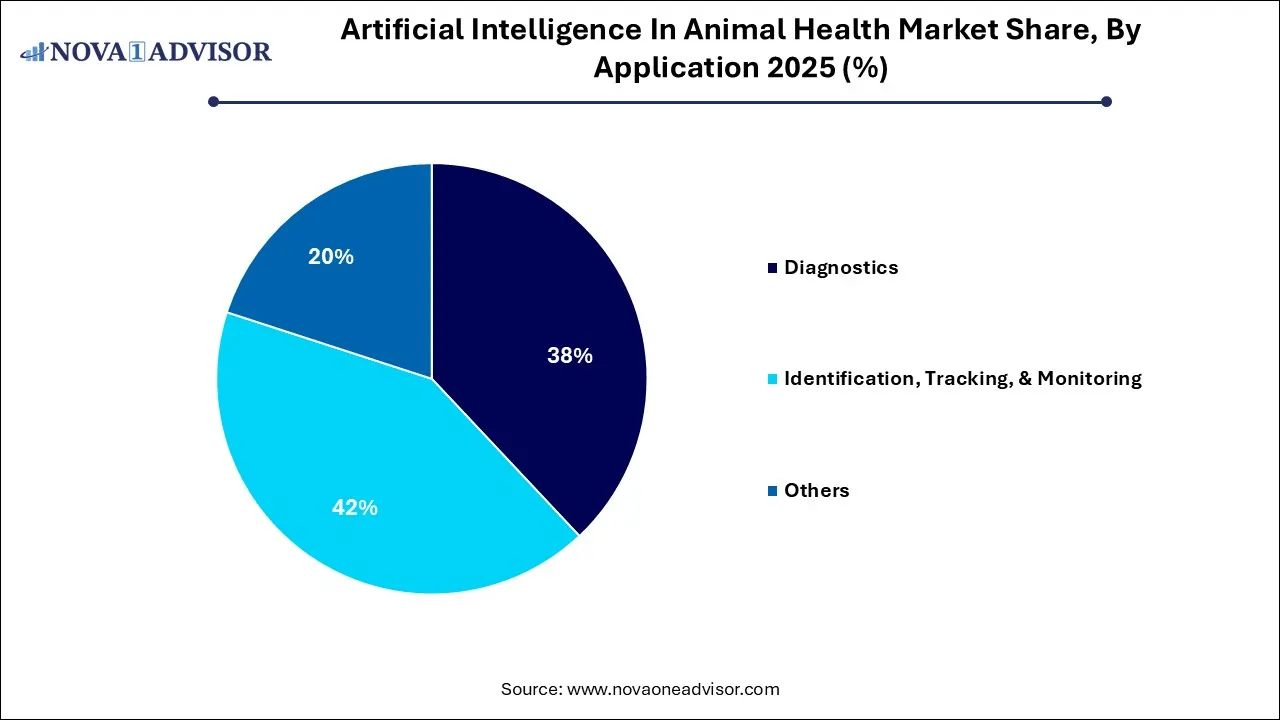
The diagnostics segment held a 38% share of the market in 2025, with the increasing use of AI for faster and more accurate disease detection. Increasingly, trending pets as family members, with a willingness to pay for premium, personalized veterinary care, preventative interventions, and predictive diagnostics.
The others segment held a 20% share of the market in 2025, due to these applications serving more specialized use cases; it allows owners and veterinarians to detect early signs of illness, even before symptoms physically manifest. It provides pet owners with instant access to preliminary triage and basic health information outside of regular clinic hours.
By End Use Insights
Why Did the Veterinary Services Segment Lead the Artificial Intelligence In Animal Health Market?
The veterinary services segment registered its dominance over the market with a share of 36% in 2025, owing to direct integration of AI into diagnostics, treatment planning, and patient monitoring; veterinary professionals are primary users of AI technologies in daily clinical practice. The growing availability of cost-effective, cloud-based AI platforms has lowered the barrier to entry, allowing independent and small-scale veterinary practices to easily implement systems.
The veterinary pharmaceutical & medtech companies segment held the 32% share of the market in 2025, owing to accelerated veterinary drug development and medical technology advancement, upgrading diagnostic and medtech hardware. By packaging AI software directly into their eliminate adoption friction for veterinarians facing staffing shortages and high administrative burdens.
The animal owners segment held a 22% share of the market in 2025, due to the direct proliferation of AI-powered wearables and smart trackers, allowing owners to gather continuous, high-fidelity biometric data directly from the home environment. To process these raw data streams effectively, veterinary networks are rapidly standardizing advanced AI software to streamline complex radiological diagnostics and predict specific disease therapies.
The others segment held a 10% share of the market in 2025, with the massive wave of preventative wellness data driven by owners utilizing biometric wearables to demand continuous, cloud-based health analysis. This technological evolution is actively steering AI out of a purely diagnostic role and directly into specialized therapeutic domains, including advanced surgical planning and high-precision canine oncology drug profiling.
By Regional Insights
Why Did the North America Region Lead the Artificial Intelligence In Animal Health Market?
The North America region registered its dominance over the market with a share of 39% in 2025, owing to high veterinary healthcare expenditure, strong AI adoption, and the presence of leading animal health companies, advanced digital infrastructure, and significant investment in AI innovation. The presence of major industry pioneers, ranging from established pharmaceutical conglomerates to agile tech startups, accelerates the rollout of AI hardware and software.
U.S. Surgical Suture Market Trends
The U.S. has a rapid clinical adoption of advanced antimicrobial coatings to minimize surgical-site infections, alongside a major surge in knotless barbed sutures engineered to optimize operating room efficiencies. While high-volume general and cardiovascular procedures preserve their structural dominance, plastic and reconstructive surgery.
The Europe region held the 27% share of the market in 2025, due to the strong animal welfare regulations and growing adoption of digital veterinary technologies, surging in demand for affordable, rapid, and species-specific digital care. AI-powered diagnostic platforms help veterinarians manage this growing caseload efficiently. Experiencing veterinary personnel shortages post-Brexit, which has accelerated the adoption of AI-enhanced digital tools and remote monitoring to increase clinic efficiency.
U.K. Surgical Suture Market Trends
The U. K’s stringent public health guidelines and procurement models are rapidly shifting toward advanced antimicrobial coatings and specialized synthetic formulations, such as Vicryl, Monocryl, and PDS. The expanding realm of minimally invasive laparoscopic, orthopedic, and cardiovascular surgeries heavily requires precision-engineered automated suturing technologies.
The Asia Pacific segment held a 22% share of the market in 2025, due to expanding livestock industries, rising pet ownership, and increasing digitalization. Gains momentum due to growing investments in AI-powered animal health solutions across emerging economies. The strong regional shift from reactive disease treatment to proactive, AI-enabled preventative healthcare is minimizing the need for heavy antibiotic use and boosting agricultural sustainability.
China Surgical Suture Market Trends
China’s clinical shift toward minimally invasive and outpatient day-care surgeries is directly influencing procedures toward specialized, high-precision closure technologies. To maximize operating room throughput and mitigate extensive surgical site infections, healthcare systems are aggressively adopting advanced product innovations, specifically knotless barbed architectures and antimicrobial-coated monofilament options.
The Latin America region held a 7% share of the market in 2025, with AI herd management, precision farming, and subclinical disease detection platforms to protect macroeconomic margins. To comply with rigorous global traceability and food safety standards for international export, enterprise producers in Brazil and Argentina are rapidly scaling B2B partnerships with agtech firms to deploy smart sensors and optimize supply chain resource allocation.
The MEA region held a 5% share of the market in 2025; due to the critical food security mandates and expanding regional populations, governments and agribusinesses are investing heavily in these automated biosecurity tools to mitigate catastrophic disease outbreaks and maximize livestock protein yields. The national development initiatives across the region are successfully upgrading veterinary infrastructure through the deployment of AI-assisted diagnostics and advanced preventative care systems.
Recent Developments
- In November 2025, PetVivo Holdings, Inc. has launched PetVivo.ai, an AI-driven SaaS platform designed to reduce veterinary client acquisition costs by 50–90% through a nine-agent system. The platform, which beta testing showed produces leads for $3 each, aims to modernize marketing for practices while providing high-margin, recurring revenue for the company.
- In April 2026, Hanumayamma Innovations and Technologies has officially launched its next-generation Cow Necklace Sensor, an advanced, wearable AI-powered device designed to bring precision livestock farming to millions of dairy farmers across India. The launch marks a critical step forward in automating herd management, improving animal welfare, and optimizing milk yields across the region.
Artificial Intelligence In Animal Health Market Companies
- Zoetis, Inc.
- Covetrus, Inc.
- IDEXX Laboratories, Inc.
- Merck & Co., Inc.
- ImpriMed, Inc.
- Mars, Inc. (Petcare)
- Vetology LLC
- AI Superior GmbH
- Petriage
- LifeLearn Inc.
- IVC Evidensia
- ScribbleVet
- Connecterra (Datamars)
- Fi
- FidoCure (One Health Co.)
- Heidi Health
Segments Covered in the Report
This report forecasts revenue growth at country levels and provides an analysis of the latest industry trends in each of the sub-segments from 2021 to 2035. For this study, Nova one advisor, Inc. has artificial intelligence in animal health market.
By Solution
- Hardware
- Software & Services
By Animal
- Companion Animals
- Production Animals
By Application
- Diagnostics
- Identification, Tracking, & Monitoring
- Others
By End Use
- Veterinary Pharmaceutical & MedTech Companies
- Veterinary Service Providers
- Animal Owners
- Others
By Region
- North America
- Europe
- Asia Pacific
- Latin America
- Middle East and Africa (MEA)
FAQ's

Proceed to Buy
Instant PDF delivery on confirmation

Artificial Intelligence In Animal Health Market Size to Hit USD 6.97 Billion b...
 Request Customization
 Download Sample

Get a Sample of this Report
Artificial Intelligence In Animal Health Market