

Artificial Pancreas Device System Market Size, Share, and Trends 2026 to 2035
 Status Published
 Category Healthcare


Content
Artificial Pancreas Device System Market Size and Growth 2026 to 2035
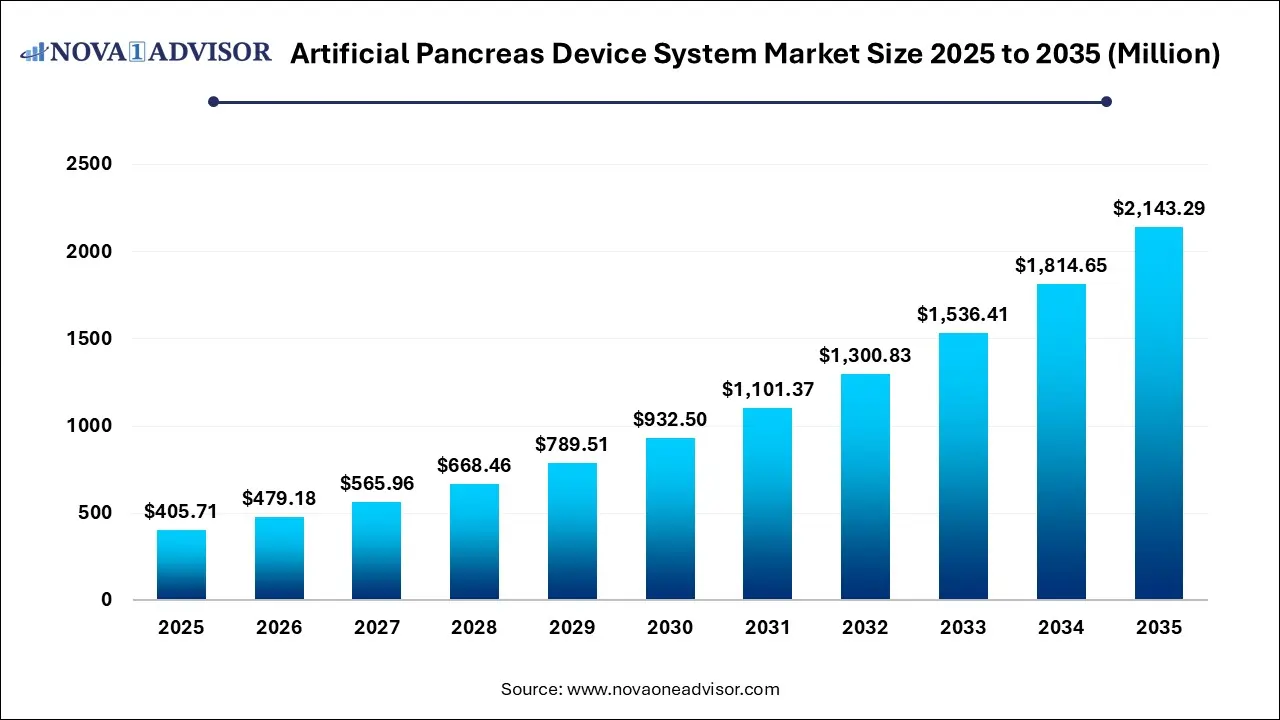
The global artificial pancreas device system market size was estimated at USD 405.71 million in 2025 and is projected to hit around USD 2,143.29 million by 2035, growing at a CAGR of 18.11% during the forecast period from 2026 to 2035.
Key Takeaway
- By type, the control-to-range systems segment dominated the market and accounted for the largest revenue share in 2025.
- By type, the control-to-target systems segment is anticipated to witness the fastest CAGR over the forecast period.
- By end use, the hospitals segment dominated the market and accounted for the largest revenue share in 2025.
- By region, North America accounted for the largest revenue share in 2025.
Market Overview
Artificial pancreas device systems represent one of the most transformative innovations in diabetes management. These systems combine continuous glucose monitors, insulin infusion pumps, and intelligent control algorithms to automate insulin delivery with minimal patient intervention. By simulating the glucose-regulating function of a healthy pancreas, these technologies aim to improve glycemic control while reducing the daily burden associated with diabetes management.
The market has evolved significantly from conventional insulin pumps requiring extensive manual adjustments to sophisticated hybrid closed-loop systems capable of automatically modifying insulin delivery based on real-time glucose readings. Increasing awareness regarding the long-term complications associated with poorly controlled diabetes has accelerated the acceptance of automated insulin delivery systems among patients and healthcare providers.
The growing incidence of Type 1 diabetes remains a major catalyst for market expansion. Additionally, selected insulin-dependent Type 2 diabetes populations are increasingly becoming eligible candidates for advanced automated insulin delivery technologies. Improvements in sensor accuracy, pump miniaturization, wireless connectivity, and smartphone integration have further enhanced patient acceptance.
For example, systems such as Medtronic's MiniMed series, Insulet's Omnipod platform, Tandem Diabetes Care's Control-IQ technology, and Beta Bionics' iLet Bionic Pancreas illustrate how innovation is shifting diabetes treatment from reactive interventions toward proactive, automated disease management.
Market Outlook
- Market Growth Overview: The global artificial pancreas device system market is expected to grow significantly between 2025 and 2035, driven by the surging incidence of global diabetes prevalence, continuous improvement in technological innovation, and growing demand for automated and homecare solutions.
- Sustainability Trends: Sustainability trends involve extended sensors and transmitter lifespan, algorithm upgrades over replacements, and reduction of consumables.
- Major Investors: Major investors in the market include Medtronic, Insulet Corporation, Tandem Diabetes Care, Dexcom, Abbott Laboratories, and Beta Bionics.
How is AI Transforming the Artificial Pancreas Device System Market?
Artificial intelligence is fundamentally redefining the capabilities of artificial pancreas systems. Traditional systems relied on pre-programmed algorithms that responded to current glucose levels. AI-enabled systems, however, continuously learn from patient-specific behavioral and physiological patterns.
Machine learning algorithms analyze historical glucose trends, meal responses, insulin sensitivity variations, exercise patterns, sleep behaviors, and stress-related fluctuations. This adaptive capability allows systems to anticipate glucose excursions before they occur and proactively adjust insulin delivery.
For instance, modern adaptive algorithms can recognize that a patient consistently experiences post-breakfast hyperglycemia and automatically modify insulin dosing strategies over time. This personalized approach reduces dependence on manual calculations and improves time-in-range outcomes.
AI also supports predictive analytics. Instead of merely reacting to low glucose events, systems forecast impending hypoglycemia and reduce insulin infusion preemptively. Similarly, anticipated hyperglycemic episodes trigger earlier corrective dosing.
Future developments may integrate voice assistants, digital twins, nutritional image recognition, and behavioral analytics into APDS platforms. Such advancements could create fully autonomous systems requiring minimal user input while improving clinical outcomes and quality of life.
Artificial Pancreas Device System Market Report Scope
| Report Coverage | Details |
| Market Size in 2026 | USD 479.18 Million |
| Market Size by 2035 | USD 2,143.29 Million |
| Growth Rate From 2026 to 2035 | CAGR of 18.11% |
| Base Year | 2025 |
| Forecast Period | 2026 to 2035 |
| Segments Covered | By Type, By End User, By Region |
| Market Analysis (Terms Used) | Value (USD Million/Billion) or (Volume/Units) |
| Regional Scope | North America; Europe; Asia Pacific; Central and South America; the Middle East and Africa |
| Key Companies Profiled | Medtronic Plc, Bigfoot Biomedical, Johnson & Johnson, Dexcom Inc., Cellnovo, Tandem Diabetes Care Inc., Pancreum Inc., TypeZero Technologies LLC, Beta Bionics, F. Hoffmann-La Roche Ltd, Inreda Diabetic B.V., Insulet Corp. |
Segmental Insights
By Type
How did the control-to-range systems segment dominate the Global Artificial Pancreas Device System market?
The control-to-range systems segment is driven by integrating advanced continuous glucose monitors and algorithms to automatically adjust insulin delivery within safe, flexible physiological boundaries. This predictive mitigation of glycemic extremes outperforms older threshold-suspend technologies, significantly lowering the cognitive burden and manual dosing frequency required by patients.
How did the control-to-target systems segment expected to hold the fastest-growing Global Artificial Pancreas Device System market in the coming years?
The control-to-target systems segment is driven by rapidly emerging as a premier choice in diabetes management by utilizing dynamic, automated glycemic adjustments to mitigate the risks of both hypoglycaemia and hyperglycaemia. By replacing manual decision-making with near real-time calculations, this advanced technology significantly alleviates the constant physical and mental burden of self-monitoring for patients.
By End User
How did the hospitals segment dominate the Global Artificial Pancreas Device System market?
The hospitals segment is driven by its robust healthcare infrastructure, which ensures strict regulatory compliance and seamless reimbursement facilitation, which are critical for handling advanced medical technologies before transitioning patients to homecare settings. The unmatched capability of hospitals to provide structured therapy initiation, specialized staff, and high-security infrastructure solidifies their position as the dominant end-user in the market.
How did the medical centers segment expected to hold the fastest-growing Global Artificial Pancreas Device System market in the coming years?
The medical centers segment is driven by the shift toward outpatient procedures, which drives the adoption of high-quality, cost-effective surgical facilities as alternatives to traditional inpatient hospital stays. Advanced technology integration, where healthcare professionals rely on real-time remote patient monitoring and connected platforms to deliver seamless insulin therapy.
By Regional
How did the North America region account for the largest share in the Global Artificial Pancreas Device System market?
North America is driven by the expansive diabetes patient base and a sophisticated healthcare infrastructure that facilitates therapy initiation and patient training seamlessly. Widespread reimbursement coverage from Medicare and private insurance significantly lowers out-of-pocket costs, making advanced hybrid closed-loop systems highly accessible to the public.
U.S. Global Artificial Pancreas Device System Market Trends
The U.S. has predictive AI and machine learning algorithms that shift automation toward proactive control-to-target models to sustain precise, healthy glucose ranges. This intelligent software integration is seamlessly paired with modern smartphone ecosystems, enabling users to manage their insulin delivery directly via mobile applications and eliminating the need for bulky, standalone device receivers.
How did the Asia-Pacific region become the fastest-growing Global Artificial Pancreas Device System Market during the forecast period?
Asia Pacific has a widespread patient base and is rapidly adopting advanced management and substantial government investments in digital healthcare infrastructure and connected insulin pump technologies. The rising disposable incomes alongside expanding public and private healthcare funding have significantly lowered financial barriers, making previously cost-prohibitive automated medical devices highly accessible.
China Global Artificial Pancreas Device System Market Trends
China’s rapid transformation as the adoption of automated insulin delivery and hybrid closed-loop systems, which accelerate the adoption of automated insulin delivery and hybrid closed-loop systems to lower HbA1c levels and prevent dangerous hypoglycaemic episodes. The successful localization of core technologies, with domestic Chinese manufacturers rapidly engineering proprietary continuous glucose monitors (CGMs), insulin pumps, and adaptive control algorithms.
How Did Europe Hold A Notable Share in the Global Artificial Pancreas Device System Market?
Europe’s advanced healthcare infrastructure across major economies, such as Germany, France, and the UK, which facilitates high penetration rates for advanced monitoring and delivery technologies. This well-established clinical foundation is strongly reinforced by favourable reimbursement policies that heavily subsidize expensive continuous glucose monitors (CGMs) and automated insulin delivery (AID) systems
Germany Global Artificial Pancreas Device System Market Trends
Germany’s swift clinical shift toward hybrid closed-loop and control-to-target systems that automate basal insulin delivery, reducing dangerous hypoglycemic episodes. Advanced machine learning algorithms and significant R&D investment by leaders, such as Abbott and Medtronic, supported by widespread reimbursement, ensure Germany's continued market dominance in Europe.
Key Players in the Global Artificial Pancreas Device System Market
- Medtronic Plc
Medtronic is a pioneer in the artificial pancreas market, having developed the world's first FDA-approved hybrid closed-loop systems. Their MiniMed series automatically adjusts basal insulin delivery every five minutes using sophisticated onboard algorithms to optimize glycemic control.
- Bigfoot Biomedical
Bigfoot Biomedical develops interconnected diabetes management solutions that feature smart insulin pen caps integrated with real-time CGM data. By automating dosing recommendations and alerts, their systems assist patients utilizing multiple daily injection (MDI) therapy.
- Johnson & Johnson
Through its strategic investments and medical technology developments, Johnson & Johnson has historically shaped the autonomous glycemic control space, working to minimize both hypoglycemia and hyperglycemia.
Segments Covered in the Report
This report forecasts revenue growth at country levels and provides an analysis of the latest industry trends in each of the sub-segments from 2021 to 2035. For this study, Nova one advisor, Inc. has artificial pancreas device system market.
By Type
- CTR (Control to Range) Systems
- CTT (Control To Target) Systems
By End User
- Hospitals
- Medical Centers
By Region
- North America
- Europe
- Asia-Pacific
- Latin America
- Middle East & Africa (MEA)
FAQ's

Proceed to Buy
Instant PDF delivery on confirmation

Artificial Pancreas Device System Market Size to Hit USD 2,143.29 Million by 2...
 Request Customization
 Download Sample

Get a Sample of this Report
Artificial Pancreas Device System Market