

Asia Pacific Business-to-Business E-commerce Market Size, Share, Growth, Report 2026 to 2035
 Status Published
 Category Information & Communications Technology


Content
Asia Pacific Business-to-Business E-commerce Market Size and Growth 2026 to 2035
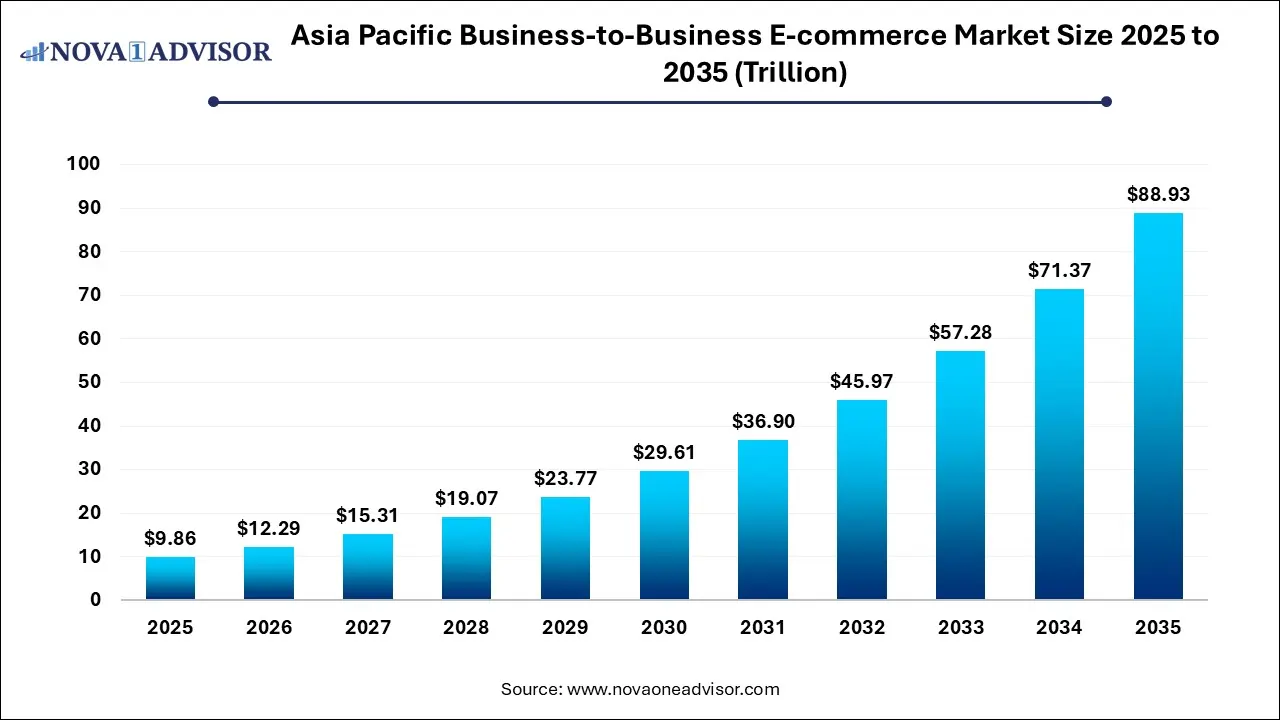
The Asia Pacific business-to-business e-commerce market size was estimated at USD 9.86 trillion in 2025 and is projected to increase from USD 12.29 trillion in 2026 to approximately USD 88.93 trillion by 2035, growing at a CAGR of 24.6% from 2026 to 2035. The Asia Pacific business-to-business e-commerce market is driven by rapid digital adoption and high internet penetration, the evolution of digital payments and embedded finance, and growing cross-border trade expansion.
Key Takeaways
- By product, the industry and science segment held a dominant position in the market with a share of in 2025.
- By product, the consumer electronics segment is the fastest-growing between 2026 and 2035.
- By deployment, the supplier-oriented segment held a dominant position in the market with a share of in 2025.
- By deployment, the buyer-oriented segment is the fastest-growing between 2026 and 2035.
Innovation Driving Transformation in the Asia Pacific Business-to-Business E-commerce Market
Asia Pacific business-to-business e-commerce comprises the electronic trade of goods and services between enterprises, driven by the rapid digitalization of corporate procurement and supply chain across nations, such as China, India, and Japan. The lowering of procurement costs, expanding cross-border sales reach, streamlining bulk purchasing, and accelerating transaction processing. The market growth is driven by the rising regional internet and smartphone penetration, government initiatives promoting digital transformation, and the integration of advanced technologies.
Asia Pacific Business-to-Business E-commerce Market Trends
- Institutional Proliferation of Centralized Digital Marketplace
The business buyers increasingly rely on third-party B2B marketplaces rather than just direct-to-manufacture channels to source a wider variety of industrial and scientific goods. These centralized platforms connect companies, streamline digital procedures, and integrate directly with enterprise resource planning systems to process bulk orders efficiently.
- Macro-Economic Scaling of Cross-Border Digital Trade Channels
The regional agreements and government support for digital trade and cross-border transactions make up a substantial volume of regional B2B growth. Countries such as China, South Korea, and Singapore act as massive hubs for trading industrial and consumer electronics across international lines.
- Strategic Deployment of Embedded Finance and B2B Trade Credit
The rise of digital wallets and B2B buy now pay later alternatives. These embedded finance rails are providing small and medium enterprises with better access to working capital and flexible payment terms directly on the transaction platforms.
Key AI Integration in the Asia Pacific Business-to-Business E-commerce Market
AI and ML are revolutionizing the Asia Pacific business-to-business e-commerce industry by driving highly personalized buyer experiences and streamlining complex supply chains. Vendors leverage these tools for dynamic pricing and intelligent product recommendations that accommodate bulk purchasing and custom contracts. AI-powered chatbots and predictive inventory forecasting help businesses cut operational costs while significantly accelerating procurement cycles.
Asia Pacific Business-to-Business E-commerce Market Report Scope
| Report Coverage | Details |
| Market Size in 2026 | USD 12.29 Trillion |
| Market Size by 2035 | USD 88.93 Trillion |
| Growth Rate From 2026 to 2035 | CAGR of 24.6% |
| Base Year | 2025 |
| Forecast Period | 2026 to 2035 |
| Segments Covered | By Product, By Deployment |
| Market Analysis (Terms Used) | Value (USD Million/Billion) or (Volume/Units) |
| Key Companies Profiled | Jingdong JD, Rakuten Group, Inc., Alibaba Group Holding Limited, Supermarket Grocery Supplies Pvt Ltd, Shopify Inc., Grofers India Pvt. Ltd., Booking Holdings, eBay Inc., Amazon, Inc., Walmart Inc., JB Hi-Fi, Home Depot Product Authority, LLC |
Driver
High Internet and Mobile Penetration
The shifting corporate procedure from traditional Paper-heavy methods to digital-first solutions. Expanding mobile networks and affordable data allow enterprises to access B2B marketplaces, compare prices, and manage supply chains in real-time, regardless of their location. This widespread connectivity supports the integration of embedded finance and seamless digital payment rails, which dramatically reduce transaction friction and streamline cash flow.
Restraint
Integration Complexity, Data Security, and Fraud Risk
The market growth is hindered by the high-ticket orders and long-term, custom client relationships, making them particularly vulnerable to targeted cyberattacks and financial fraud. To combat these threats, businesses are compelled to invest heavily in advanced payment security systems and real-time fraud engines. The fragmented regulatory regimes, varying digital tax policies, and cross-border documentation discrepancies across diverse Asian economies create massive hurdles.
Opportunity
Cross-Border Expansion
The enabling suppliers to penetrate previously inaccessible international buyer networks. Companies unlock significant economies of scale by scaling production to meet surging pan-regional demand, which simultaneously lowers their per-unit operational costs. By establishing a presence across multiple countries, businesses effectively insulate themselves from localized economic downturns while gaining a substantial competitive advantage over domestic-only operators.
Segment Insights
By Product Insights
Why Did the Industrial and Science Segment Lead the Asia Pacific Business-to-Business E-commerce Market?
The industrial and science segment registered its dominance over the market with a share of in 2025, owing to the utilization of centralized B2B digital intermediaries to seamlessly connect localized production ecosystems with international buyer networks. The structural transformation is heavily accelerated by proactive state-level digital support, regulatory incentives, and targeted logistical investments that solidify B2B platforms as the primary framework for regional industrial trade.
The consumer electronics segment held the share of the market in 2025, with the essential platform for bulk wholesale sourcing, raw components, and cross-border trade among businesses. The E-commerce platform removes traditional friction from the international supply chain. It offers enterprises volume-based pricing, efficient inventory tracking, and predictable digital payments, which are vital for high-ticket electronic purchases.
The home and kitchen application segment held the share of the market in 2025, due to rapid regional urbanization and rising disposable incomes that compel enterprise buyers to consistently refresh their inventories via these efficient digitally financed transactional frameworks to maintain market alignment. The hospitality and cloud kitchen sectors across major developing economies mandate the deployment of scalable, on-demand online sourcing channels for specialized commercial kitchen infrastructure.
The clothing segment held the share of the market in 2025. Due to the expanding network of intra-regional trade agreements and the outward migration of textile manufacturing into emerging markets, such as Indonesia and Thailand, there is unprecedented cross-border B2B garment trade efficiency. The rapid, multi-season fashion cycles and continuous SKU diversification mandate highly frequent wholesale restock cycles to prevent supply chain obsolescence.
The healthcare segment held the share of the market in 2025 because of the aggressive expansion of robust digital infrastructure and mobile enterprise applications across major emerging economies, significantly streamlining supply chain tracking and localized warehouse logistics.
The automotive segment held the share of the market in 2025, due to the presence of established e-commerce models tailored for B2B transactions, provides critical benefits such as bulk financing, presales technical assistance, and customized warranties. These platforms build trust by offering supplier rating systems and supply chain transparency.
The beauty and personal care segment held the share of the market in 2025, due to the escalating consumer disposable incomes and heightened personal grooming awareness across major emerging markets, mandating highly frequent retail restock cycles to satisfy volatile consumer demand. Social media commerce and influencer trends, both emerging indie brands and established international labels utilize digital distributor networks to scale their warehousing, logistical infrastructure, and direct-to-consumer fulfillment capabilities.
The sports apparel segment held the share of the market in 2025, due to consumers increasingly prioritizing functional, comfort-oriented clothing that transitions seamlessly from workouts to daily casual wear. This widespread adoption of athletic clothing for everyday use has caused consumer demand to skyrocket.
The books and stationery segment held the share of the market in 2025, due to institutional education networks, corporate enterprises, and government training centers systematically adopting B2B e-commerce architectures to automate massive, high-volume procurement of educational literature and commercial stationery through streamlined digital channels.
The others segment held the share of the market in 2025, due to the proliferation of intermediary-oriented platforms, which have made it cost-effective for niche manufacturers and smaller merchants across emerging markets, such as India and China, to digitize their procurement.
By Deployment Insights
Why Did the Supplier-oriented Segment Hold a Share for the Asia Pacific Business-to-Business E-commerce Market?
The supplier-oriented segment held a dominant position in the market with a share of in 2025. Owing to achieving deep technical synchronization between front-end storefronts and back-end ERP and CRM architectures, these systems ensure real-time inventory visibility and eliminate traditional data silos across enterprise operations. The expanding SME ecosystems and supportive state-level commerce policies allow localized suppliers across developing economies to bypass third-party brokers and scale their regional market reach autonomously.
The buyer-oriented segment held a share of the market in 2025. By expanding small and medium-sized enterprises across manufacturing and wholesale, companies use these platforms for real-time supply chain visibility, predictive analytics, and AI-driven recommendations.
The intermediary-oriented segment held a share of the market in 2025, owing to widespread government initiatives in countries such as China, India, and Japan, coupled with mobile-first purchasing trends, accelerating digital adoption and trade automation. They automate procurement, consolidate accounts, and manage fragmented logistics across diverse regional markets.
Recent Developments
- In June 2025, SAP announced the expansion of its S/4HANA Cloud, public edition for retail, fashion, and vertical business to Indonesia, Malaysia, the Philippines, South Korea, and Thailand in the second half of. This follows the initial launch in Australia, India, New Zealand, and Singapore, aiming to support retailers with localized cloud ERP technology for agility and efficiency.
- In July 2026, Visa, in collaboration with KOTRA, VPBank, Shinhan Bank Vietnam, and MB, has launched the Global Trade Payment Platform (GTPP), Vietnam's first card-based solution for B2B trade payments to South Korea. The platform enables secure, real-time, and digital cross-border transactions for SMEs, targeting increased efficiencies in a trade corridor.
Asia Pacific Business-to-Business E-commerce Market Companies
- Jingdong JD
- Rakuten Group, Inc.
- Alibaba Group Holding Limited
- Supermarket Grocery Supplies Pvt Ltd
- Shopify Inc.
- Grofers India Pvt. Ltd.
- Booking Holdings
- eBay Inc.
- Amazon, Inc.
- Walmart Inc.
- JB Hi-Fi
- Home Depot Product Authority, LLC
Segments Covered in the Report
This report forecasts revenue growth at country levels and provides an analysis of the latest industry trends in each of the sub-segments from 2021 to 2035. For this study, Nova one advisor, Inc. has Asia Pacific Business-to-Business E-commerce Market.
By Product
- Home & Kitchen Application
- Consumer Electronics
- Industrial & Science
- Healthcare
- Clothing
- Beauty & Personal Care
- Sports Apparels
- Books & Stationery
- Automotive
- Others
By Deployment
- Supplier-oriented
- Buyer-oriented
- Intermediary-oriented
FAQ's

Proceed to Buy
Instant PDF delivery on confirmation

Asia Pacific Business-to-Business E-commerce Market Size to Hit USD 88.93 Tril...
 Request Customization
 Download Sample

Get a Sample of this Report
Asia Pacific Business-to-Business E-commerce Market