

Automotive E-Compressor Market Size, Share, and Trends 2026 to 2035
 Status Published
 Category Automation and Transport


Content
Automotive E-Compressor Market Size and Growth 2026 to 2035
The global automotive E-compressor market size was valued at USD 12.95 billion in 2025 and is projected to grow from USD 17.19 billion in 2026 to USD 219.60 billion by 2035, at a CAGR of 32.72% from 2026 to 2035.
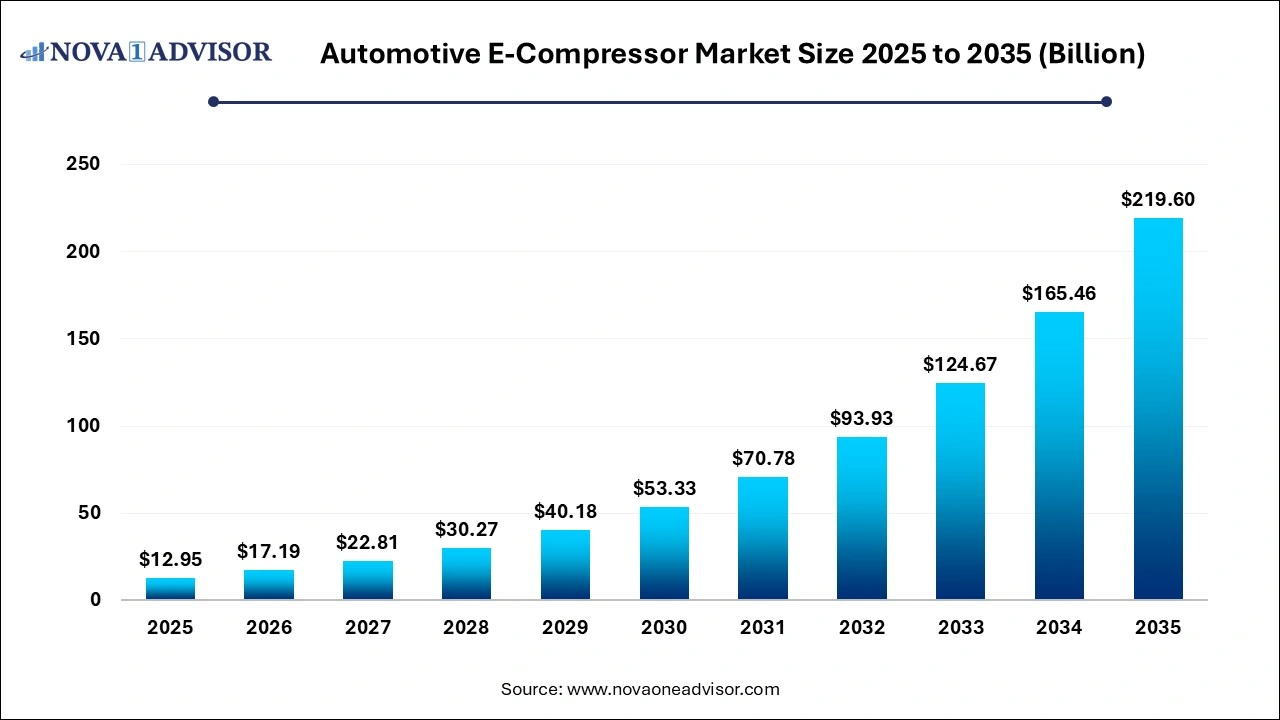
Key Takeaway:
- By sales channel, the OEM segment dominated the market with the largest share in 2025.
- By sales channel, the aftermarket segment is expected to grow at the fastest CAGR over the forecast period.
- By vehicle type, the passenger vehicle segment dominated the market with the largest share in 2025.
- By type, the scroll segment dominated the market with the largest share in 2025.
- By region, North America dominated the market with the largest share in 2025.
Market Overview
The global Automotive E-Compressor Market is expanding alongside vehicle electrification and the growing adoption of advanced thermal-management systems. E-compressors provide independent electric operation for cabin cooling and battery, motor, inverter, and power-electronics temperature management, making them essential across BEVs, hybrids, and plug-in hybrids. Rising demand for EV efficiency, fast charging, longer driving range, compact vehicle architectures, and integrated heat-pump systems is accelerating technology development. Manufacturers are increasingly focusing on high-voltage platforms, inverter integration, refrigerant flexibility, low NVH, and intelligent control. Leading participants include DENSO, Hanon Systems, Valeo, MAHLE, Sanden, Toyota Industries, Bosch, BorgWarner, Mitsubishi Heavy Industries Thermal Systems, and Highly Marelli.
Market Outlook
- Market Growth Overview: The global automotive e-compressor market is expected to grow significantly between 2025 and 2035, driven by the growing adoption of electric vehicles and hybrid vehicles.
- Sustainability Trends: Sustainability trends involve growing adoption of eco-friendly refrigerants with low global warming potential (GWP).
- Major Investors: Major investors in the market include DENSO Corporation, Hanon Systems, Valeo, Toyota Industries Corporation, MAHLE GmbH, Robert Bosch GmbH, and Sanden Corporation.
AI Impact on the Global Automotive E-Compressor Market
AI is transforming automotive e-compressors by enabling smarter, predictive, and energy-efficient thermal management. AI-based systems can analyze real-time inputs such as cabin temperature, battery temperature, ambient conditions, vehicle speed, charging status, occupancy, and driving patterns to predict cooling requirements and dynamically adjust compressor operation.
Key applications include:
- Predictive thermal management: Anticipates cabin, battery, and power-electronics cooling demand before thermal conditions change.
- Energy optimization: Adjusts compressor speed to balance passenger comfort with EV energy consumption and driving range.
- Battery thermal management: Helps maintain battery temperatures within suitable operating conditions, particularly during fast charging and high-load driving.
- Predictive maintenance: Uses compressor temperature, vibration, current, pressure, and operating data to identify potential component issues at an early stage.
- Intelligent system integration: AI can coordinate the e-compressor with heat pumps, chillers, valves, sensors, and other thermal components for vehicle-level optimization.
As EV architectures become more software-defined, competition is shifting from compressor hardware performance alone toward hardware-plus-software capabilities, creating opportunities for suppliers offering intelligent controls, connected sensors, predictive analytics, and integrated thermal-management solutions.
Automotive E-Compressor Market Report Scope
| Report Coverage | Details |
| Market Size in 2026 | USD 17.19 Billion |
| Market Size by 2035 | USD 219.60 Billion |
| Growth Rate From 2026 to 2035 | CAGR of 32.72% |
| Base Year | 2025 |
| Forecast Period | 2026 to 2035 |
| Segments Covered | By Sales Channel, By Vehicle Type, By Type, By Region |
| Market Analysis (Terms Used) | Value (USD Million/Billion) or (Volume/Units) |
| Regional Scope | North America; Europe; Asia Pacific; Central and South America; the Middle East and Africa |
| Key Companies Profiled | Denso Corporation, Sanden Corporation, Mahle Behr GmbH, Toyota Industries Corporation, Hanon Systems, Robert Bosch GmbH, Valeo S.A., Marelli, SCHOTT AG, and Mitsubishi Heavy Industries Automotive Thermal Systems Co., Ltd. |
Market Driver – Rapid Electrification and Increasing Thermal-Management Requirements
Rapid vehicle electrification is a major growth driver for the Automotive E-Compressor Market. Battery electric vehicles require electrically powered compressors because conventional engine-driven systems are unsuitable for vehicles without combustion engines. Beyond cabin cooling, e-compressors increasingly support thermal management for batteries, electric motors, inverters, onboard chargers, and other power-electronic components.
The need to maximize EV driving range further strengthens demand for highly efficient compressors, as HVAC and thermal-management functions consume battery energy. The growing adoption of high-voltage architectures, heat pumps, variable-speed compressors, and advanced refrigerant systems is therefore increasing the technological value of e-compressors. Hanon Systems' reported production of more than one million R744 electric compressors for Volkswagen Group's MEB platform illustrates the increasing integration of e-compressors into EV production programs.
Market Restraint – High Technology, Integration, and Validation Costs
The technical complexity of e-compressors can restrain market expansion, particularly for smaller suppliers. Modern systems combine compression mechanisms with electric motors, power electronics, sensors, control software, and vehicle communication interfaces. These components must withstand demanding conditions involving temperature fluctuations, vibration, humidity, pressure changes, and high-voltage operation.
Integration with battery cooling, heat pumps, cabin HVAC, and broader vehicle thermal-management controllers also requires extensive testing and validation. Compatibility with refrigerants such as CO₂ (R744) can introduce additional engineering requirements. High investment in testing facilities, automated production, OEM qualification, and long automotive development cycles can therefore create substantial barriers to entry.
Market Opportunity – Integrated Thermal Management for EVs and Commercial Vehicles
The integration of e-compressors into complete EV thermal-management systems represents a significant market opportunity. Instead of supplying standalone compressors, manufacturers can offer integrated solutions combining e-compressors with expansion valves, condensers, heat exchangers, chillers, sensors, refrigerant lines, and intelligent controls. Such systems can increase thermal-management content per vehicle while simplifying integration for OEMs.
Electric buses, trucks, and other commercial vehicles provide another growth avenue because their larger batteries, extended operating cycles, and high cabin-conditioning requirements create substantial thermal loads. Meanwhile, expanding EV manufacturing in Asia-Pacific, particularly China and India, is creating opportunities for suppliers offering scalable, cost-efficient, locally manufactured e-compressor technologies.
Segmental Insights
By Sales Channel
Why did the OEM segment dominate the global automotive e-compressor market?
The OEM segment dominated the market with the largest share in 2025. The dominance of the segment can be attributed to the growing manufacturing of electric and hybrid vehicles across the globe and the rising integration of electric compressors. In addition, original equipment manufacturers (OEMs) are required to protect battery longevity and enhance charging efficiency by rigorously managing thermal thresholds through the implementation of high-voltage electric compressor loops.
How did the aftermarket segment expected to hold the significantly growing global automotive e-compressor market in the coming years?
The aftermarket segment is expected to grow at the fastest CAGR over the forecast period. The growth of the segment can be credited to the increasing number of hybrid and electric vehicles operating across the globe and the expansion of vehicle fleets. Also, government incentives and zero-emission mandates are compelling manufacturers to transition from mechanical units to high-efficiency electric alternatives.
By Vehicle Type
Why did the passenger vehicle segment dominate the global automotive e-compressor market?
The passenger vehicle segment dominated the market with the largest share in 2025. The dominance of the segment can be linked to the ongoing growth of electric passenger cars and increasing need for improved cabin comfort. Modern consumers demand minimal noise, vibration, and harshness (NVH) characteristics with rapid cabin climate regulation, driving the adoption of advanced scroll and variable-speed electric compressors.
How did the light-duty vehicle segment expected to hold the significantly growing global automotive e-compressor market in the coming years?
The light-duty vehicle segment is expected to grow at the fastest CAGR over the forecast period. The growth of the segment can be driven by ongoing expansion of e-commerce and logistics services and a rise in demand for reliable and efficient compressor technologies. Modern electric vehicles deploy reversible heat pumps that require high-efficiency electric compressors to manage both heating and cooling functions.
By Type
Why did the scroll segment dominate the global automotive e-compressor market?
The scroll segment dominated the market with the largest share in 2025. The dominance of the segment is owing to its compact structure and reliable performance in automotive air conditioning systems. Furthermore, scroll compressors deliver reduced energy consumption, continuous and stable refrigerant compression, and whisper-quiet operation, aligning smoothly with the rigorous performance.
How did the screw segment expected to hold the significantly growing global automotive e-compressor market in the coming years?
The screw segment is expected to grow at the fastest CAGR over the forecast period. The growth of the segment is due to its capability to handle higher pressure ratios and offer constant cooling performance. Moreover, screw compressors provide exceptional mechanical durability and extended maintenance intervals during intensive commercial operations.
By Region
Why did the North American region account for the largest share of the global automotive e-compressor market?
North America dominated the market with the largest share in 2025. The dominance of the region can be attributed to the ongoing surge in electric vehicle (EV) manufacturing and stringent government emission regulations. In addition, localized manufacturing initiatives and strategic joint ventures among premier component suppliers are effectively reducing foreign supply chain challenges while systematically scaling regional production capacity.
U.S. Global Automotive E-Compressor Market Trends
The growth of the market in the country can be driven by the growing electric vehicle (EV) adoption and ongoing transition towards cutting-edge heat pump HVAC systems. Also, U.S. manufacturers currently use advanced smart heat pumps in place of conventional resistance heaters. These systems incorporate electric compressors to optimize energy efficiency during cold weather conditions.
- In August 2025, MAHLE has initiated the production of electric compressors (e-compressors) at its manufacturing facility in Morristown, Tennessee, a site historically dedicated to the fabrication of steel pistons for several decades. This operational expansion introduces approximately 50 new manufacturing roles aimed at supplying the North American automotive market.
Why did the Asia-Pacific region become the fastest-growing global automotive e-compressor market during the forecast period?
Asia Pacific is expected to grow at the fastest CAGR over the forecast period. The growth of the region can be credited to the ongoing urbanization, increasing disposable incomes, and surge in electric vehicle adoption in developing nations such as China, Japan, and South Korea. Furthermore, national commitments to achieving net-zero emissions, stringent fuel-economy standards, and targeted electric vehicle financial incentives are propelling the transition toward sustainable transportation systems.
China Global Automotive E-Compressor Market Trends
The market in the country is growing due to the rising production of electric and hybrid vehicles and demand for OEM-installed e-compressors. Moreover, automakers are increasingly adopting advanced, energy-efficient heat pump HVAC systems over conventional resistance heaters to maximize cold-weather driving efficiency.
Key Players in the Global Automotive E-Compressor Market
- DENSO Corporation: Offers high-efficiency electric compressors designed for diverse vehicle architectures, anchoring a massive global supply footprint.
- Sanden Corporation: Renowned for high-reliability scroll units and eco-conscious refrigerant systems that limit noise, vibration, and harshness (NVH).
- MAHLE GmbH: Develops robust power electronics and thermal management components, including specialized e-compressors tailored for tight packaging limits.
Recent Developments
- In November 2025, Honda introduced the V3R 900 E-Compressor Prototype, featuring a pioneering V3 engine integrated with an electronically controlled compressor. This advanced machine is engineered to pioneer a distinct category of motorcycles, delivering elevated customer value through proprietary and innovative engineering.
Segments Covered in the Report
This report forecasts revenue growth at country levels and provides an analysis of the latest industry trends in each of the sub-segments from 2021 to 2035. For this study, Nova one advisor, Inc. has automotive E-compressor market.
By Sales Channel
- OEM
- Aftermarket
By Vehicle Type
- Passenger Vehicle
- Light Duty Vehicle
- Medium & Heavy-Duty Trucks
- Buses & Coaches
By Type
- Swash
- Wobble
- Screw
- Scroll
- Others
By Region
- North America
- Europe
- Asia-Pacific
- Latin America
- Middle East & Africa (MEA)
FAQ's

Proceed to Buy
Instant PDF delivery on confirmation

Automotive E-Compressor Market Size to Hit USD 219.60 Billion by 2035
 Request Customization
 Download Sample

Get a Sample of this Report
Automotive E-Compressor Market