

Automotive Pressure Plates Market Size, Share, and Trends 2026 to 2035
 Status Published
 Category Automation and Transport


Content
Automotive Pressure Plates Market Size and Growth 2026 to 2035
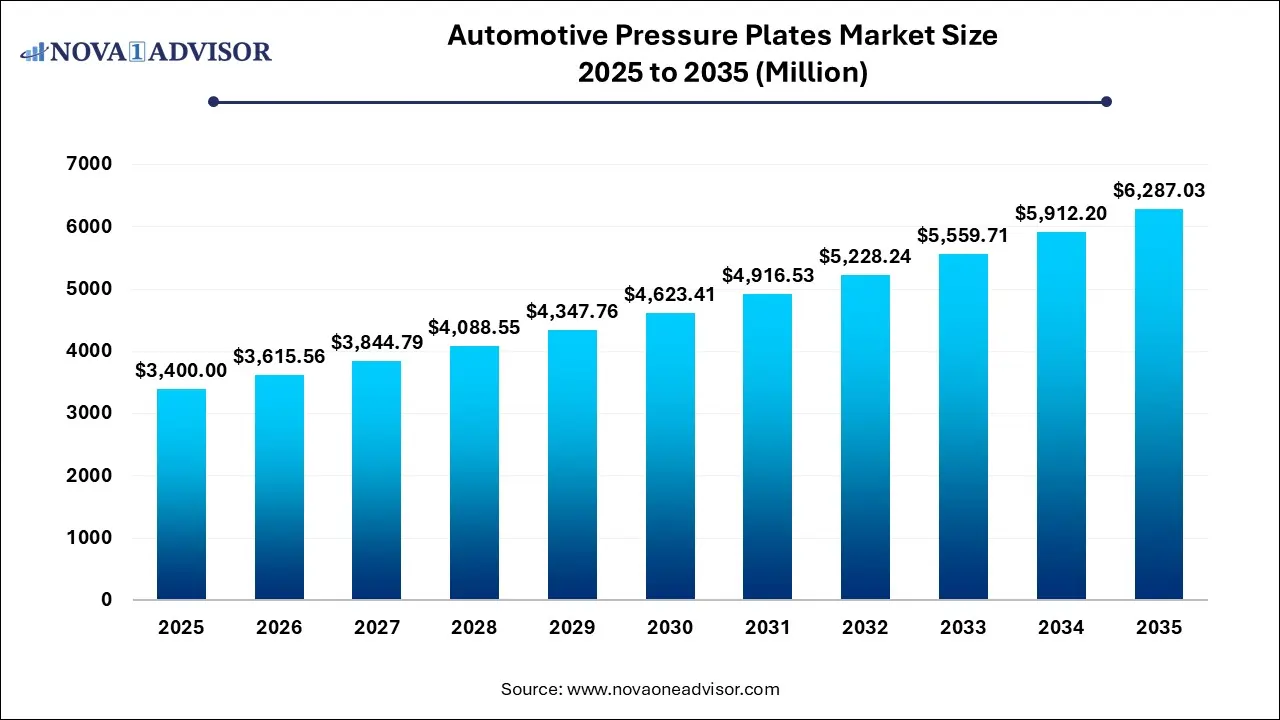
The global automotive pressure plates market size was valued at USD 3,400.00 million in 2025 and is projected to grow from USD 3,615.56 million in 2026 to USD 6,287.03 million by 2035, at a CAGR of 6.34% from 2026 to 2035.
Key Takeaway:
- By application, the passage vehicle segment dominated the market and accounted for the largest revenue share in 2025.
- By application, the commercial vehicle segment fastest growing in the market in 2025.
- By material type, the cast iron segment dominated the market and accounted for the largest revenue share in 2025.
- By transmission type, the manual transmission segment dominated the market and accounted for the largest revenue share in 2025.
- By clutch type, the single plate clutch segment dominated the market and accounted for the largest revenue share in 2025.
- By region, North America accounted for the largest revenue share in 2025.
Market Overview
The global Automotive Pressure Plates Market is a crucial segment of the automotive drivetrain industry, driven by steady vehicle production, increasing replacement demand, and continuous advancements in clutch system technologies. Pressure plates play an essential role in transmitting engine power to the transmission, ensuring smooth gear engagement and efficient vehicle performance. Demand remains strong across passenger vehicles, commercial vehicles, motorcycles, and heavy-duty equipment, particularly in regions where manual and semi-automatic transmissions continue to dominate. Additionally, a growing automotive aftermarket supports market expansion as pressure plates require periodic replacement due to wear and tear.
Technological innovations are reshaping the market through the adoption of lightweight materials, improved diaphragm spring designs, precision manufacturing, and Industry 4.0 technologies. Manufacturers are increasingly utilizing aluminum alloys, high-strength steel, and composite materials to improve durability while reducing vehicle weight and enhancing fuel efficiency. Artificial intelligence, automation, predictive maintenance, and digital quality inspection are further optimizing production processes and product reliability. Although the gradual shift toward electric vehicles presents long-term challenges for conventional clutch components, sustained demand from manual transmission vehicles, commercial fleets, and emerging automotive manufacturing markets is expected to support the Automotive Pressure Plates Market throughout the forecast period.
Market Outlook
- Market Growth Overview: The global automotive pressure plates market is expected to grow significantly between 2025 and 2035, driven by the rising vehicle production, rebounding demand, and innovation in drivetrain technology.
- Sustainability Trends: Sustainability trends involve remanufacturing and circular economy, design for efficiency and light weighting, and decarbonized production processes.
- Major Investors: Major investors in the market include Valeo, Schaeffler Group, ZF Friedrichshafen, BorgWarner, and Aisin Corporation.
How AI is Impacting the Global Automotive Pressure Plates Market?
AI and ML are revolutionizing the global automotive pressure plates industry by optimizing both manufacturing quality and component longevity. Manufacturers use ML algorithms to analyze real-time production data, drastically reducing defects and waste during casting and machining. AI-driven predictive modeling allows engineers to simulate thermal stress and mechanical wear, leading to lighter and more durable clutch designs. As a result, companies are achieving faster time-to-market and significantly lowering operational costs.
Major Trends in the Automotive Pressure Plates Market
- Increasing adoption of lightweight pressure plate materials
Manufacturers are replacing conventional heavy components with aluminum alloys, high-strength steel, and composite materials to improve fuel efficiency and reduce vehicle weight without compromising durability.
- Growing automation in manufacturing facilities
Robotic machining, automated assembly lines, AI-based inspection systems, and smart factories are enhancing production precision while reducing manufacturing costs and product defects.
- Rising demand from the automotive aftermarket
Aging vehicle fleets across developed and emerging economies continue generating strong replacement demand for pressure plates as clutch systems require periodic maintenance.
- Expansion of commercial vehicle production
Growing logistics, mining, agriculture, and infrastructure sectors are increasing demand for durable heavy-duty pressure plates capable of handling higher torque loads.
- Development of advanced friction technologies
Manufacturers continue improving diaphragm spring designs, friction interfaces, and thermal resistance to increase clutch durability and enhance driving comfort.
Automotive Pressure Plates Market Report Scope
| Report Coverage | Details |
| Market Size in 2026 | USD 3,615.56 Million |
| Market Size by 2035 | USD 6,287.03 Million |
| Growth Rate From 2026 to 2035 | CAGR of 6.34% |
| Base Year | 2025 |
| Forecast Period | 2026 to 2035 |
| Segments Covered | By End Use, By Clutch Type, By Application, By Material Type, By Transmission Type, By Region |
| Market Analysis (Terms Used) | Value (USD Million/Billion) or (Volume/Units) |
| Regional Scope | North America; Europe; Asia Pacific; Central and South America; the Middle East and Africa |
| Key Companies Profiled | California Custom Clutch Corporation (US), Raicam Clutch Ltd (Italy), Makino Auto Industries Private Limited (India), SASSONE SRL (Italy), ANAND Group (India), Apls Automotive Industries Private Limited (India), MACAS Automotive (India), Hebei Tengda Auto Parts Co., Ltd. (China), S. K. Auto Industries (India), Setco Automotive Ltd (India), GOLDEN Precision Products Private Limited (India), and RSM Autokast Ltd. (India). |
Segmental Insights
By Application
How did the passage vehicle segment dominate the Global Automotive Pressure Plates market?
The passenger vehicle segment is driven by the massive global production volume of passenger vehicles, establishes as the original equipment manufacturers. Despite the rise of automatic vehicles, budget-friendly and performance care continue to rely heavily on manual transmissions, where every unit requires a high-quality clutch pressure plate.
How did the commercial vehicle segment expect to hold the fastest-growing Global Automotive Pressure Plates market in the coming years?
The commercial vehicle segment is driven by the rising global trade, expanding industrialisation, and surging logistics activities across emerging markets, which are fuelling continuous usage and steady production of commercial vehicles. This targeted shift toward high-performance components optimizes fleet reliability, minimizes commercial vehicle downtime, and secures robust market expansion worldwide.
By Material Type
How did the cast iron segment dominate the Global Automotive Pressure Plates market?
The cast iron segment is driven by the unbeatable balance of durability and low cost, which secures cast iron as the high-volume manual transmission of emerging economies. Its incredible cost efficiency at scale makes it significantly cheaper to produce at high volumes compared to advanced composites or aluminum alloys.
How did the aluminium segment expect to hold the fastest-growing Global Automotive Pressure Plates market in the coming years?
The aluminium segment is driven by the advanced engineering that offers mechanical stress concerns through high-performance alloys and specialized heat-treating processes that drastically enhance strength, hardness, and thermal conductivity. The advanced alloys deliver superior drivetrain noise and vibration damping, satisfying modern consumer demands for a smoother, quieter, and highly efficient driving experience.
By Transmission Type
How did the manual transmission segment dominate the Global Automotive Pressure Plates market?
The manual transmission segment is driven by manual transmissions and their associated single-plate clutches, which are significantly cheaper to manufacture and maintain than automatic alternatives, making them highly attractive to cost-conscious buyers. In cost-sensitive, high-volume emerging materials, such as the Asia Pacific region, the dominant standard is to lower initial acquisition costs and deep operator familiarity.
How did the automatic transmission segment expected to hold the fastest-growing Global Automotive Pressure Plates market in the coming years?
The automatic transmission segment is driven by the structural transition, which creates an exceptionally lucrative, high-value aftermarket for complex replacement parts and specialized diagnostic repair service worldwide. To capture momentum, automakers are heavily focusing on advanced continuously variable transmissions and dual-clutch transmissions designed to satisfy modern consumer demands while lowering carbon emissions.
By Clutch Type
How did the single plate clutch segment dominate the Global Automotive Pressure Plates market?
The single plate clutch segment is driven by the fact that it is cheaper to manufacture and install than multi-plate or complex dual-clutch systems, establishing itself as the standard for budget and mass-market vehicles. The strong consumer preference in cost-sensitive markets drives continuous, high-volume production and secures a stable manufacturing baseline for component suppliers.
How did the multi-plate clutch segment expected to hold the fastest-growing Global Automotive Pressure Plates market in the coming years?
The multi-plate clutch segment is driven by the automotive industry shift toward partial electrification. Multi-plate clutches are highly favoured in hybrid power-split configurations and modern dual-clutch transmissions due to their compact footprint and ability to seamlessly handle complex torque transitions. To address the intense heat buildup inherent in these high-performance systems, manufacturers are utilizing upgraded materials, such as graphene-reinforced friction plates and advanced composites, to dramatically improve thermal stability.
By Regional
How did the North America region account for the largest share in the Global Automotive Pressure Plates market?
North America is driven by the region's benefits from a highly established, integrated automotive supplier ecosystem spanning the US, Mexico, and Canada, ensuring seamless production and efficient distribution of drivetrain parts. The heavy reliance on manual and automated-manual transmissions across North American semi-trucks, freight, and logistics fleets demands highly durable, heavy-duty pressure plates, driving steady market volume and revenue.
U.S. Global Automotive Pressure Plates Market Trends
The U.S. is delivering a compact footprint, superior high-RPM performance, and lower pedal effort for drivers. To help automakers comply with strict emission regulations, manufacturers are increasingly utilizing advanced, lighter friction materials and specialized metals that significantly reduce total drivetrain weight.
How did the Asia-Pacific region become the fastest-growing Global Automotive Pressure Plates Market during the forecast period?
Asia Pacific is driven by the growing demand for passenger cars, the expansion of hybrid powertrains, and heavy-duty commercial fleets, ensuring sustained, long-term demand for robust, heart-resistant drivetrain solutions. To help automakers comply with strict emission regulations, manufacturers are increasingly utilizing advanced, lighter friction materials and specialized metals that significantly reduce total drivetrain weight.
China Global Automotive Pressure Plates Market Trends
China’s supply of roughly global automotive components, cost-effective manufacturing networks allow prominent Chinese players to remain highly competitive export hubs worldwide. China's status as the world's largest vehicle fleet creates explosive aftermarket demand for routine repairs, prompting a significant shift toward eco-friendly, certified refurbished clutch assemblies.
How Did Europe Hold A Notable Share in the Global Automotive Pressure Plates Market?
Europe’s massive automotive aftermarket ensures consistent, high-volume replacement sales for millions of aging passenger and commercial vehicles, securing steady long-term revenue streams. The rigorous quality and safety compliance frameworks mandated by the European Union position regional manufacturers as global leaders while establishing high barriers to entry for unverified competitors.
Germany Global Automotive Pressure Plates Market Trends
Germany’s diaphragm-type pressure plates continue to dominate the regional market over older coil spring designs, largely due to their compact size and superior torque transmission capabilities. The technological evaluation is strongly supported by a thriving aftermarket segment, as recent structural challenges among local OEMs cause vehicle lifespans to extend, forcing consumers to maintain aging fleets.
Key Players in the Global Automotive Pressure Plates Market
- California Custom Clutch Corporation California Custom Clutch (US) supports the market by specializing in heavy-duty and high-performance aftermarket custom clutches, providing engineered pressure plates for racing and specialized vehicles.
- Raicam Clutch Ltd Raicam Clutch (Italy/UK/India) contributes as a prominent global tier-1 supplier that designs and manufactures innovative clutch systems and pressure plates for original equipment manufacturers (OEMs).
- Makino Auto Industries Private Limited contributes to the global automotive pressure plates market by designing and manufacturing high-precision, asbestos-free clutch pressure plates and assemblies for OEMs and the aftermarket.
Segments Covered in the Report
This report forecasts revenue growth at country levels and provides an analysis of the latest industry trends in each of the sub-segments from 2021 to 2035. For this study, Nova one advisor, Inc. has automotive pressure plates market.
By End Use
- OEM
- Aftermarket
By Application
- Passenger Vehicle
- Commercial Vehicle
- Motorcycle
- Heavy-Duty Vehicle
By Material Type
- Cast Iron
- Aluminum
- Composite Material
- Steel
By Transmission Type
- Manual Transmission
- Automatic Transmission
- Semi-Automatic Transmission
By Region
- North America
- Europe
- Asia-Pacific
- Latin America
- Middle East & Africa (MEA)
FAQ's

Proceed to Buy
Instant PDF delivery on confirmation

Automotive Pressure Plates Market Size to Hit USD 6,287.03 Million by 2035
 Request Customization
 Download Sample

Get a Sample of this Report
Automotive Pressure Plates Market