

Automotive Pumps Market Size, Share, Forecast Report, 2026-2035
 Status Published
 Category Automation and Transport


Content
Automotive Pumps Market Size, Growth and Trends 2026 to 2035
The global automotive pumps market garnered revenue around USD 30.85 Billion in 2025 and projected to reach USD 34.76 Billion in 2035, with at a compound annual growth rate of 1.2% throughout the estimate period from 2026 to 2035.
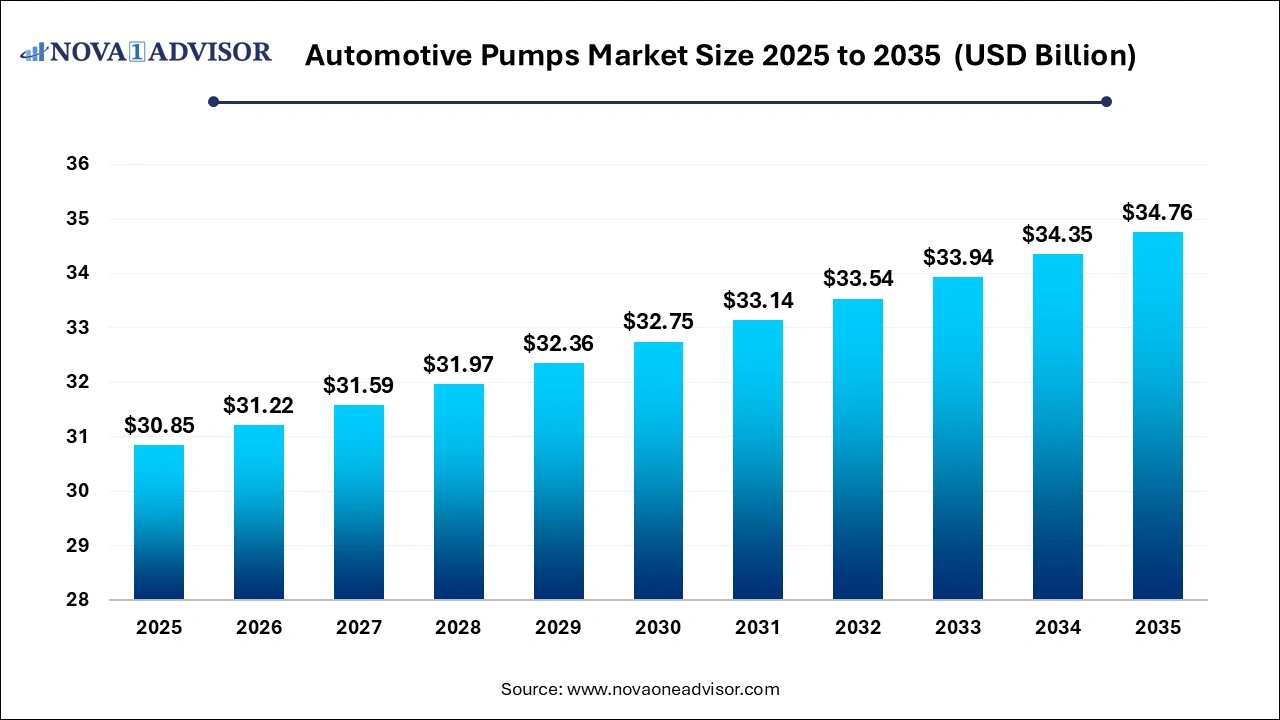
Automotive Pumps Market Outlook
- Market Growth Overview: The automotive pumps market is expected to grow significantly between 2026 and 2035, driven by emission regulations and fuel efficiency, growing demand for electric pumps over mechanical, and expansion in emerging markets.
- Sustainability Trends: Sustainability trends involve the rise of electric water and coolant pumps, energy-efficient and smart technology, and emission of reducing technology, and sustainable manufacturing and materials.
- Major Investors: Major investors in the market include Robert Bosch GmbH, Denso Corporation, Aisin Corporation, Continental AG, and Johnson Electric Holding Limited.
Report Scope Automotive Pumps Market
| Report Coverage | Details |
| Market Size in 2026 | USD 31.22 Billion |
| Market Size by 2035 | USD 34.76 Billion |
| Growth Rate From 2026 to 2035 | CAGR of 1.2% |
| Base Year | 2025 |
| Forecast Period | 2026 to 2035 |
| Segments Covered | By Product, By Technology, By Vehicle Type, |
| Market Analysis (Terms Used) | Value (USD Million/Billion) or (Volume/Units) |
| Regional Covered | North America; Europe; Asia Pacific; Latin America; MEA |
| Key Companies Profiled | Aisin Seiki Co. Ltd., Delphi Automotive, Denso Corporation, Robert Bosch GmbH |
Automotive Pumps Market Segment Insights
By Product Insights
How did the Fuel Pump Segment Dominate the Automotive Pumps Market?
The fuel pump segment is driven by the massive global volume of ICE and hybrid vehicles that require precise, high-pressure fuel delivery for emissions compliance. The transition from mechanical to electronic fuel injection (EFI) has increased the technological value and unit cost of these components, sustaining their market leadership. While pure EV adoption is rising, the continued growth of PHEVs ensures a long-term, stable demand for advanced turbine-style pumps.
How did the Water Pump Segment Expect to Hold the Fastest-Growing Automotive Pumps Market in the Coming Years?
The water pump segment is driven by the technological transition toward 12V and 24V architectures, which allow pumps to operate independently of engine speed for maximum efficiency. Manufacturers are increasingly adopting modular plug-and-play designs that integrate pumps with heat exchangers, significantly reducing assembly time while meeting stringent environmental regulations. The strategic focus on smart, energy-efficient pumping solutions by industry leaders ensures that electrification remains the most powerful catalyst for long-term market growth.
By Technology Insights
How did the Mechanical Pumps Segment Account for the Largest Share in the Automotive Pumps Market?
The mechanical pumps segment is driven by its ability to handle the high-pressure demands of modern direct-injection engines ensures they are indispensable for core functions like fuel injection and lubrication. While electric alternatives are growing, the proven durability and lower manufacturing costs of mechanical systems make them the preferred choice for mass-market passenger cars. The sheer volume of the existing global fleet ensures that these pumps remain the primary revenue anchor for the automotive industry.
How did the Electrical pumps Segment Expect to Hold the Fastest-Growing Automotive Pumps Market in the Coming Years?
The electrical pumps segment is driven by reducing parasitic engine losses and operating on-demand to meet stringent global emission standards. Technological shifts toward smart BLDC motors and integrated sensors are providing a competitive edge through predictive maintenance and superior reliability. The 12V electric water pump rapid dominance as manufacturers strategically expand their portfolios to support the next generation of passenger cars.
By Vehicle Type Insights
How did the Passenger Cars Segment Account for the Notable Share in the Automotive Pumps Market?
The passenger cars segment is driven by the rising consumer demand for compact SUVs. Modern vehicles now require an array of specialized fuel, water, and vacuum pumps to meet increasingly strict efficiency and emissions standards. The electrification trend, which creates a high-value market for advanced electric pumps dedicated to battery and motor cooling. The rising disposable incomes in emerging economies and a post-pandemic preference for private mobility ensure that passenger cars remain the primary revenue anchor for pump manufacturers.
Key Players in the Automotive Pumps Market
- Aisin Seiki Co. Ltd.: Aisin Corporation produces a wide range of automotive pumps, specializing in high-efficiency water and oil pumps that enhance fuel efficiency and reduce vehicle emissions.
- Delphi Automotive: Delphi offers a comprehensive portfolio of fuel management products, including advanced fuel injection pumps, fuel modules, and gasoline direct injection (GDI) pumps for both OEM and aftermarket sectors.
- Denso Corporation: Denso is a leading supplier of powertrain and thermal components, manufacturing advanced fuel pumps, high-pressure pumps, and electric water pumps for diverse vehicle types.
- Robert Bosch GmbH: Bosch is a global leader in automotive pump innovation, providing comprehensive solutions for fuel injection, oil lubrication, and coolant management for internal combustion and electric vehicles.
Segments Covered in the Report
By product
- Fuel Pump
- Oil Pump
- Steering Pump
- Water Pump
- Fuel Injection Pump and other
By Technology
- Mechanical
- electrical
By Vehicle type
- Passenger car
- LCV
- HUV
- two wheeler
Regional Analysis and Forecast
Further, this research study analyses market size, production, consumption and its advancement trends at global, regional, and country level for period 2026 to 2035 and covers following region in its scope:
- North America
- U.S.
- Canada
- Europe
- Germany
- U.K.
- Italy
- France
- Rest of EU
- Asia Pacific
- China
- India
- Japan
- Southeast Asia
- Rest of APAC
- Central & South America
- Brazil
- Argentina
- Rest of Central & South America
- Middle East and Africa
- UAE
- Saudi Arabia
- Rest of MEA

Proceed to Buy
Instant PDF delivery on confirmation

Automotive Pumps Market Size to Worth Around USD 34.76 Bn by 2035
 Request Customization
 Download Sample

Get a Sample of this Report
Automotive Pumps Market