

Bioidentical Hormones Market Size, Share, Forecast Report, 2026-2035
 Status Published
 Category Healthcare


Content
Bioidentical Hormones Market Summary
The global bioidentical hormones market size was estimated at USD 2.51 billion in 2025 and is projected to hit around USD 4.44 billion by 2035, growing at a CAGR of 5.9% during the forecast period from 2026 to 2035.
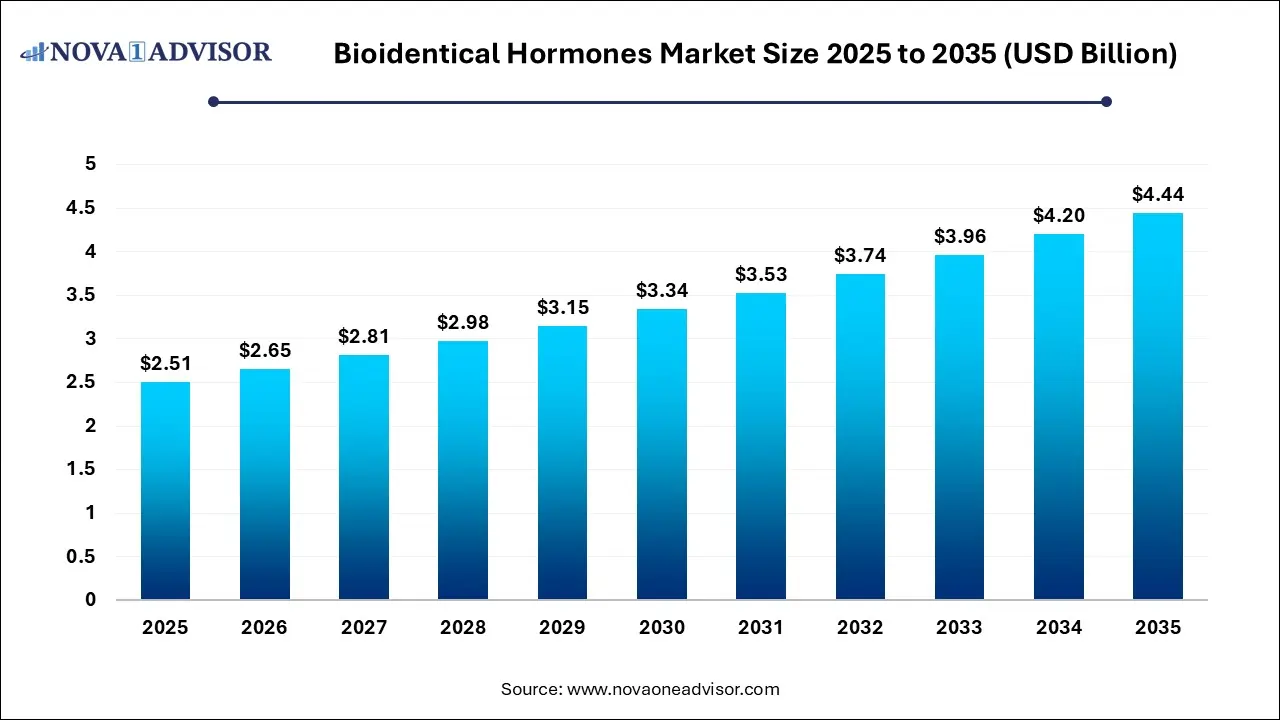
Market Key Takeaways
- The Bioidentical Hormones Market is experiencing steady growth driven by rising awareness of hormone replacement therapies (HRT) and aging populations.
- Increasing prevalence of menopause-related conditions and hormonal imbalances is significantly boosting demand.
- Estrogen-based therapies dominate the market due to their widespread use in menopause management.
- Clinics represent the leading end-user segment owing to personalized hormone therapy services.
- North America holds the largest market share due to advanced healthcare systems and higher patient awareness.
- Technological advancements and increasing integration of personalized medicine are reshaping treatment approaches.
Market Overview
The Bioidentical Hormones Market is a dynamic segment within the broader hormone replacement therapy (HRT) landscape, focusing on compounds that are chemically identical to hormones naturally produced by the human body. These hormones, including estrogen, progesterone, and testosterone, are commonly used to treat hormonal imbalances associated with menopause, andropause, thyroid disorders, and other endocrine conditions.
Bioidentical hormones are often derived from plant sources such as soy and yams and are formulated to closely mimic endogenous hormones. This structural similarity is believed to enhance compatibility with the human body, reducing adverse effects compared to synthetic alternatives. As a result, bioidentical hormone therapy (BHT) has gained considerable traction among patients seeking more “natural” treatment options.
The market is witnessing growth due to demographic shifts, particularly the aging global population. Women entering menopause represent a significant patient pool, with symptoms such as hot flashes, mood swings, and bone density loss driving demand for hormone therapy. Similarly, testosterone therapy is increasingly used among aging men experiencing fatigue, reduced muscle mass, and decreased libido.
In addition, lifestyle factors such as stress, poor diet, and environmental influences are contributing to hormonal imbalances across various age groups. This has expanded the market beyond traditional menopause treatment to include broader wellness and anti-aging applications.
Healthcare providers are increasingly adopting personalized treatment approaches, tailoring hormone therapy based on individual patient profiles. This trend is supported by advancements in diagnostic tools and biomarker analysis, enabling more precise dosing and monitoring.
Market Outlook
Market Growth Overview: The global bioidentical hormones market is expected to grow significantly between 2025 and 2035, driven by the growing preference for personalized medicine, rising demand for natural alternatives, and an aging population and menopause care.
Sustainability Trends: Sustainability trends involve green manufacturing, ethical and responsible sourcing, and plant-derived ingredients.
Major Investors: Major investors in the market include Bayer AG, Pfizer Inc., Novartis AG, AbbVie Inc., Merck KGaA, and Novo Nordisk A/S.
How is AI Transforming the Bioidentical Hormones Market?
Artificial Intelligence (AI) is playing a transformative role in the Bioidentical Hormones Market by enabling precision medicine, improving treatment outcomes, and optimizing healthcare delivery. AI technologies are being integrated into clinical workflows to analyze patient data, predict hormonal imbalances, and recommend personalized treatment regimens.
One of the key applications of AI is in hormone level analysis and diagnostics. Machine learning algorithms can process large datasets, including patient history, lab results, and lifestyle factors, to identify patterns indicative of hormonal imbalances. This allows clinicians to make more accurate diagnoses and develop targeted treatment plans.
AI is also enhancing personalized dosing strategies. Traditional hormone therapy often relies on standardized dosing, which may not be optimal for all patients. AI-driven platforms can simulate how different hormone levels affect individual patients, enabling customized dosing that minimizes side effects and maximizes therapeutic efficacy.
For example, digital health platforms are emerging that use AI to continuously monitor patient symptoms and hormone levels, adjusting treatment in real time. These platforms can integrate wearable device data, providing insights into sleep patterns, stress levels, and metabolic activity.
Another significant impact of AI is in drug development and clinical research. Pharmaceutical companies are leveraging AI to identify new formulations, optimize delivery mechanisms, and accelerate clinical trials. AI can also help in predicting patient responses to therapy, reducing trial costs and improving success rates.
Overall, AI is shifting the market toward a more data-driven, patient-centric approach, improving both clinical outcomes and operational efficiency.
Bioidentical Hormones Market Report Scope
| Report Coverage | Details |
| Market Size in 2026 | USD 2.65 Billion |
| Market Size by 2035 | USD 4.44 Billion |
| Growth Rate From 2026 to 2035 | CAGR of 5.9% |
| Base Year | 2025 |
| Forecast Period | 2026 to 2035 |
| Segments Covered | By Type,By End-User,By Product Type, By Region |
| Market Analysis (Terms Used) | Value (USD Million/Billion) or (Volume/Units) |
| Regional Scope | North America; Europe; Asia Pacific; Central and South America; the Middle East and Africa |
| Key Companies Profiled | SottoPelle, BioTE Medical, Advantage Pharmaceuticals, Inc., Full Life Wellness Center, Neuva Aesthetics, Defy Medical, Biostation and others. |
Segmental Insights
By Type
How did the estrogens segment dominate the Global Bioidentical Hormones market?
The estrogens segment is driven by bioidentical hormones, as an aging global population seeks safer alternatives to traditional synthetic therapies. The preference for estrogen and progestin combination therapies has solidified because they effectively alleviate symptoms while safeguarding long-term uterine health. The rise of personalized, compounded formulations allows for tailored dosing that meets specific patients' needs, driving significant popularity in the U.S. and the North American region.
How did the testosterone segment expect to hold the fastest-growing Global Bioidentical Hormones market in the coming years?
The testosterone segment is driven by the rising awareness of male hormonal deficiency and its impact on energy and muscle mass, is drive higher demand for treatments. The growing shift toward personalized medicine, where bioidentical hormones are compounded to fit individual hormonal profiles, is improving patient adoption. Growing focus on the intersection of testosterone therapy with cardiovascular safety, and expanding in high-growth regions, such as the Asia Pacific.
By Product Type
How did the tablets and capsules segment account for the largest share in the Global Bioidentical Hormones market?
The tablets and capsules segment is driven by the widespread prescription for estrogen and thyroid management, which is supported by continuous innovations in absorption efficiency, making them both reliable and safe for long-term use. As manufacturers scale production to meet the needs of an aging population, these products continue to capture the largest revenue share in the industry. The cornerstone of the hormone therapy market because their convenience and high availability ensure superior patient compliance compared to invasive alternatives.
The cream and gels segment accounts for the largest share in the Global Bioidentical Hormones market.
The cream and gels segment is driven by the widespread use of oral tablets, which provide high patient compliance. The shift toward specialised menopause care, which remains the single largest application segment globally. The landscape is evolving to balance traditional oral accessibility with the growing demand for targeted, site-specific hormone delivery.
By End User
How did the clinics segment account for the largest share in the Global Bioidentical Hormones market?
The clinics segment is driven by the rise of specialized menopause and wellness clinics is transforming hormone therapy by providing the professional expertise required for complex delivery methods, such as pellet implants and injections. The growing demand for personalized care plans offering a level of customization that standard healthcare settings often lack. The shift toward these specialized environments reflects a broader trend of prioritizing individual safety and tailored medical outcomes in women's health.
The hospitals segment accounts for the largest share in the Global Bioidentical Hormones market.
The hospitals segment is driven by the high level of trust patients place in physician-led care. These facilities provide the controlled environment and professional expertise necessary for administering complex treatments and managing acute hormonal imbalances safely. While they lead in volume, the rise of specialized and compounding pharmacies is challenging the status quo by meeting the surge in demand for highly personalized hormone profiles.
By Regional
How did the North America region account for the largest share in the Global Bioidentical Hormones market?
North America’s focus on personalized, compounded bioidentical therapies addresses a growing consumer demand for customized care that synthetic options often fail to meet. A constant stream of product innovation, particularly in advanced delivery systems like pellets and transdermal patches, keeps the market competitive and technologically ahead. The synergy of medical expertise, patient awareness, and robust R&D ensures the region remains the global standard for hormone therapy.
U.S. Global Bioidentical Hormones Market Trends
The U.S. surge in personalized medicine, as patients move away from one-size-fits-all synthetics toward customized, plant-derived formulations. Innovative delivery methods, such as slow-release implants and transdermal gels, are further driving growth by significantly enhancing patient compliance and convenience. The combination of advanced bioavailability and a focus on individualized wellness is positioning bioidentical therapies as a primary pillar of modern hormonal health.
How did the Asia Pacific region hold the fastest-growing Global Bioidentical Hormones Market in the forecast period?
Asia Pacific’s improved healthcare infrastructure and increasing disposable income allow greater access to premium personalized healthcare services. The shift toward holistic, natural therapies adoption of bioidentical hormones over traditional synthetic alternatives. Increasing awareness regarding penetration by both international and local pharmaceutical firms, along with improved availability of compounded products.
China Global Bioidentical Hormones Market Trends
China’s dominance of combined estrogen and progestin therapy, which addresses the primary needs of a large menopausal population. While oral administration remains the most common route due to established trust, the rapid rise of transdermal patches and gels reflects a growing patient preference for sustained-release safety. This evolution is driven by an aging demographic that increasingly prioritizes personalized medicine over traditional, synthetic hormone replacement options.
Key Players in the Global Bioidentical Hormones Market
- SottoPelle
SottoPelle contributes to the global bioidentical hormones market by providing a patented, specialized pellet therapy method designed for individualized, consistent hormone delivery.
- BioTE Medical
BioTE Medical operates as a leader in precision and preventive medicine, providing a comprehensive "BioTE Method" for hormone optimization using pellets, which includes training, clinical decision-making software, and access to FDA-registered outsourcing facilities.
- Advantage Pharmaceuticals, Inc.
Advantage Pharmaceuticals, Inc. acts as a key supplier within the bioidentical hormones sector, specializing in the formulation and distribution of hormone therapies and compounding pharmacy services.
Segments Covered in the Report
This report forecasts revenue growth at country levels and provides an analysis of the latest industry trends in each of the sub-segments from 2021 to 2035. For this study, Nova one advisor, Inc. has segmented the bioidentical hormones market.
By Type
- Estrogens
- Progesterone
- Testosterone
By End-User
- Clinics
- Hospitals
By Product Type
- Tablets and Capsules
- Creams and Gels
- Injectables
- Patches and Implants
By Region
- North America
- Europe
- Asia Pacific
- Latin America
- Middle East and Africa (MEA)
FAQ's

Proceed to Buy
Instant PDF delivery on confirmation

Bioidentical Hormones Market Size to Hit USD 4.44 Billion by 2035
 Request Customization
 Download Sample

Get a Sample of this Report
Bioidentical Hormones Market