

Bioimplants Market Size, Share, Forecast Report, 2026-2035
 Status Published
 Category Healthcare


Content
Bioimplants Market Size and Growth 2026 to 2035
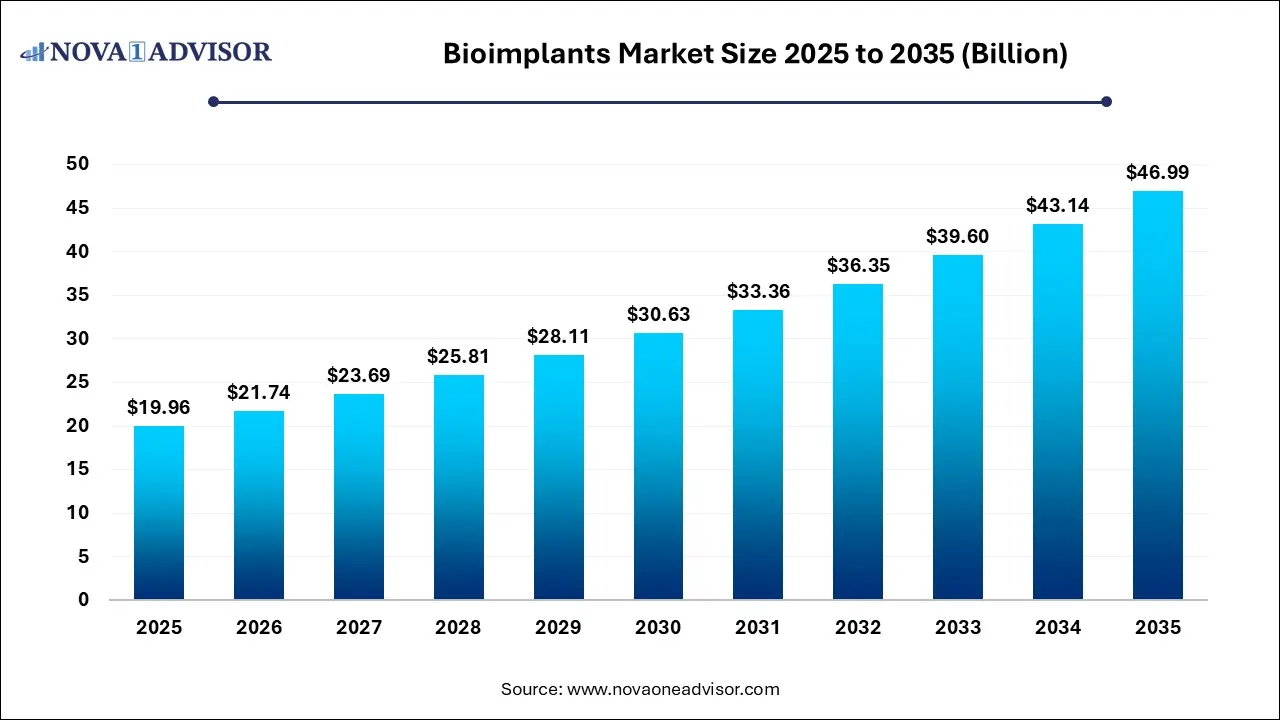
The global bioimplants market size was estimated at USD 19.96 billion in 2025 and is projected to hit around USD 46.99 billion by 2035, growing at a CAGR of 8.94% during the forecast period from 2026 to 2035.
Market Overview
The bioimplants market represents one of the most rapidly evolving segments within the global medical devices and healthcare technology industry. Bioimplants are medical devices or biological substitutes designed to replace, support, repair, or enhance damaged biological structures and tissues within the human body. These implants are widely utilized across multiple medical specialties including orthopedics, cardiology, dentistry, ophthalmology, spinal surgery, and reconstructive medicine.
The increasing prevalence of chronic diseases and age-related degenerative disorders is significantly driving demand for bioimplant procedures worldwide. Conditions such as cardiovascular disease, osteoarthritis, spinal degeneration, dental disorders, glaucoma, and traumatic injuries are becoming more common due to aging populations, sedentary lifestyles, obesity, and rising life expectancy. Bioimplants offer long-term therapeutic solutions that improve patient mobility, functionality, and quality of life.
Orthopedic implants represent one of the largest categories within the market. Joint replacement implants, trauma fixation devices, and spinal implants are increasingly being used to manage musculoskeletal disorders and sports injuries. For example, knee and hip replacement procedures have become highly common among elderly patients suffering from severe osteoarthritis. Similarly, spinal bioimplants are increasingly utilized in minimally invasive spinal surgeries to treat disc degeneration and spinal instability.
Cardiovascular implants also hold a significant market share due to the growing incidence of coronary artery disease, arrhythmias, and heart failure. Stents and pacing devices are widely implanted to restore vascular function and maintain cardiac rhythm stability. Technological advancements such as drug-eluting stents and MRI-compatible pacemakers are further improving treatment outcomes and patient safety.
Dental implants have gained substantial popularity due to increasing awareness regarding oral health and cosmetic dentistry. Root-form implants, in particular, are becoming the preferred solution for tooth replacement because of their superior stability and natural appearance. The rising demand for aesthetic dental procedures is further contributing to market expansion.
Advancements in biomaterials have transformed implant performance and durability. Materials such as titanium, ceramics, polymers, and specialized alloys offer enhanced biocompatibility, reduced rejection risks, and improved structural strength. Researchers are also focusing on bioactive materials that promote tissue integration and accelerate healing.
The market is increasingly influenced by technological innovations including robotic-assisted surgery, 3D printing, smart implants, nanotechnology, and AI-based surgical planning systems. Customized implants manufactured using additive manufacturing technologies are enabling patient-specific treatment solutions with improved anatomical fit and surgical precision.
Growing healthcare expenditure and expanding access to advanced surgical procedures in emerging economies are further supporting market growth. Governments and private healthcare providers are investing heavily in hospital modernization, specialty surgical centers, and advanced diagnostic capabilities.
Despite strong growth potential, the market faces several challenges. High implant costs, stringent regulatory approval processes, risk of implant-associated infections, and limited reimbursement coverage in certain regions can restrict adoption. Additionally, implant revision surgeries and complications related to implant wear remain important clinical concerns.
Nevertheless, continuous technological innovation, rising patient awareness, expanding healthcare infrastructure, and increasing demand for minimally invasive procedures are expected to sustain long-term growth in the global bioimplants market.
Market Outlook
- Market Growth Overview: The global bioimplants market is expected to grow significantly between 2025 and 2035, driven by the rising prevalence of chronic diseases, the aging global population, and increasing emphasis on cosmetic and lifestyle preferences.
- Sustainability Trends: Sustainability trends involve bioresorbable and biodegradable implants, biocompatible and bioactive surface modifications, and green manufacturing.
- Major Investors: Major investors in the market include Medtronic, Zimmer Biomet, Stryker, Johnson & Johnson, Abbott, and Boston Scientific.
How is AI Transforming the Bioimplants Market
Artificial intelligence is playing an increasingly transformative role in the bioimplants market by improving surgical planning, implant customization, predictive diagnostics, and postoperative patient monitoring. AI-driven technologies are enabling healthcare providers to deliver more accurate, personalized, and efficient implant procedures.
One of the most significant applications of AI is in preoperative planning and imaging analysis. Advanced AI algorithms can analyze CT scans, MRI images, and 3D anatomical data to help surgeons identify optimal implant sizes, positioning angles, and surgical pathways. This improves implant accuracy while reducing complications associated with poor alignment or anatomical mismatch.
AI is also accelerating the development of patient-specific implants through integration with 3D printing technologies. Machine learning systems can evaluate patient anatomy and generate customized implant designs tailored to individual physiological structures. For example, orthopedic and dental implants can now be manufactured with precise geometric configurations that enhance osseointegration and long-term stability.
Robotic-assisted surgeries supported by AI are improving procedural precision in orthopedic, spinal, and cardiovascular implant procedures. AI-guided robotic systems provide real-time feedback during surgery, helping surgeons achieve accurate implant placement while minimizing tissue damage. This contributes to faster recovery times and reduced postoperative complications.
Another important application involves predictive analytics and postoperative monitoring. AI systems can analyze patient recovery patterns, implant performance data, and complication risks to support early intervention and personalized rehabilitation planning. Smart implants embedded with sensors can transmit physiological data that AI algorithms use to detect implant loosening, infection, or mechanical stress before severe complications develop.
AI is also enhancing manufacturing quality control processes. Automated inspection systems powered by computer vision and machine learning can detect microscopic defects in implant surfaces and ensure consistent product quality. This is particularly important for highly regulated implant manufacturing environments.
Furthermore, AI is improving clinical research and implant design optimization. By analyzing large datasets from implant registries and patient outcomes, AI can identify factors associated with implant longevity, revision risks, and treatment success rates. These insights are helping manufacturers develop safer and more durable implants.
As healthcare systems increasingly adopt digital technologies and precision medicine approaches, AI is expected to become a central driver of innovation within the bioimplants market.
Bioimplants Market Report Scope
| Report Coverage | Details |
| Market Size in 2026 | USD 21.74 Billion |
| Market Size by 2035 | USD 46.99 Billion |
| Growth Rate From 2026 to 2035 | CAGR of 8.94% |
| Base Year | 2025 |
| Forecast Period | 2026 to 2035 |
| Segments Covered | By Type, By Material, By Origin, By Material, By Region |
| Market Analysis (Terms Used) | Value (USD Million/Billion) or (Volume/Units) |
| Regional Scope | North America; Europe; Asia Pacific; Central and South America; the Middle East and Africa |
| Key Companies Profiled | Abbott, Boston Scientific Corporation, Dentsply Sirona, Johnson & Johnson Services, Inc., Invibio Ltd., Integra LifeSciences, Medtronic, Smith & Nephew plc, Stryker, Wright Medical Group N.V., Zimmer Biomet, Cook Group, and C.R.Bard, Inc. |
Segmental Insights
By Product
How did the orthopaedic implants segment dominate the Global Bioimplants market?
The orthopaedic implants segment is driven by the rising prevalence of musculoskeletal conditions, such as osteoarthritis, among a growing geriatric demographic, drastically driving global demand for joint reconstruction and trauma bioimplants. The increase in road traffic accidents and sports injuries that require immediate, high-precision orthopaedic intervention.
How did the dental implants segment expected to hold the fastest-growing Global Bioimplants market in the coming years?
The dental implants segment is driven by material innovations in biocompatible titanium alloys and metal-free zirconia alternatives, which offer exceptional mechanical strength. The integration of digital dentistry, including 3D printing and computer-guided placement, has drastically improved surgical precision while reducing patient recovery times.
By Material
How did the biomaterial metal segment dominate the Global Bioimplants market?
The biomaterial metal segment is driven by the unmatched durability and resistance to degradation within the corrosive environment of the human body. Their unique manufacturing versatility also makes them indispensable for forging intricate devices, ensuring metals retain the largest market share in the bioimplants industry.
How did the ceramic implants segment expected to hold the fastest-growing Global Bioimplants market in the coming years?
The ceramic implants segment is driven by superior biocompatibility, corrosion resistance, and hypoallergenic properties, providing a safer alternative to metal implants by eliminating localized or systemic allergic reactions. Advanced bio-ceramics with hydroxylapatite coatings further enhance patient outcomes by chemically bonding with host bone structure to stimulate regeneration and minimize rejection risks.
By Origin
How did the xenografts segment dominate the Global Bioimplants market?
The xenografts segment is driven by advanced decellularization protocols that strip away immunogenic proteins while retaining vital osteoinductive cues, allowing these animal-derived matrices to safely avoid immune rejection. Its broad applicability across orthopedics, dentistry, and cardiovascular surgeries establishes xenografts as a cornerstone segment within the global bioimplants market.
How did the allografts segment expected to hold the fastest-growing Global Bioimplants market in the coming years?
The allografts segment is driven by advanced lyophilization and processing techniques that maximize shelf life while preventing immune rejection; allografts experience robust demand driven by an aging global population. It eliminates the risk of harvest site morbidity, shortens surgical time, and minimizes patient trauma by removing the need to harvest autologous tissue.
By End-Use
How did the hospital segment dominate the Global Bioimplants market?
The hospital segment is driven by the advanced surgical infrastructure, hybrid operating rooms, and complex sterilization units required for intricate bio-implant procedures. These institutions are uniquely equipped with multidisciplinary medical teams and on-site critical care units necessary to manage complex trauma cases and mitigate post-operative complications.
How did the clinics segment expected to hold the fastest-growing Global Bioimplants market in the coming years?
The clinics segment is driven by the growing patient demand for targeted, minimally invasive outpatient surgeries, which fuels the steady expansion of specialty clinics by offering faster-recovery times and less complex post-operative care. The direct integration of cutting-edge technologies, including 3D imaging, computer integration of cutting-edge technologies, including 3D imaging, computer-guided placement, and robotic surgical systems.
By Regional
How did the North America region account for the largest share in the Global Bioimplants market?
North America is driven by the advanced healthcare infrastructure, high per-capita spending, and favourable reimbursement frameworks that enable rapid adoption of next-generation bioimplants. A high prevalence of chronic conditions fuels a massive volume of orthopaedic, dental, and spinal procedures across the region’s dense networks of top-tier medical centers.
U.S. Global Bioimplants Market Trends
The U.S. is rising prevalence of cardiovascular diseases and osteoarthritis continues to drive a high volume of pacemaker, stent, and joint replacements across expanding clinical settings. The aging demographic is seeking aesthetic dental implants and a notable shift toward performing complex procedures safety within outpatient ambulatory surgical centers.
How did the Asia-Pacific region become the fastest-growing Global Bioimplants Market during the forecast period?
Asia Pacific’s rapid demographic shift toward an expanding aging population across the region naturally requires joint and dental replacements. The thriving medical tourism hubs in India, Thailand, and Singapore attract thousands of international patients seeking high-quality, cost-effective bio-integrative procedures.
China Global Bioimplants Market Trends
China’s joint replacement and cardiovascular bioimplants are driven by shifting lifestyles and higher incidence of bone and heart-related ailments. The significant shift toward domestic manufacturing and research, with global and local companies actively securing national medical products administration approvals to commercialize regenerative products.
How did Europe Hold A Notable Share in the Global Bioimplants Market?
Europe’s extensive regional R&D investments from global giants, such as Medtronic, fuel advancements in 3D-printed bio-scaffolds and bioresorbable polymers. The stringent, standardized safety frameworks set by the European medicines agency, these factors collectively reinforce Europe’s highly mature and dominant position in the global market.
Germany Global Bioimplants Market Trends
Germany’s integration of 3D-printed personalized constructs and sensor-embedded smart systems is transforming patient care by enabling continuous post-operative monitoring. While advanced healthcare infrastructure drives steady device adoption, strict regional regulatory approvals and public cost-control measures remain prominent factors shaping commercial strategies.
Key Players in the Global Bioimplants Market
- Abbott
Abbott advances the cardiovascular bioimplants sector through innovative, leadless pacemakers and insertable cardiac monitors designed to seamlessly stream continuous physiological data. Their minimally invasive technologies are revolutionizing patient monitoring while driving significant market growth in remote therapy management.
- Boston Scientific Corporation
Boston Scientific is a major contributor to the cardiovascular bioimplants market by manufacturing critical devices like stents, structural heart valves, and the WATCHMAN FLX™ Pro for left atrial appendage closure.
- Dentsply Sirona
Dentsply Sirona contributes as a global leader in professional dental products, offering comprehensive end-to-end implant and restorative solutions.
Segments Covered in the Report
This report forecasts revenue growth at country levels and provides an analysis of the latest industry trends in each of the sub-segments from 2021 to 2035. For this study, Nova one advisor, Inc. has gel bioimplants market.
By Type
- Cardiovascular Implant
-
- Stents
- Pacing devices
- Others
- Dental Implants
-
- Plate Form Dental Implant
- Root Form Dental Implant
- Spinal Bioimplants
-
- Thoracolumber Implants
- Intervertebral Implants
- Cervical Implants
- Motion Preservation Implants
- Orthopedic Implants
-
- Orthobiologics
- Trauma Implants
- Joint Replacement Implants
- Knee Replacement Implants
- Ophthalmic Implants
-
- Glaucoma Implants
- Intraocular Implants
- Others
By Material
- Biomaterial metals
-
- Titanium
- Gold
- Silver
- Platinum
- Ceramics
- Polymers
- Alloys
- Others
By Origin
- Autograft
- Allograft
- Xenograft
- Synthetic
By Material
- Hospitals
- Clinics
- Specialty Centres
- Others
By Region
- North America
- Europe
- Asia Pacific
- Latin America
- Middle East and Africa (MEA)
FAQ's

Proceed to Buy
Instant PDF delivery on confirmation

 Request Customization
 Download Sample

Get a Sample of this Report
Bioimplants Market