

Bioremediation Technology & Services Market Size, Share, Forecast Report, 2026-2035
 Status Published
 Category Healthcare


Content
Bioremediation Technology & Services Market Size and Growth 2026 to 2035
The global bioremediation technology & services market size was estimated at USD 12.20 billion in 2025 and is projected to hit around USD 25.14 billion by 2035, growing at a CAGR of 7.5% during the forecast period from 2026 to 2035.
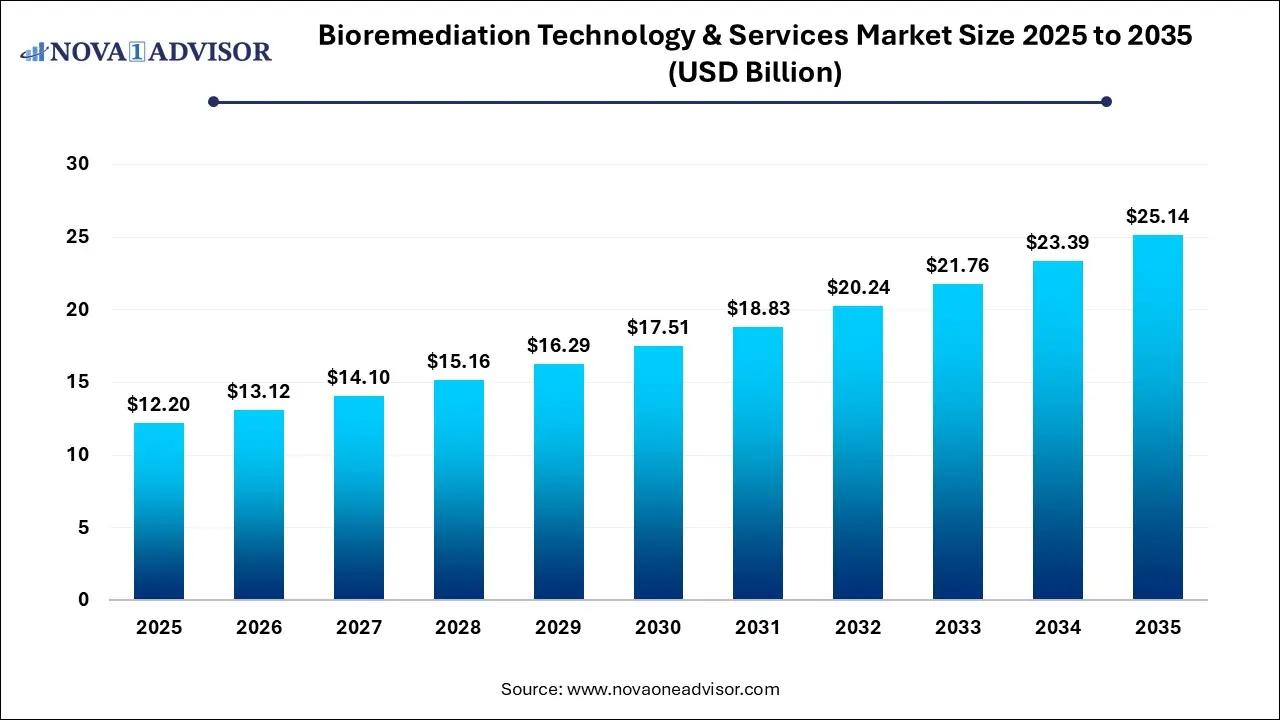
Market Key Takeaways
- The bioremediation technology & services market is expanding rapidly due to increasing environmental regulations and sustainability initiatives.
- In situ bioremediation dominates due to its cost-effectiveness and minimal site disturbance.
- Wastewater remediation is a key service segment driven by industrial discharge regulations.
- Phytoremediation and bioaugmentation technologies are gaining traction for eco-friendly remediation.
- Asia Pacific is emerging as the fastest-growing region due to industrial expansion and pollution concerns.
- Oil spill incidents and soil contamination cases continue to drive demand for advanced remediation solutions.
- Integration of biotechnology and environmental engineering is transforming remediation efficiency.
Market Overview
The bioremediation technology & services market focuses on the use of biological agents such as microorganisms, plants, and enzymes to degrade, detoxify, or remove pollutants from soil, water, and air. This approach has emerged as a sustainable alternative to conventional remediation methods such as chemical treatment and incineration, which often have secondary environmental impacts.
Bioremediation technologies are widely used to treat contaminants such as hydrocarbons, heavy metals, pesticides, and industrial chemicals. These technologies are applied across industries including oil & gas, agriculture, manufacturing, mining, and municipal waste management. With increasing industrialization and urbanization, environmental pollution has become a major concern, prompting governments and organizations to adopt eco-friendly remediation techniques.
The market is witnessing significant growth due to stringent environmental regulations, increasing awareness about sustainable practices, and advancements in biotechnology. Governments across the globe are enforcing stricter pollution control norms, requiring industries to adopt remediation solutions for contaminated sites. For example, remediation of oil-contaminated soils in oilfields and cleanup of industrial wastewater have become mandatory in many regions.
Technological advancements such as genetically engineered microorganisms, advanced bioreactors, and precision monitoring systems are enhancing the effectiveness of bioremediation processes. Additionally, the growing emphasis on circular economy and environmental sustainability is further boosting market demand.
Market Outlook
- Market Growth Overview: The global bioremediation technology & services market is expected to grow significantly between 2025 and 2035, driven by the growing stringent environmental regulations, rapid growth in industrialization and urbanization, and shift toward green technologies and the development of specialized microbes.
- Sustainability Trends: Sustainability trends involve the in-situ and eco-friendly methods, circular economy, waste management, bioaugmentation, and genetically modified organisms.
- Major Investors: Major investors in the market include REGENESIS, Xylem, Inc., Aquatech International LLC, Drylet, Inc., and Veolia Environnement S.A.
How AI is Impacting the Global Bioremediation Technology & Services Market
AI and ML are transforming the global bioremediation technology & services industry by shifting from traditional, passive methods to smart, data-driven, and adaptive environmental cleanup strategies. AI algorithms and machine learning models, such as random forest and artificial neural networks, are utilized to analyze complex environmental data to predict optimal microbial consortia and site-specific degradation pathways, enhancing pollutant removal efficiency. The integration of AI with Internet of Things (IoT) sensors enables real-time monitoring of contaminants and dynamic adjustment of parameters like pH and nutrient levels, which accelerates remediation rates and lowers operational costs.
Major Trends in the Market
- Increasing adoption of eco-friendly and sustainable remediation technologies
- Rising use of genetically engineered microbes for enhanced degradation efficiency
- Growing application of phytoremediation for heavy metal removal in soil
- Integration of IoT and real-time monitoring systems in remediation processes
- Expansion of bioremediation services in oil spill management
- Increasing demand for decentralized wastewater treatment solutions
- Growing investments in research and development for advanced bioremediation techniques
- Adoption of hybrid remediation approaches combining biological and physical methods
- Rising public and private sector partnerships for environmental cleanup projects
- Increasing use of bioreactors in industrial wastewater treatment
Bioremediation Technology & Services Market Report Scope
| Report Coverage | Details |
| Market Size in 2026 | USD 13.12 Billion |
| Market Size by 2035 | USD 25.14 Billion |
| Growth Rate From 2026 to 2035 | CAGR of 7.5% |
| Base Year | 2025 |
| Forecast Period | 2026 to 2035 |
| Segments Covered | By Type, By Technology, By Service, By Regional |
| Market Analysis (Terms Used) | Value (USD Million/Billion) or (Volume/Units) |
| Regional Scope | North America; Europe; Asia Pacific; Central and South America; the Middle East and Africa |
| Key Companies Profiled | REGENESIS, Xylem, Inc., Aquatech International LLC, Drylet LLC, Altogen Labs, InSitu Remediation Services Limited, PROBIOSPHERE, Ivey International, Inc., Sumas Remediation Services, Inc., and Sarva Bio Remed, LLC. |
Market Driver (Well Explained)
Stringent Environmental Regulations and Increasing Pollution Levels
One of the most significant drivers of the bioremediation technology & services market is the increasing enforcement of environmental regulations combined with rising pollution levels globally. Industrial activities, urbanization, and agricultural practices have led to widespread contamination of soil and water resources. Governments and regulatory bodies are implementing strict laws to control pollution and mandate remediation of contaminated sites.
For instance, industries such as oil & gas, chemicals, and mining are required to treat contaminated soil and wastewater before disposal. Failure to comply with these regulations can result in heavy penalties, legal actions, and reputational damage. This has compelled companies to invest in effective remediation solutions, including bioremediation technologies.
Bioremediation offers several advantages over conventional methods, including lower cost, minimal environmental impact, and the ability to treat contaminants on-site. For example, in situ bioremediation allows treatment of contaminated soil without excavation, reducing operational costs and environmental disruption. Similarly, microbial degradation of oil spills has been successfully used in marine environments, demonstrating the effectiveness of biological approaches.
As environmental concerns continue to grow and regulations become more stringent, the demand for bioremediation technologies and services is expected to increase significantly.
Market Restraint (Well Explained)
Limited Effectiveness for Certain Contaminants and Environmental Conditions
Despite its advantages, bioremediation faces limitations in terms of effectiveness under certain conditions, which acts as a major restraint for market growth. The success of bioremediation depends on various factors such as temperature, pH, oxygen availability, and nutrient levels. In unfavorable conditions, the activity of microorganisms can be significantly reduced, leading to slower or incomplete degradation of contaminants.
Additionally, bioremediation is not equally effective for all types of pollutants. For example, certain heavy metals and complex synthetic chemicals are resistant to biological degradation. In such cases, conventional methods such as chemical treatment or thermal remediation may be required, limiting the applicability of bioremediation.
Another challenge is the longer time required for remediation compared to traditional methods. While bioremediation is cost-effective, it may take weeks or months to achieve desired results, which may not be suitable for projects requiring immediate cleanup. For instance, in emergency situations such as chemical spills, faster remediation methods may be preferred.
These limitations highlight the need for continued research and development to enhance the efficiency and applicability of bioremediation technologies.
Market Opportunity (Well Explained)
Growing Demand for Sustainable Wastewater Treatment Solutions
The increasing demand for sustainable wastewater treatment presents a significant opportunity for the bioremediation technology & services market. Rapid industrialization and urban population growth have led to a surge in wastewater generation, posing serious environmental and public health challenges.
Traditional wastewater treatment methods often involve high energy consumption and chemical usage, making them less sustainable. In contrast, bioremediation offers an eco-friendly alternative by utilizing microorganisms to degrade organic pollutants. Technologies such as bioreactors and bioaugmentation are widely used in wastewater treatment plants to improve efficiency and reduce environmental impact.
For example, industries such as textiles, pharmaceuticals, and food processing generate large volumes of wastewater containing organic and inorganic contaminants. Bioremediation technologies can effectively treat these effluents, enabling reuse and reducing environmental discharge.
Moreover, the adoption of decentralized wastewater treatment systems in developing regions is creating new growth opportunities. Governments and organizations are increasingly investing in sustainable water management solutions, further driving demand for bioremediation technologies.
Segmental Insights
By Type
How did the in-situ bioremediation segment dominate the Global Bioremediation Technology & Services market?
The in-situ bioremediation segment is driven by its superior cost-efficiency and minimal site disruption, eliminating the logistical burden of soil excavation and transport. Its regulatory endorsements from bodies, such as the EPA, and continuous technological breakthroughs in delivery methods like bio-sparings. By providing a scalable, green solution for large-scale industrial and municipal contaminants, most economically viable choice for modern environmental management.
By Technology
How did the biostimulation segment account for the largest share in the Global Bioremediation Technology & Services market?
The biostimulation segment is driven by leveraging indigenous microorganisms to provide a highly sustainable, low-disruption alternative to traditional chemical excavation. Its exceptional success rate in degrading hydrocarbons makes it a choice for the global oil and gas industry when managing large-scale spills. The stringent environmental mandates, technology offers a cost-effective path for industrial compliance without excessive logistical overhead.
How did the phytoremediation segment expect to hold the fastest-growing Global Bioremediation Technology & Services market in the coming years?
The phytoremediation segment is driven by its offer a hyper-cost-effective alternative to traditional excavation, reducing remediation expenses by up to 1oo times. The rapid industrialization in Asia-Pacific, where emerging economies are adopting plant-based solutions to restore agricultural soil fertility and manage legacy pollutants. Its combination of aesthetic appeal and high efficacy makes it the premier sustainable choice for modern environmental restoration.
By Services
How did the soil remediation segment account for the largest share in the Global Bioremediation Technology & Services market?
The soil remediation segment is driven by rising industrial waste, and stringent government mandates for brownfield redevelopment drive a critical need for efficient clean-up. Using eco-friendly microbes and plants offers a significantly more cost-effective alternative to traditional mechanical methods, such as excavation or incineration. It is heavily utilized for treating hydrocarbons, pesticides, and industrial contaminants in soil.
How did the wastewater remediation segment expect to hold the fastest-growing Global Bioremediation Technology & Services market in the coming years?
The wastewater remediation segment is driven by worsening water scarcity, driving a critical shift toward circular water reuse and sustainable biological treatment systems in water-intensive industries. Technological breakthroughs in AI-driven monitoring and advanced microbial cultures, such as white, root fungi, are significantly enhancing the efficiency of breaking down persistent pollutants.
Key Players in the Global Bioremediation Technology & Services Market
- REGENESIS
REGENESIS contributes by developing advanced in-situ soil and groundwater remediation technologies, such as oxygen-releasing compounds and electron donors, that accelerate the natural biodegradation of contaminants.
- Xylem, Inc.
Xylem provides integrated bioremediation solutions through its extensive water technology portfolio, focusing on treating groundwater, industrial water, and municipal wastewater to mitigate contamination.
- Aquatech International LLC
Aquatech contributes to the market by delivering comprehensive, high-recovery water and process technology solutions that enable water reuse and zero liquid discharge, critical for reducing industrial footprints.
- Drylet LLC
Drylet contributes through a patented biocatalytic technology platform that utilizes specially selected microorganisms embedded in porous particles to accelerate the biodegradation of organic waste.
- Altogen Labs
Altogen Labs contributes to the market by providing specialized contract research services, focusing on bioremediation studies, microbial testing, and environmental impact assessment.
Bioremediation Technology & Services Market Segmentation
By Type
- In Situ Bioremediation
- Ex Situ Bioremediation
By Technology
- Phytoremediation
- Biostimulation
- Bioaugmentation
- Bioreactors
- Fungal Remediation
- Land-based Treatments
By Service
- Soil Remediation
- Wastewater Remediation
- Oilfield Remediation
- Others
By Regional
- North America
- United States
- Canada
- Europe
- Germany
- United Kingdom
- Italy
- France
- Rest of EU
- Asia Pacific
- China
- India
- Japan
- Southeast Asia
- Rest of APAC
- Central & South America
- Brazil
- Argentina
- Rest of Central & South America
- Middle East and Africa
- UAE
- Saudi Arabia
- Rest of MEA
FAQ's

Proceed to Buy
Instant PDF delivery on confirmation

Bioremediation Technology & Services Market Size to Hit USD 25.14 Billion by 2...
 Request Customization
 Download Sample

Get a Sample of this Report
Bioremediation Technology & Services Market