

Blood Testing Market Size, Share, Forecast Report, 2026-2035
 Status Published
 Category Healthcare


Content
Blood Testing Market Summary
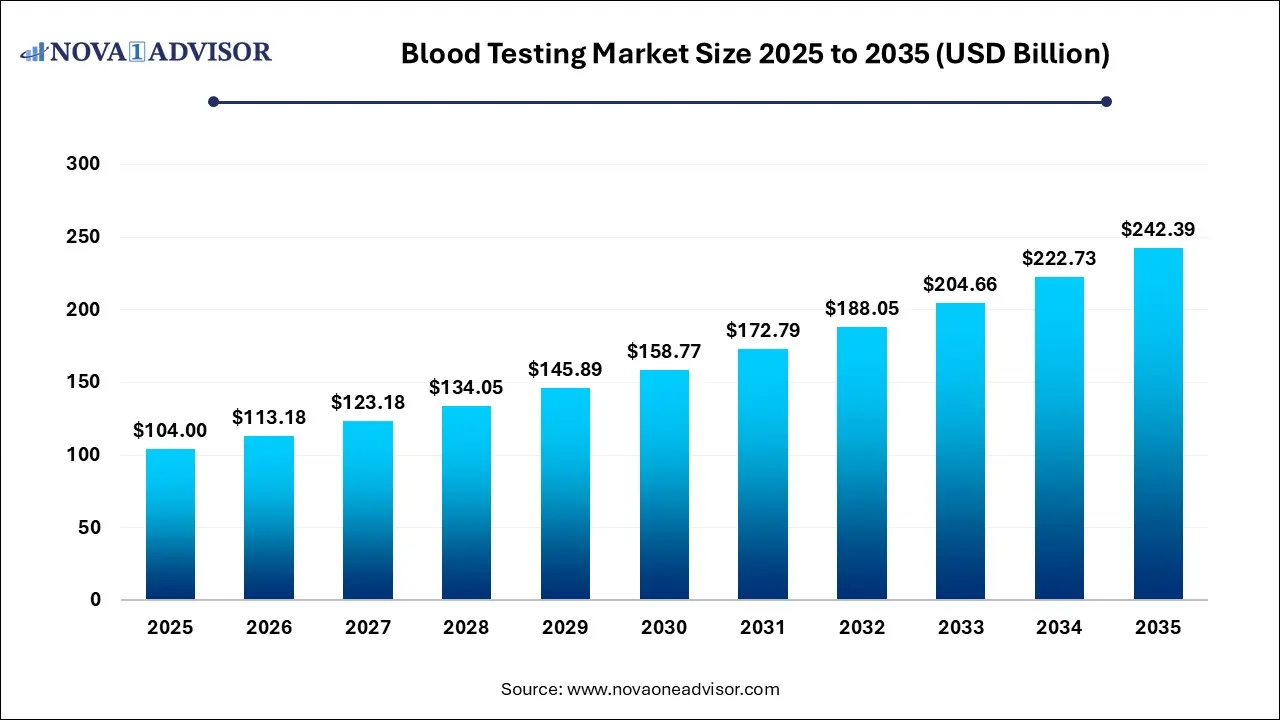
The global blood testing market size was estimated at USD 104.00 billion in 2025 and is projected to hit around USD 242.39 billion by 2035, growing at a CAGR of 8.83% during the forecast period from 2026 to 2035.
Key Takeaways
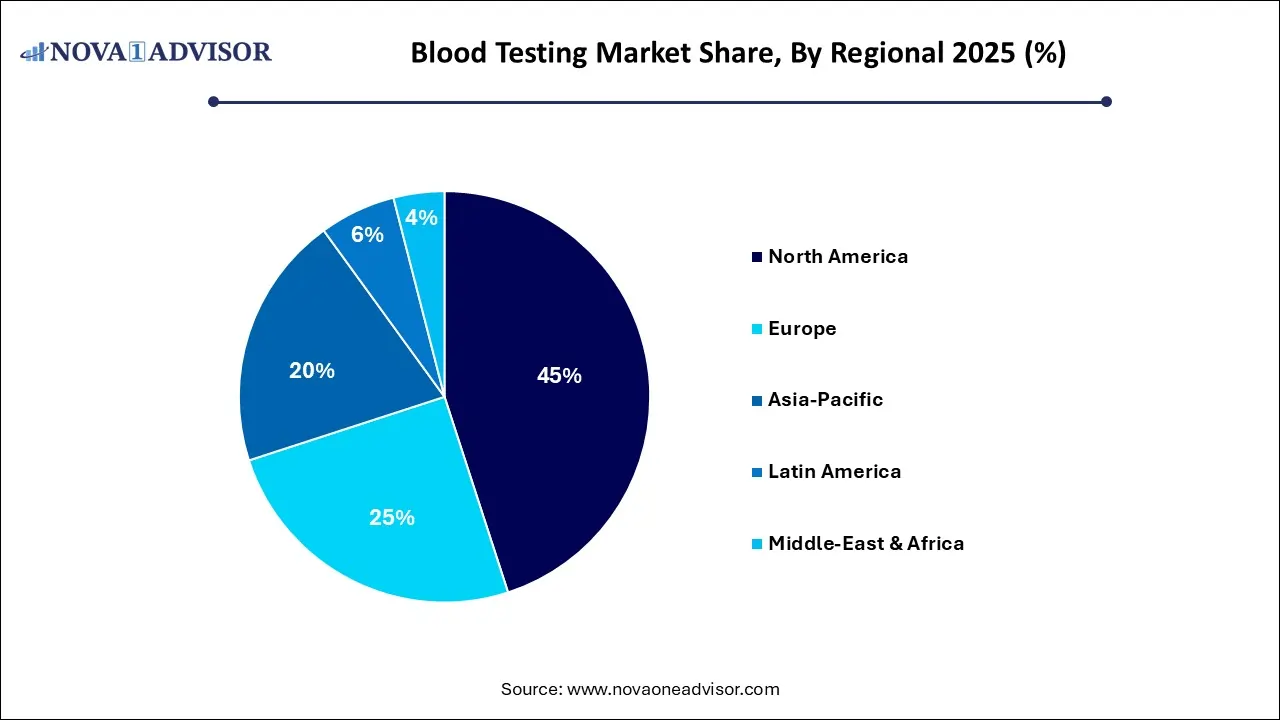
- North America blood testing market dominated the industry with the largest revenue share of 45.0% in 2025.
- The blood testing market in U.S. is expected to grow at the fastest CAGR over the forecast period
- Based on test type, the glucose testing segment led the market with the largest revenue share of 16.25% in 2025 and is anticipated to grow at the fastest CAGR over the forecast period.
Market Overview
The Blood Testing Market has witnessed significant growth over the last few decades, driven by the increasing prevalence of chronic diseases, rising awareness about early diagnosis, and advancements in diagnostic technology. Blood tests are among the most common and essential tools for medical practitioners to diagnose a variety of conditions, from diabetes to infections and cancer. In recent years, the market has expanded due to a rise in preventive health check-ups, technological innovations, and the increasing focus on personalized medicine. The market includes several test types, ranging from glucose testing and lipid panels to more specialized tests such as prostate-specific antigen (PSA) and COVID-19 testing. These tests are performed in laboratories, hospitals, diagnostic centers, and through at-home testing kits.
Market Outlook
- Market Growth Overview: The global blood testing market is expected to grow significantly between 2025 and 2035, driven by the rising prevalence of chronic and infectious diseases, increasing geriatric population, and innovation in technological advancements.
- Sustainability Trends: Sustainability trends involve decentralized and point-of-care testing, eco-friendly consumables and lab practice, and non-invasive testing technology.
- Major Investors: Major investors in the market include Abbott Laboratories, F. Hoffmann-La Roche Ltd., Danaher Corporation, Siemens Healthineers AG, and Thermo Fisher Scientific Inc.
How AI is Transforming the Blood Testing Market
Artificial intelligence (AI) has had a transformative effect on the blood testing market by improving the accuracy, speed, and efficiency of tests. AI algorithms are now being used to analyze test results more quickly and accurately than traditional methods, reducing human error. For example, AI-powered systems can detect patterns in blood samples that might be invisible to the naked eye, allowing for earlier detection of diseases such as cancer, diabetes, and heart disease. Furthermore, AI is helping to streamline the process of sample analysis, speeding up turnaround times, and providing more reliable diagnostic results. One of the most notable advancements in this area is the development of AI-assisted automated blood testing systems, which can rapidly process large volumes of samples and provide accurate results in real time, greatly benefiting both healthcare providers and patients.
Major Trends in the Market
- Shift Toward Home Testing Kits: With the rise in preventive healthcare, many consumers now prefer at-home blood tests. The market for home testing kits is growing rapidly, with innovations in self-testing devices that provide instant results for various tests like glucose, cholesterol, and Vitamin-D levels.
- Personalized Medicine: There is a growing trend toward personalized medicine, where blood tests help tailor treatments to individual patients based on their genetic makeup, lifestyle, and disease profile. This has led to the rise in demand for advanced diagnostic tests that provide more specific and detailed insights into a patient’s health.
- Technological Advancements: Advancements in diagnostic technologies, such as the use of liquid biopsy and microfluidics, have allowed for more accurate and non-invasive blood tests. These innovations are reshaping the market, making blood tests quicker, cheaper, and less intrusive for patients.
- Rise of Preventive Healthcare: With increasing awareness about the benefits of early detection, the demand for blood tests to monitor general health, especially among aging populations, is on the rise. As people focus more on maintaining their health rather than simply treating diseases, blood tests are being used more frequently as part of routine health check-ups.
- Integration of AI and Big Data: The integration of AI and big data analytics into blood testing is improving patient outcomes. AI helps analyze large data sets from blood tests, enabling healthcare providers to detect patterns and make more accurate predictions about a patient's health.
Blood Testing Market Report Scope
| Report Coverage | Details |
| Market Size in 2026 | USD 113.18 Billion |
| Market Size by 2035 | USD 242.39 Billion |
| Growth Rate From 2026 to 2035 | CAGR of 8.83% |
| Base Year | 2025 |
| Forecast Period | 2026 to 2035 |
| Segments Covered | Test Type, Region |
| Market Analysis (Terms Used) | Value (USD Million/Billion) or (Volume/Units) |
| Regional Scope | North America; Europe; Asia Pacific; Central and South America; the Middle East and Africa |
| Key Companies Profiled | Abbott; F. Hoffmann-La Roche Ltd; Bio-Rad Laboratories, Inc.; bioMerieux; Quest Diagnostics Incorporated; Biomerica; BD; Siemens Healthineers AG; Danaher Corporation; Trinity Biotech Plc |
Segmental Insights
By Test Type
How did the glucose testing segment dominate the Global Blood Testing market?
The glucose testing segment is driven by the affordability and convenience of SMBG devices. This growth is being accelerated by the rapid adoption of Continuous Glucose Monitoring (CGM) systems and AI-powered sensors that provide real-time, actionable health data. Strategic innovations and Bluetooth-enabled tools from industry leaders are further enhancing patient compliance and making routine monitoring more accessible than ever.
How did the A1C testing segment expect to hold the fastest-growing Global Blood Testing market in the coming years?
The A1C testing segment is driven by the global surge in diabetes prevalence, which is driving a critical transition toward rapid, high-precision diagnostic tools that facilitate immediate clinical decisions. This demand is being met by technological breakthroughs in microfluidics and ion-exchange HPLC, which provide laboratory-grade accuracy in both clinical and home settings. The expansion of point-of-care (POC) testing ensures that constant monitoring is both scalable and essential for long-term chronic disease management.
By Regional
How did the North America region account for the largest share in the Global Blood Testing market?
North America is driven by the high prevalence of chronic diseases, in North America creats a continuous, high-volume demand for regular blood screening and diagnostic monitoring. This is supported by an advanced infrastructure of sophisticated laboratories and plasma collection centres that allow for the rapid integration of automated molecular diagnostics. Strong government initiatives and the presence of global industry leaders further accelerate the adoption of these high-accuracy technologies.
U.S. Global Blood Testing Market Trends
The U.S.’s transition toward at-home and point-of-care diagnostics is revolutionising blood testing by providing instant, laboratory-grade results for critical conditions, such as Hepatitis C. This shift is further fueled by the rising burden of chronic diseases, necessitating the rapid adoption of AI-integrated tools and continuous glucose monitors for personalized management. The synergy between telemedicine and smart devices is establishing a decentralized healthcare model that prioritizes patient convenience and long-term preventative care.
How did the Asia Pacific region hold the fastest-growing Global Blood Testing Market in the forecast period?
Asia Pacific’s surge in chronic diseases is increasing a massive, sustained demand for routine blood monitoring and high-volume diagnostic testing. The rapid adoption of automated analyzers and advanced molecular technologies (NAT) has significantly enhanced testing speed and laboratory efficiency. The aggressive government infrastructure investment and the entry of multinational firms are transforming the Asia-Pacific region into a global engine for blood testing innovation.
China Global Blood Testing Market Trends
China’s convergence of a rapidly ageing population and a massive rise in diabetes cases is affecting the establishment of glucose testing as the primary revenue engine for the diagnostics market. The rapid expansion of private diagnostic labs and the adoption of advanced, high-accuracy technologies, such as next-generation sequencing (NGS) and automated blood culture techniques. The industry must navigate significant strategic gaps, including stringent regional regulations, high R&D expenditures, and lengthy approval processes for innovative diagnostic tools.
Key Players in the Global Blood Testing Market
- Abbott Laboratories Inc.
Abbott Laboratories contributes significantly to the global blood testing market through its advanced immunoassay platforms like ARCHITECT and Alinity, which provide high-throughput, accurate diagnostics for infectious diseases, cardiology, and oncology.
- Baxter International
Baxter International plays a vital role in blood management by offering specialized products that facilitate the safe handling, separation, and storage of blood components, such as their historical Plasma-Vac containers. Additionally, they support the wider blood testing sector through their expertise in critical care, renal therapies, and the provision of automated solutions for hospital pharmacies.
- Gen-Probe, Inc.
Gen-Probe, Inc. pioneered the development of rapid, accurate nucleic acid testing (NAT) technologies specifically designed to screen donated human blood for infectious diseases such as HIV and hepatitis.
Segments Covered in the Report
This report forecasts revenue growth at country levels and provides an analysis of the latest industry trends in each of the sub-segments from 2021 to 2035. For this study, Nova one advisor, Inc. has segmented the blood testing market.
By Test Type
- Glucose Testing
- A1C Testing
- Direct LDL Testing
- Lipid Panel Testing
- Prostate-specific Antigen Testing
- COVID-19 Testing
- BUN Testing
- Vitamin-D Testing
- Thyroid-stimulating Hormone (TSH)
- Serum Nicotine/Cotinine
- High sensitivity CRP Testing
- Testosterone Testing
- ALT Testing
- Cortisol Testing
- Creatinine Testing
- AST Testing
- Others Blood Tests
By Region
- North America
- Europe
- Asia Pacific
- Latin America
- Middle East and Africa (MEA)

Proceed to Buy
Instant PDF delivery on confirmation

 Request Customization
 Download Sample

Get a Sample of this Report
Blood Testing Market