

Body Temperature Monitoring Market Size, Share, Forecast Report, 2026 - 2035
 Status Published
 Category Healthcare


Content
Body Temperature Monitoring Market Size and Growth 2026 to 2035
The global body temperature monitoring market size was valued at USD 2.15 billion in 2025 and is projected to grow from USD 2.25 billion in 2026 to USD 3.42 billion by 2035, at a CAGR of 4.74% from 2026 to 2035.
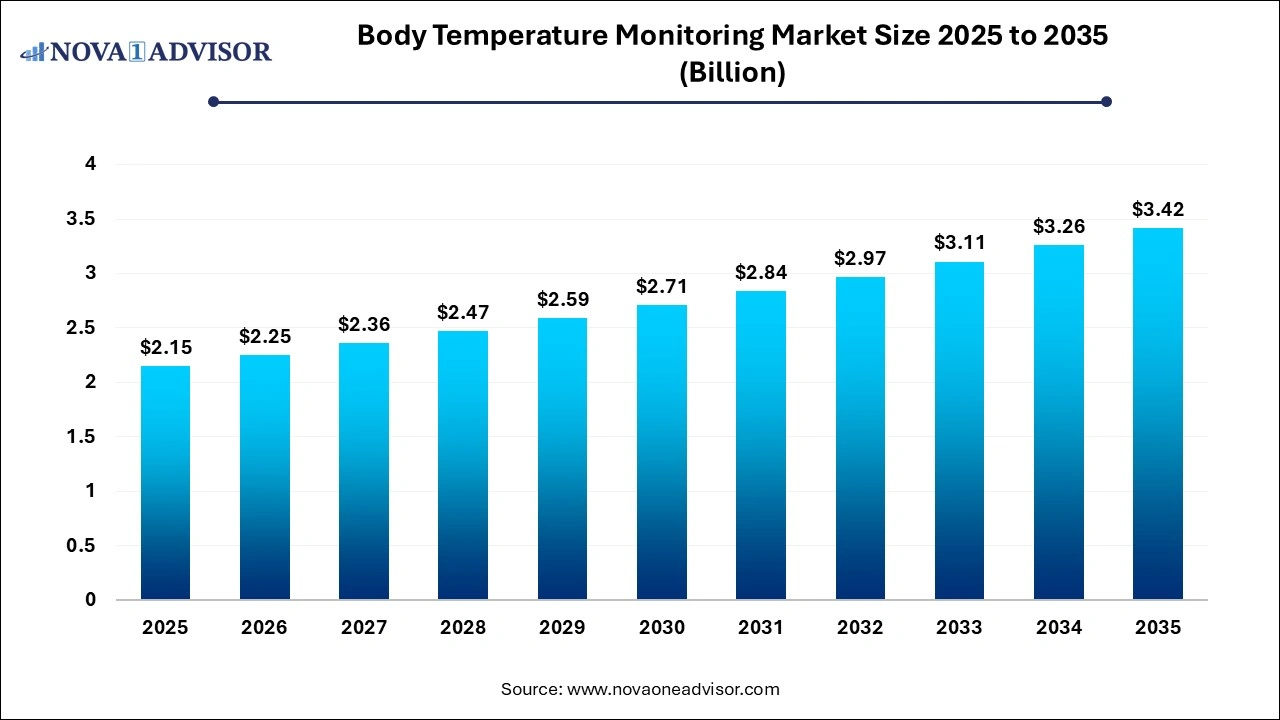
Key Takeaway
- By product type, the contact device segment dominated the market with the largest share in 2025.
- By product type, the non-contact IR systems segment is expected to grow at the fastest CAGR over the forecast period.
- By distribution channel, the offline segment dominated the market with the largest share in 2025.
- By end user, the hospitality segment dominated the market with the largest share in 2025.
Market Overview
The Body Temperature Monitoring Market covers devices used to measure, record, transmit, and continuously track human body temperature, including digital thermometers, infrared devices, thermal scanners, wearable sensors, monitoring patches, and connected platforms.
Temperature remains a fundamental vital sign across hospitals, clinics, emergency care, pediatrics, neonatal care, home healthcare, and clinical research. The market has evolved from conventional spot measurement toward faster, contactless, wearable, and connected monitoring technologies.
Infrared thermometers have improved measurement speed and reduced physical contact, while wearable sensors enable continuous or frequent temperature tracking. Integration with broader patient-monitoring platforms can combine temperature data with parameters such as heart rate, respiratory rate, oxygen saturation, and blood pressure, supporting more comprehensive patient assessment.
The market is increasingly shifting from simple temperature measurement to continuous monitoring and data-driven clinical insight. Growth opportunities are therefore emerging around connected devices, wearable sensors, remote patient monitoring, interoperability, and technologies capable of identifying meaningful temperature trends rather than isolated readings.
Market Outlook
- Market Growth Overview: The global body temperature monitoring market is expected to grow significantly between 2025 and 2035, driven by the growing elderly population across the globe.
- Sustainability Trends: Sustainability trends involve growing emphasis on reducing hazardous materials like mercury along with minimizing electronic waste.
- Major Investors: Major investors in the market include Koninklijke Philips N.V., Omron Corporation, Microlife Corporationand Becton, Dickinson and Company.
How is AI Impacting The Global Body Temperature Monitoring Market?
Artificial intelligence (AI) is reshaping the market by transitioning it from episodic and manual checks to automated, continuous, and predictive tracking. Furthermore, artificial intelligence algorithms instantly evaluate continuous streams of thermal and contact sensor data. This capability allows the real-time detection of acute fever elevations or hypothermia hazards independently of continuous human supervision.
Major Trends in the Market
- Shift from spot measurement to continuous monitoring: Wearable patches and connected sensors are enabling frequent or continuous temperature measurements.
- Rapid adoption of non-contact infrared technology: Touch-free measurement improves convenience and can support faster screening.
- Growth of wearable health monitoring: Smart patches, watches, and other wearables are incorporating temperature sensing into broader physiological-monitoring platforms.
- Integration with electronic health records: Connected devices increasingly transmit measurements directly into digital clinical workflows.
- AI-enabled fever and anomaly detection: Algorithms can analyze temperature trends and generate alerts when measurements deviate from expected patterns.
- Multimodal patient monitoring: Temperature is increasingly combined with heart rate, respiratory rate, oxygen saturation, and other vital signs.
Body Temperature Monitoring Market Report Scope
| Report Coverage | Details |
| Market Size in 2026 | USD 2.25 Billion |
| Market Size by 2035 | USD 3.42 Billion |
| Growth Rate From 2026 to 2035 | CAGR of 4.74% |
| Base Year | 2025 |
| Forecast Period | 2026 to 2035 |
| Segments Covered | By Product, By Distribution Channel, By End Use, By Region |
| Market Analysis (Terms Used) | Value (USD Million/Billion) or (Volume/Units) |
| Regional Scope | North America; Europe; Asia Pacific; Central and South America; the Middle East and Africa |
| Key Companies Profiled | Baxter International, Helen of Troy Limited, Koninklijke Philips N.V., Microlife Corporation, Omron Corporation |
Market Driver
Rising demand for early detection and continuous patient monitoring is driving the Body Temperature Monitoring Market. Temperature remains an important indicator of infection, inflammation, and physiological changes across hospitals, home healthcare, postoperative care, pediatrics, and chronic-care settings. Wearable and connected devices are expanding this demand by enabling frequent or continuous monitoring, supporting earlier intervention and remote patient management.
Market Restraint
Accuracy, environmental sensitivity, and clinical-validation requirements remain major challenges. Measurement results can vary based on sensor placement, measurement site, ambient conditions, movement, skin temperature, calibration, and user technique. Wearable and non-contact technologies therefore require strong validation to demonstrate that readings are sufficiently reliable for intended clinical applications. Regulatory requirements can also increase development costs and time.
Market Opportunity
Continuous wearable monitoring and connected home healthcare offer significant growth opportunities. Wearable temperature sensors can generate longitudinal data for remote monitoring, oncology, pediatrics, post-discharge care, chronic disease management, and clinical trials. Integration with connectivity platforms and AI-based analytics can enable automated alerts, personalized temperature baselines, and earlier identification of potentially significant physiological changes. Asia-Pacific also offers opportunities as healthcare infrastructure, smartphone adoption, and IoT-enabled medical technologies expand.
Segmental Insights
By Product
Why did the contact device segment dominate the global body temperature monitoring market?
The contact device segment dominated the market with the largest share in 2025. The dominance of the segment can be attributed to its high clinical trust, accuracy, and extensive use in routine inpatient and home care. In addition, contact thermometers deliver direct internal or surface core body measurements, including oral, axillary, and rectal sites, giving the high and repeatable precision required for clinical reliability.
How did the non-contact IR systems segment expected to hold the significantly growing global body temperature monitoring market in the coming years?
The non-contact IR systems segment is expected to grow at the fastest CAGR over the forecast period. The growth of the segment can be credited to the growing need for touch-free screening and hygiene. Also, as they provide instantaneous readouts, non-contact devices are ideally suited for high-traffic environments such as airports, educational institutions, corporate offices, and large-scale public events.
By Distribution Channel
Why did the offline segment dominate the global body temperature monitoring market?
The offline segment dominated the market with the largest share in 2025. The dominance of the segment can be linked to the rapid product availability and high institutional procurement. Additionally, enhancing retail pharmacy distribution networks and expanding foundational healthcare infrastructure across developing regional areas can fuel market growth soon.
How did the online segment expected to hold the significantly growing global body temperature monitoring market in the coming years?
The online segment is expected to grow at the fastest CAGR over the forecast period. The growth of the segment can be driven by growing adoption of e-commerce platforms and a surge in consumer preference for home-care medical devices. Digital marketplaces provide transparent pricing structures, verified customer feedback, and an expanded inventory of non-contact and digital thermometers.
- In May 2026, Chili Technology has officially announced the launch of the Chilipad 2.0, a re-engineered, performance-oriented cooling mattress topper designed to actively regulate bed temperature through water-based heating and cooling. Developed to streamline environmental control for sleep optimization.
By End-User
Why did the hospitality segment dominate the global body temperature monitoring market?
The hospitality segment dominated the market with the largest share in 2025. The dominance of the segment is owing to the integration of continuous digital monitoring and growing healthcare infrastructure investments across the globe. Furthermore, transitioning from manual, episodic monitoring to intelligent, wireless, and continuous digital sensing significantly enhances operational efficiency.
How did the home-care segment expected to hold the significantly growing global body temperature monitoring market in the coming years?
The home-care segment is expected to grow at the fastest CAGR over the forecast period. The growth of the segment is due to increasing consumer health awareness and an ongoing transition towards remote patient management. Moreover, the expansion of virtual medical consultations encourages patients to accurately measure and report their body temperatures from home, driving segment growth further.
By Region
Why did the North American region account for the largest share of the global body temperature monitoring market?
North America dominated the market with the largest share in 2025. The dominance of the region can be attributed to the growing incidence of infectious conditions and the presence of cutting-edge healthcare infrastructure in major countries. In addition, the development of wireless, Bluetooth-enabled, and artificial intelligence-assisted non-contact infrared instruments enhances measurement precision and expands remote patient monitoring capabilities.
U.S. Global Body Temperature Monitoring Market Trends
The growth of the market in the country can be driven by the growing need for remote patient monitoring tools and the growing incidence of chronic and infectious diseases. Also, comprehensive insurance frameworks, advanced patient health literacy, and market-leading medical device manufacturers are the primary drivers for sustained industry growth and market valuation.
Why did the Asia-Pacific region become the fastest-growing global body temperature monitoring market during the forecast period?
Asia Pacific is expected to grow at the fastest CAGR over the forecast period. The growth of the region can be credited to the growing healthcare spending in developing economies such as China and India and the transition towards digital thermometers. Furthermore, in technologically advanced countries such as Japan, continuous body temperature monitoring systems are being integrated into smart telehealth platforms to facilitate elderly care.
China Global Body Temperature Monitoring Market Trends
The market in the country is growing due to the robust government backing for healthcare infrastructure and rapid expansion in domestic technological advancements. Moreover, a rising elderly population, increasingly vulnerable to chronic and infectious diseases, needs frequent and precise clinical or home-based monitoring systems.
Key Players in the Global Body Temperature Monitoring Market
- Koninklijke Philips N.V.: Provides advanced clinical and patient-connected monitoring systems integrating core temperature tracking into critical care units.
- 3M Company: Focuses on patient warming and precise temperature management solutions utilized heavily in perioperative and surgical settings.
- Terumo Corporation: Manufactures precision clinical thermometers and medical devices widely adopted across Asian and global clinical networks.
Recent Developments
- In Februvary 2026, CHILTIER, a prominent developer of wearable climate technology, has officially announced the launch of its highly anticipated Hydro Vest, an advanced thermoelectric personal heating and cooling system. Engineered to ensure user comfort and safety amid extreme meteorological conditions, the product is currently available for early pre-order.
Segments Covered in the Report
This report forecasts revenue growth at country levels and provides an analysis of the latest industry trends in each of the sub-segments from 2021 to 2035. For this study, Nova one advisor, Inc. has body temperature monitoring market.
By Product
- Contact
- Digital Thermometers
- Infrared Ear Thermometers
- Other Contact Products
- Non-Contact
- Non-contact Infrared Thermometers
- Thermal Scanners
- Wearable & Continuous-Monitoring Devices
By Distribution Channel
- Offline
- Online
By End-User
- Hospitals
- Clinics
- Home-care Settings
- Other End-Users
By Region
- North America
- Europe
- Asia-Pacific
- Latin America
- Middle East & Africa (MEA)
FAQ's

Proceed to Buy
Instant PDF delivery on confirmation

Body Temperature Monitoring Market Size to Hit USD 3.42 Billion by 2035
 Request Customization
 Download Sample

Get a Sample of this Report
Body Temperature Monitoring Market