

Botulinum Toxin CDMO Market Size, Share, Growth, Report 2026 to 2035
 Status Published
 Category Healthcare


Content
Botulinum Toxin CDMO Market Size and Growth 2026 to 2035
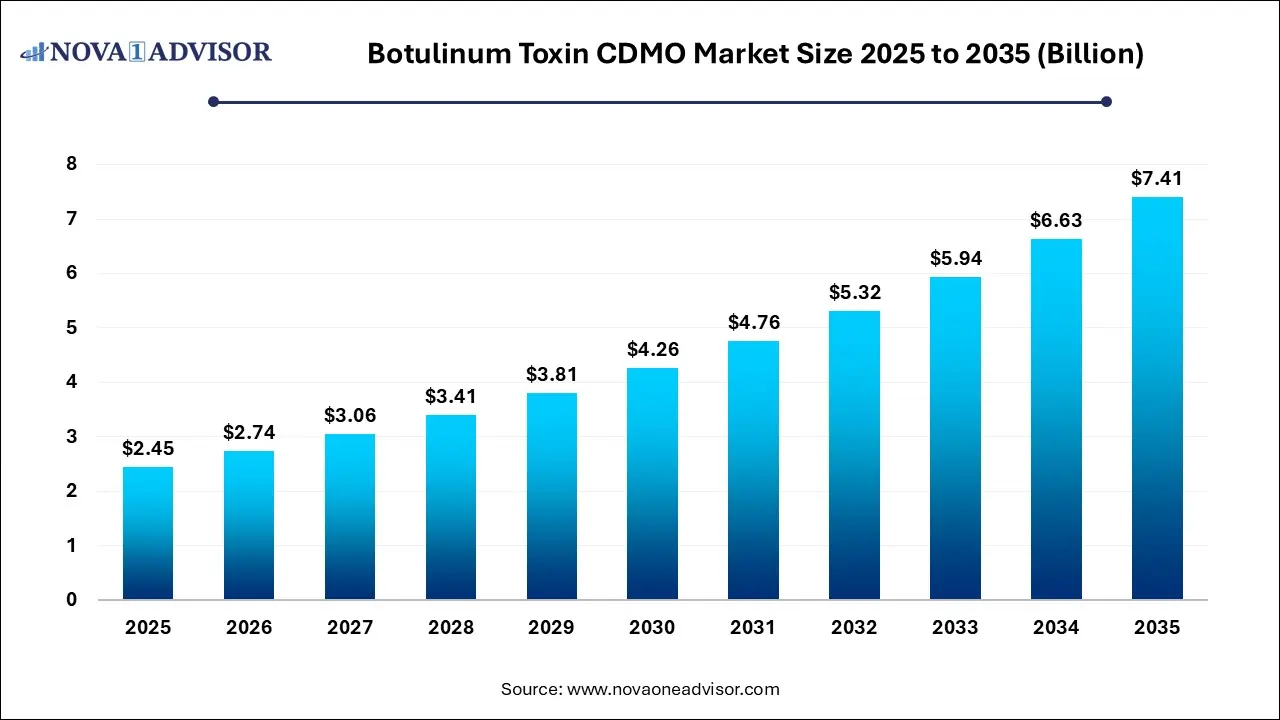
The global botulinum toxin CDMO market size was valued at USD 2.45 billion in 2025 and is projected to grow from USD 2.74 billion in 2026 to USD 7.41 billion by 2035, at a CAGR of 11.7% from 2026 to 2035. The North America region held a dominant position in the market with a share of 39% in 2025
Key Takeaways
- By product, the type A botulinum toxin segment held a dominant position in the market with a share of 82% in 2025.
- By product, the type B botulinum toxin segment is the fastest growing between 2026 and 2035.
- By service, the contract manufacturing segment held a dominant position in the market with a share of 37% in 2025.
- By service, the contract development segment is the fastest growing between 2026 and 2035.
- By application, the therapeutic segment held a dominant position in the market with a share of 58% in 2025.
- By application, the anesthetic segment is the fastest growing between 2026 and 2035.
- By end use, the pharmaceutical companies segment held a dominant position in the market with a share of 48% in 2025.
- By region, the North America region held a dominant position in the market with a share of 39% in 2025.
Innovation Driving Transformation in the Botulinum Toxin CDMO Market
Botulinum toxin CDMOs comprise the outsourcing of development and manufacturing services for neurotoxin-based drugs. The cost-efficient production, high-yield scalability, and adherence to strict sterility standards. These advantages support vital applications, such as treating chronic migraines, spasticity, and hyperhidrosis, as well as cosmetic wrinkles. The market growth is driven by the rising demand for minimally invasive cosmetic procedures and the rapid diversification of clinical, therapeutic indications.
Botulinum Toxin CDMO Market Trends
- Operational Optimization Through Advanced Manufacturing ; CDMOs are upgrading their facilities with automated fermentation, precision purification, and robotics for aseptic fill-finish. These advanced capabilities ensure high-purity yields, improve product shelf life, and guarantee safety while meeting stringent global regulatory requirements.
- Diversification into Therapeutic Indications: Beyond cosmetic applications, botulinum toxin is driving soaring demand for treating neurological and muscular disorders, such as chronic migraines, spasticity, and overactive bladders. CDMOs are adapting their facilities to produce clinical-grade neurotoxins in larger volumes tailored to these specific medical-grade approvals.
- Evolution of Strategic Pricing Models : To better accommodate varying biotech budgets, CDMOs are offering flexible commercial models ranging from free-for-service and full-time equivalent to cost-plus and fixed-price contracts. This trend lowers financial barriers for small-to-midsize biotech firms looking to outsource development.
Key AI Integration in the Botulinum Toxin CDMO Market
AI and ML are revolutionizing the botulinum toxin CDMO industry by optimizing complex fermentation and bioprocess operations. CDMOs utilize these technologies to predict formulation stability, minimize batch-to-batch variability, and streamline rigorous quality control processes. The machine learning models analyze large datasets to forecast demand fluctuations and optimize supply chains for these highly regulated, temperature-sensitive biologics.
Botulinum Toxin CDMO Market Report Scope
| Report Coverage | Details |
| Market Size in 2026 | USD 2.74 Billion |
| Market Size by 2035 | USD 7.41 Billion |
| Growth Rate From 2026 to 2035 | CAGR of 11.7% |
| Base Year | 2025 |
| Forecast Period | 2026 to 2035 |
| Segments Covered | Product, Service, Application, End use, Region |
| Market Analysis (Terms Used) | Value (USD Million/Billion) or (Volume/Units) |
| Regional Scope | North America; Europe; Asia Pacific; Central and South America; the Middle East and Africa |
| Key Companies Profiled | Lonza Group; Thermo Fisher Scientific (Patheon); Vetter Pharma-Fertigung GmbH & Co. KG; Recipharm AB; Cenexi Group; Grand River Aseptic Manufacturing; Pharmaron; WuXi Biologics; Samsung Biologics; Catalent, Inc.; Boehringer Ingelheim BioXcellence; Fujifilm Diosynth Biotechnologies; Cambrex Corporation; Apeloa Pharmaceutical Co., Ltd.; Hikal Ltd. |
Market Dynamics
Driver
Rising Aesthetic Demand
The continuous increasing procedures volumes for minimally invasive cosmetic treatments. To keep up with this consumer preference, emerging aesthetic brands increasingly rely on contract development and manufacturing organizations for flexible scale-up and specialized production. This growing reliance allows pharmaceutical companies to accelerate the launch of innovative neurotoxin formulations, such as longer-lasting or liquid products, without heavy capital investment in in-house infrastructure.
Restraint
High Production and Treatment Costs
The market growth is hindered by the heavy investment in containment facilities and regulatory compliance. These steep manufacturing expenditures directly inflate final retail and therapy costs for consumers. Because botulinum treatments require repeat sessions to maintain results, elevated cumulative costs often deter patients, restricting broader market penetration in price-sensitive regions.
Opportunity
Advanced Lyophilization (Freeze-Drying)
By significantly improving the stability, efficacy, and shelf-life of these highly sensitive neurotoxin proteins. By outsourcing specialized freeze-drying cycles to contract development and manufacturing organizations, pharmaceutical companies avoid massive capital investments in cryogenic equipment and achieve precise, scalable batch uniformity. This technological capability allows manufacturers to overcome the degradation challenges associated with diluting botulinum toxins, ensuring product integrity from production to patient administration.
Segment Insights
By Product Insights
Why Did the Type A Botulinum Toxin Segment Hold an 82% Share for the Botulinum Toxin CDMO Market?
The type A botulinum toxin segment held a dominant position in the market with a share of 82% in 2025. Owing to its extensive regulatory approvals, strong clinical efficacy, broad physician adoption, and dominant presence in both cosmetic and therapeutic procedures. The wider range of indications, ranging from aesthetic wrinkle reduction to therapeutic uses, such as chronic migraines, hyperhidrosis, and muscle spasticity.
The type B botulinum toxin segment held a 18% share of the market in 2025, with strategic outsourcing enabling drug developers to meet stringent regulatory standards while efficiently accelerating the commercialization of specialized therapeutic products. The contract manufacturers are scaling their operations to provide advanced bioprocessing, precision purification, and automated aseptic fill-finish lines.
By Service Insights
Why Did the Contract Manufacturing Segment Hold a 37% Share for the Botulinum Toxin CDMO Market?
The contract manufacturing segment held a dominant position in the market with a share of 37% in 2025. Owing to the specialized contract development and manufacturing organization, drug developers can avoid building and staffing massive in-house production sites. A rising shift toward minimally invasive procedures and expanding therapeutic uses requires companies to rapidly scale commercial production to capture market share.
The contract development segment held a 22% share of the market in 2025, with the retrofitting of specialized containment facilities for highly potent active pharmaceutical ingredients requiring major upfront capital investments that many developers choose to exclude. To mitigate these costs, biopharmaceutical companies outsource formulation, analytical testing, and process scale-up to leverage specialized CDMO technical expertise.
The packaging & labelling segment held a 12% share of the market in 2025, due to advanced packaging expertise required to handle complex cold-chain demands, including specialized labelling for cryogenic transport and controlled-temperature storage. To combat the rise of counterfeit products driven by the high commercial value of cosmetic toxins, CDMOs incorporate advanced serialization, holographic labeling, and robust track-and-trace features.
The regulatory affairs segment held an 8% share of the market in 2025, due to gaining regulatory clearances for both aesthetic and therapeutic uses involving vastly different and rigorous submission pathways. The chem, biologics, and neurotoxins are highly detailed. CDMOs manage these submissions to achieve first-time-right approvals, thus preventing expensive delays, requirements for biologics and manufacturing, and controls requirements for
The supply chain & logistics segment held a 14% share of the market in 2025, with the increasing globalization of biologics supply chains and rising demand for temperature-sensitive product logistics. It offers pre-established, scalable distribution networks, allowing drug manufacturers and medical aesthetic OEMs to quickly penetrate new markets without investing heavily in their own physical distribution infrastructure.
The others segment held a 7% share of the market in 2025, due to the standard use in the heavily consolidated market by industry giants, specialty regional contract manufacturers, and small-to-medium enterprises having captured significant footing, particularly in the Asia-Pacific region. These smaller players drive outsourced production volumes by manufacturing highly cost-effective alternatives and localized brands tailored to emerging market demands.
By Application Insights
Why Did the Therapeutic Segment Lead the Botulinum Toxin CDMO Market?
The therapeutic segment registered its dominance over the market with a share of 58% in 2025, owing to expanding clinical indications, strong reimbursement support, and increasing adoption in chronic neurological treatments. Increasing research and development to secure regulatory approvals for new medical treatments.
The anesthetic segment held a 42% share of the market in 2025, with the rising consumer awareness, preventive aesthetics trends, and growing demand for minimally invasive cosmetic procedures. The increasing offering of pre-formulated neurotoxin products mixed with anesthetics, ready-to-use formulation cuts preparation time and ensures consistent dosing.
By End Use Insights
Why Did the Pharmaceutical Companies Segment Lead the Botulinum Toxin CDMO Market?
The pharmaceutical companies segment registered its dominance over the market with a share of 48% in 2025, owing to strong commercial pipelines, high biologics outsourcing budgets, and increasing focus on operational efficiency through external manufacturing partnerships. The pharma companies rely on specialized CDMOs to navigate these stringent compliance requirements, and a surge in dual usage drives high-volume, continuous outsourcing needs.
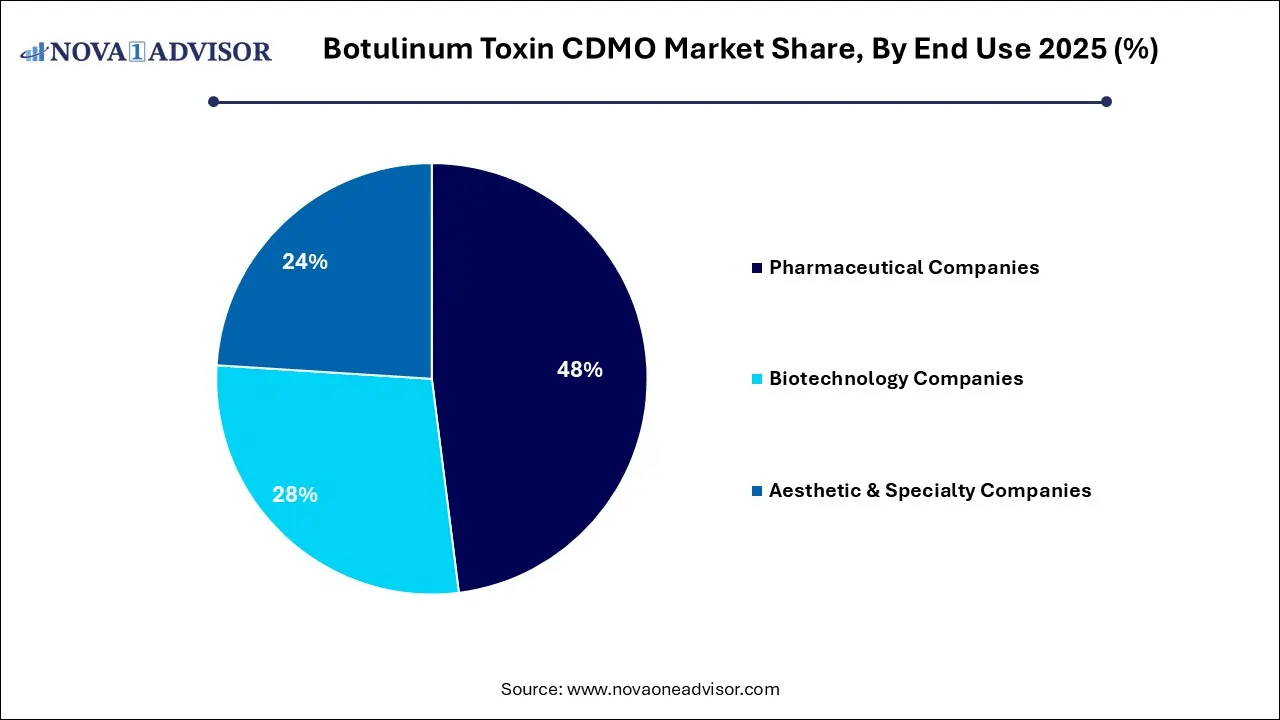
The biotechnology companies segment held the 28% share of the market in 2025, owing to gaining momentum as smaller biotech innovators increasingly rely on outsourced expertise to reduce infrastructure investment and accelerate product launches. Outsourcing process development and commercial manufacturing enables biotech companies to focus on their core competencies: drug discovery and clinical development.
The aesthetic & specialty companies segment held a 24% share of the market in 2025, due to the strong sustained demand for non-surgical aesthetic enhancement, such as wrinkle reduction, which forces cosmetic companies to outsource manufacturing to meet high-volume targets. Contract manufacturers specialize in meeting the stringent global regulatory and quality-control standards mandated for neurotoxins, significantly reducing compliance risks for their partners.
By Regional Insights
Why Did the North America Region Lead the Botulinum Toxin CDMO Market?
The North America region registered its dominance over the market with a share of 39% in 2025, owing to strong pharmaceutical outsourcing activity, advanced biologics manufacturing capabilities, and high demand for therapeutic and aesthetic botulinum toxin products. Surging clinical demand for indications, such as chronic migraines, muscle spasticity, and hyperhidrosis, which requires ongoing, specialized production.
U.S. Surgical Suture Market Trends
The U.S. is increasingly dominated by shifts in reimbursement policies; surgeons are increasingly adopting absorbable options to eliminate the need for costly suture-removal visits. This economic incentive positions absorbable sutures as the market share leader, with demand further amplified by antimicrobial coatings that lower surgical-site infection rates.
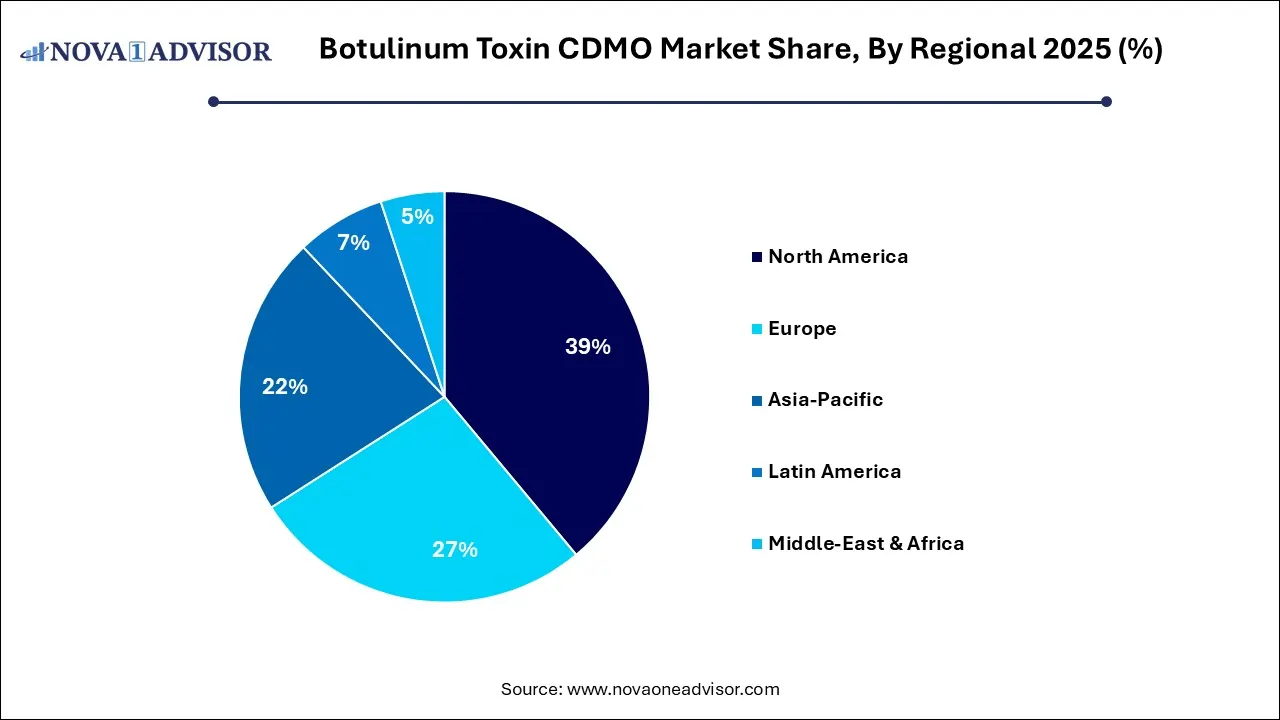
The Europe region held the 27% share of the market in 2025, due to the strong regulatory systems and biologics manufacturing expertise. The streamlined regulatory pathways managed by the European Medicines Agency encourage continuous product development and rapid commercial scaling across these advanced contract manufacturing facilities.
U.K. Surgical Suture Market Trends
The U. K’s growing popularity of laparoscopic and robotic-assisted procedures fuels a massive demand for specialized, high-precision closure materials. These innovations combine to shorten operating times, lower post-operative complication rates, and streamline clinical workflows across medical facilities.
The Asia Pacific segment held 22% share of the market in 2025, due to the lower manufacturing costs, expanding CDMO investments, and rising regional demand for aesthetic and therapeutic biologics. The widespread adoption of botulinum toxin for medical treatments, such as chronic migraines, muscle spasticity, cervical dystonia, and overactive bladders.
China Surgical Suture Market Trends
China’s accelerating clinical shift toward knotless, barbed sutures that reduce both operating room time and surgical-site infection rates in plastic and reconstructive surgeries. To ensure long-term safety, manufacturers are driving technological advancements in antibacterial-coated sutures and synthetic polymer structures that minimize tissue reactivity and align with government healthcare accessibility initiatives.
The Latin America region held a 7% share of the market in 2025, with the strong cultural emphasis on physical beauty and an expanding middle class adopting an emphasis on physical beauty and an expanding middle class adopting minimally invasive facial injectables. To satisfy this rising disposable income, there is a massive demand for price-disruptive biosimilars, prompting CDMOs to establish localized manufacturing and cost-effective supply chains.
The MEA region held a 5% share of the market in 2025, due to rising disposable incomes and a growing cultural acceptance of minimally invasive cosmetic enhancements, driving a massive surge in aesthetic demand across affluent Gulf nations. To bypass traditional import dependencies, major CDMOs are investing heavily in local manufacturing capacity, establishing dedicated production facilities directly within specialized hubs like Dubai Science Park.
Recent Developments
- In April 2026, Chongqing Claruvis Pharmaceutical has received NMPA approval in China for Retoxin® (recombinant botulinum toxin type A), the world's first approved recombinant botulinum toxin for treating moderate-to-severe glabellar lines. This milestone marks a shift from traditional extraction to a proprietary recombinant platform, providing a high-purity, 150kDa active protein that eliminates traditional biosafety risks associated with Clostridium botulinum.
- In July 2024, AEON Biopharma is pivoting to a 351(k) biosimilar pathway for its lead candidate, ABP-450, aiming to prove non-inferiority to BOTOX® in a single, 400-patient Phase 3 cervical dystonia study. This strategy leverages extensive analytical data to potentially secure U.S. approvals for up to eight therapeutic indications based on a direct comparison to the market leader.
Botulinum Toxin CDMO Market Companies
- Lonza Group
- Vetter Pharma-Fertigung GmbH & Co. KG
- Thermo Fisher Scientific (Patheon)
- Recipharm AB
- Grand River Aseptic Manufacturing
- Cenexi Group
- Pharmaron
- Samsung Biologics
- WuXi Biologics
- Catalent, Inc.
- Fujifilm Diosynth Biotechnologies
- Boehringer Ingelheim BioXcellence
- Cambrex Corporation
- Hikal Ltd
- Apeloa Pharmaceutical Co., Ltd.
Segments Covered in the Report
This report forecasts revenue growth at country levels and provides an analysis of the latest industry trends in each of the sub-segments from 2021 to 2035. For this study, Nova one advisor, Inc. has botulinum toxin CDMO market.
By Product
- Type A Botulinum Toxin
- Type B Botulinum Toxin
By Service
- Contract Development
-
- Formulation Development
- Process Development and Scale-Up
- Analytical and Testing Services
- Others
- Contract Manufacturing
-
- Clinical Manufacturing
- Commercial Manufacturing
- Packaging & Labelling
- Regulatory Affairs
- Supply Chain & Logistics
- Others
By Application
- Therapeutic
- Aesthetic
By End Use
- Pharmaceutical Companies
- Biotechnology Companies
- Aesthetic & Specialty Companies
By Region
- North America
- Europe
- Asia Pacific
- Latin America
- Middle East and Africa (MEA)
FAQ's

Proceed to Buy
Instant PDF delivery on confirmation

Botulinum Toxin CDMO Market Size to Hit USD 7.41 Billion by 2035
 Request Customization
 Download Sample

Get a Sample of this Report
Botulinum Toxin CDMO Market