

Cannabis Testing Market by Product (Instruments, Consumables, and Software), Test Type (Heavy Metal Testing, Microbial Analysis, Potency Testing, Residual Screening, and Others), and End User (Cannabis Cultivators/Growers, Cannabis Drug Manufacturers, and Others) - Global Industry Analysis, Share ,Growth ,Regional Outlook And Forecasts, 2026-2035
 Status Published
 Category Healthcare


Content
Cannabis Testing Market Summary
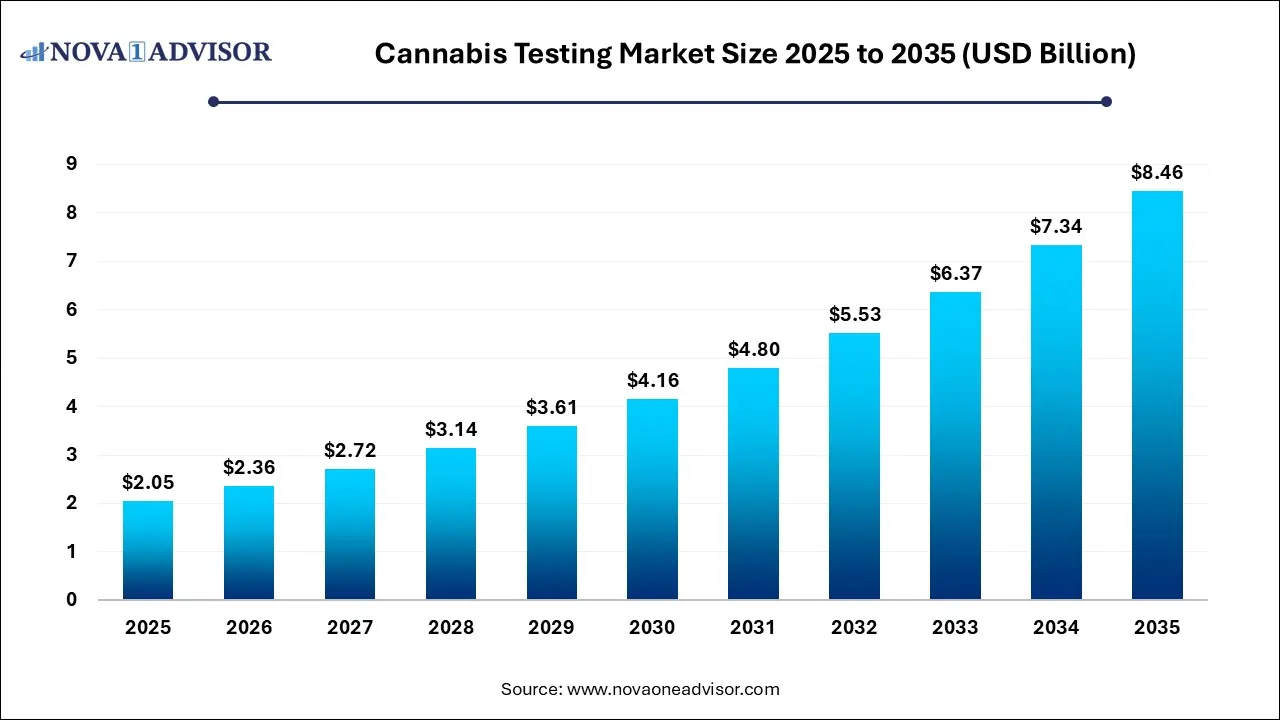
The global cannabis testing market size was estimated at USD 2.05 billion in 2025 and is projected to hit around USD 8.46 billion by 2035, growing at a CAGR of 15.23% during the forecast period from 2026 to 2035.
Market Overview
The Cannabis Testing Market is experiencing rapid growth due to the legalization of cannabis across multiple regions and the increasing demand for high-quality, safe, and standardized cannabis products. Cannabis testing is essential for ensuring product safety, verifying potency, and analyzing contaminants such as heavy metals and microbes. These tests provide assurance to both consumers and regulators, driving the need for advanced technologies. The market includes testing products and services that cater to the cannabis industry’s various needs, such as chromatography instruments, mass spectrometry instruments, and software tools for analyzing test results. Growing research, a demand for better regulatory compliance, and the increasing number of cannabis producers worldwide have contributed to the market's growth.
Market Outlook
- Market Growth Overview: The cannabis testing market is expected to grow significantly between 2025 and 2035, driven by the increasing legalization of cannabis, stringent regulatory standards and mandatory testing, and growing demand for safe, high-quality cannabis products.
- Sustainability Trends: Sustainability trends involve solvent reduction and recovery, green analytical techniques, and energy-efficient instrumentation.
- Major Investors: Major investors in the market include Tress Capital, Casa Verde Capital, Salveo Capital, and Ares Capital Corporation.
How AI is Transforming the Cannabis Testing Market:
Artificial Intelligence (AI) is transforming the cannabis testing market by improving the accuracy, speed, and efficiency of cannabis product analysis. AI-powered software can interpret test data faster than traditional methods, enabling labs to provide faster and more reliable results. Machine learning algorithms also help in predicting contamination risks, optimizing testing protocols, and automating the calibration of testing instruments. With AI, the market is seeing innovations like automated chromatography systems that offer precise chemical separation for cannabinoid profiles. AI integration also allows cannabis cultivators and producers to monitor product quality throughout the entire production process, ensuring consistent product standards and facilitating real-time decision-making.
Major Trends in the Market:
- Shift towards Standardization and Compliance: With increasing legalization, regulatory bodies are placing more emphasis on product quality, driving the demand for standardized testing methods.
- Integration of Advanced Technologies: AI, machine learning, and automation are playing an increasingly significant role in speeding up testing and ensuring consistent product quality.
- Expanding Market for Hemp Testing: With the growing interest in hemp-based products, the testing of hemp for CBD and other cannabinoids is becoming more important.
- Demand for Full Spectrum Testing: Cannabis producers and consumers alike are demanding a broader range of tests to assess cannabinoid content, terpenes, contaminants, and microbial quality.
- Growing Cannabis Cultivation and Production: As cannabis cultivation expands globally, more growers are seeking compliance with regulations, creating a demand for comprehensive testing solutions.
Cannabis Testing Market Report Scope
| Report Coverage | Details |
| Market Size in 2026 | USD 2.36 Billion |
| Market Size by 2035 | USD 8.46 Billion |
| Growth Rate From 2026 to 2035 | CAGR of 15.23% |
| Base Year | 2025 |
| Forecast Period | 2026 to 2035 |
| Segments Covered | Product, Test Type, region |
| Market Analysis (Terms Used) | Value (USD Million/Billion) or (Volume/Units) |
| Regional Scope | North America; Europe; Asia Pacific; Central and South America; the Middle East and Africa |
| Key Companies Profiled | Agilent Technologies Inc., Danaher Corporation, Merck KGAA, PerkinElmer, Restek Corporation, SC Laboratories, Shimadzu Corporation, Steep Hill, Thermo Fisher Scientific, and Waters Corporation. |
Segmental Insights
By Product
How did the consumables segment dominate the Cannabis Testing market?
The consumables segment is driven by the high volume of analytical testing for potency and safety, which directly scales the demand for sample preparation tools, reagents, and reference materials. The global expansion of licensed laboratories necessitates a constant supply of specialized vials and filters to manage complex cannabis matrices. The high intensity of sample preparation makes consumables the backbone of the cannabis testing industry’s financial growth.
How did the software segment expect to hold the fastest-growing Cannabis Testing market in the coming years?
The software segment is driven by automation of complex data management and ensuring rigorous ISO 17025 compliance. By incorporating blockchain for speed-to-sale traceability and supporting portable testing tools, software solutions are drastically enhancing eliminate THC inflation through automated, tamper-proof reporting that restores market credibility. The shift toward a software-centric laboratory model is the primary catalyst for operational efficiency and consumer trust in a rapidly maturing industry.
By Test Type
How did the potency testing segment account for the largest share in the Cannabis Testing market?
The potency testing segment is driven by the critical need for precise dosing in medical-grade products and rising consumer demand for transparency, further solidifying its dominance across all testing portfolios. High-performance analytical tools like HPLC and GC enable labs to deliver these results with the speed and reliability necessary for commercial scale. The foundational role of potency testing in building market trust makes it the primary revenue driver for modern analytical laboratories.
The microbial analysis and residual screening segment accounts for the largest share in the Cannabis Testing market.
The microbial analysis and residual screening segment is driven by the universal legal mandates for THC and CBD qualification. While pesticide screening is rapidly expanding to meet heightened safety standards, extract and concentrate validation. The diversified testing landscape ensures that labs can capture multiple revenue streams from a single production sample.
By End User
How did the cannabis drug manufacturing segment account for the largest share in the Cannabis Testing market?
The cannabis drug manufacturing segment is driven by the expansion of pharmaceutical R&D and clinical trials, which further drives the requirement for advanced analytical methods to guarantee consistent dosing. In highly regulated regions like North America and Europe, these stringent mandates transform testing from a simple check into a critical quality assurance pillar. This segment's commitment to medical-grade accuracy ensures it remains the most stable and dominant revenue source for the testing industry.
How did the cannabis cultivators/growers segment expect to hold the fastest-growing Cannabis Testing market in the coming years?
The cannabis cultivators/growers segment is driven by the global expansion of licensed facilities, which is significantly increasing the volume of routine checks, while the adoption of in-house HPLC analyzers allows for real-time batch monitoring. Strategic partnerships with accredited labs further ensure that raw materials consistently meet legal THC thresholds and quality standards before reaching the market. These factors position cannabis cultivators as a primary engine for high-frequency, comprehensive testing demand.
By Regional
U.S. Cannabis Testing Market Trends
The U.S. state-level mandates that make potency and contaminant testing indispensable for legal compliance and consumer safety. Advanced analytical tools, such as HPLC and GC-MS, alongside AI-integrated LIMS, are streamlining high-volume workflows while ensuring audit-proof data integrity. A surge in demand for terpene profiling and microbial analysis reflects a maturing consumer base focused on therapeutic precision and product purity.
How did the European region hold the fastest-growing Cannabis Testing Market in the forecast period?
Europe’s expansion of medical programs in the market for contaminant screening. Strategic investments in specialized laboratory networks and advanced LC-MS/MS technology are rapidly enhancing the region's technical infrastructure. The shifts are positioning Europe as a high-standard global leader, where precise, pharmaceutical-grade testing is the non-negotiable gateway to market entry.
Germany Cannabis Testing Market Trends
Germany’s integration of AI-enabled analytics and automated reporting is further optimizing the speed of product release for both third-party labs and in-house facilities. These stringent quality requirements are transforming the German market into a pharmaceutical-grade model for the rest of Europe. The enactment of the Cannabis Act (CanG) and the expansion of medical use have catalyzed a surge in demand for safety and potency validation in Germany.
Key Players in the Cannabis Testing Market
- Agilent Technologies Inc.
Agilent provides a comprehensive suite of analytical instruments, including HPLC, GC/MS, and ICP-MS systems, to test cannabis for potency, pesticides, residual solvents, and heavy metals.
- Danaher Corporation
Through its subsidiaries like SCIEX and Cytiva, Danaher contributes high-resolution mass spectrometry and advanced analytical tools designed to ensure the safety and quality of cannabis-derived products. Their technologies enable precise profiling and contaminant detection, supporting research and commercial testing in the growing cannabis market.
- Merck KGaA
Merck offers a comprehensive portfolio of analytical chemistry tools, including specialized chromatography columns like Ascentis® Express, for high-throughput cannabis separation and analysis.
Recent Developments:
- March 2026: PerkinElmer, Inc. launched a new line of mass spectrometry instruments designed for cannabis testing. These instruments aim to improve testing accuracy and speed for regulatory compliance and consumer safety.
- January 2026: Thermo Fisher Scientific announced a partnership with a leading cannabis cultivator to provide them with advanced chromatography solutions for potency testing, supporting the ongoing need for cannabis testing innovations.
Segments Covered in the Report
This report forecasts revenue growth at country levels and provides an analysis of the latest industry trends in each of the sub-segments from 2021 to 2035. For this study, Nova one advisor, Inc. has segmented the cannabis testing market.
By Product
- Instruments
-
- Chromatography instruments
-
-
- Liquid chromatography
- Gas chromatography
-
-
- Spectroscopy instruments
-
-
- Mass spectrometry instruments
- Atomic spectroscopy instruments
-
- Consumables
- Software
By Test Type
- Heavy metal testing
- Microbial analysis
- Potency testing
- Residual screening
- Others
By End User
- Cannabis cultivators/growers
- Cannabis drug manufacturers
- Others
By Geography
North America
- U.S.
- Canada
Europe
- Germany
- France
- United Kingdom
- Rest of Europe
Asia Pacific
- China
- Japan
- India
- Southeast Asia
- Rest of Asia Pacific
Latin America
- Brazil
- Rest of Latin America
Middle East & Africa (MEA)
- GCC
- North Africa
- South Africa
- Rest of Middle East & Africa

Proceed to Buy
Instant PDF delivery on confirmation

 Request Customization
 Download Sample

Get a Sample of this Report
Cannabis Testing Market