

Catheters Market Size, Share, Forecast Report, 2026-2035
 Status Published
 Category Healthcare


Content
Catheters Market Size, Growth and Trends 2026 to 2035
The global catheters market size was valued at USD 24.20 billion in 2025 and is expected to hit around USD 56.77 billion by 2035 with a CAGR of 8.9% from 2026 to 2035.
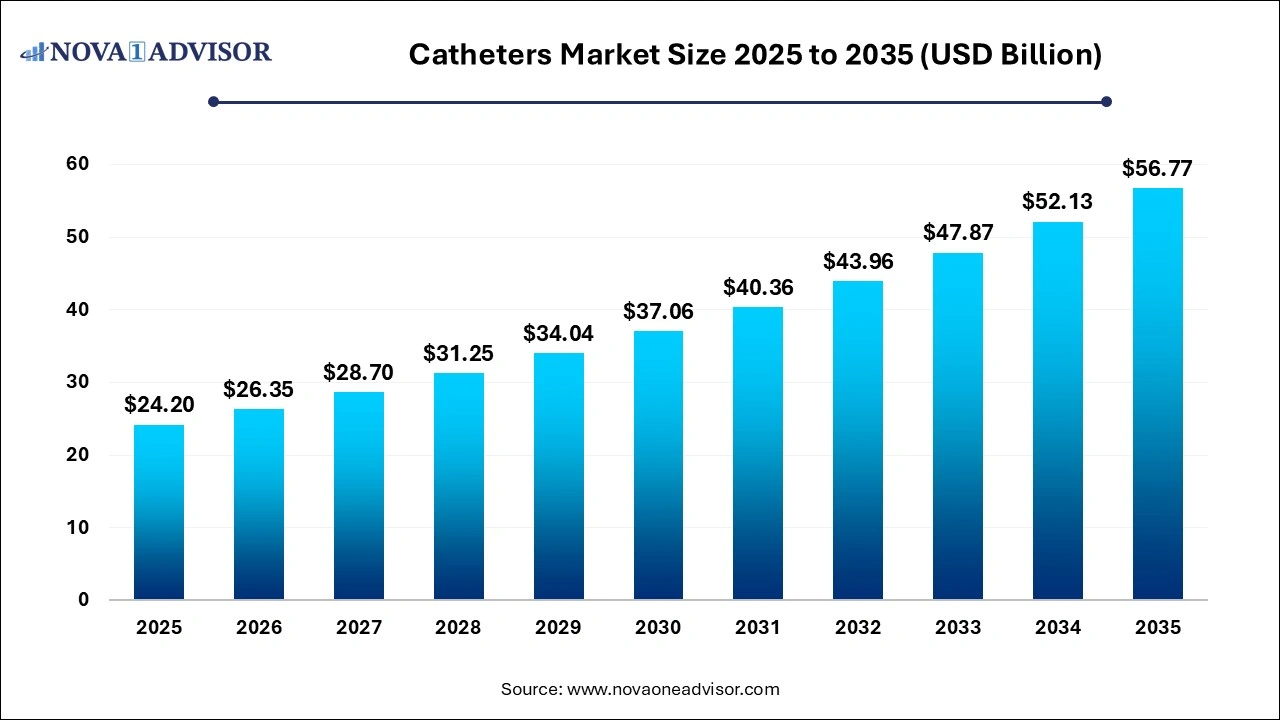
Catheters Market Outlook
- Market Growth Overview: The catheter market is expected to grow significantly between 2026 and 2035, driven by the rise in minimally invasive surgeries, the growing geriatric population and chronic illnesses, and the rising demand in healthcare infrastructure.
- Sustainability Trends: Sustainability trends involve material and waste reduction, design for sustainability, and a shift in usage models.
- Major Investors: Major investors in the market include Becton, Dickinson, and Company (BD), Medtronic, Teleflex Incorporated, and Boston Scientific Corporation.
Report Scope of Catheters Market
| Report Coverage | Details |
| Market Size in 2026 | USD 26.35 Billion |
| Market Size by 2035 | USD 56.77 Billion |
| Growth Rate From 2026 to 2035 | CAGR of 8.9% |
| Base Year | 2025 |
| Forecast Period | 2026 to 2035 |
| Segments Covered | By Type, By End User |
| Market Analysis (Terms Used) | Value (USD Million/Billion) or (Volume/Units) |
| Regional Covered | North America; Europe; Asia Pacific; Latin America; MEA |
| Key Companies Profiled | Medtronic, Teleflex Incorporated, Abbott, B. Braun Melsungen AG, Edwards Lifesciences Corporation |
Catheters Market Segment Insights
By Type Insights
How did the Cardiovascular Catheters Segment Dominate the Catheters Market?
The cardiovascular catheters, in which sub foley catheters segment is driven by the high-volume demand for Foley catheters, which remain an essential utility for post-operative care and long-term drainage in aging populations. Strategic shifts toward biocompatible materials, such as silicon-based polymers, are further enhancing patient outcomes by reducing infection rates and recovery times. These technological advancements are driving a global migration from traditional surgery to precision catheter-based therapies, optimizing both clinical efficiency and hospital resource allocation.
How did the Neurovascular Catheters Segment Expect to Hold the Fastest-Growing Catheter Market in the Coming Years?
The neurovascular catheters segment is driven by a clear market preference for minimally invasive procedures that offer superior clinical outcomes, reduced recovery times, and lower procedural trauma compared to traditional surgery. Technological breakthroughs in biocompatible coatings and AI-integrated imaging are further enhancing the safety and efficacy of these devices, establishing thrombectomy as a global standard of care. The shift towards high-precision neurovascular interventions.
By End User Insights
How did the Hospitals Segment Account for the Largest Share in the Catheter Market?
The adult hospitals segment is driven by the sophisticated cath-lab infrastructure and specialized medical staff, which provide the necessary environment for deploying high-precision, next-generation technologies like TJ1600-D3 interconnected diagnostics. The rising burden of chronic disease management ensures a consistent inpatient flow, reinforcing the hospital's role as the primary driver of medical devices ROI. The centralized reimbursement frameworks and large-scale procurement policies consolidate the hospital’s position as the critical anchor for global catheter market stability.
How did the Diagnostic Imaging Centres Segment Expect to Hold the Fastest-Growing Catheter Market in the Coming Years?
The diagnostic imaging centres segment is driven by the rising global burden of cardiovascular and peripheral artery diseases, which is transforming diagnostic centres into a high-growth nexus for recurring, technology-intensive medical interventions. The superior cost-utility ratio compared to traditional hospital settings is driven by a growing patient preference for minimally invasive procedures with reduced recovery times. The integration of miniaturized, high-flexibility catheters specifically designed for ambulatory use ensures that diagnostic accuracy is maintained without the overhead of inpatient infrastructure.
Key Players in the Catheters Market
- Medtronic: Medtronic is a leading player offering a broad portfolio of catheters, including advanced coronary, peripheral vascular, and guiding catheters.
- Teleflex Incorporated: Teleflex is a dominant force in the vascular access catheter market, offering products such as peripherally inserted central catheters (PICCs), central venous catheters (CVCs), and antimicrobial catheters under the Arrow brand.
- Abbott: Abbott contributes significantly through its specialized interventional cardiology portfolio, including superior coronary balloon catheters and steerable electrophysiology mapping catheters.
- B. Braun Melsungen AG: B. Braun is a key manufacturer of peripheral intravenous catheters and urology catheters, focusing on safety and infection control. Their contribution includes a wide range of disposables for infusion therapy, vascular access, and anesthesia.
- Edwards Lifesciences Corporation: Edwards Lifesciences specializes in hemodynamic monitoring and structural heart catheters, particularly through their advanced Swan-Ganz pulmonary artery catheters.
Catheters Market, by Type
- Cardiovascular Catheters
- Angiography catheters
- IVUS/OCT catheters
- Guiding catheters
- Electrophysiology catheters
- Balloon catheters
- Urological Catheters
- Urinary Catheters
- Indwelling/Foley Catheters
- Intermittent Catheters
- External Catheters
- Dialysis Catheters
- Hemodialysis catheters
- Peritoneal dialysis catheters;
- Intravenous Catheters
- Peripheral Catheters
- Midline Peripheral Catheters
- Central Venous Catheters
- Peripherally inserted central catheters
- Non-tunneled central catheters
- Skin-tunneled central catheters
- Implantable ports
- Neurovascular Catheters
- Specialty Catheters
- Pressure and Hemodynamic Monitoring Catheters
- Temperature Monitoring Catheters
- Intrauterine Insemination Catheters
- Other Catheters
Catheters Market, by End User
- Hospitals
- Long-term Care Facilities
- Diagnostic Imaging Centers
- Other End Users
Catheters Market, by Region
- North America
- US
- Canada
- Europe
- Germany
- France
- UK
- Italy
- Spain
- RoE
- Asia Pacific
- Japan
- China
- India
- Rest of Asia Pacific
- Rest of the World

Proceed to Buy
Instant PDF delivery on confirmation

 Request Customization
 Download Sample

Get a Sample of this Report
Catheters Market