

Cell Dissociation Market by Product (Enzymatic (Trypsin), Non-enzymatic, Instruments & Accessories), Type (Tissue Dissociation, Cell Detachment), Tissue (Connective, Epithelial), End User (Pharma and Biotech, Research institutes)- Global Industry Analysis, Share ,Growth ,Regional Outlook And Forecasts, 2026-2035
 Status Published
 Category Healthcare


Content
Cell Dissociation Market Size and Growth 2026 to 2035
The global Cell Dissociation market gathered revenue around USD 457.50 million in 2025 and market is set to grow USD 1,633.14 million by the end of 2035 and is estimated to expand at a modest CAGR of 13.57% during the prediction period 2026 to 2035.
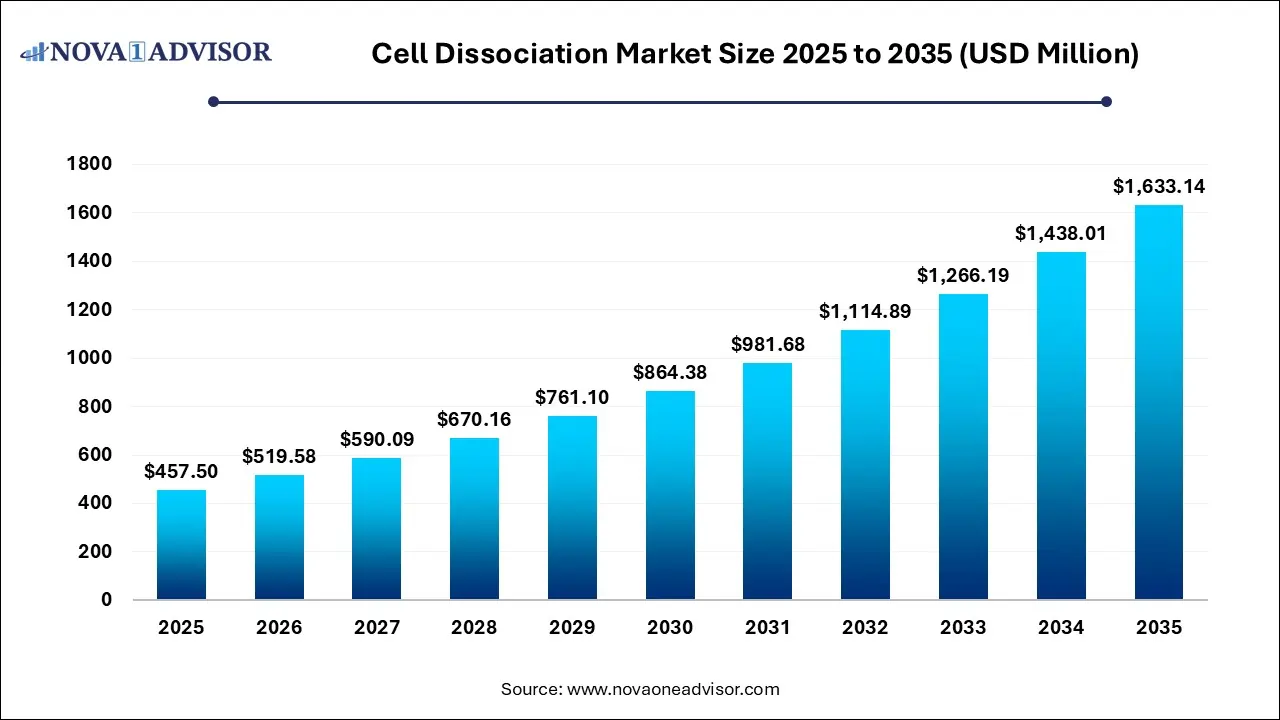
Market Key Takeaways
- The cell dissociation market is experiencing strong growth driven by increasing demand for cell-based research, regenerative medicine, and biopharmaceutical production.
- Enzymatic dissociation products dominate due to their efficiency in isolating viable cells for downstream applications.
- Tissue dissociation remains the leading type segment, supported by expanding applications in oncology, stem cell research, and immunology.
- Pharmaceutical and biotechnology companies represent the largest end-user segment due to rising biologics and cell therapy pipelines.
- Asia Pacific is the fastest-growing regional market owing to expanding biotech infrastructure and research funding.
- AI integration is improving cell isolation precision, reducing variability, and enhancing reproducibility in laboratory workflows.
Market Overview
The global cell dissociation market has emerged as a critical component within life sciences research, playing a foundational role in cell-based experiments, diagnostics, and therapeutic development. Cell dissociation refers to the process of separating cells from tissues or cell aggregates into individual viable cells, which is essential for applications such as flow cytometry, single-cell sequencing, cell culture, and regenerative medicine.
The market is being propelled by rapid advancements in biotechnology, particularly in areas such as stem cell therapy, cancer research, and immunotherapy. As precision medicine gains traction, the need for high-quality single-cell suspensions has become increasingly important. For instance, in CAR-T cell therapy development, efficient dissociation of tumor tissues is essential to analyze tumor-infiltrating lymphocytes and understand immune responses.
The increasing prevalence of chronic diseases such as cancer and autoimmune disorders has also accelerated research activities globally. This has directly translated into higher demand for reliable dissociation tools and reagents. Additionally, the expansion of biopharmaceutical manufacturing, particularly monoclonal antibodies and cell-based vaccines, further supports market growth.
Technological innovations have significantly improved the efficiency and viability of dissociated cells. Automated dissociation systems and optimized enzyme formulations now enable standardized workflows, reducing human error and improving reproducibility.
Moreover, academic institutions and research organizations are investing heavily in single-cell analysis technologies. For example, single-cell RNA sequencing requires high-quality dissociated cells, making cell dissociation a critical preparatory step.
Despite strong growth, challenges such as variability in dissociation efficiency and potential cell damage remain. However, ongoing research and development efforts are addressing these limitations through the introduction of gentler and more specific dissociation methods.
Market Outlook
- Market Growth Overview: The cell dissociation market is expected to grow significantly between 2025 and 2034, driven by the expansion of cell therapy and regenerative medicine, rising in stem cell research and drug discovery, and increased research and developments in pharmaceutical and biotechnology.
- Sustainability Trends: Sustainability trends involve green chemistry in reagent development, improved efficiency and lower resource consumption, and biodegradable and eco-friendly materials.
- Major Investors: Major investors in the market include Thermo Fisher Scientific, Merck KGaA, Danaher Corporation, BD (Becton, Dickinson and Company), and STEMCELL Technologies
How is AI Transforming the Cell Dissociation Market?
Artificial Intelligence (AI) is playing a transformative role in the cell dissociation market by enhancing process efficiency, consistency, and data-driven decision-making. Traditionally, cell dissociation has been a labor-intensive process with variability depending on operator skill, tissue type, and reagent selection. AI is helping overcome these challenges.
AI-powered systems are being integrated into automated dissociation instruments to optimize parameters such as enzyme concentration, incubation time, and mechanical force. These systems analyze real-time data to adjust protocols dynamically, ensuring optimal cell yield and viability. For instance, AI algorithms can identify subtle differences in tissue composition and recommend tailored dissociation strategies.
Machine learning models are also being used to predict cell viability outcomes based on experimental conditions. This reduces trial-and-error approaches and accelerates research timelines. In high-throughput laboratories, AI-enabled robotic systems can process multiple samples simultaneously with minimal human intervention.
Another significant application is in image analysis. AI-driven imaging tools can assess the quality of dissociated cells by analyzing morphology and detecting cell damage or clumping. This ensures higher accuracy in downstream applications such as cell sorting and sequencing.
AI is also facilitating integration with omics technologies. By linking dissociation data with genomic and proteomic outputs, researchers can better understand how dissociation methods impact cellular characteristics.
Overall, AI is transforming cell dissociation from a manual, variable process into a standardized, intelligent workflow, significantly improving research efficiency and reliability.
Cell Dissociation Market Report Scope
| Report Coverage | Details |
| Market Size in 2026 | USD 519.58 Million |
| Market Size by 2035 | USD 1,633.14 Million |
| Growth Rate From 2026 to 2035 | CAGR of 13.57% |
| Base Year | 2025 |
| Forecast Period | 2026 to 2035 |
| Segments Covered | By Product, By Tissue, By Type, By End User, Region |
| Market Analysis (Terms Used) | Value (USD Million/Billion) or (Volume/Units) |
| Regional Scope | North America; Europe; Asia Pacific; Central and South America; the Middle East and Africa |
| Key Companies Profiled | Thermo Fisher Scientific (US), Becton, Dickinson and Company (US), Roche Diagnostics (Switzerland), Cytiva (a part of Danaher Corporation) (US), STEMCELL Technologies (Canada), Miltenyi Biotec (Germany), PromoCell GmbH (Germany), AcceGen(US), VitaCyte (US), Alstem (US), Biological Industries (Israel), Gemini Bio (US), Innovative Cell Technologies (US), Central Drug House (India), Worthington Biochemical Corporation (US), Capricorn Scientific (Germany), Abeomics (US), Genlantis (US), and Neuromics (US) |
Segmental Insights
By Product
How did the enzymatic dissociation products segment dominate the Cell Dissociation market?
The enzymatic dissociation products segment is driven by providing the high efficiency and reliability needed to break down complex tissue matrices while maintaining cell viability. As the indispensable standards for drug discovery and flow cytometry, these reagents offer tailored solution, such as specialized collagenases for diverse biological applications. The rising research and developments investments in regenerative medicine, ensuring a steady, high-volume demand for these essential laboratory tools.
How did the non-enzymatic dissociation products segment expect to hold the fastest-growing Cell Dissociation market in the coming years?
The non-enzymatic dissociation products segment is driven by the preservation of cell surface proteins and functionality, which is critical for high-stakes stem cell research and flow cytometry. By offering gentier, low cytotoxicity alternatives to traditional enzymes, these methods significantly increase cell viability during delicate detachment processes. The rise of acoustic-based dissociation and non-invasive technologies is providing the precision required to meet the accelerating demand of the regenerative medicine market.
By Tissue
How did the connective tissues segment account for the largest share in the Cell Dissociation market?
The connective tissues segment is driven by its essential role in regenerative medicine and organoid studies, which require specialized collagenase digestion. It serves as a foundational process for isolating fibroblasts, critical components in large-scale pharmaceutical and biotechnology R&D. The standardized, efficient protocols that ensure high data consistency across complex matrices. The rising shift toward individualized cell-based therapies continuous to drive high-volume demand for these robust dissociation techniques.
By Type
How did the tissue dissociation segment account for the largest share in the Cell Dissociation market?
The tissue dissociation segment is driven by the utilizing high-efficiency enzymetic processes, this techniques maximizes cell yield from complex samples, such as connective tissues, ensuring the integrity of biological data. The pharmaceutical and biotech firms requiring scalable, automated tools to support high-volume drug discovery and regenerative medicine pipelines.
How did the cell detachment segment expect to hold the fastest-growing Cell Dissociation market in the coming years?
The cell detachment segment is driven by its critical role in monoclonal antibody development and the expanding biopharmaceutical sector.The shift toward non-enzymatic methods and high purity, GMP-grade enzymes has significantly improved cell viability and surface protein protection for sensitive steam cell research. The rise in cell-based therapies massive strategic investment across North America and APAC to deliver automated, standardized detachment tools that ensure consistent, high-throughput manufacturing results.
By End User
How did the pharmaceutical and biotechnology companies segment account for the largest share in the Cell Dissociation market?
The pharmaceutical and biotechnology companies segment is driven by the massive R&D investments in oncology and regenerative medicine, which necessitate high-throughput, automated tools to maintain consistent workflows and minimize manual error. The essential role of specialized enzymes in large-scale bioprocessing and subculturing ensures that these firms remain the primary drivers of high-volume demand for both reagents and instrumentation.
How did the research and academic segment expect to hold the fastest-growing Cell Dissociation market in the coming years?
The research and academic segment is driven by massive funding for stem cell therapy and organoid modelling. The surge in single cell omics and NSG has created a critical demand for gentler, non-enzymatic dissociation methods that preserve delicate surface proteins and cell integrity. As 3D cultures become a staple of preclinical testing, these institutions are leading the transition toward specialized reagents capable of precisely deconstructing complex extracellular matrices while maintaining maximum cell viability.
By Region
North America dominated the market due to its advanced healthcare infrastructure, strong research ecosystem, and presence of major biotechnology companies. The region also benefits from significant funding for biomedical research and early adoption of advanced technologies.
Asia Pacific is the fastest-growing region driven by increasing investments in biotechnology, expanding research infrastructure, and rising demand for advanced healthcare solutions. Countries such as China, India, and Japan are emerging as key players in life sciences research, creating significant growth opportunities.
Key Players in the Cell Dissociation Market
- Thermo Fisher Scientific
Thermo Fisher dominates the cell dissociation market with a broad portfolio of Gibco-brand enzymatic and non-enzymatic dissociation products, including trypsin, TrypLE enzymes, and Collagenase. Their comprehensive offerings cater to both tissue dissociation and adherent cell detachment, making them a leading provider in both research and biopharmaceutical production.
- Becton, Dickinson and Company (BD)
BD contributes to the market through specialized, high-viability dissociation reagents such as BD Horizon™ Tumor & Tissue Dissociation Reagents, designed specifically to maintain sample heterogeneity for downstream single-cell analysis.
- Roche Diagnostics
Roche Diagnostics provides high-quality enzymes through its CustomBiotech portfolio, supporting complex cell isolation and tissue dissociation needs in the manufacturing of advanced therapies.
Recent Developments
- March 2025 – Thermo Fisher Scientific introduced an advanced enzymatic dissociation kit designed for single-cell sequencing applications, improving cell viability and yield.
- January 2025 – Miltenyi Biotec launched an automated tissue dissociation system integrated with AI-based protocol optimization.
- November 2024 – BD (Becton, Dickinson and Company) expanded its cell preparation portfolio with new reagents targeting immune cell isolation.
- September 2024 – STEMCELL Technologies announced a collaboration with a leading research institute to develop specialized dissociation kits for organoid research.
- July 2024 – Merck KGaA invested in expanding its life sciences division, including advanced cell dissociation products.
Segments Covered in the Report
This report forecasts revenue growth at country levels and provides an analysis of the latest industry trends in each of the sub-segments from 2021 to 2035. For this study, Nova one advisor, Inc. has segmented the cell dissociation market.
By Product
- Enzymatic Dissociation Products
-
- Collagenase
- Trypsin
- Papain
- Elastase
- DNase
- Hyaluronidase
- Other Enzymes
- Enzymatic Dissociation Products
- Instruments
By Tissue
- Connective Tissues
- Epithelial Tissues
- Other type tissues (skeletal and muscles tisues)
By Type
- Tissue dissociation
- Cell detachment
By End User
- Pharmaceutical and Biotechnology companies
- Research and Academics
- Other end users
By Geography
North America
- U.S.
- Canada
Europe
- Germany
- France
- United Kingdom
- Rest of Europe
Asia Pacific
- China
- Japan
- India
- Southeast Asia
- Rest of Asia Pacific
Latin America
- Brazil
- Rest of Latin America
Middle East & Africa (MEA)
- GCC
- North Africa
- South Africa
- Rest of Middle East & Africa
FAQ's

Proceed to Buy
Instant PDF delivery on confirmation

Cell Dissociation Market Size to Hit USD 1,633.14 Million by 2035
 Request Customization
 Download Sample

Get a Sample of this Report
Cell Dissociation Market