

Cell Harvesting Market Size, Share, and Trends 2026 to 2035
 Status Published
 Category Healthcare


Content
Cell Harvesting Market Size and Growth 2026 to 2035
The global cell harvesting market size was estimated at USD 6.85 billion in 2025 and is projected to hit around USD 23.19 billion by 2035, growing at a CAGR of 12.97% during the forecast period from 2026 to 2035.
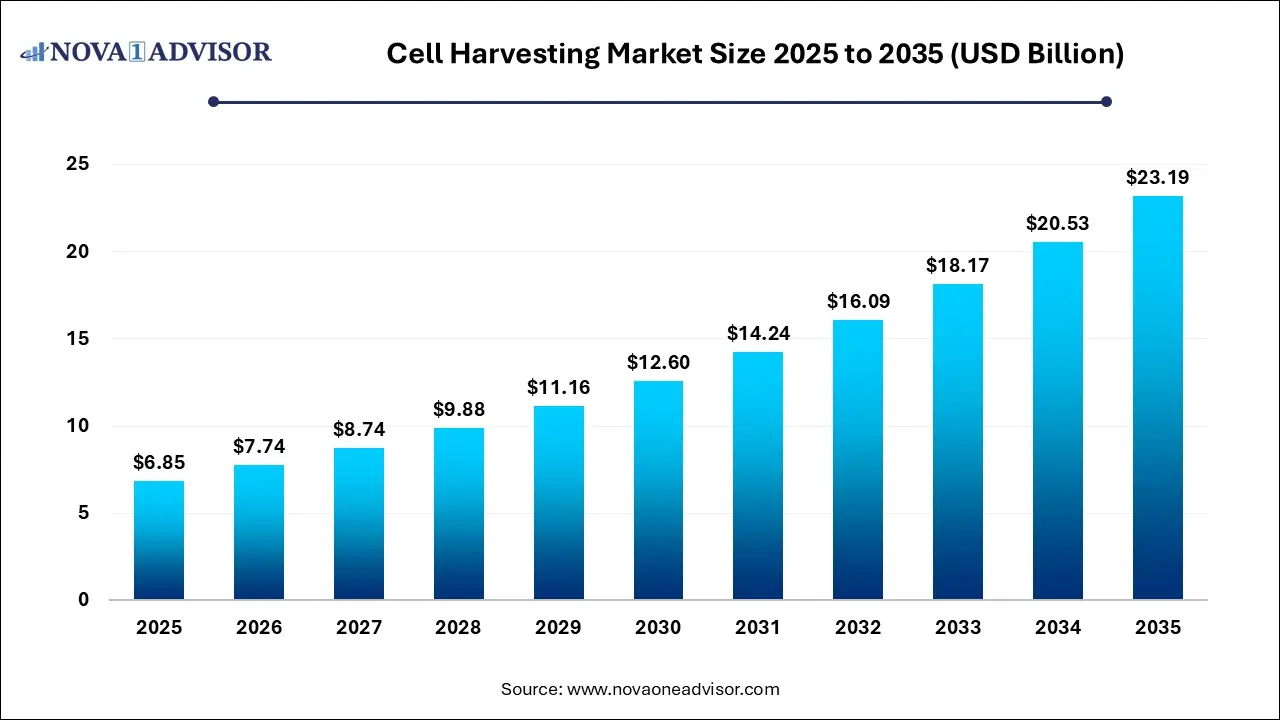
Market Key Takeaways
- The cell harvesting market is witnessing robust growth driven by expanding biologics and cell therapy pipelines.
- Automated cell harvesting systems are rapidly gaining traction due to improved efficiency, scalability, and reduced contamination risks.
- Biopharmaceutical applications dominate the market owing to increasing monoclonal antibody and vaccine production.
- North America holds the largest market share due to strong R&D infrastructure and regulatory support.
- Asia Pacific is expected to emerge as the fastest-growing region due to rising investments in biotechnology and contract manufacturing.
- Integration of AI and automation is reshaping operational efficiency in cell harvesting workflows.
Market Overview
The global cell harvesting market has evolved into a critical component of modern bioprocessing and life sciences research. Cell harvesting refers to the process of separating cells from culture media, which is a crucial step in downstream processing for biologics production, regenerative medicine, and cell-based therapies. The increasing reliance on biologics such as monoclonal antibodies, vaccines, and recombinant proteins has significantly amplified the demand for efficient and scalable cell harvesting solutions.
In recent years, the rapid expansion of the biopharmaceutical industry has been a primary growth engine for this market. Companies are increasingly investing in upstream and downstream bioprocessing technologies to enhance yield and reduce production timelines. Cell harvesting systems, particularly automated solutions, play a vital role in ensuring process consistency and regulatory compliance. As therapies become more complex, including personalized medicines and cell-based treatments, the need for precision harvesting technologies continues to grow.
Furthermore, the emergence of advanced therapies such as CAR-T cell therapy and stem cell-based regenerative medicine has introduced new challenges in cell harvesting. These applications require high cell viability and purity, pushing manufacturers to innovate and develop more sophisticated systems. The growing emphasis on closed systems and contamination-free processing environments is further driving technological advancements.
The market is also benefiting from increased collaboration between academic institutions, contract research organizations (CROs), and biotechnology firms. These collaborations are fostering innovation and accelerating the commercialization of novel therapies, thereby boosting the demand for efficient cell harvesting solutions.
Market Outlook
- Market Growth Overview: The global cell harvesting market is expected to grow significantly between 2025 and 2034, driven by the expansion of regenerative medicine and cell therapies, rising chronic disease prevalence, and growth in CAR-T therapy manufacturing.
- Sustainability Trends: Sustainability trends involve advancement in cell therapy production, AI integration for quality control, and ESG ethical sourcing.
- Major Investors: Major investors in the market include Thermo Fisher Scientific, Sartorius AG, Danaher Corporation (Cytiva, Beckman Coulter), Miltenyi Biotec, and Lonza Group.
How is AI Transforming the Cell Harvesting Market?
Artificial Intelligence (AI) is playing a transformative role in the cell harvesting market by enhancing process optimization, predictive analytics, and automation capabilities. Traditional cell harvesting processes often rely on manual intervention and operator expertise, which can introduce variability and inefficiencies. AI-driven systems are addressing these challenges by enabling real-time monitoring and adaptive control of harvesting processes.
One of the most significant contributions of AI is in process optimization. Machine learning algorithms can analyze large datasets generated during cell culture and harvesting to identify optimal conditions for maximum yield and viability. For instance, AI systems can predict the ideal harvesting time by monitoring cell density, nutrient levels, and metabolic activity. This reduces the risk of over-harvesting or under-harvesting, leading to improved productivity.
AI is also facilitating the development of smart bioreactors and integrated harvesting systems. These systems can automatically adjust parameters such as flow rates, centrifugation speed, and filtration conditions based on real-time data. This level of automation minimizes human intervention and reduces the likelihood of errors, making the process more reliable and scalable.
Another important application of AI is in quality control. Advanced imaging and data analytics tools can detect anomalies in harvested cells, such as contamination or morphological changes. This ensures that only high-quality cells proceed to downstream processing, thereby improving overall product quality and compliance with regulatory standards.
For example, several biopharmaceutical companies are now deploying AI-enabled platforms to streamline their manufacturing workflows. These platforms integrate upstream and downstream processes, including cell harvesting, to create a seamless and efficient production environment.
Cell Harvesting Market Report Scope
| Report Coverage | Details |
| Market Size in 2026 | USD 7.74 Billion |
| Market Size by 2035 | USD 23.19 Billion |
| Growth Rate From 2026 to 2035 | CAGR of 12.97% |
| Base Year | 2025 |
| Forecast Period | 2026 to 2035 |
| Segments Covered | By Product Type, By Application, By End User, By Region |
| Market Analysis (Terms Used) | Value (USD Million/Billion) or (Volume/Units) |
| Regional Scope | North America; Europe; Asia Pacific; Central and South America; the Middle East and Africa |
| Key Companies Profiled | Thermo Fisher Scientific Inc., Sartorius AG, Merck KGaA, Danaher Corporation (Cytiva), Eppendorf AG, BD (Becton, Dickinson and Company), Lonza Group AG, Agilent Technologies, PerkinElmer Inc., Getinge AB |
Segmental Insights
By Product Type
How did the automated cell harvesters segment dominate the Global Cell Harvesting market?
The automated cell harvesters segment is driven by providing the high-throughput efficiency and scalability essential for commercial-scale biopharmaceutical production. The strict contamination control and closed-loop processing are required for GMP compliance. As the industry shifts toward complex cell-based therapies, the integration of AI and robotics further solidifies automation as the preferred choice for reducing labour costs and manual error.
The growing adoption of automated systems is also driven by the need for compliance with stringent regulatory standards. These systems offer better process control and documentation, which are essential for regulatory approvals. Additionally, the integration of AI and real-time monitoring capabilities further enhances their appeal in modern bioprocessing environments.
Manual cell harvesters are expected to witness steady growth, particularly in research and small-scale production settings. These systems are cost-effective and offer flexibility, making them suitable for academic laboratories and early-stage research. However, their limited scalability and higher risk of contamination compared to automated systems may restrict their adoption in large-scale manufacturing.
By Application
How did the biopharmaceutical application segment account for the largest share in the Global Cell Harvesting market?
The biopharmaceutical application segment is driven by the global demand for high-yield vaccines and therapeutic proteins. With annual research and development efforts to ensure the high-purity recovery required for CAR-T and cell therapies. The urgent need for scalable, compliant bioprocessing that minimizes contamination risks while maximizing commercial productivity.
How did the stem cell research segment expect to hold the fastest-growing Global Cell Harvesting market in the coming years?
The stem cell research segment is driven by the shift toward automated and closed systems, primarily to eliminate the higher concentration risk associated with manual models. Advancements in cryopreservation and a surge in autologous stem cell transplants, rising prevalence of chronic diseases, such as cancer and diabetics is accelerating the need for mesenchymal stem cells and CAR-T therapies, which rely on ultrapure cell isolation.
By End User
How did the biotechnology and biopharmaceutical companies segment account for the largest share in the Global Cell Harvesting market?
The biotechnology and biopharmaceutical companies segment is driven by the scaling of monoclonal antibody and vaccine production through a high-capacity harvesting system. The aggressive investments in regenerative medicine and oncology necessitate a rapid shift toward automated, single-use technologies to ensure commercial-grade yields. The need for scalable, GMP-compliant separation processes that reduce manual labor while meeting the high-volume recovery demands of modern biomanufacturing.
How did the research institutes segment expect to hold the fastest-growing Global Cell Harvesting market in the coming years?
The research institutes segment is driven by substantial grant funding for regenerative medicine and GMP facility development. As hubs for disease modeling and therapeutic discovery, these centers are rapidly adopting automated, closed-system harvesters to maximize cell yield and ensure sterile environments. Their role in translational research collaborations with biotech firms is essential for accelerating the movement of novel cell therapies from benchtop discovery to clinical trials.
By Region
North America dominated the global cell harvesting market due to its well-established biopharmaceutical industry, advanced healthcare infrastructure, and strong regulatory support. The presence of leading market players and extensive research activities further strengthens the region's position. The U.S., in particular, is a major hub for biologics production and innovation.
Government initiatives and funding programs aimed at promoting biotechnology and life sciences research are also contributing to market growth in this region.
Asia Pacific is the fastest-growing region, driven by increasing investments in biotechnology, expanding manufacturing capabilities, and supportive government policies. Countries such as China, India, and South Korea are активно investing in biopharmaceutical infrastructure and research, creating significant opportunities for market players.
The availability of skilled labor and cost advantages further enhance the attractiveness of this region for global companies.
Key Players in the Global Cell Harvesting Market
- Argos Technologies, Inc.
Argos Technologies focuses on the development of advanced adipose tissue harvesting systems designed to enhance cell yield and viability for regenerative medicine.
- Arthrex, Inc.
Arthrex is a dynamic player in the cell harvesting market that specializes in developing innovative orthobiologic products and minimally invasive surgical technologies. The company contributes to the sector by providing advanced systems for harvesting regenerative cells, including bone marrow aspirate concentration, to improve patient outcomes in orthopedic applications.
- Avita Medical
Avita Medical drives the cell harvesting market with its proprietary RECELL System, a regenerative medicine technology that prepares spray-on skin cells (autologous suspension) for treating burns and skin defects.
Segments Covered in the Report
This report forecasts revenue growth at country levels and provides an analysis of the latest industry trends in each of the sub-segments from 2021 to 2035. For this study, Nova one advisor, Inc. has segmented the cell harvesting market.
By Product Type
- Manual Cell Harvesters
- Automated Cell Harvesters
By Application
- Biopharmaceutical Application
- Stem Cell Research
- Others
By End User
- Pharmaceutical Companies
- Biotechnology Companies
- Research Institutes
- Others
By Region
- Americas
- North America
- US
- Canada
- South America
- North America
- Europe
- Western Europe
- Germany
- France
- Italy
- Spain
- UK
- Rest of Western Europe
- Eastern Europe
- Western Europe
- Asia-Pacific
- Japan
- China
- India
- Australia
- South Korea
- Rest of Asia-Pacific
- Middle East & Africa
- Middle East
- Africa
FAQ's

Proceed to Buy
Instant PDF delivery on confirmation

 Request Customization
 Download Sample

Get a Sample of this Report
Cell Harvesting Market