

Cleanroom Consumables Market Size, Share, and Trends 2026 to 2035
 Status Published
 Category Healthcare


Content
Cleanroom Consumables Market Size and Growth 2026 to 2035
The global cleanroom consumables market size was valued at USD 5.86 billion in 2025 and is projected to grow from USD 6.28 billion in 2026 to USD 11.70 billion by 2035, at a CAGR of 7.16% from 2026 to 2035.
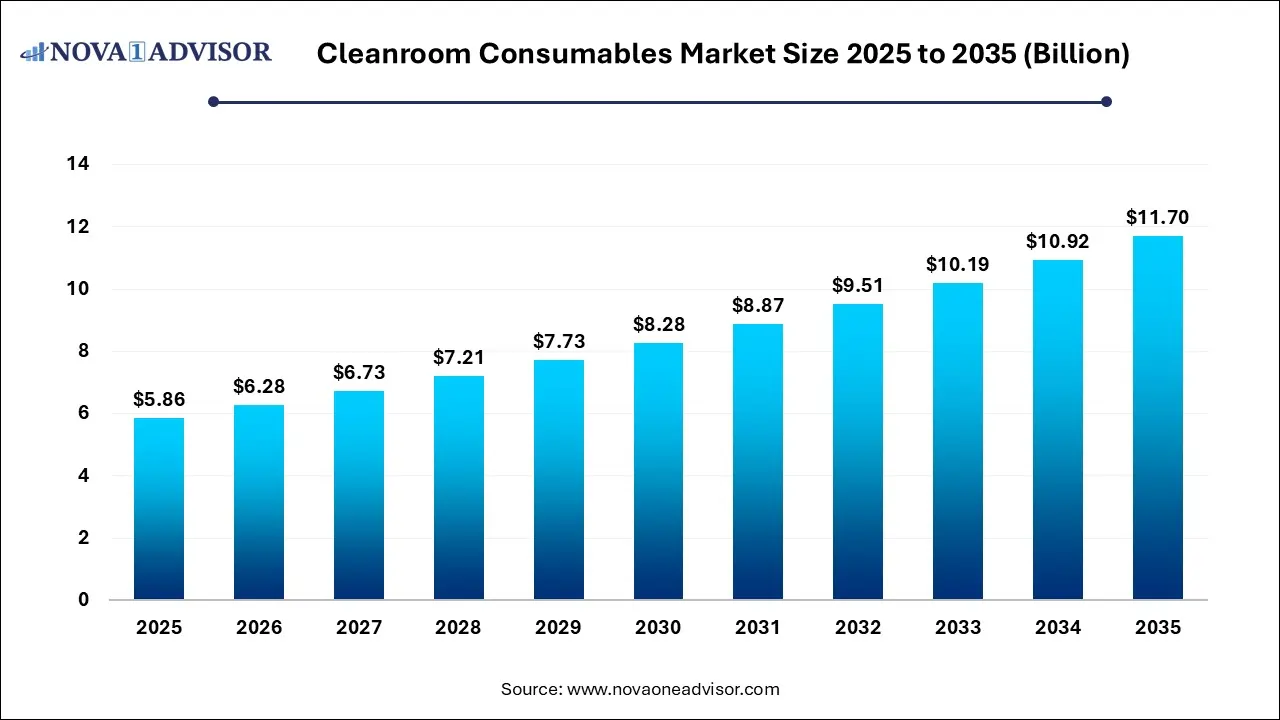
Key Takeaway:
- By product, the gloves segment dominated the market and accounted for the largest revenue share in 2025.
- By product, the cleanroom apparel segment fastest growing in the market in 2025.
- By application, the electronic segment dominated the market and accounted for the largest revenue share in 2025.
- By region, North America accounted for the largest revenue share in 2025.
Market Overview
The global Cleanroom Consumables Market is experiencing steady growth as industries such as pharmaceuticals, biotechnology, semiconductor manufacturing, healthcare, and electronics increasingly prioritize contamination control and regulatory compliance. Cleanroom consumables—including gloves, garments, wipers, cleaning products, adhesive mats, and stationery—play a critical role in maintaining sterile environments and ensuring product quality. Rising investments in biologics, vaccine production, advanced semiconductor fabrication, and medical device manufacturing are driving consistent demand for high-performance contamination control solutions. Additionally, the integration of automation, artificial intelligence, and sustainable product innovations is enhancing operational efficiency while supporting long-term market expansion across both developed and emerging economies.
Market Outlook
- Market Growth Overview: The cleanroom consumables market is expected to grow significantly between 2025 and 2035, driven by the growing expansion of the pharmaceutical and biotech industries, stringent regulatory standards, and booming semiconductor and electronics.
- Sustainability Trends: Sustainability trends involve biodegradable apparel and gloves, circular economy for garments, and reduced packaging and bioburden.
- Major Investors: Major investors in the market include DuPont, Kimberly-Clark Corporation, Ansell Limited, Contec, Inc., and Thermo Fisher Scientific.
How AI is Impacting the Cleanroom Consumables Market?
AI and ML are revolutionizing the cleanroom consumables industry by analyzing environmental data, AI algorithms forecast contamination risks and dynamically adjust cleaning schedules, ensuring optimal consumable lifecycles and minimizing material waste. AI-powered systems frequently pair with IoT and RFID tagging on apparel and wipes to automate supply replenishment, reduce human-driven errors, and guarantee strict compliance with stringent ISO standards.
Major Trends in the Cleanroom Consumables Market
- Increasing investments in semiconductor fabrication facilities worldwide.
- Rapid expansion of biologics, cell therapy, and gene therapy manufacturing.
- Growing demand for sterile pharmaceutical manufacturing environments.
- Rising adoption of reusable and environmentally sustainable cleanroom apparel.
- Integration of AI-based contamination monitoring systems.
- Development of low-lint and ultra-low particle generation consumables.
- Increasing use of RFID-enabled inventory management for cleanroom supplies.
- Expansion of contract manufacturing organizations (CMOs and CDMOs).
- Greater utilization of robotic manufacturing inside cleanroom facilities.
- Increasing regulatory scrutiny regarding contamination prevention.
- Growing demand from advanced medical device manufacturing.
- Higher investments in vaccine production infrastructure.
- Adoption of environmentally friendly disinfectants and cleaning chemicals.
- Rising demand for customized cleanroom consumables tailored to industry-specific applications.
- Increasing focus on lifecycle cost optimization rather than product purchase price alone.
Cleanroom Consumables Market Report Scope
| Report Coverage | Details |
| Market Size in 2026 | USD 6.28 Billion |
| Market Size by 2035 | USD 11.70 Billion |
| Growth Rate From 2026 to 2035 | CAGR of 7.16% |
| Base Year | 2025 |
| Forecast Period | 2026 to 2035 |
| Segments Covered | By Product, By Application, By Region |
| Market Analysis (Terms Used) | Value (USD Million/Billion) or (Volume/Units) |
| Regional Scope | North America; Europe; Asia Pacific; Central and South America; the Middle East and Africa |
| Key Companies Profiled | Berkshire Corporation, Cantel Medical, Contec, Inc., DuPont, Micronclean, Ansell Ltd., Texwipe, Valutek, Inc., KM, Valmed, and Kimberly-Clark Corporation. |
Market Dynamics
Driver: Expansion of Pharmaceutical and Biopharmaceutical Manufacturing
The rapid expansion of global pharmaceutical and biopharmaceutical manufacturing is the primary driver of the Cleanroom Consumables Market. Modern pharmaceutical production increasingly focuses on sterile injectable drugs, monoclonal antibodies, vaccines, biosimilars, cell therapies, and gene therapies—all of which require contamination-controlled manufacturing environments. Unlike conventional oral medicines, these products cannot undergo terminal sterilization after production, making contamination prevention essential throughout every manufacturing stage.
Governments worldwide have also prioritized domestic pharmaceutical manufacturing capabilities following supply chain disruptions experienced during recent global health emergencies. New manufacturing facilities require comprehensive contamination control infrastructure, including gloves, garments, cleaning products, adhesive mats, sterile wipes, and specialized stationery for documentation within cleanroom environments. As production capacity expands across developed and emerging markets, recurring demand for disposable and reusable cleanroom consumables continues increasing. Since many consumables require frequent replacement to maintain cleanliness standards, they generate stable recurring revenue streams for manufacturers while supporting long-term market growth.
Restraint: High Operational Costs Associated with Premium Cleanroom Consumables
Despite robust demand, the market faces challenges related to the high operational costs associated with premium cleanroom consumables. Advanced sterile gloves, specialized garments, validated cleaning chemicals, low-lint wipes, and contamination-tested accessories command significantly higher prices than conventional industrial products due to specialized manufacturing processes and strict quality validation requirements.
Small pharmaceutical companies, research laboratories, academic institutions, and emerging biotechnology firms often experience budget limitations when establishing or expanding cleanroom operations. Additionally, recurring replacement requirements increase operating expenses over time. Organizations must also invest in staff training, inventory management, waste disposal, and compliance documentation, further increasing the total cost of ownership. These financial considerations may delay facility expansion or encourage organizations to optimize consumable usage, particularly in cost-sensitive markets.
Opportunity: Growth of Semiconductor Manufacturing and Advanced Electronics
The rapid expansion of semiconductor manufacturing presents one of the strongest long-term opportunities for cleanroom consumable suppliers. Artificial intelligence, high-performance computing, electric vehicles, cloud infrastructure, 5G communication, and advanced consumer electronics are driving unprecedented investments in semiconductor fabrication facilities worldwide. Modern semiconductor production requires extremely stringent contamination control because microscopic particles can destroy integrated circuits or significantly reduce manufacturing yields.
As governments encourage domestic semiconductor production through industrial incentives and strategic investments, numerous new fabrication plants are being constructed across Asia-Pacific, North America, and Europe. Each facility requires continuous supplies of gloves, garments, adhesive mats, specialized wipes, cleaning agents, and contamination-control accessories throughout decades of operation. Suppliers capable of developing next-generation consumables compatible with increasingly sophisticated semiconductor manufacturing processes are well positioned to capitalize on this expanding opportunity.
Segmental Insights
By Product
How did the gloves segment dominate the Cleanroom Consumables market?
The gloves segment is driven by stringent regulatory standards set by agencies such as the FDA, which require frequent, high-volume replacement of protective gear to ensure contamination-free, compliant production environments. Material innovations, particularly in nitrile and latex, provide essential chemical, electrostatic, and hypoallergenic properties for sensitive applications.
How did the cleanroom apparel segment expect to hold the fastest-growing Cleanroom Consumables market in the coming years?
The cleanroom apparel segment is driven by expanding local supply chains in high-growth hubs, ensuring these innovative apparel options seamlessly meet escalating global cleanroom demand. The shift is accelerated by material breakthroughs that introduce anti-static properties and superior particle filtration tailored for highly complex cell and gene therapy manufacturing.
By Application
How did the electronic segment dominate the Cleanroom Consumables market?
The electronic segment is driven by the rapid miniaturization of electronic components to nanometer scales, which intensifies the necessity for flawless contamination control to eliminate catastrophic particulate and microbial risks. The global expansion of semiconductor fabrication and localized manufacturing facilities ensures a sustained, long-term trajectory for electronics-driven cleanroom products.
How did the pharmaceutical and biotechnology segment expect to hold the fastest-growing Cleanroom Consumables market in the coming years?
The pharmaceutical and biotechnology segment is driven by the integrating advanced anti-counterfeiting features within these sterile manufacturing lines, further solidifying the critical, high-volume role of cleanroom consumables in securing global drug safety. The booming pipeline of biosimilars, mRNA platforms, and cell and gene therapies demands highly controlled environments that directly accelerate the continuous use of specialized sterile consumables.
By Regional
How did the North America region account for the largest share in the Cleanroom Consumables market?
North America is driven by the extensive research and development spending across prominent academic and healthcare institutions, which ensures a steady, continuous demand for baseline cleanroom products. The continuous and high-turnover validation of sterile garments, wipes, and gloves to prevent product contamination.
U.S. Cleanroom Consumables Market Trends
The U.S. is booming in artificial intelligence hardware, driving massive semiconductor investments in ultra-clean environments, reinforcing the U.S. market's dominant global share across its advanced healthcare and tech infrastructure. The manufacturers are increasingly offering eco-friendly and biodegradable cleanroom consumables to meet corporate ESG goals without compromising sterility.
How did the Asia-Pacific region become the fastest-growing Cleanroom Consumables Market during the forecast period?
Asia Pacific is driven by the aging demographic and patent expirations, while also seeing high demand for specialized, ultra-clean consumables due to massive investments in semiconductor and EV battery production. The stricter manufacturing regulations and the rapid expansion of outsourced CDMO services throughout the region.
China Cleanroom Consumables Market Trends
China’s increasingly shift toward eco-friendly and biodegradable cleanroom stationery and packaging to align with broader national sustainability mandates. The rapid expansion of 300mm wafer fabs and electric vehicle battery gigafactories is fueling a surge in demand for ultra-precision ISO Class 1–3 cleanrooms, which require specialized non-shedding wipes and particle-free apparel.
How Did Europe Hold A Notable Share in the Cleanroom Consumables Market?
Europe’s strict EU environmental policies have led the region to pioneer a significant shift toward eco-friendly consumables, biodegradable apparel, and localized PPE recycling programs. The widespread cleanroom adoption across medical device and advanced semiconductor manufacturing in countries such as Germany and France sustains consistent daily demand.
Germany Cleanroom Consumables Market Trends
Germany’s intersecting regulatory and industrial expansions reinforce Germany's pivotal role in driving advanced contamination control solutions. As Europe’s pharmaceutical powerhouse, Germany's drug manufacturing and cell/gene therapy suites account for nearly half of this local cleanroom end-user demand.
Key Players in the Cleanroom Consumables Market
- Berkshire Corporation manufactures high-performance contamination control consumables, including cleanroom wipes, swabs, and mops. Their advanced materials are designed to minimize the risk of particulate and chemical contamination in highly regulated industries like pharmaceuticals and medical devices.
- Cantel Medical provides critical infection prevention and contamination control solutions for healthcare and life science facilities. Their specialized consumables and reprocessing systems ensure rigorous sterility, protecting sensitive medical procedures from microbial contamination.
- Contec, Inc. develops a broad portfolio of contamination control products, including presaturated wipes, sterile swabs, and specialized disinfectants.
Segments Covered in the Report
This report forecasts revenue growth at country levels and provides an analysis of the latest industry trends in each of the sub-segments from 2021 to 2035. For this study, Nova one advisor, Inc. has cleanroom consumables market.
By Product
- Cleanroom Apparels
- Cleaning Products
- Cleanroom Stationery
- Gloves
- Adhesive Mats
- Wipers
By Application
- Electronics
- Pharmaceuticals & Biotechnology
- Hospitals & Clinics
- Automotive
- Academics & Research Institutes
- Food & Beverage
- Others
By Region
- North America
- Europe
- Asia-Pacific
- Latin America
- Middle East & Africa (MEA)
FAQ's

Proceed to Buy
Instant PDF delivery on confirmation

Cleanroom Consumables market Size to Hit USD 11.70 Billion by 2035
 Request Customization
 Download Sample

Get a Sample of this Report
Cleanroom Consumables Market