

Collagen Dressings Market (Type: Antimicrobial Collagen Dressings, Alginate Collagen Dressings, Hydrogel Collagen Dressings, Native Collagen Dressings, and Others)- Global Industry Analysis, Share, Growth, Regional Outlook and Forecasts, 2026-2035
 Status Published
 Category Healthcare


Content
Collagen Dressings Market Size and Growth 2026 to 2035
The global Collagen Dressings market size was valued at USD 2,361.84 million in 2025 and is predicted to hit USD 4,521.70 million by 2035 with a registered CAGR of 6.71% during the forecast period 2026 to 2035.
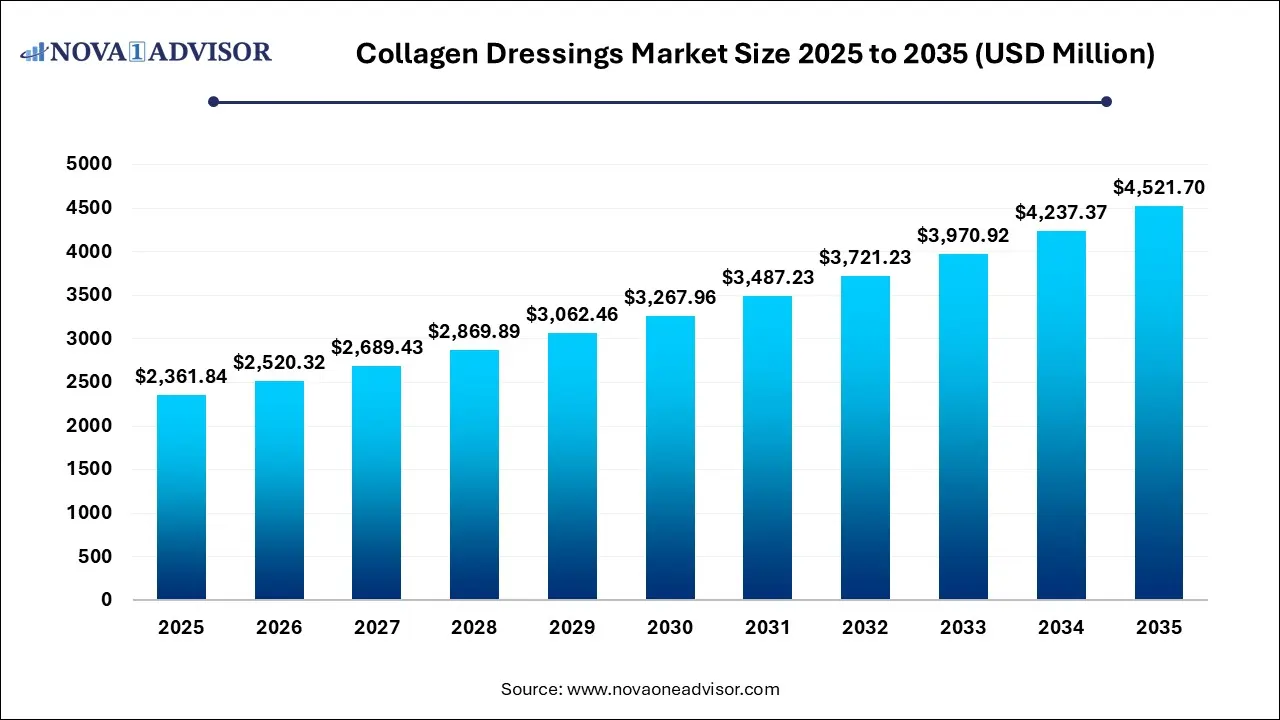
Market Key Takeaways
- The collagen dressings market is expanding steadily due to increasing prevalence of chronic wounds such as diabetic foot ulcers and pressure ulcers.
- Antimicrobial collagen dressings dominate due to their ability to prevent infections and accelerate healing.
- Bovine-derived collagen remains the most widely used source due to cost-effectiveness and availability.
- Chronic wound applications account for the largest share of the market.
- Hospitals represent the dominant end-user segment owing to higher patient inflow and advanced treatment facilities.
- Asia Pacific is emerging as the fastest-growing region due to rising healthcare infrastructure and diabetic population.
- Technological advancements in wound care products are improving patient outcomes and driving adoption.
Market Overview
The collagen dressings market is a critical segment of the advanced wound care industry, focusing on products designed to enhance wound healing through the use of collagen. Collagen is a natural protein found in the human body that plays a vital role in tissue regeneration and repair. Collagen dressings are widely used in the treatment of both acute and chronic wounds, including surgical wounds, burns, diabetic ulcers, and pressure sores.
These dressings function by providing a scaffold that promotes cellular migration and growth, thereby accelerating the healing process. They also help maintain a moist wound environment, which is essential for optimal healing. Additionally, collagen dressings can bind to matrix metalloproteinases (MMPs), which are enzymes that can hinder wound healing when present in excess.
The market is driven by the increasing prevalence of chronic diseases such as diabetes, which often lead to non-healing wounds. According to healthcare trends, the global rise in diabetes cases has significantly increased the incidence of diabetic foot ulcers, a major application area for collagen dressings. For example, diabetic patients often experience poor circulation and nerve damage, making wound healing more challenging and necessitating advanced wound care solutions.
Technological advancements have led to the development of various types of collagen dressings, including antimicrobial, hydrogel-based, and alginate-based products. These innovations have improved the effectiveness of collagen dressings in managing complex wounds. Furthermore, increasing awareness among healthcare professionals and patients about advanced wound care options is contributing to market growth.
Market Outlook
- Market Growth Overview: The collagen dressings market is expected to grow significantly between 2025 and 2035, driven by the rising incidence of chronic and acute wounds, technological advancements in wound care, and the shift to advanced wound care solutions.
- Sustainability Trends: Sustainability trends involve the alternative and sustainable sourcing, green manufacturing processes, and multifunctional and smart sustainable solutions.
- Major Investors: Major investors in the market include Smith & Nephew, 3M, Integra LifeSciences, Coloplast Group, and Convatec Group PLC.
How AI is Impacting the Collagen Dressings Market
AI and ML are transforming the collagen dressings industry by enabling the development of smart collagen-based materials that offer real-time monitoring of wound exudate, temperature, and PH. These technologies allow ML models to analyse vast datasets of wound images to predict healing trajectories and recommend optimal collagen dressing types, significantly increasing the personalization of patient care. AI accelerates the R&D process by simulating the interaction between collagen scaffolds and tissue, which reduces the need for expensive, time-consuming physical trials and optimizes the structural properties of dressings.
Major Trends in the Market
- Increasing adoption of antimicrobial collagen dressings to prevent infection in chronic wounds
- Growing demand for combination dressings integrating collagen with alginate or hydrogel materials
- Rising focus on biologically active wound care products
- Expansion of home healthcare and outpatient wound management
- Development of next-generation collagen dressings with enhanced bioactivity
- Increasing use of collagen dressings in burn care and surgical wound management
- Growth in diabetic population driving demand for advanced wound care
- Integration of wound care products with digital monitoring technologies
- Increasing preference for minimally invasive wound treatment solutions
- Rising investments in research and development for advanced biomaterials
Collagen Dressings Market Report Scope
| Report Coverage | Details |
| Market Size in 2026 | USD 2,520.32 Million |
| Market Size by 2035 | USD 4,521.70 Million |
| Growth Rate From 2026 to 2035 | CAGR of 6.71% |
| Base Year | 2025 |
| Forecast Period | 2026 to 2035 |
| Segments Covered | By Dressing Type, By Source, By Application, By End-user, By Geography |
| Market Analysis (Terms Used) | Value (USD Million/Billion) or (Volume/Units) |
| Regional Scope | North America; Europe; Asia Pacific; Central and South America; the Middle East and Africa |
| Key Companies Profiled | 3M, Smith & Nephew, Integra Lifesciences Corporation, Coloplast Corporation |
Market Driver
Rising Prevalence of Chronic Wounds and Diabetes
One of the most significant drivers of the collagen dressings market is the increasing prevalence of chronic wounds, particularly those associated with diabetes. Chronic wounds such as diabetic foot ulcers, pressure ulcers, and venous leg ulcers require specialized care due to their prolonged healing time and susceptibility to infection.
The global rise in diabetes cases has led to a corresponding increase in diabetic foot ulcers. These wounds are often difficult to heal due to poor blood circulation and reduced immune response. Collagen dressings play a crucial role in managing these wounds by promoting tissue regeneration and reducing inflammation.
For instance, in clinical practice, collagen dressings are frequently used in diabetic wound care to stimulate the formation of new tissue and accelerate healing. Hospitals and clinics are increasingly adopting these dressings as part of standard wound care protocols. Additionally, the aging population is more prone to chronic wounds, further driving demand.
The economic burden associated with chronic wounds is also significant, prompting healthcare systems to adopt cost-effective and efficient treatment solutions. Collagen dressings, by reducing healing time and complications, contribute to lower overall treatment costs. As the prevalence of chronic conditions continues to rise, the demand for collagen dressings is expected to grow substantially.
Market Restraint
High Cost of Advanced Collagen Dressings
Despite their clinical benefits, the high cost of collagen dressings remains a major restraint for market growth. Advanced collagen-based products, particularly those with antimicrobial properties or combined with other biomaterials, are often more expensive than traditional wound care products such as gauze or basic dressings.
In many healthcare systems, especially in developing countries, cost considerations play a significant role in treatment decisions. Hospitals and clinics may opt for less expensive alternatives, even if they are less effective, due to budget constraints. This limits the adoption of collagen dressings in price-sensitive markets.
Additionally, reimbursement policies for advanced wound care products vary across regions, affecting affordability and accessibility. In some cases, patients may have to bear the cost of treatment out-of-pocket, further restricting usage.
The cost factor is particularly relevant in long-term wound management, where patients require multiple dressing changes over an extended period. While collagen dressings can reduce overall treatment time, the initial cost may still be a barrier. Addressing this challenge requires efforts to reduce production costs and improve reimbursement frameworks.
Market Opportunity
Growing Adoption of Advanced Wound Care in Emerging Markets
Emerging markets present a significant growth opportunity for the collagen dressings market due to improving healthcare infrastructure and increasing awareness of advanced wound care solutions. Countries in Asia Pacific, Latin America, and the Middle East are witnessing a rise in healthcare investments and access to medical services.
The growing prevalence of diabetes and chronic wounds in these regions is creating a strong demand for effective treatment solutions. For example, India and China have some of the largest diabetic populations in the world, leading to a high incidence of diabetic foot ulcers. This creates a substantial market for collagen dressings.
Additionally, the expansion of private healthcare facilities and medical tourism is driving the adoption of advanced wound care products. Healthcare providers in these regions are increasingly adopting modern treatment protocols, including the use of collagen dressings.
Government initiatives aimed at improving healthcare access and quality are also supporting market growth. As awareness continues to increase and affordability improves, emerging markets are expected to become key growth drivers for the collagen dressings market.
Segmental Insights
By Dressing Type
How did the antimicrobial collagen dressings segment dominate the Collagen Dressings market?
The antimicrobial collagen dressings segment is driven by providing a critical dual-action solution that combines structural tissue scaffolding with powerful infection control. Their ability to integrate silver nanoparticles and other anti-infective agents directly into the collagen matrix significantly reduces the risk of surgical site infections and chronic wound complications. The urgent need to manage rising rates of diabetic foot ulcers and healthcare-associated infections worldwide.
How did the alginate collagen dressings segment expect to hold the fastest-growing Collagen Dressings market in the coming years?
The alginate collagen dressings segment is driven by its superior exudate management, making them indispensable for treating complex, high-fluid chronic wounds, such as diabetic foot ulcers. The shift toward home care, where long-wear, easy-to-use bioactive designs reduce the need for frequent professional intervention. Accelerating demand in the Asia Pacific region is solidifying this technology as the next standard in cost-effective, advanced wound management.
By Source
How did the bovine segment account for the largest share in the Collagen Dressings market?
The bovine segment is driven by its abundant raw material supply and significantly lower production costs compared to human or marine alternatives. Its well-established clinical effectiveness in providing tensile strength and promoting fibroblast migration makes it the gold standard for treating high-volume cases. The segment's benefits include streamlined regulatory pathways and a vast existing product portfolio of gels, powders, and sheets.
How did the porcine segment expect to hold the fastest-growing Collagen Dressings market in the coming years?
The porcine segment is driven by a superior biological match for complex skin grafting and full-thickness wound care. Their competitive cost structure makes them an attractive option for large-scale production in price, sensitive healthcare systems. The porcine-derived materials are increasingly becoming the preferred choice for specialized regenerative therapies and dermal matrix replacements worldwide.
By Application
How did the acute wounds segment account for the largest share in the Collagen Dressings market?
The acute wounds segment is driven by the high global incidence of traumatic injuries from road accidents and sports, which require immediate, high-performance healing solutions. Continuous technological advancements in delivery formats, such as gels, sheets, and powders, enable these dressings to provide superior moisture control and accelerated tissue repair.
How did the chronic wounds segment expect to hold the fastest-growing Collagen Dressings market in the coming years?
The chronic wounds segment is driven by the aging population and a major shift toward home-care settings, where easy-to-use, long-wear dressings are preferred for patient comfort. The integration of antimicrobial silver and hydrogels into collagen products is drastically reducing recovery times, making them the new standard for complex wound management.
By End-User
How did the hospitals segment account for the largest share in the Collagen Dressings market?
The hospitals segment is driven by managing the highest volume of complex surgical procedures and severe burn cases, which require consistent supplies of advanced collagen materials. The substantial bulk-purchasing power and favorable inpatient reimbursement policies make high-priced advanced wound products more accessible in a clinical setting. The hospitals remain the central hub for the most resource-intensive wound management applications in the healthcare system.
How did the ambulatory surgical centers segment expect to hold the fastest-growing Collagen Dressings market in the coming years?
The ambulatory surgical centers segment is driven by a cost-effective alternative to traditional hospitals for minimally invasive and outpatient surgeries. These centers increasingly utilize advanced collagen to facilitate faster tissue regeneration and prevent costly surgical site infections in high-risk patients. The modern reimbursement models that incentivise early discharge are driving demand for high-performance materials that support safe recovery at home. The shift toward outpatient care positions ASCs as a critical hub for efficient, quality-focused wound management in the evolving healthcare landscape.
By Region
North America dominates the collagen dressings market, due to advanced healthcare infrastructure and high awareness of wound care solutions. The presence of leading market players and favorable reimbursement policies further support market growth. The high prevalence of chronic diseases also contributes to strong demand.
Asia Pacific is the fastest-growing region, driven by increasing healthcare investments and rising incidence of chronic wounds. Countries such as India and China are experiencing rapid growth in healthcare infrastructure, making advanced wound care products more accessible. The growing diabetic population is a key factor driving market expansion in this region.
Key Players in the Collagen Dressings Market
- 3M
3M leverages its extensive healthcare portfolio and R&D capabilities to offer advanced wound care products that establish optimal healing environments and focus on moisture management.
- Smith & Nephew
Smith & Nephew holds a leading position in the bioactive collagen dressing market through significant investment in R&D and a robust distribution network that spans global markets.
- Integra Lifesciences Corporation
Integra Lifesciences contributes significantly to the market with its biologically active collagen products, including the surgiMend collagen matrix for soft tissue reconstruction.
- Coloplast Corporation
Coloplast Corporation focuses on providing advanced wound dressings that promote healing in chronic conditions, such as diabetic foot ulcers, pressure ulcers, and venous leg ulcers. Their strategy revolves around developing products that address both the wound microenvironment and patient quality of life, often using bovine collagen in their formulations.
Segments Covered in the Report
This report forecasts revenue growth at global, regional, and country levels and provides an analysis of the latest industry trends in each of the sub-segments from 2021 to 2035. For this study, Nova one advisor, Inc. has segmented the global Collagen Dressings market
By Dressing Type
- Antimicrobial Collagen Dressings
- Alginate Collagen Dressings
- Hydrogel Collagen Dressings
- Native Collagen Dressings
- Others
By Source
- Bovine
- Porcine
- Others
By Application
- Acute Wounds
- Surgical Wounds
- Burns
- Chronic Wounds
- Ulcers and Ischemic
- Diabetic Foot Ulcers
- Pressure Ulcers
- Others
- Infectious Wounds
- Ulcers and Ischemic
By End-user
- Hospitals
- Clinics
- Ambulatory Surgical Centers
- Others
By Geography
North America
- U.S.
- Canada
Europe
- Germany
- France
- United Kingdom
- Rest of Europe
Asia Pacific
- China
- Japan
- India
- Southeast Asia
- Rest of Asia Pacific
Latin America
- Brazil
- Rest of Latin America
Middle East & Africa (MEA)
- GCC
- North Africa
- South Africa
- Rest of Middle East & Africa
FAQ's

Proceed to Buy
Instant PDF delivery on confirmation

Collagen Dressings Market Size to Hit USD 4,521.70 Million by 2035
 Request Customization
 Download Sample

Get a Sample of this Report
Collagen Dressings Market