

Colposcopy Market Size, Share, and Trends 2026 to 2035
 Status Published
 Category Healthcare


Content
Colposcope Market Size and Growth 2026 to 2035
The global colposcope market size was valued at USD 426.25 million in 2025 and is projected to grow from USD 445.43 million in 2026 to USD 661.95 million by 2035, at a CAGR of 4.5% from 2026 to 2035.
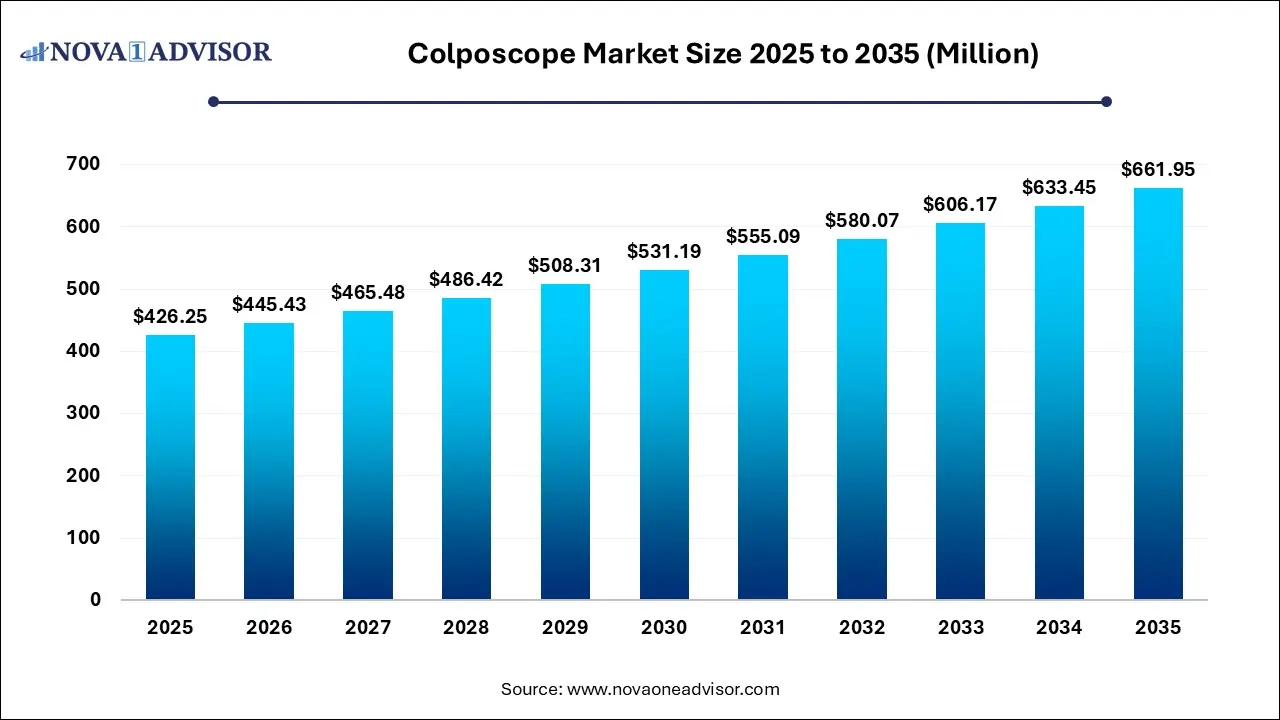
Key Takeaway:
- By instrument type, the optical colposcopes segment dominated the market and accounted for the largest revenue share in 2025.
- By instrument type, the digital colposcopes segment fastest growing in the market in 2025.
- By instrument portability, the fixed colposcopes segment dominated the market and accounted for the largest revenue share in 2025.
- By application, the cervical cancer screening segment dominated the market and accounted for the largest revenue share in 2025.
- By modification type, the variable segment dominated the market and accounted for the largest revenue share in 2025.
- By end use, the hospitals segment dominated the market and accounted for the largest revenue share in 2025.
- By region, North America accounted for the largest revenue share in 2025.
Market Overview
The global Colposcope Market is witnessing steady growth due to the increasing focus on early detection of cervical cancer, expanding cervical cancer screening programs, and rising awareness of preventive women's healthcare. Colposcopes play a crucial role in diagnosing cervical abnormalities by providing magnified visualization of the cervix, enabling clinicians to detect precancerous lesions at an early stage. Growing adoption of HPV testing, government-supported screening initiatives, and improvements in healthcare infrastructure are driving demand for advanced colposcopy systems across hospitals, clinics, and diagnostic centers. The transition from conventional optical devices to digital colposcopes with high-definition imaging and electronic documentation is further enhancing diagnostic accuracy and clinical efficiency.
Technological advancements, including artificial intelligence (AI), cloud connectivity, and telemedicine integration, are transforming the colposcopy landscape by enabling automated image analysis, standardized reporting, and remote specialist consultations. Manufacturers are also introducing portable and handheld colposcopes to improve access to cervical cancer screening in rural and underserved regions. Rising investments in women's health programs, combined with innovations in digital imaging and ergonomic device design, are expected to support sustained market growth. As healthcare providers continue prioritizing early diagnosis and personalized patient care, the Colposcope Market is poised for significant expansion throughout the forecast period.
Market Outlook
- Market Growth Overview: The global colposcopy market is expected to grow significantly between 2025 and 2035, driven by the rising prevalence of cervical cancer and HPV, national screening mandates and awareness, and a shift towards portable and point-of-care devices.
- Sustainability Trends: Sustainability trends involve portable and energy-efficient devices, lifecycle management, and telescopic and cloud integration.
- Major Investors: Major investors in the market include Carl Zeiss Meditec AG, CooperSurgical, Olympus Corporation, McKesson Medical-Surgical, DYSIS Medical, and ATMOS MedizinTechnik.
How AI is Impacting the Global Colposcopy Market?
AI and ML are revolutionizing the global colposcopy industry by addressing critical operator-dependent limitations and standardizing diagnostic accuracy. Algorithms analyze digital images to help clinicians detect precancerous lesions, identify optimal biopsy sites, and reduce false-negative rates. This technological shift is especially impactful in remote and underserved regions, where machine learning integrated into portable colposcopes allows for rapid image review and remote consultations. The mitigating the shortage of experienced specialists, these innovations improve overall workflow efficiency and support global cervical cancer screening programs.
Major Trends in the Colposcope Market
- Rapid adoption of digital colposcopes
Healthcare providers are increasingly replacing conventional optical systems with digital colposcopes that offer high-definition imaging, image storage, video recording, and seamless electronic documentation.
- Growing integration of artificial intelligence
AI-powered software is improving lesion detection, image interpretation, clinical decision support, and standardized reporting, enhancing diagnostic consistency and reducing observer variability.
- Rising demand for portable and handheld devices
Portable colposcopes are enabling cervical cancer screening programs to expand into rural communities, mobile healthcare units, and resource-limited clinical environments.
- Expansion of telecolposcopy services
Cloud-based image sharing and remote specialist consultations are improving access to expert gynecological diagnostics, particularly in underserved regions.
- Increasing participation in cervical cancer screening programs
Government initiatives, HPV screening campaigns, and public awareness programs are encouraging earlier diagnosis and increasing demand for colposcopy examinations.
- Advancements in optical imaging technologies
Manufacturers are introducing enhanced LED illumination, superior optics, variable magnification, autofocus capabilities, and improved image enhancement technologies.
- Integration with electronic medical records (EMRs)
Modern colposcopes increasingly integrate with hospital information systems, enabling centralized documentation, workflow automation, and longitudinal patient monitoring.
- Focus on ergonomic and user-friendly system designs
Manufacturers continue developing lightweight, compact, and intuitive colposcopy systems that improve clinician comfort, workflow efficiency, and patient experience.
Colposcope Market Report Scope
| Report Coverage | Details |
| Market Size in 2026 | USD 445.43 Million |
| Market Size by 2035 | USD 661.95 Million |
| Growth Rate From 2026 to 2035 | CAGR of 4.5% |
| Base Year | 2025 |
| Forecast Period | 2026 to 2035 |
| Segments Covered | By Instrument Type, By Instrument Portability, By Application, By Magnification Type, By End-User, By Region |
| Market Analysis (Terms Used) | Value (USD Million/Billion) or (Volume/Units) |
| Regional Scope | North America; Europe; Asia Pacific; Central and South America; the Middle East and Africa |
| Key Companies Profiled | Carl Zeiss, Olympus Corporation, Danaher Corporation, Philips Healthcare, CooperSurgical, McKesson Corporation, DYSIS Medical, Atmos, Alliton, Seliga Microscopes, Karl Kaps, Bovie Medical, Segmentation |
Segmental Insights
By Instrument Type
How did the optical colposcopes segment dominate the Global Colposcopy market?
The optical colposcopes segment is driven by the widespread, intensive use in routine pelvic examinations and periodic cervical cancer screenings, which ensures a steady, high-volume demand across global institutional frameworks. The mechanical simplicity and durability translate to minimal staff training requirements and a lower risk of component failure.
How did the digital colposcopes segment expect to hold the fastest-growing Global Colposcopy market in the coming years?
The digital colposcope segment is driven by the traditional optical scope; digital devices automatically log and store visual records while integrating with electronic health records to streamline patient tracking. These video capabilities empower tele-colposcopy, allowing remote triage, specialist oversight, and long-distance consultations to expand access in underserved areas.
By Instrument Portability
How did the fixed colposcopes segment dominate the Global Colposcopy market?
The fixed colposcopes segment is driven by the deep enhancement in hospital gynaecology departments and large-scale clinics where they integrate directly with electronic medical records for robust patient documentation. Its structural stability, permanent clinical placement, and reliable performance ensure they anchor the premium segment of the medical visualization market.
How did the handheld colposcopes segment expect to hold the fastest-growing Global Colposcopy market in the coming years?
The handheld colposcopes segment is driven by the equipping of scopes with high-definition digital imaging and smartphone integration, which enable tele-colposcopy, real-time image sharing, and computer-aided mapping to significantly improve diagnostic accuracy. Their highly cost-effective positioning makes them accessible, lower-cost alternatives that accelerate adoption across budget-sensitive community clinics and primary care centers.
By Application
Dominating Segment: Cervical Cancer Screening
Cervical cancer screening dominated the Colposcope Market because colposcopy remains the gold standard for evaluating abnormal Pap smear and HPV screening results. Growing awareness regarding early cancer detection has significantly increased demand for colposcopy examinations across hospitals, women's health clinics, and diagnostic centers. National screening programs increasingly recommend colposcopy for women presenting with abnormal cervical cytology or persistent high-risk HPV infections, driving consistent utilization of these diagnostic systems.
Healthcare providers continue emphasizing early diagnosis because cervical cancer is highly treatable when detected during precancerous stages. Modern colposcopes equipped with digital imaging, image storage, and AI-assisted lesion analysis improve diagnostic accuracy while facilitating long-term patient monitoring. Rising investments in women's healthcare infrastructure and organized cervical cancer screening programs worldwide continue reinforcing this segment's dominant market position.
Fastest-Growing Segment: Physical Examinations
Physical examinations are anticipated to witness the fastest growth as gynecologists increasingly incorporate colposcopy into broader women's health evaluations. Beyond cervical cancer diagnosis, colposcopes are used to investigate unexplained vaginal bleeding, chronic infections, vulvar abnormalities, and suspicious lesions identified during routine gynecological examinations. Growing awareness regarding preventive healthcare encourages more women to undergo comprehensive reproductive health assessments.
The expansion of outpatient gynecology services and preventive health check-up programs is creating additional demand for colposcopy during routine physical examinations. Improved affordability of portable digital colposcopes allows clinics to integrate advanced visualization technologies into standard gynecological practice. As preventive medicine gains greater importance worldwide, physical examination applications are expected to grow steadily throughout the forecast period.
By Magnification Type
Dominating Segment: Variable Magnification
Variable magnification dominated the Colposcope Market because it provides clinicians with greater diagnostic flexibility and improved visualization across different examination scenarios. Adjustable magnification enables physicians to evaluate cervical tissue at both low and high magnification levels, facilitating detailed assessment of lesion borders, vascular patterns, acetowhite changes, and epithelial abnormalities. This versatility significantly improves diagnostic confidence compared to fixed magnification systems.
Modern digital colposcopes increasingly combine variable optical zoom with high-definition imaging, autofocus, and image enhancement technologies. These capabilities support precise lesion identification while improving biopsy site selection and treatment planning. Hospitals and specialized gynecology centers consistently prefer variable magnification systems because they accommodate a wide variety of clinical applications while supporting superior diagnostic performance.
Fastest-Growing Segment: Fixed Magnification
Fixed magnification is expected to experience the fastest growth in community healthcare settings due to its affordability, operational simplicity, and reliability. Basic fixed magnification systems provide sufficient visualization for routine cervical examinations while requiring minimal operator training. Their lower acquisition costs make them attractive for healthcare facilities with limited financial resources.
Healthcare providers implementing large-scale cervical cancer screening initiatives often prioritize fixed magnification systems because they offer dependable performance while enabling widespread deployment across primary healthcare centers. Improvements in optical quality, LED illumination, and ergonomic design have further enhanced the clinical value of these systems. Consequently, fixed magnification colposcopes are expected to register notable growth in emerging healthcare markets.
By End-User
How did the hospitals segment dominate the Global Colposcopy market?
The hospitals segment is driven by the advanced medical infrastructure that houses the high-quality resources, dedicated surgical suites, and specialized gynecologists required to treat precancerous and cancerous growths effectively. The structural integration of high-end digital and AI-integrated video colposcopes establishes hospitals as the dominant, high-volume end-user driving the medical visualization market.
How did the clinics segment expected to hold the fastest-growing Global Colposcopy market in the coming years?
The clinics segment is driven by the structural shift away from crowded, long-wait hospital networks establishes specialized clinics and diagnostic labs as the fastest-growing end-user segment in the international market. The integration of digital and AI-enhanced colposcopy platforms allows smaller clinics to utilize automated documentation, precise lesion mapping, and remote tele-colposcopy consultations.
By Regional
How did the North America region account for the largest share in the Global Colposcopy market?
North America is driven by the heavy regional concentration of major medical device manufacturers, continually investing in research and development, cementing North America as the dominant market leader globally. The highly developed healthcare infrastructure, regional diagnostic centers, and specialized medical facilities seamlessly integrate cutting-edge visualization systems into routine preventative care workflows.
U.S. Global Colposcopy Market Trends
The U.S. is rapidly transitioning from traditional optical systems to advanced digital and video colposcopes that deliver high-resolution imaging, streamlined electronic health record integration, and clear patient education tools. The surge in point-of-care testing drives the demand for portable and handheld colposcopes, providing diagnostic flexibility outside traditional hospital settings, such as primary care clinics and rural health centers.
How did the Asia-Pacific region become the fastest-growing Global Colposcopy Market during the forecast period?
Asia Pacific is driven by the disproportionately high regional incidence of cervical cancer and HPV infections, making early diagnostic tools an urgent public health priority. To successfully bridge the rural-urban healthcare divide, widespread adoption of portable, handheld colposcopes allows for efficient point-of-care testing in low-resource settings.
China Global Colposcopy Market Trends
China’s powerful commercial shift is underway toward digital colposcopes equipped with integrated artificial intelligence to accurately identify tissue abnormalities. To reach underserved rural populations across this vast market, healthcare infrastructure demands are fueling a boom in lightweight, portable optical and digital visualization devices.
How Did Europe Hold A Notable Share in the Global Colposcopy Market?
Europe’s strong clinical emphasis on minimally invasive diagnostics and precision health management drives continuous, high-volume demand for high-resolution imaging platforms across both hospital departments and specialized outpatient clinics.
Germany Global Colposcopy Market Trends
Germany’s affordability and established reliability in mature clinical setups, digital and AI-enhanced platforms, represent the fastest-growing segment. Advanced digital units allow for enhanced image resolution, accurate documentation, and remote tele-colposcopy consultations across the country's medical networks. The diagnostic software is making its way into German clinics, where AI-assisted imaging helps gynecologists execute real-time tissue assessment to reduce misinterpretation risks.
Key Players in The Colposcopy Market
- Carl Zeiss
Carl Zeiss contributes to the global colposcopy market by offering high-end optical systems that deliver superior visualization and imaging clarity. Their devices enable clinicians to perform highly accurate diagnoses of cervical tissues, setting an industry standard for precision and ergonomic design.
- Olympus Corporation
Olympus supplies the global market with advanced digital colposcopes and endotherapy devices designed for superior lesion detection. Their specialized equipment features powerful magnification and high-definition imaging, which greatly improve the efficiency of routine gynecological exams and cervical disease management.
- Danaher Corporation
Danaher contributes through its diverse life sciences and diagnostics subsidiaries, which provide essential staining, testing, and analytical tools used in conjunction with colposcopy.
Segments Covered in the Report
This report forecasts revenue growth at country levels and provides an analysis of the latest industry trends in each of the sub-segments from 2021 to 2035. For this study, Nova one advisor, Inc. has colposcope market.
By Instrument Type
- Introduction
- Optical Colposcopes
- Digital Colposcopes
By Instrument Portability
- Introduction
- Portable
- Fixed
- Handheld
By Application
- Introduction
- Cervical Cancer Screening
- Physical Examinations
- Other
By Magnification Type
- Fixed Magnification
- Variable Magnification
By End-User
- Introduction
- Hospitals
- Clinics
- Diagnostic Centers
- Other
By Region
- North America
- Europe
- Asia-Pacific
- Latin America
- Middle East & Africa (MEA)
FAQ's

Proceed to Buy
Instant PDF delivery on confirmation

 Request Customization
 Download Sample

Get a Sample of this Report
Colposcopy Market