

Continuous Renal Replacement Therapy (CRRT) Market by Product (Disposables (Hemofilters, Bloodlines), Machine, Dialysates, Renal Replacement fluids), Modality (SCUF, CVVH, CVVHD, CVVHDF), Patient (Adult, Pediatrics, Neonates)- Global Industry Analysis, Share ,Growth ,Regional Outlook And Forecasts, 2026-2035
 Status Published
 Category Healthcare


Content
Continuous Renal Replacement Therapy (CRRT) Market Size and Growth 2026 to 2035
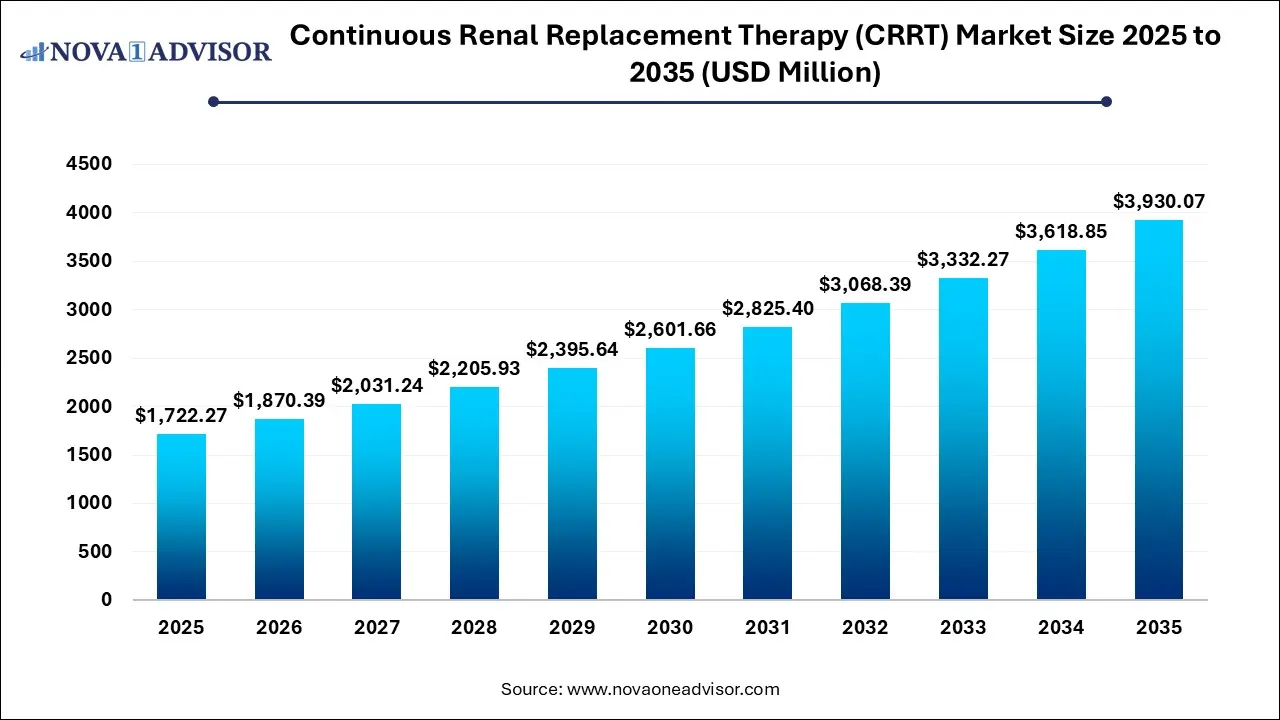
The global continuous renal replacement therapy (CRRT) market size was estimated at USD 1,722.27 million in 2025 and is projected to hit around USD 3,930.07 million by 2035, growing at a CAGR of 8.6% during the forecast period from 2026 to 2035.
Market Overview
The global Continuous Renal Replacement Therapy (CRRT) market has emerged as a critical segment within the broader renal care and critical care therapeutics industry. CRRT refers to a blood purification therapy primarily used for hemodynamically unstable patients suffering from acute kidney injury (AKI), fluid overload, septic shock, and multiple organ dysfunction syndrome. Unlike conventional intermittent hemodialysis, CRRT operates continuously over 24 hours, allowing gradual removal of toxins and fluids while minimizing cardiovascular instability.
The increasing burden of kidney disorders has become a major concern for healthcare systems worldwide. Acute kidney injury is frequently observed among patients admitted to intensive care units, especially those with severe infections, trauma, burns, cardiovascular complications, or post-surgical complications. The growing prevalence of diabetes and hypertension, which are leading causes of chronic kidney disease, is indirectly contributing to the increasing incidence of renal complications requiring CRRT intervention.
Modern ICUs are increasingly incorporating CRRT systems as part of standard critical care management. These systems help clinicians maintain electrolyte balance, acid-base equilibrium, and fluid management in critically ill patients. The therapy is especially valuable in patients who cannot tolerate rapid fluid shifts associated with traditional dialysis procedures. The integration of sophisticated monitoring systems and user-friendly interfaces has significantly improved the operational efficiency of CRRT machines.
The COVID-19 pandemic also highlighted the importance of CRRT in critical care medicine. Many severely infected patients developed acute kidney injury due to systemic inflammation and organ failure, leading to a surge in demand for CRRT systems and consumables. Healthcare providers across multiple countries expanded ICU capacities and invested in advanced renal replacement technologies during the pandemic period.
Manufacturers are focusing heavily on innovation in disposables, hemofilters, and machine automation to improve patient outcomes and reduce operational complexities. Portable and compact CRRT systems are gaining popularity in emergency and resource-limited settings. Moreover, increasing healthcare expenditure and improvements in critical care infrastructure in emerging economies are expected to create significant growth opportunities for the market over the coming years.
Market Outlook
- Market Growth Overview: The continuous renal replacement therapy (CRRT) market is expected to grow significantly between 2025 and 2035, driven by the rising incidence of acute kidney injury, growing ICU administration and geriatric population, and increasing healthcare investment and access.
- Sustainability Trends: Sustainability trends involve green dialysis and waste minimization, eco-efficient technology advancements, and water usage reduction.
- Major Investors: Major investors in the market include Fresenius Medical Care, Baxter International (Vantive), B. Braun Melsungen AG, and Medtronic.
How is AI Transforming the Continuous Renal Replacement Therapy (CRRT) Market
Artificial Intelligence (AI) is playing an increasingly transformative role in the Continuous Renal Replacement Therapy market by improving treatment precision, clinical decision-making, and workflow efficiency. AI-driven technologies are helping healthcare professionals manage critically ill patients more effectively while reducing complications associated with renal replacement therapies.
One of the primary applications of AI in CRRT is predictive analytics. Machine learning algorithms can analyze large volumes of patient data, including blood pressure, electrolyte levels, fluid balance, urine output, and laboratory biomarkers, to predict the onset of acute kidney injury before severe symptoms occur. Early identification allows clinicians to initiate CRRT at optimal stages, potentially improving survival outcomes.
AI is also improving fluid management during therapy. Advanced CRRT systems integrated with intelligent software can continuously monitor patient hemodynamics and automatically adjust ultrafiltration rates based on real-time physiological conditions. This reduces the risk of excessive fluid removal, hypotension, and electrolyte imbalance. Such automation improves patient safety and reduces the burden on ICU staff.
Clinical decision support systems powered by AI are enhancing treatment customization. These systems can recommend personalized therapy settings, anticoagulation protocols, and replacement fluid composition based on patient-specific variables. For example, AI algorithms may suggest optimal dialysis dosing strategies for septic shock patients with varying metabolic requirements.
Remote monitoring and tele-ICU integration are additional areas where AI is influencing the CRRT market. Connected CRRT systems can transmit treatment data to centralized monitoring platforms, enabling specialists to supervise multiple ICU patients remotely. This capability is especially useful in regions facing shortages of nephrologists and critical care specialists.
AI is further supporting operational efficiency through predictive maintenance of CRRT equipment. Smart diagnostics can identify equipment performance issues before failures occur, minimizing downtime and ensuring uninterrupted patient care. Medical device companies are increasingly investing in AI-enabled CRRT platforms to differentiate their offerings and strengthen market competitiveness.
As hospitals continue adopting digital healthcare ecosystems, AI integration is expected to become a defining feature of next-generation CRRT systems. The combination of real-time analytics, automation, and predictive intelligence is likely to revolutionize renal replacement therapy management in intensive care settings.
Continuous Renal Replacement Therapy (CRRT) Market Report Scope
| Report Coverage | Details |
| Market Size in 2026 | USD 1,870.39 Million |
| Market Size by 2035 | USD 3,930.07 Million |
| Growth Rate From 2026 to 2035 | CAGR of 8.6% |
| Base Year | 2025 |
| Forecast Period | 2026 to 2035 |
| Segments Covered | By Product, By Modality, By Age group, By Region |
| Market Analysis (Terms Used) | Value (USD Million/Billion) or (Volume/Units) |
| Regional Scope | North America; Europe; Asia Pacific; Central and South America; the Middle East and Africa |
| Key Companies Profiled | Baxter International Inc. (US), Fresenius Medical Care AG & Co. KGaA (Germany), NIKKISO CO., LTD. (Japan), B. Braun Melsungen AG (Germany), Asahi Kasei Corporation (Japan), Toray Medical Co., Ltd. (Japan), Infomed SA (Switzerland), Medtronic plc (Ireland), Medica S.p.A. (Italy), Medical Components, Inc. (US), Medites Pharma spol. s.r.o. (Czech Republic), SWS Hemodialysis Care Co., Ltd. (China), Ningbo Tianyi Medical Devices Co., Ltd. (China), Nipro Corporation (Japan), and Anjue Medical Equipment Co., Ltd. (China), |
Segmental Insights
By Product
How did the consumables segment account for the largest share in the Continuous Renal Replacement Therapy (CRRT) market?
The consumables segment is driven by the highly consistent and resilient demand curve compared to capital hardware. The widespread clinical adoption of complex modalities, such as CVVHDF, introduces an advanced layer of processing that requires a diverse array of specialized filters, bloodlines, and fluid management systems. To capitalize on this high-volume utilization, medical device manufacturers are aggressively expanding their portfolios with next-generation, cytokine-adsorbing architectures and biocompatible layouts designed to improve therapeutic efficiency.
How did the system segment expect to hold the fastest-growing Continuous Renal Replacement Therapy (CRRT) market in the coming years?
The system segment is driven by the single-use nature of continuous renal replacement therapy consumables, such as specialized filter sets, bloodlines, dialyzers, and dialyzing systemic fluids, which ensures a highly resilient and consistent recurring revenue stream for manufacturers. Ongoing technical innovation in high-efficiency filtration membranes and advanced regional citrate anticoagulation’s in high-efficiency filtration membranes and advanced regional citrate anticoagulant solutions is expanding the therapeutic reliability of these essential components.
By Modality
How did the continuous venovenous hemofiltration (CVVH) segment account for the largest share in the Continuous Renal Replacement Therapy (CRRT) market?
The continuous venovenous hemofiltration (CVVH) segment is driven by the rising global prevalence of acute kidney injury and severe fluid overload among critically ill populations. The specialized convective clearance mechanism of CVVH excels at extracting large inflammatory cytokines, making it the preferred clinical choice for managing sepsis-associated AKI.
How did the CVVHDF segment expect to hold the fastest-growing Continuous Renal Replacement Therapy (CRRT) market in the coming years?
The CVVHDF segment is driven by the technological innovation from medical device manufacturers who are integrating automated replacement-fluid calculations directly into modern consoles to simplify bedside administration. The modality has emerged as the most prevalent continuous renal replacement therapy method for acute kidney injury globally, demonstrating a direct correlation with improved patient survival rates.
By Regional
How did the North America region account for the largest share in the Continuous Renal Replacement Therapy (CRRT) market?
North America’s dense, highly advanced ICU network facilitates the rapid, routine deployment of specialized critical care technologies. The continuous innovation and strategic device clearance ensure an uninterrupted pipeline of next-generation machines and high-volume consumables.
U.S. Continuous Renal Replacement Therapy (CRRT) Market Trends
The U.S. escalating incidence of acute kidney injury and sepsis among an expanding geriatric population serves as the primary catalyst for intensive renal care adoption. The growing clinical preference for continuous therapies over intermittent methods when treating hemodynamically unstable patients within intensive care units. Ongoing technical innovations in automated delivery consoles and high-efficiency filtration membranes continue to optimize patient outcomes and streamline bedside management.
How did the Asia Pacific region hold the fastest-growing Continuous Renal Replacement Therapy (CRRT) Market in the forecast period?
Asia Pacific’s highly lucrative, recurring consumables market ensures continuous, high-volume operational revenues across the territory. The aggressive infrastructure investment, intensive care unit expansion, and the widespread adoption of portable, user-friendly dialysis systems in regional hospitals.
China Continuous Renal Replacement Therapy (CRRT) Market Trends
China’s escalating prevalence of acute renal failure, sepsis, and severe fluid overload among critical care patients serves as the primary catalyst driving advanced intensive care unit (ICU) demand. The regional healthcare sector is intensely focused on adopting advanced, automated, and user-friendly continuous renal replacement therapy (CRRT) hardware to safely manage complex, hemodynamically unstable individuals.
Key Players in the Continuous Renal Replacement Therapy (CRRT) Market
- Baxter International Inc.
Baxter is a market leader in CRRT, providing the widely used Prismaflex and next-generation PrisMax systems, which are designed to support critical care patients with acute kidney injury (AKI).
- Fresenius Medical Care AG & Co. KGaA
As a dominant player in the global dialysis market, Fresenius contributes to CRRT through its advanced multiFiltrate and multiFiltratePRO systems, which are engineered for high-precision, 24-hour treatment.
- NIKKISO CO., LTD.
Nikkiso contributes to the CRRT market by providing specialized, high-reliability artificial kidney machines and blood purification systems, particularly dominant within Japan and with a strong presence in international markets.
Segments Covered in the Report
This report forecasts revenue growth at country levels and provides an analysis of the latest industry trends in each of the sub-segments from 2021 to 2035. For this study, Nova one advisor, Inc. has segmented the continuous renal replacement therapy (CRRT) market.
By Product
- Dialysates and Replacement Fluids
- Disposables
- Hemofilters
- Bloodline Sets & Tubes
- Other Disposables
- CRRT Systems
By Modality
- Continuous venovenous hemofiltration (CVVH)
- Continuous venovenous hemodiafiltration (CVVHDF)
- Continuous venovenous haemodialysis (CVVHD)
- Slow continuous ultrafiltration (SCUF)
By Age group
- Adults
- Pediatrics /Neonates
By Geography
North America
- U.S.
- Canada
Europe
- Germany
- France
- United Kingdom
- Rest of Europe
Asia Pacific
- China
- Japan
- India
- Southeast Asia
- Rest of Asia Pacific
Latin America
- Brazil
- Rest of Latin America
Middle East & Africa (MEA)
- GCC
- North Africa
- South Africa
- Rest of Middle East & Africa

Proceed to Buy
Instant PDF delivery on confirmation

Continuous Renal Replacement Therapy (CRRT) Market Size to Hit USD 3,930.07 Mi...
 Request Customization
 Download Sample

Get a Sample of this Report
Continuous Renal Replacement Therapy (CRRT) Market