

Contrast Enhanced Digital Mammography (CEDM) Market Size, Share, and Trends 2026 to 2035
 Status Published
 Category Healthcare


Content
Contrast Enhanced Digital Mammography (CEDM) Market Size and Growth 2026 to 2035
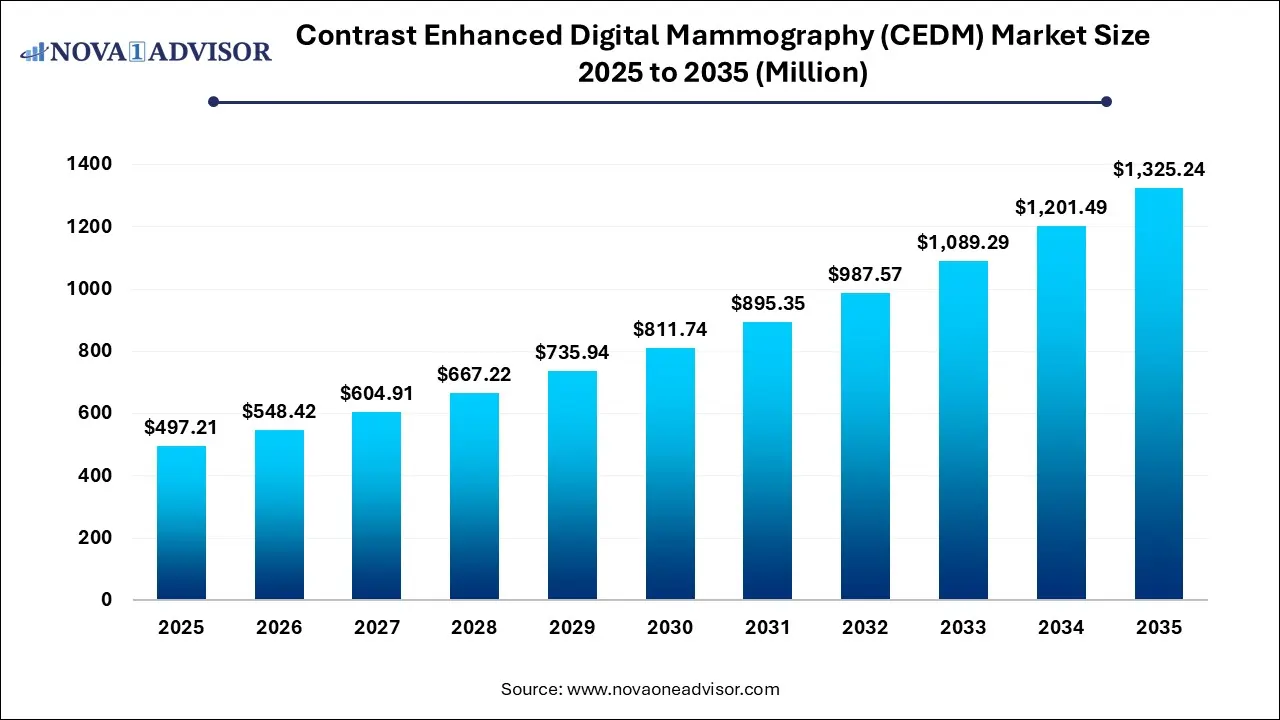
The global contrast enhanced digital mammography (CEDM) market size was valued at USD 497.21 million in 2025 and is projected to grow from USD 548.42 million in 2026 to USD 1,325.24 million by 2035, at a CAGR of 10.3% from 2026 to 2035.
Key Takeaway
- By application, the diagnostics segment dominated the market and accounted for the largest revenue share in 2025.
- By application, the screening segment is anticipated to witness the fastest CAGR over the forecast period.
- By technique, the dual-energy CEDM segment dominated the market and accounted for the largest revenue share in 2025.
- By end user, the hospitals segment dominated the market and accounted for the largest revenue share in 2025.
- By region, North America accounted for the largest revenue share in 2025.
Market Overview
The Contrast Enhanced Digital Mammography (CEDM) market represents a specialized segment within breast imaging technologies focused on improving the detection and characterization of breast lesions. CEDM combines conventional digital mammography with the administration of intravenous iodinated contrast agents, allowing radiologists to visualize tumor-associated vascularity that may not be apparent through standard mammography alone.
Breast cancer remains one of the most frequently diagnosed cancers among women worldwide. Despite advancements in screening methodologies, conventional mammography often faces limitations, particularly in women with dense breast tissue. Dense breast tissue can obscure lesions and reduce diagnostic sensitivity, leading to delayed diagnosis and increased healthcare burden. CEDM addresses this challenge by highlighting areas of abnormal blood flow associated with malignant tumors.
The growing demand for accurate diagnostic imaging is encouraging healthcare providers to adopt advanced breast imaging technologies. CEDM offers several advantages, including shorter examination times, lower costs compared to breast MRI, greater patient comfort, and widespread compatibility with existing mammography infrastructure. These benefits have significantly contributed to its increasing clinical adoption.
The market is also benefiting from government-sponsored breast cancer awareness campaigns, expanded screening initiatives, and increased healthcare investments in oncology diagnostics. As healthcare systems worldwide emphasize early cancer detection and personalized treatment planning, CEDM is becoming an important component of comprehensive breast imaging strategies.
Additionally, ongoing innovations in detector technology, image acquisition methods, and software-based image enhancement are improving the clinical utility of CEDM. Healthcare providers increasingly rely on these systems for lesion characterization, treatment planning, monitoring therapy response, and reducing unnecessary biopsies.
As precision medicine continues to gain prominence in oncology, the role of advanced imaging modalities such as CEDM is expected to expand further, supporting more informed clinical decision-making and improved patient outcomes.
Market Outlook
- Market Growth Overview: The global contrast enhanced digital mammography (CEDM) market is expected to grow significantly between 2026 and 2035, driven by the increasing prevalence of breast cancer, superior lesion detection in dense breasts, and a cost-effective alternative to MRI.
- Sustainability Trends: Sustainability trends involve energy optimization, optimized patient workflows, and hardware upgrades over replacements.
- Major Investors: Major investors in the market include Hologic Inc., GE HealthCare, Siemens Healthineers, and Fujifilm Holdings.
How AI is Impacting the Global Contrast Enhanced Digital Mammography (CEDM) Market?
AI and ML are fundamentally transforming the global contrast enhanced digital mammography (CEDM) industry by improving diagnostic accuracy and streamlining workflows. Deep learning algorithms are increasingly being used to optimize the image acquisition process and enhance the resolution of recombined iodine images. AI-driven analytics assist radiologists by automatically segmenting and flagging suspicious lesions, which significantly reduces the rate of false negatives and speeds up image interpretation.
Contrast Enhanced Digital Mammography (CEDM) Market Report Scope
| Report Coverage | Details |
| Market Size in 2026 | USD 548.42 Million |
| Market Size by 2035 | USD 1,325.24 Million |
| Growth Rate From 2026 to 2035 | CAGR of 10.3% |
| Base Year | 2025 |
| Forecast Period | 2026 to 2035 |
| Segments Covered | By Application, By Technique, By End-User, By Region |
| Market Analysis (Terms Used) | Value (USD Million/Billion) or (Volume/Units) |
| Regional Scope | North America; Europe; Asia Pacific; Central and South America; the Middle East and Africa |
| Key Companies Profiled | Hologic, Inc., Planmed Oy, General Electric Company, Siemens Healthineers, and Allengers |
Segmental Insights
By Application
How did the diagnostics segment dominate the Global Contrast Enhanced Digital Mammography (CEDM) market?
The diagnostics segment is driven by superior diagnostic accuracy, serving as an effective, faster alternative to breast MRIs for evaluating abnormal screenings and symptomatic patients. The technology improves specificity and reduces false-positive recalls, with the added benefits of integrating into existing imaging infrastructure for enhanced, precise biopsy guidance.
How did the screening segment expected to hold the fastest-growing Global Contrast Enhanced Digital Mammography (CEDM) market in the coming years?
The screening segment is driven by the rising global government initiatives for breast cancer awareness and standardized screening programs, which are generating heavier patient volumes, directly boosting the demand for advanced imaging. The ability to upgrade standard digital mammography systems with software and contrast filters provides an affordable solution that reduces false-positive rates and prevents unnecessary tissue biopsies.
By Techniques
Dual Energy CEDM dominated the market due to its superior ability to differentiate contrast-enhanced lesions from surrounding breast tissue. The technique captures low-energy and high-energy images following contrast administration, producing recombined images that highlight areas of increased vascularity associated with malignancy.
Healthcare providers prefer dual-energy approaches because they offer greater diagnostic accuracy and improved visualization compared to traditional imaging techniques. Continued advancements in detector technology and image processing algorithms are further enhancing the clinical utility of dual-energy CEDM systems.
Temporal Subtraction is expected to register notable growth as technological improvements enhance its clinical feasibility. This technique compares pre-contrast and post-contrast images to identify areas of enhancement, allowing radiologists to evaluate lesion vascularity effectively.
Growing research activity and increasing interest in optimizing contrast-enhanced imaging workflows are contributing to segment expansion. Improved software platforms capable of reducing motion artifacts and enhancing image registration are expected to accelerate adoption across clinical settings.
By End User
How did the hospitals segment dominate the Global Contrast Enhanced Digital Mammography (CEDM) market?
The hospitals segment is driven by tertiary care centers; hospitals heavily leverage the problem-solving utility of CEDM to accurately evaluate inconclusive findings, dense breast tissue, and high-risk patient assessments. The institutions are increasingly integrating advanced imaging systems into dedicated, one-stop breast health centers that streamline everything from detection to oncology treatments.
How did the diagnostic centers segment expected to hold the fastest-growing Global Contrast Enhanced Digital Mammography (CEDM) market in the coming years?
The diagnostic centers segment is driven by efficient infrastructure that ensures faster patient throughput and minimized examination wait times, enabling specialized imaging centers to seamlessly manage higher patient volumes while maintaining exceptional diagnostic focus. By utilizing contrast agents to brightly highlight vascularized lesions, facilities dramatically improve diagnostic efficiency, resolve inconclusive findings, and lower false-positive recall rates.
By Regional
How did the North America region account for the largest share in the Global Contrast Enhanced Digital Mammography (CEDM) market?
North America is driven by a strong concentration of leading medical device manufacturers and research institutions that accelerate the rollout of cutting-edge, AI-enabled diagnostic software. The extensive government and non-profit public awareness campaigns maximize this infrastructure by ensuring exceptionally high participation rates in routine, early-detection breast screening programs.
U.S. Global Contrast Enhanced Digital Mammography (CEDM) Market Trends
The U.S. rising clinical preference as physicians increasingly recommend CEDM over combined ultrasound and standard mammography for high-risk patients and preoperative staging due to its superior sensitivity and specificity. To enhance these clinical workflows, leading vendors are seamlessly embedding deep learning and advanced reconstruction algorithms directly into their imaging software.
How did the Asia-Pacific region become the fastest-growing Global Contrast Enhanced Digital Mammography (CEDM) Market during the forecast period?
Asia Pacific is driven by the rising breast cancer incidence across China, India, and Japan coupled with upgraded hospital infrastructures- and has fueled a massive regional procurement of modern mammography units. The organized government screening campaigns, improved reimbursement policies, and the integration of AI-powered 3D visualization further accelerate the adoption of these advanced contrast-enhanced digital systems.
China Global Contrast Enhanced Digital Mammography (CEDM) Market Trends
China’s government initiatives, shift to advanced contrast-enhanced digital mammography, and deep learning integration. The strategic shift toward outpatient screening centers and intense competition between global, high-definition spectral imaging providers and emerging domestic manufacturers.
How Did Europe Hold A Notable Share in the Global Contrast Enhanced Digital Mammography (CEDM) Market?
Europe’s rapid integration of standardized ACR BI-RADS guidelines has boosted the overall reliability of these systems, establishing contrast-enhanced imaging as a preferred diagnostic alternative across the region. The clinical uptake is concentrated within high-volume academic settings and specialized centers, where widespread research from the European Society of Breast Imaging drives the deployment of dual-energy protocols.
Germany Global Contrast Enhanced Digital Mammography (CEDM) Market Trends
Germany’s rollout of AI-assisted workflows optimizes the ecosystem by streamlining image acquisition, improving subtle lesion detection, and easing clinical interpretation in complex anatomies. The increasingly recognized as a faster, more cost-effective functional imaging alternative to breast MRI for patients with inconclusive findings or dense breast tissue.
Key Players in the Global Contrast Enhanced Digital Mammography (CEDM) Market
- Hologic, Inc.
Hologic contributes to the CEDM market through its I-View™ software, which seamlessly integrates with their 3Dimensions® Mammography System to produce iodine-enhanced images. This technology allows clinicians to conduct fast, cost-effective contrast-enhanced breast exams as an alternative to MRI without needing entirely new hardware.
- Planmed Oy
Planmed Oy drives the CEDM market through its Planmed Clarity+™ product line, which features an optional, flexible contrast-enhanced mammography (CEM) upgrade. Their systems combine traditional mammography with iodine-based contrast agents to enhance lesion visibility, offering highly sensitive diagnostic tools for women with dense breast tissue.
- General Electric Company (GE HealthCare)
GE HealthCare revolutionized the CEDM market with its SenoBright™ HD Contrast Enhanced Mammography solution.
Segments Covered in the Report
This report forecasts revenue growth at country levels and provides an analysis of the latest industry trends in each of the sub-segments from 2021 to 2035. For this study, Nova one advisor, Inc. has contrast enhanced digital mammography (CEDM) market.
By Application
- Screening
- Diagnostics
By Technique
- Temporal Subtraction
- Dual Energy CEDM
By End User
- Hospitals
- Diagnostic Centers
- Specialty Clinics
- Others
By Regional
- North America
- United States
- Canada
- Europe
- Germany
- United Kingdom
- Italy
- France
- Rest of EU
- Asia Pacific
- China
- India
- Japan
- Southeast Asia
- Rest of APAC
- Central & South America
- Brazil
- Argentina
- Rest of Central & South America
- Middle East and Africa
- UAE
- Saudi Arabia
- Rest of MEA
FAQ's

Proceed to Buy
Instant PDF delivery on confirmation

Contrast Enhanced Digital Mammography (CEDM) Market Size to Hit USD 1,325.24 M...
 Request Customization
 Download Sample
Warning: Trying to access array offset on value of type null in /home/multiwpmr/public_html/report-details.php on line 1145

Get a Sample of this Report
Contrast Enhanced Digital Mammography (CEDM) Market