

Coronary Angiography Devices Market Size, Share, and Trends 2026 to 2035
 Status Published
 Category Healthcare


Content
Coronary Angiography Devices Market Size and Growth 2026 to 2035
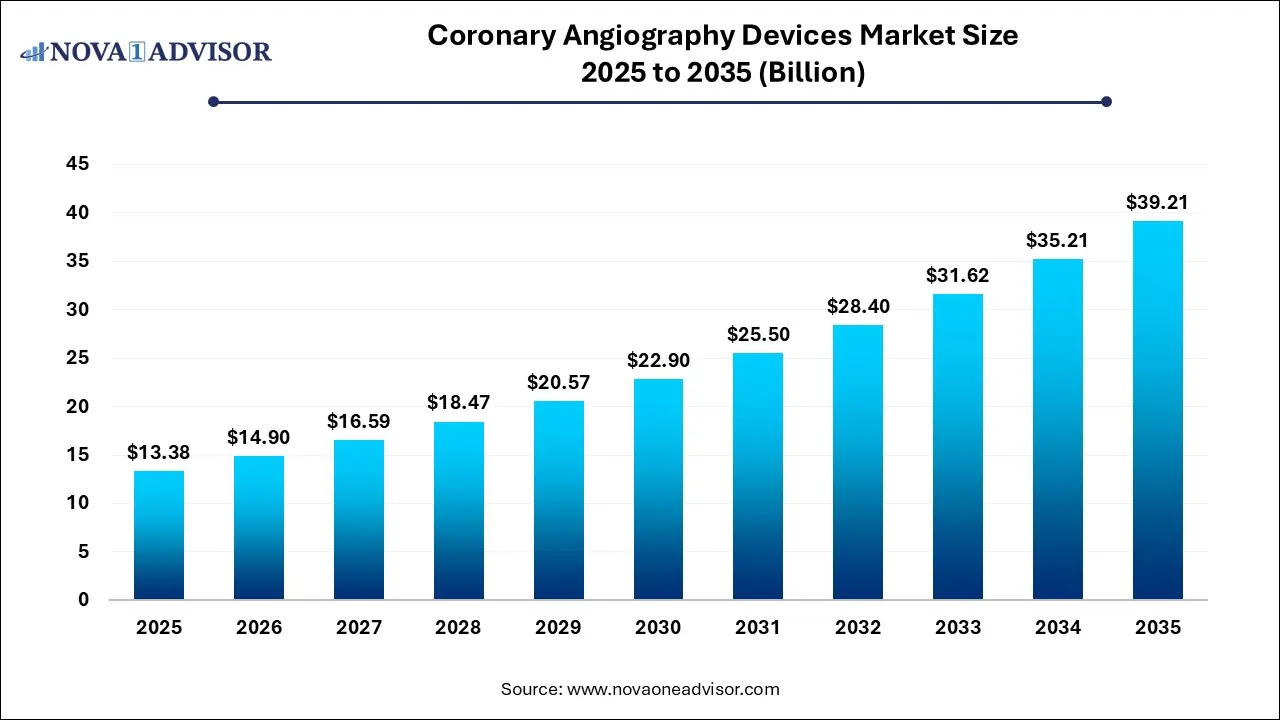
The global coronary angiography devices market size was valued at USD 13.38 billion in 2025 and is projected to grow from USD 14.90 billion in 2026 to USD 39.21 billion by 2035, at a CAGR of 11.35% from 2026 to 2035.
Key Takeaway:
- By device type, the catheters segment dominated the market and accounted for the largest revenue share in 2025.
- By device type, the guidewires segment fastest growing in the market in 2025.
- By application, the diagnostic segment dominated the market and accounted for the largest revenue share in 2025.
- By end user, the hospitals segment dominated the market and accounted for the largest revenue share in 2025.
- By region, North America accounted for the largest revenue share in 2025.
Market Overview
The coronary angiography devices market is growing steadily due to the increasing prevalence of coronary artery disease (CAD) and the rising demand for minimally invasive cardiovascular diagnostics and interventions. Coronary angiography remains the gold standard for visualizing coronary arteries, enabling accurate diagnosis and treatment planning using catheters, guidewires, contrast media, and advanced imaging systems. Continuous technological advancements, including AI-enabled imaging, 3D visualization, and integrated catheterization laboratories, are improving procedural precision, patient safety, and clinical outcomes while supporting market expansion.
Market Outlook
- Market Growth Overview: The global coronary angiography devices market is expected to grow significantly between 2025 and 2035, driven by the rising cardiovascular diseases, growing minimally invasive procedures, and rising geriatric population.
- Sustainability Trends: Sustainability trends involve energy-efficient hardware, radiation and contrast optimization, and circular economy initiatives.
- Major Investors: Major investors in the market include GE HealthCare, Siemens Healthineers, Koninklijke Philips, Medtronic, Abbott, and Boston Scientific.
How is AI Impacting the Global Coronary Angiography Devices Market?
AI and ML are driving the rapid growth of the global coronary angiography devices industry by automating routine tasks, improving diagnostic precision, and minimizing interobserver variability in cardiovascular procedures. AI-powered systems can now instantly extract key functional and physiological data from routine angiograms and enable fully automated quantitative coronary analysis (AI-QCA). By evaluating complex parameters and vessel characteristics in a fraction of the time, these technologies allow clinicians to optimize stent placement and personalize patient treatment strategies.
Coronary Angiography Devices Market Report Scope
| Report Coverage | Details |
| Market Size in 2026 | USD 14.90 Billion |
| Market Size by 2035 | USD 39.21 Billion |
| Growth Rate From 2026 to 2035 | CAGR of 11.35% |
| Base Year | 2025 |
| Forecast Period | 2026 to 2035 |
| Segments Covered | By Device Type, By Application, By End User, By Region |
| Market Analysis (Terms Used) | Value (USD Million/Billion) or (Volume/Units) |
| Regional Scope | North America; Europe; Asia Pacific; Central and South America; the Middle East and Africa |
| Key Companies Profiled | Terumo, Boston Scientific Corporation, Canon Medical Systems, Cordis ( A Cardinal Health Company), B. Braun Melsungen AG, Angiodynamics, Abbott Vascular (Abbott Laboratories), Toshiba Medical Systems Corporation, Royal Philips Electronics, GE Healthcare, Medtronic, Inc., Shimadzu Corporation, and Siemens Healthcare. |
Market Driver: Rising Burden of Coronary Artery Disease
The growing incidence of coronary artery disease, driven by aging populations, diabetes, obesity, hypertension, and unhealthy lifestyles, is the primary driver of the market. Increasing demand for early diagnosis and minimally invasive treatment continues to boost the adoption of coronary angiography devices worldwide.
Market Restraint: High Cost of Advanced Angiography Systems
The high acquisition and maintenance costs of advanced angiography systems, along with infrastructure requirements and the need for specialized personnel, limit adoption, particularly in smaller healthcare facilities and developing countries with constrained healthcare budgets.
Market Opportunity: Expansion of AI-Enabled Image-Guided Cardiology
The integration of AI, intravascular imaging technologies, and advanced image-guided interventions presents significant growth opportunities. These innovations improve diagnostic accuracy, procedural efficiency, and personalized treatment planning, driving the adoption of next-generation coronary angiography systems across modern cardiac care centers.
Segmental Insights
By Device Type
How did the catheters segment dominate the Global Coronary Angiography Devices market?
The catheters segment is driven by the strong clinical shift toward minimally invasive access and offers a safer alternative to traditional open exploratory methods. The technological innovations, such as advanced hydrophilic coatings, significantly enhance trackability and navigation through complex vascular anatomies, boosting procedural success rates.
How did the guidewires segment expect to hold the fastest-growing Global Coronary Angiography Devices market in the coming years?
The guidewires segment is driven by the surging preference for minimally invasive treatments, such as surging preference for minimally invasive treatments, such as percutaneous coronary interventions, which require specialized wires to navigate complex vasculature. The continuous engineering innovations, including hybrid core designs, real-time pressure sensing capabilities, and advanced torque control, optimize procedural efficiency and lower patient mortality risk.
By Application
How did the diagnostic segment dominate the Global Coronary Angiography Devices market?
The diagnostic segment is driven by technological innovations such as AI-powered image analysis, real-time 3D imaging, and advanced software road mapping that drastically improve overall procedural efficiency and diagnostic accuracy. The growing global disease burden of heart attacks, angina, and cardiac arrhythmias has significantly increased clinical reliance on early diagnostic imaging to plan effective treatments.
How did the therapeutic segment expect to hold the fastest-growing Global Coronary Angiography Devices market in the coming years?
The therapeutic segment is driven by the emergency interventions for conditions such as myocardial infarctions, driving steady, non-discretionary utilization of therapeutic tools. Additionally, a surge in local and regional market players across emerging economies is increasing overall access to advanced cardiac care while driving localized product distribution networks.
By End User
How did the hospitals segment dominate the Global Coronary Angiography Devices market?
The hospitals segment is driven by the massive and diverse patient pool, centralizing complex care pathways and emergency interventions for severe cardiovascular diseases. The advanced infrastructure, dedicated space, and highly specialized personnel are required to safely conduct high-acuity diagnostic and interventional procedures.
How did the cardiology clinics segment expect to hold the fastest-growing Global Coronary Angiography Devices market in the coming years?
The cardiology clinics segment is driven by the massive clinical shift transferring routine diagnostic and interventional procedures out of traditional hospital settings. The cost-effectiveness and streamlined operational design of ASCs, which offer patients quicker recovery times and significantly lower out-of-pocket costs.
By Regional
How did the North America region account for the largest share in the Global Coronary Angiography Devices market?
North America is driven by the vast healthcare infrastructure of specialized laboratories and hybrid operating rooms that seamlessly integrate flat-panel detectors with 3D rotational angiography. The region acts as a primary hub for early technological adoption, with hospitals heavily investing in next-generation, AI-integrated guidance platforms.
U.S. Global Coronary Angiography Devices Market Trends
The U.S.'s strong industry shift toward minimally invasive procedures reduces hospital stays and accelerates patient recovery times. The modern angiography systems are increasingly integrating artificial intelligence and robotics, significantly enhancing image quality while drastically reducing radiation exposure for both patients and clinical staff.
How did the Asia-Pacific region become the fastest-growing Global Coronary Angiography Devices Market during the forecast period?
Asia Pacific is driven by the rising rate of diabetes, hypertension, and a rapidly aging demographic across emerging economies, such as China and India. The massive public and private investments to modernize cardiac care, rapidly establish catheterization labs, and widen public insurance coverage for advanced endovascular interventions.
China Global Coronary Angiography Devices Market Trends
China has massive integration of artificial intelligence and advanced imaging inside hybrid operating rooms, which enables faster diagnoses and precise visualization during complex, minimally invasive procedures. The rapid expansion of a national network of dedicated chest pain centers has drastically reduced emergency door-to-balloon times, driving immense and continuous demand for rapid diagnostic catheters in urgent care settings.
How Did Europe Hold A Notable Share in the Global Coronary Angiography Devices Market?
Europe’s high procedural volumes and advanced healthcare infrastructure, with nations such as Germany generating immense, recurring demand for fixed X-ray systems and consumables. The rapid adoption of next-generation technologies, such as AI-powered image enhancement, 3D rotational angiography, and integrated intravascular imaging platforms.
Germany Global Coronary Angiography Devices Market Trends
Germany’s integration of artificial intelligence and digital subtraction angiography optimizes procedural workflows to deliver highly precise image-guided therapies. The heavy hospital investments in advanced hybrid operating rooms allow teams to immediate catheter-based interventions in a single clinical setting.
Key Players in the Global Coronary Angiography Devices Market
- Terumo Corporation ; Terumo dominates the consumables side of the market by holding a major global share in high-performance angiographic guidewires and catheters. They pioneer Transradial Intervention (TRI) techniques that enable doctors to access coronary arteries via the wrist, significantly reducing patient recovery times and complication risks.
- Boston Scientific Corporation ; Boston Scientific is a primary provider of catheter-based therapies and intravascular imaging systems (such as IVUS) that deliver multi-modality guidance during coronary angiography procedures. Their advanced tools are designed specifically to help physicians navigate, map, and treat complex arterial blockages with pinpoint precision.
- Canon Medical Systems ; Canon Medical Systems supplies the heavy hardware, engineering high-end X-ray angiography systems and CT scanners that provide real-time, high-definition visualization of coronary arteries.
Segments Covered in the Report
This report forecasts revenue growth at country levels and provides an analysis of the latest industry trends in each of the sub-segments from 2021 to 2035. For this study, Nova one advisor, Inc. has coronary angiography devices market.
By Device Type
- Catheters
- Guidewires
- Contrast Media
- Imaging Systems
By Application
- Diagnostic
- Therapeutic
- Research
By End User
- Hospitals
- Cardiology Clinics
- Ambulatory Surgical Centers
By Region
- North America
- Europe
- Asia-Pacific
- Latin America
- Middle East & Africa (MEA)
FAQ's

Proceed to Buy
Instant PDF delivery on confirmation

Coronary Angiography Devices Market Size to Hit USD 39.21 Billion by 2035
 Request Customization
 Download Sample

Get a Sample of this Report
Coronary Angiography Devices Market