

Counterfeit Drug Detection Device Market Size, Share, Growth, Report 2026 to 2035
 Status Published
 Category Healthcare


Content
Counterfeit Drug Detection Device Market Size and Growth 2026 to 2035
The global counterfeit drug detection device market size was valued at USD 1.95 billion in 2025 and is projected to grow from USD 2.04 billion in 2026 to USD 3.12 billion by 2035, at a CAGR of 4.82% from 2026 to 2035.
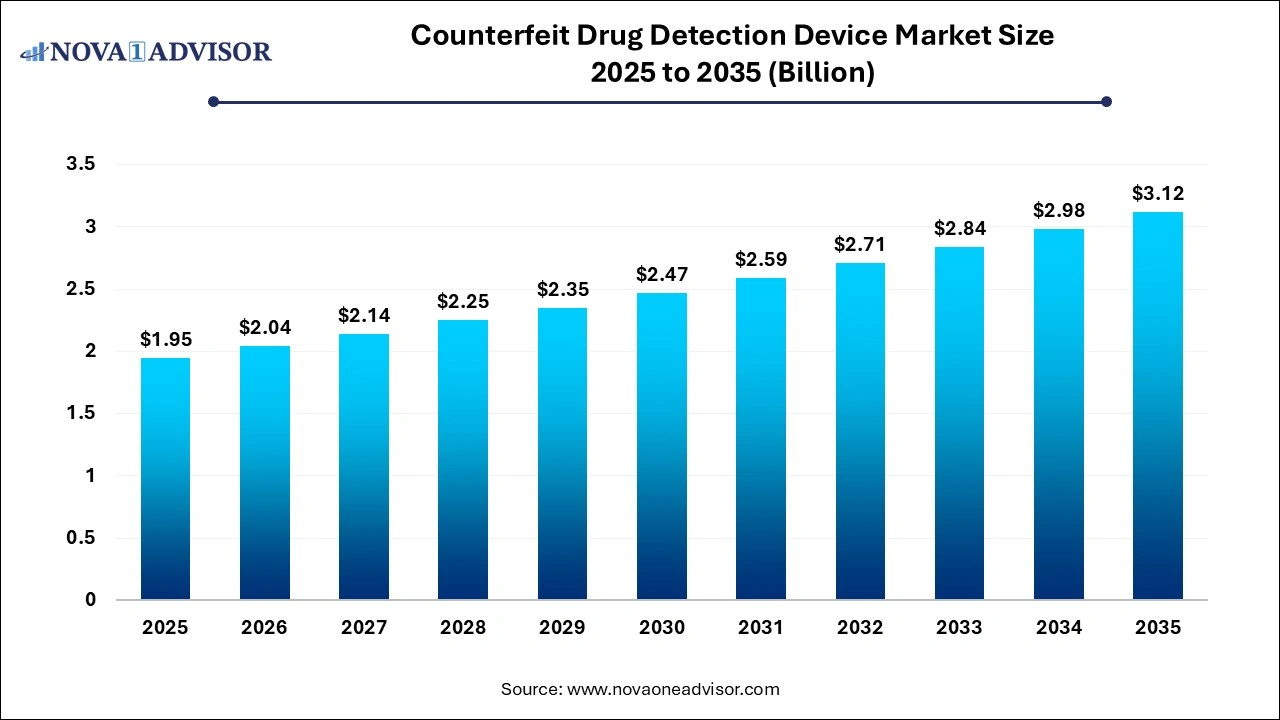
Key Takeaway:
- By product, the counterfeit chemical composition detection devices segment dominated the market with the largest share in 2025.
- By product, the counterfeit packaging and labelling detection devices segment is expected to grow at the fastest CAGR over the forecast period.
- By modality, the benchtop devices segment dominated the market with the largest share in 2025.
- By end use, the pharmaceutical companies segment dominated the market with the largest share in 2025.
- By region, North America dominated the market with the largest share in 2025.
Market Overview
The counterfeit drug detection device market includes analytical instruments, screening systems, spectroscopy devices, imaging technologies, and inspection equipment used to identify falsified, adulterated, mislabeled, or substandard medicines. These solutions support pharmaceutical manufacturers, customs authorities, regulators, laboratories, healthcare organizations, and post-market surveillance programs.
Detection technologies range from handheld Raman and other spectroscopic systems for rapid chemical authentication to laboratory-based chromatography and advanced analytical methods for confirmatory testing. Packaging inspection, serialization, and traceability technologies increasingly complement chemical analysis as pharmaceutical supply chains become more complex and e-commerce expands.
Portable detection devices are gaining importance because they can screen suspicious medicines rapidly at manufacturing, distribution, customs, and field locations. However, their effectiveness can vary by formulation, dosage form, and counterfeit characteristics, making laboratory confirmation important for complex cases. The market is therefore moving toward integrated solutions combining chemical authentication, packaging verification, serialization, traceability, and confirmatory analysis.
Market Outlook
- Market Growth Overview: The global counterfeit drug detection device market is expected to grow significantly between 2025 and 2035, driven by the growing incidence of counterfeit and substandard medicines globally.
- Sustainability Trends: Sustainability trends involve a growing emphasis on minimizing electronic waste and using sustainable materials.
- Major Investors: Major investors in the market include Rigaku Analytical Devices, Metrohm AG, Smiths Detection, Spectral Engines Oy, Systech International, and GAO Group.
How is AI Impacting The Global Counterfeit Drug Detection Device Market?
Artificial intelligence (AI) is reshaping the market by transitioning capabilities from slow manual testing to predictive, real-time, and portable analysis. Furthermore, AI-powered chemometrics can interpret complicated data from near-infrared (NIR) spectrometers on the spot, by letting pharmacy inspectors verify chemical compounds instantly without lab delays.
Major Trends in the Market
- Rapid growth of handheld spectroscopy: Portable Raman and NIR systems are increasingly used for field screening and point-of-need authentication.
- Shift toward non-destructive testing: Manufacturers and regulators increasingly favor methods that can analyze products without destroying valuable samples.
- Integration of chemical and packaging authentication: Chemical composition testing is increasingly combined with visual, barcode, serialization, and packaging analysis.
- AI-assisted spectral classification: Machine learning is increasingly being explored to improve the interpretation of complex spectral datasets.
- Growth of mobile laboratories: Regulatory agencies and enforcement organizations are deploying analytical capabilities closer to ports, borders, warehouses, and distribution centers.
Counterfeit Drug Detection Device Market Report Scope
| Report Coverage | Details |
| Market Size in 2026 | USD 2.04 Billion |
| Market Size by 2035 | USD 3.12 Billion |
| Growth Rate From 2026 to 2035 | CAGR of 4.82% |
| Base Year | 2025 |
| Forecast Period | 2026 to 2035 |
| Segments Covered | By Product, By Modality, By End Use, Region |
| Market Analysis (Terms Used) | Value (USD Million/Billion) or (Volume/Units) |
| Regional Scope | North America; Europe; Asia Pacific; Central and South America; the Middle East and Africa |
| Key Companies Profiled | Companies such as Thermo Fisher Scientific Inc. (U.S.), Agilent Technologies, Inc. (U.S.), Bruker Corporation (U.S.), PerkinElmer Inc. (U.S.), Abbott (U.S.) are major players in counterfeit drug detection device market. |
Major Driver: Increasing Global Circulation of Falsified Medicines
The growing circulation of falsified and substandard medicines through complex international supply chains is driving demand for rapid detection technologies. Pharmaceutical products increasingly move across manufacturers, distributors, wholesalers, pharmacies, hospitals, online platforms, and borders, creating more points where substitution or tampering can occur. The expansion of e-commerce and sophisticated counterfeit packaging further increases the need for analytical authentication. Portable Raman and NIR systems can support rapid field screening, allowing regulators and supply-chain operators to identify suspicious products before sending them for confirmatory laboratory testing.
Major Restraint: Analytical Complexity and False-Positive/False-Negative Risk
Accurately distinguishing genuine medicines from falsified or substandard products can be technically challenging because counterfeit products may contain incorrect ingredients, different concentrations, substituted excipients, or even the correct active ingredient in an unauthorized formulation. Spectroscopic and imaging technologies can provide rapid screening but may have limitations depending on dosage form, formulation, packaging, measurement conditions, and operator technique. High-end laboratory systems also require significant investment, skilled personnel, maintenance, and validated procedures, reinforcing the need for layered detection strategies.
Major Opportunity: Portable and AI-Enabled Field Detection
Portable, connected, and AI-assisted detection systems represent a significant growth opportunity by extending pharmaceutical authentication beyond centralized laboratories. Handheld spectroscopy can enable rapid screening at customs checkpoints, warehouses, pharmacies, manufacturing facilities, and distribution centers. AI can help compare measurements with validated reference libraries, assess confidence levels, and identify samples requiring laboratory confirmation. Smartphone-based imaging and digital authentication can further combine packaging, serialization, and chemical information. The long-term opportunity is increasingly centered on integrated, affordable, field-deployable authentication ecosystems rather than standalone detection instruments.
Segmental Insights
By Product
Why did the counterfeit chemical composition detection devices segment dominate the global counterfeit drug detection device market?
The counterfeit chemical composition detection devices segment dominated the market with the largest share in 2025. The dominance of the segment can be attributed to the growing demand for precise verification of active pharmaceutical ingredients (APIs) and identification of falsified drugs. In addition, counterfeiters no longer depend on crude packaging copies; they manufacture pills with correct visual appearance but with the incorrect chemical formulas.
How did the counterfeit packaging and labelling detection devices segment expected to hold the significantly growing global counterfeit drug detection device market in the coming years?
The counterfeit packaging and labelling detection devices segment is expected to grow at the fastest CAGR over the forecast period. The growth of the segment can be credited to the growing sophistication in counterfeit packaging methods and surge in demand for authentication of barcodes and labels. Also, emerging countries are increasingly rolling out mandatory QR code and other regulatory mandates on pharmaceutical packaging.
By Modality
Why did the benchtop devices segment dominate the global counterfeit drug detection device market?
The benchtop devices segment dominated the market with the largest share in 2025. The dominance of the segment can be linked to its high precision, innovative analytical capabilities, and extensive use in pharmaceutical quality control settings. Additionally, it offers deeper chemical characterization and extensive spectral ranges than portable units, reducing false results.
How did the portable devices segment expected to hold the significantly growing global counterfeit drug detection device market in the coming years?
The portable devices segment is expected to grow at the fastest CAGR over the forecast period. The growth of the segment can be driven by the growing need for rapid and on-site drug verifications. The growing global distribution of substandard, falsified, and dangerous synthetic drugs forces healthcare providers to take action.
By End Use
Why did the pharmaceutical companies segment dominate the global counterfeit drug detection device market?
The pharmaceutical companies segment dominated the market with the largest share in 2025. The dominance of the segment is owing to the growing demand to ensure drug compliance, safety, and quality assurance over the production and distribution processes. Furthermore, modern devices validate active pharmaceutical ingredients (APIs) without opening or eliminating primary packaging.
How did the drug testing laboratories segment expected to hold the significantly growing global counterfeit drug detection device market in the coming years?
The drug testing laboratories segment is expected to grow at the fastest CAGR over the forecast period. The growth of the segment is due to the growing need for solo validation of pharmaceutical products and technological innovations in laboratory automation. Moreover, this lab represents a high-reliability, core segment as it can handle confirmatory assays and forensic evaluation of suspect products.
By Region
Why did the North American region account for the largest share of the global counterfeit drug detection device market?
North America dominated the market with the largest share in 2025. The dominance of the region can be attributed to the growing adoption of pharmaceutical authentication technologies and the presence of cutting-edge healthcare infrastructure in major countries. In addition, pharmaceutical firms and distributors are heavily adopting stringent verification technology to prevent penalties and legal action.
U.S. Global Counterfeit Drug Detection Device Market Trends
The growth of the market in the country can be driven by the growing adoption of cutting-edge drug authentication technologies and the presence of robust authentication technologies. Also, the growth in online pharmacies and sourcing channels raises the risk of fraudulent products bypassing legitimate distribution networks in verification infrastructure.
Why did the Asia-Pacific region become the fastest-growing global counterfeit drug detection device market during the forecast period?
Asia Pacific is expected to grow at the fastest CAGR over the forecast period. The growth of the region can be credited to the growing prevalence of counterfeit drugs and rapid expansion of pharmaceutical manufacturing in emerging economies such as China and India. Furthermore, APAC acts as a leading global pharmaceutical production hub; local generic drug makers use various devices to pass stringent Western regulatory audits (FDA/EMA), driving regional growth soon.
China Global Counterfeit Drug Detection Device Market Trends
The market in the country is growing due to the ongoing growth of cutting-edge traceability systems and robust investments in healthcare technology. Moreover, China's expansive domestic drug manufacturing and API markets need strong on-site screening and supply-chain structure.
Key Players in the Global Counterfeit Drug Detection Device Market
- Thermo Fisher Scientific Inc. (U.S.): An industry leader providing high-end lab and field instruments. Their portable XRF, NIR, and handheld Raman spectrometers can identify active pharmaceutical ingredients (APIs) on-site within 30 seconds.
- PerkinElmer Inc. (U.S.): It delivers specialized benchtop and inline optical automated screening systems optimized for immediate bulk checking at the manufacturing and large-scale distribution levels.
- Systech International (U.S.): A pioneer in pharmaceutical serialization and track-and-trace software platforms. They combine packaging inspection hardware with digital serialization to verify unit-level authenticity across global supply chains.
Recent Developments
In November 2025, amid increasing safety concerns, Karnataka is set to implement a third-party drug testing model facilitated by the Quality Council of India (QCI). Industry stakeholders have noted that recent instances of substandard pharmaceuticals underscore a critical necessity for enhanced regulatory oversight, greater transparency, and independent audits of analytical testing facilities.
Segments Covered in the Report
This report forecasts revenue growth at country levels and provides an analysis of the latest industry trends in each of the sub-segments from 2021 to 2035. For this study, Nova one advisor, Inc. has counterfeit drug detection device market.
By Product
- Counterfeit Chemical Composition Detection Devices
- Counterfeit Packaging
- Labelling Detection Devices
By Modality
- Portable Devices
- Handheld Devices
- Benchtop Devices
By End Use
- Pharmaceutical Companies
- Drug Testing Laboratories
- Research Organizations
- Regulatory Authorities
- Others
By Region
- North America
- Europe
- Asia-Pacific
- Latin America
- Middle East & Africa (MEA)
FAQ's

Proceed to Buy
Instant PDF delivery on confirmation

Counterfeit Drug Detection Device Market Size to Hit USD 3.12 Billion by 2035
 Request Customization
 Download Sample

Get a Sample of this Report
Counterfeit Drug Detection Device Market