

COVID-19 Impact on Critical Care Device Market Size, Share, Forecast Report, 2026-2035
 Status Published
 Category Healthcare


Content
COVID-19 Impact on Critical Care Device Market Size, Growth and Trends 2026 to 2035
The covid-19 impact on critical care device market size was valued at USD 82.34 Billion in 2025 and is expected to hit around USD 3,268.03 Billion by 2035 with a CAGR of 44.5%.
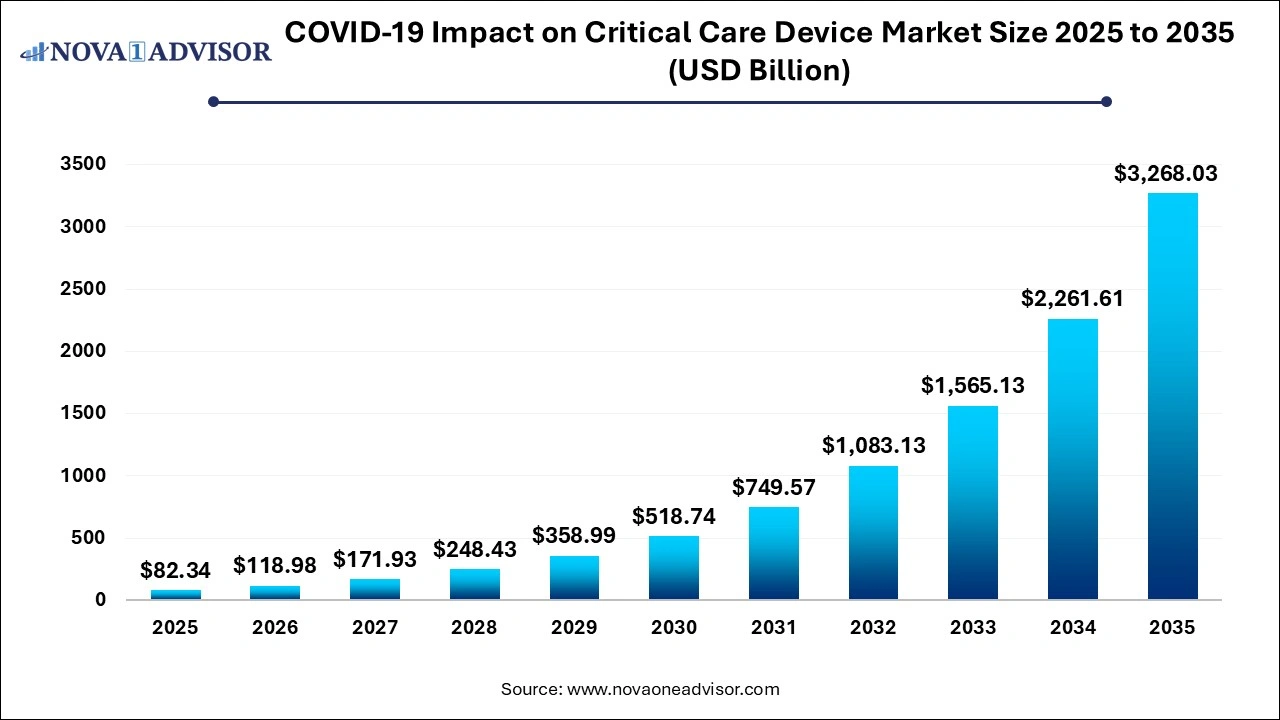
COVID-19 Impact on Critical Care Device Market Outlook
- Market Growth Overview: The COVID-19 impact on the critical care device market is expected to grow significantly between 2026 and 2035, driven by the expansion of ICU infrastructure, rising prevalence of chronic diseases, and demographic shift towards growing geriatric populations.
- Sustainability Trends: Sustainability trends involve eco-friendly design and circularity, energy-efficient critical care, and sustainable packaging solutions.
- Major Investors: Major investors in the market include Becton, Dickinson and Company, Johnson & Johnson, Stryker, and GE Healthcare.
Report Scope of COVID-19 Impact on Critical Care Device Market
| Report Coverage | Details |
| Market Size in 2026 | USD 118.98 Billion |
| Market Size by 2035 | USD 3,268.03 Billion |
| Growth Rate From 2026 to 2035 | CAGR of 44.5% |
| Base Year | 2025 |
| Forecast Period | 2026 to 2035 |
| Segments Covered | By Product Type, By End User |
| Market Analysis (Terms Used) | Value (USD Million/Billion) or (Volume/Units) |
| Regional Covered | North America; Europe; Asia Pacific; Latin America; MEA |
COVID-19 Impact on Critical Care Device Market Segment Insights
By Product Type Insights
How did the Ventilators and Supplies Segment Dominate the COVID-19 Impact on Critical Care Device Market?
The ventilators and supplies segment is driven by the unprecedented global surge in patients with severe respiratory failure, which mandated mechanical ventilation as a primary life-saving intervention. The pandemic exposed critical shortages, forcing governments and hospitals into "panic buying" that increased demand. To meet this deficit, major manufacturers like Medtronic and Philips ramped up production, while non-healthcare companies like Ford and Tesla repurposed assembly lines for rapid manufacturing.
By End User Insights
How did the Hospitals and Clinics Segment Dominate the COVID-19 Impact on Critical Care Device Market?
The hospitals and clinics segment is driven by serving as the primary frontline for managing severe COVID-19 cases, accounting for a massive revenue share. Their strong financial capabilities to purchase high-priced equipment like ventilators and multiparameter monitors, alongside the specialized infrastructure of intensive care units (ICUs) required for life-support. The hospitals provided the only centralized pool of trained healthcare professionals capable of operating complex devices under emergency conditions.
How did the home care settings segment expect to hold the fastest-growing COVID-19 Impact on Critical Care Device market in the coming years?
The home care settings segment is driven by a strategic shift toward cost-effective, decentralized care following the COVID-19 pandemic. The integration of AI-powered remote monitoring and the Internet of Things (IoT) allows complex devices like portable ventilators and infusion pump to be operated safely outside traditional ICUs. The growing geriatric population suffering from chronic respiratory and cardiovascular diseases increasingly prefers "aging in place," which reduces the burden on overcapacity hospitals.
The COVID-19 Impact on Critical Care Device Market Segments Covered in the Report
By Product
- High-Impact Products
- Ventilators and Supplies
- Patient Monitors
- Infusion Pumps
- Hyperbaric Oxygen Therapy Devices
- Sleep Apnea Devices
- Low-Impact Products
- Anesthesia Machines
- Defibrillators
- Blood Warmers
- Other Critical Care devices and supplies
By End User
- Hospitals and Clinics
- Home Care Settings
- Ambulatory Care Settings
- Emergency Medical Services
By Region
- North America
- US
- Canada
- Europe
- Germany
- UK
- France
- Italy
- Spain
- Rest of Europe (RoE)
- Asia Pacific
- Japan
- China
- India
- Rest of Asia Pacific (RoAPAC)
- Latin America
- Middle East & Africa

Proceed to Buy
Instant PDF delivery on confirmation

COVID-19 Impact on Critical Care Device Market Size to Exceed USD 3,268.03 Bn ...
 Request Customization
 Download Sample

Get a Sample of this Report
COVID-19 Impact on Critical Care Device Market