

Customer Communication Management Market Size, Share, and Trends 2026 to 2035
 Status Published
 Category Healthcare


Content
Customer Communication Management Software Market Size and Growth 2026 to 2035
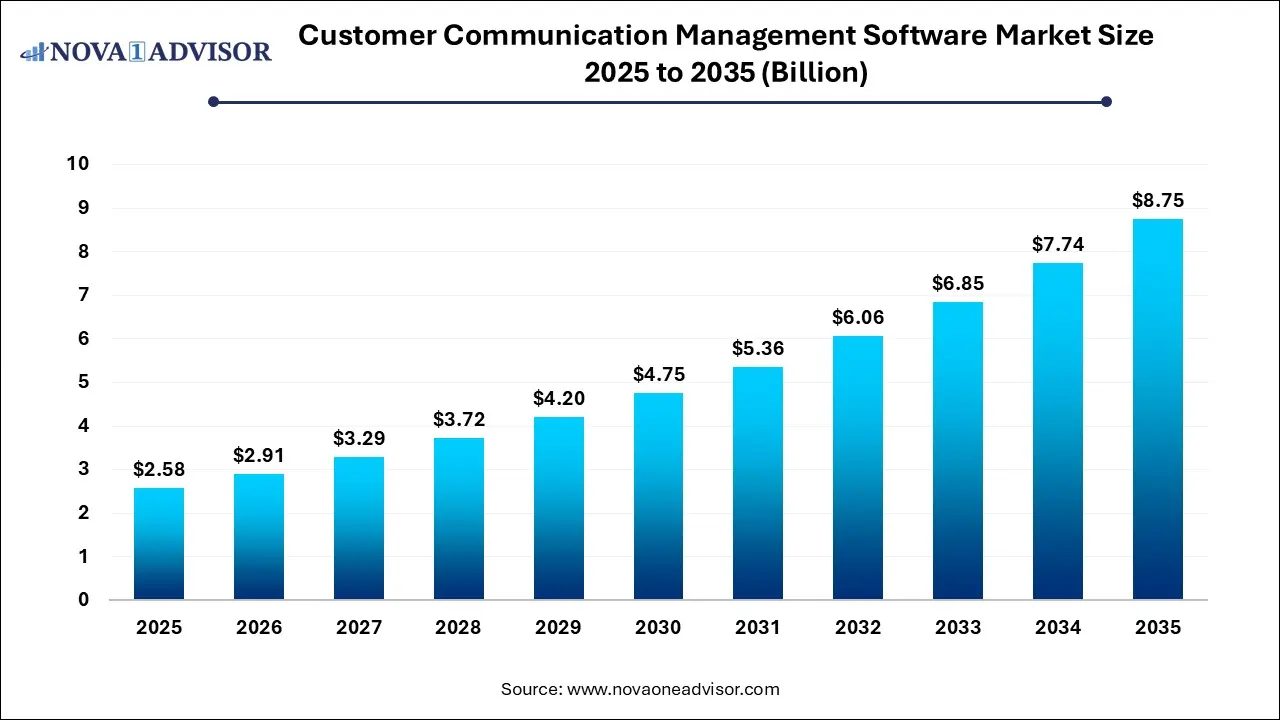
The global customer communication management software market size was valued at USD 2.58 billion in 2025 and is projected to grow from USD 2.91 billion in 2026 to USD 8.75 billion by 2035, at a CAGR of 13.0% from 2026 to 2035.
Key Takeaway:
- By component, the solution segment dominated the market and accounted for the largest revenue share in 2025.
- By component, the service segment is the fastest-growing in the market in 2025.
- By deployment, the cloud segment dominated the market and accounted for the largest revenue share in 2025.
- By enterprise size, the large enterprises segment dominated the market and accounted for the largest revenue share in 2025.
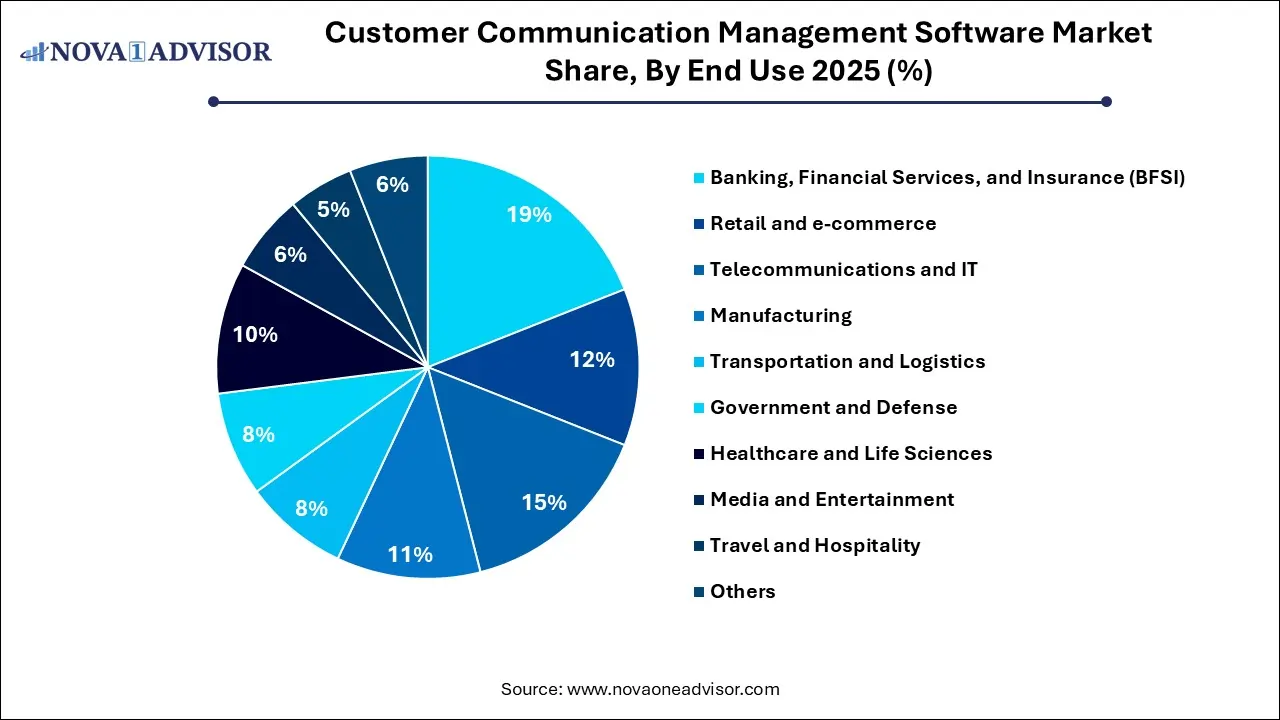
- By end use, the banking, financial services, and insurance (BFSI) segment dominated the market and accounted for the largest revenue share of 19.0% in 2025.
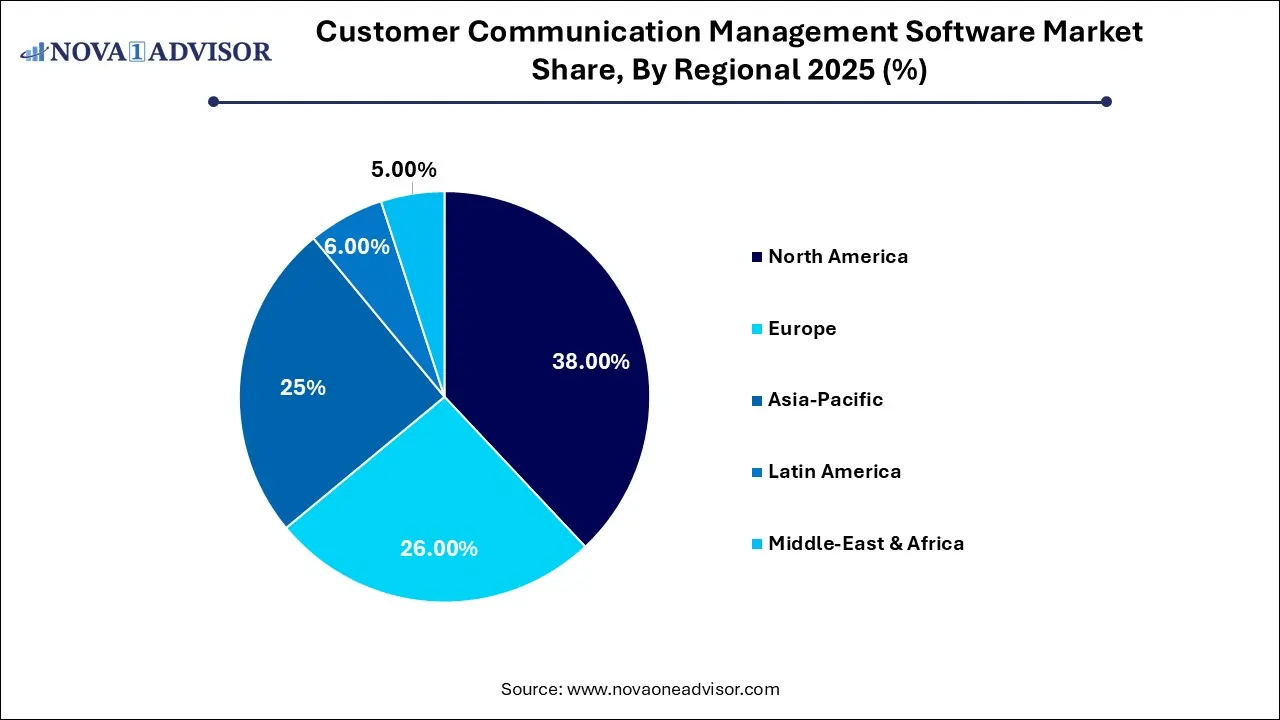
- By region, North America accounted for the largest revenue share of 38% in 2025.
Market Overview
The Customer Communication Management (CCM) software market is witnessing robust growth as organizations prioritize personalized, consistent, and omnichannel customer engagement. Modern CCM platforms enable businesses to create, manage, deliver, and monitor communications across email, SMS, mobile apps, web portals, chatbots, print, and social media through a centralized system. Rising digital transformation initiatives are accelerating the shift from legacy document management solutions to cloud-based CCM platforms that integrate with CRM, ERP, Customer Data Platforms (CDPs), and marketing automation tools. Additionally, growing regulatory requirements in industries such as banking, insurance, healthcare, telecommunications, and government are driving demand for secure, compliant communication management solutions. As customer expectations for personalized, real-time interactions continue to increase, enterprises are investing in advanced CCM software to improve customer experience, operational efficiency, and long-term customer loyalty.
Market Outlook
- Market Growth Overview: The global customer communication management market is expected to grow significantly between 2025 and 2035, driven by omnichannel customer expectations, the transition from cloud-native deployment, and stricter regulatory compliance and data privacy.
- Sustainability Trends: Sustainability trends involve paper-to-digital transition, targeted communication via AI, and regulatory compliance and ESG reporting.
- Major Investors: Major investors in the market include Adobe, OpenText, Quadient, Oracle, Smart Communications, Zendesk, and Newgen Software.
How AI is Impacting the Global Customer Communication Management (CCM) Software Market
Artificial Intelligence (AI) is transforming Customer Communication Management (CCM) software by enabling intelligent, personalized, and data-driven customer interactions. Modern AI-powered CCM platforms leverage machine learning, Natural Language Processing (NLP), and generative AI to automate content creation, personalize communications, optimize delivery timing, and enhance customer engagement across multiple channels. Organizations can generate tailored emails, invoices, policy documents, notifications, and marketing messages based on customer behavior, preferences, and transaction history while ensuring brand consistency and regulatory compliance.
AI-powered analytics help businesses predict customer needs and determine the most effective communication channel, timing, and messaging, improving campaign performance and customer retention. NLP enhances communication quality through multilingual translation, simplified language, and sentiment-aware messaging, while conversational AI and chatbots automate customer support by handling routine inquiries and generating personalized responses. Additionally, AI strengthens compliance by reviewing communications for regulatory accuracy, maintaining audit trails, and ensuring approved templates are consistently used. As AI adoption accelerates, CCM software is evolving into an intelligent customer engagement platform that delivers predictive, automated, and highly personalized communication throughout the customer lifecycle.
Major Trends in the Customer Communication Management (CCM) Software Market
- Rapid migration from on-premise deployments to cloud-native CCM platforms.
- Increasing adoption of AI-powered content generation and hyper-personalized customer communications.
- Growing demand for seamless omnichannel engagement across email, SMS, mobile apps, web portals, print, and social media.
- Rising use of low-code and no-code platforms for faster communication template design and deployment.
- Deeper integration with CRM, ERP, Customer Data Platforms (CDPs), and marketing automation systems.
- Greater emphasis on customer journey orchestration and real-time engagement management.
- Expanding implementation of conversational AI, chatbots, and virtual assistants for automated customer interactions.
- Increased focus on regulatory compliance, data governance, and secure digital communications.
- Growing adoption of real-time analytics and AI-driven insights to optimize communication effectiveness.
- Expansion of multilingual and localization capabilities to support global customer engagement.
Customer Communication Management Software Market Report Scope
| Report Coverage | Details |
| Market Size in 2026 | USD 2.91 Billion |
| Market Size by 2035 | USD 8.75 Billion |
| Growth Rate From 2026 to 2035 | CAGR of 13.0% |
| Base Year | 2025 |
| Forecast Period | 2026 to 2035 |
| Segments Covered | Component, Deployment, Enterprise Size, End-use, Region |
| Market Analysis (Terms Used) | Value (USD Million/Billion) or (Volume/Units) |
| Regional Scope | North America; Europe; Asia Pacific; Central and South America; the Middle East and Africa |
| Key Companies Profiled | Adobe; Oracle; Open Text Corporation; Zendesk; Newgen Software Technologies Limited; Capgemini; Quadient; Smart Communications; Precisely; Sefas Innovation, Inc. |
Market Driver
Growing Demand for Personalized Omnichannel Customer Experiences
The increasing need for personalized and consistent customer engagement across multiple communication channels is a key driver of the Customer Communication Management (CCM) software market. Businesses are adopting CCM platforms to deliver tailored communications through email, SMS, mobile apps, web portals, social media, and print from a centralized system. By leveraging customer data to personalize messages and ensure seamless omnichannel experiences, organizations improve customer satisfaction, strengthen brand loyalty, reduce churn, and enhance overall business performance.
Market Restraint
Data Privacy, Compliance, and Legacy System Integration Challenges
Data privacy regulations, compliance requirements, and integration with legacy enterprise systems remain major challenges for the CCM software market. Organizations in highly regulated industries must protect sensitive customer information while meeting evolving regulatory standards. In addition, migrating from outdated document management systems to modern cloud-based CCM platforms often requires significant investment, technical expertise, and employee training, increasing implementation complexity and costs.
Market Opportunity
Expansion of AI-Driven Customer Journey Orchestration
The growing adoption of AI-powered customer journey orchestration presents a significant opportunity for the CCM software market. Advanced CCM platforms enable businesses to automate and personalize customer interactions across the entire lifecycle, from onboarding and transactional notifications to retention campaigns and post-sale engagement. AI-driven analytics help predict customer behavior, recommend next-best actions, optimize communication channels, and deliver highly personalized experiences, creating strong growth opportunities for cloud-native, intelligent CCM solutions.
Segmental Insights
By Component
Why did the solution segment dominate the Global Customer Communication Management market?
The solution segment is driven by the integration of document creation, compliance tracking, multi-channel delivery, and real-time analytics into a single platform. Highly regulated sectors such as BFSI and healthcare rely heavily on these secure platforms to manage sensitive data and satisfy strict compliance mandates across print and digital formats. CCM software automates highly targeted, real-time personalized messaging to enhance customer engagement without requiring manual intervention.
How did the service segment expected to hold the fastest-growing Global Customer Communication Management market in the coming years?
The service segment is driven by the shift to subscription-based models, as businesses utilize managed services to keep their consumer-facing templates continuously updated to comply with changing industry and legal regulations. Consulting and professional services are heavily sought after to integrate artificial intelligence AI, data analytics, and omnichannel strategies into existing enterprise workflows.
By Deployment
Why did the cloud segment dominate the Global Customer Communication Management market?
The cloud segment is driven by replacing extensive hardware and software licenses with a subscription, pay-as-you-go model. The existing CRM and ERP architectures to centralize customer data and maintain consistent, omnichannel messaging across physical and digital touchpoints. The cloud environments provide the inherent scalability and agility needed to rapidly expand communication operations during peak demand or major marketing campaigns.
How did the on-premises segment expected to hold the fastest-growing Global Customer Communication Management market in the coming years?
The on-premises segment is driven by the strict regulatory frameworks that require enterprises to maintain absolute sovereignty over sensitive customer data, s heavily monitored on local servers. Cloud computing offers lower upfront costs; large organizations often prefer on-premises solutions that involve one-time licensing and amortized long-term capital investments.
By Enterprise Size
Why did the large enterprises segment dominate the Global Customer Communication Management market?
The large enterprises segment is driven by massive operational scale, and compliance mandates position large enterprises as the dominant revenue-generating and end-user in market segmentation. The organization manages complex, high-volume communications across multiple channels.
How did the SMEs segment expected to hold the fastest-growing Global Customer Communication Management market in the coming years?
The SMEs segment is driven by the cloud-first CCM deployment, providing small and medium enterprises with low initial costs and rapid implementation times, making advanced communication tools accessible without requiring dedicated on-premises IT personnel. The automated personalization effectively levels the playing field, allowing agile SMEs to compete directly with larger enterprise rivals for customer loyalty. Cloud accessibility is accelerating the rapid adoption of sophisticated communication systems among growing businesses worldwide.
By End Use
Why did the banking, financial services, and insurance (BFSI) segment dominate the Global Customer Communication Management market?
The banking, financial services, and insurance (BFSI) segment is driven by sensitive financial data and maintains strict adherence to supervisory disclosure mandates through advanced encryption, audit trails, and access controls. The automated generation of statements, regulatory alerts, and chatbot notifications significantly lowers operational costs while improving service quality. This combination of robust data security and dynamic multi-channel automation makes CCM software an indispensable asset for the modern BFSI sector.
How did the media and entertainment segment expected to hold the fastest-growing Global Customer Communication Management market in the coming years?
The media and entertainment segment is driven by the CCM tools apps, optimizing the ad-supported streaming tier through dynamic marketing integration, while embedded generative AI scales content delivery and lowers operational costs via automated conversational support. These platforms provide robust consent infrastructure and audit-ready governance systems to strictly manage data security and ensure total compliance with tightening global privacy mandates such as GDPR.
By Regional
Why did the North American region account for the largest share in the Global Customer Communication Management market?
North America is driven by a highly advanced technology infrastructure and extensive IT spending across the U.S. and Canada. The high concentration of major global CCM software providers allows for rapid deployment and localized support. The immediate volume of day-to-day B2B transactions from regional verticals, including telecommunications, healthcare, utility, and finance. These sectors continuously invest in high-volume document processing platforms, cementing North America as the primary revenue generator for the worldwide market.
U.S. Global Customer Communication Management Market Trends
The U.S. has been driven by the rapid integration of generative AI, enabling organizations to craft hyper-personalized messaging across digital touchpoints, significantly boosting consumer click-through rates and long-term brand engagement. The massive cloud transformation, where scalable SaaS models lower the barrier to entry for agile small and medium enterprises. The strict data security and accessibility regulations mandate standardized, verifiable workflows across highly monitored sectors such as healthcare and the BFSI industry.
Why did the Asia-Pacific region become the fastest-growing global veterinary point-of-care (PoC) Diagnostics Market during the forecast period?
In Asia-Pacific, the rapid urbanization and the growing trend of pet humanization have boosted companion animal adoption, driving substantial demand for rapid, on-site wellness and disease diagnostics. The massive commercial livestock expansion in emerging economies requires routine testing to maintain strict biosecurity and prevent transboundary outbreaks. The stricter government regulations requiring diagnostic confirmation before prescribing critical treatments are accelerating the adoption of rapid screening tools globally.
China Global Customer Communication Management Market Trends
China's heavily integrating artificial intelligence to deploy hyper-personalized communications directly through local platforms such as WeChat and interactive voice assistants, rapidly replacing traditional batch emails. The strict data security mandates, such as China’s PIPL, alongside ongoing trade friction, are driving a strategic preference for localized data storage and homegrown CCM software solutions.
Why Did Europe Hold A Notable Share in the Global Customer Communication Management Market?
Europe’s unique combination of strict privacy laws, mandatory accessibility standards, and dense enterprise verticals the region as a primary fuel high-security, omnichannel CCM adoption in the region. Strict European Union regulatory frameworks such as GDPR and DORA require heavily monitored industries to securely manage user consent and protect data privacy through fully auditable communication workflows.
Germany Global Customer Communication Management Market Trends
Germany’s shift away from print-centric batch systems toward real-time, interactive, and AI-driven omnichannel solutions that personalize messaging across MS, email, chatbots, and voice assistants. The enterprises are actively embedding real-time customer feedback tools and advanced data analytics into these workflows to precisely measure consumer preferences and maximize retention rates.
Key Players in the Global Customer Communication Management Market
- Visa Inc. drives digital customer communication by powering real-time transactional alerts and personalized digital receipts across global banking networks.
- Mastercard Inc. contributes by facilitating conversational commerce, such as Mastercard Agent Pay, which allows AI platforms to verify identity and communicate payment statuses to millions of users securely. Mastercard and PayPal join forces. Their tokenization and messaging infrastructure ensures that digital billing and financial notifications remain compliant and interoperable across diverse channels. Mastercard and PayPal join forces.
- PayPal Holdings Inc. A Comprehensive Analysis of Paypal (PYPL) anchors digital customer engagement by offering a unified communication platform for transaction confirmations, peer-to-peer messaging, and account alerts A Comprehensive Analysis of Paypal (PYPL).
Recent Developments:
- In July 2026, Messagepoint launched MARCIEAssure™, an AI-powered quality assurance solution designed to automate compliance and verification checks for Medicare Advantage documents, addressing significant administrative burdens for health plans. According to IDC Research, the tool enables rapid alignment with Centers for Medicare & Medicaid Services (CMS) guidelines and is reported to reduce QA review cycles by up to 80%.
Segments Covered in the Report
This report forecasts revenue growth at country levels and provides an analysis of the latest industry trends in each of the sub-segments from 2021 to 2035. For this study, Nova one advisor, Inc. has customer communication management software market.
By Component
- Solution
- Services
By Deployment
- On-premise
- Cloud
By Enterprise Size
- SMEs
- Large Enterprises
By End-use
- Banking, Financial Services, and Insurance (BFSI)
- Retail and e-commerce
- Telecommunications and IT
- Manufacturing
- Transportation and Logistics
- Government and Defense
- Healthcare and Life Sciences
- Media and Entertainment
- Travel and Hospitality
- Others
By Regional
North America
- U.S.
- Canada
- Mexico
Europe
- Germany
- UK
- France
Asia Pacific
- China
- India
- Japan
- South Korea
- Australia
Latin America
- Brazil
Middle East & Africa
- U.A.E
- Saudi Arabia
- South Africa
FAQ's

Proceed to Buy
Instant PDF delivery on confirmation

Customer Communication Management Software Market Size to Hit USD 8.75 Billion...
 Request Customization
 Download Sample

Get a Sample of this Report
Customer Communication Management Market