

Customized Procedure Trays Market Size, Share, Forecast Report, 2026-2035
 Status Published
 Category Healthcare


Content
Customized Procedure Trays Market Size. Growth and Trends 2026 to 2035
The global customized procedure trays market size was reached at USD 4.20 Bn in 2025 and is expected to be worth around USD 11.50 Bn by 2035 with a CAGR of 10.6% from 2026 to 2035.
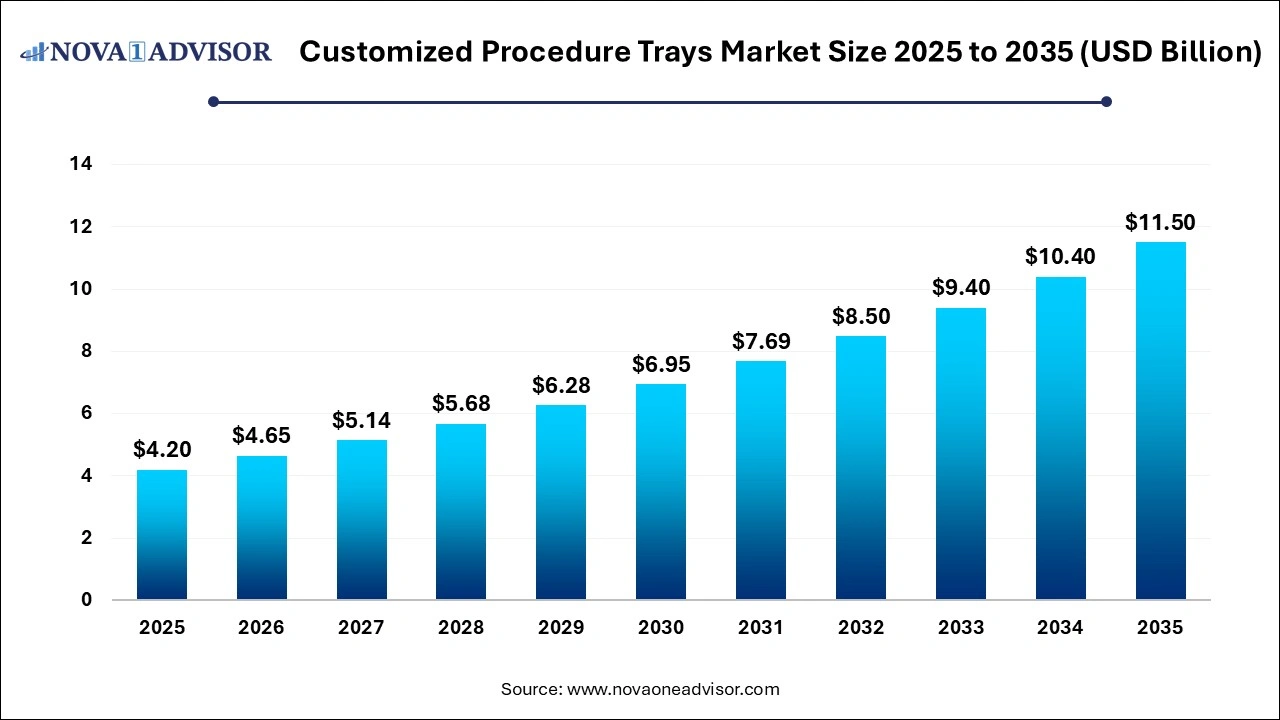
Customized Procedure Trays Market Outlook
- Market Growth Overview: The customized procedure trays market is expected to grow significantly between 2026 and 2035, driven by the rising surgical volumes and aging population, operational efficiency and time saving, and rapid growth in ambulatory surgical centers.
- Sustainability Trends: Sustainability trends involve eco-friendly materials and packaging, waste reduction and efficiency, and smart technology integration.
- Major Investors: Major investors in the market include Cardinal Health, Medline Industries, Owens & Minor, 3M, and Teleflex Incorporated.
Report Scope of Customized Procedure Trays Market
| Report Coverage | Details |
| Market Size in 2026 | USD 4.20 Billion |
| Market Size by 2035 | USD 11.50 Billion |
| Growth Rate From 2026 to 2035 | CAGR of 10.6% |
| Base Year | 2025 |
| Forecast Period | 2026 to 2035 |
| Segments Covered | By Application, By End User |
| Market Analysis (Terms Used) | Value (USD Million/Billion) or (Volume/Units) |
| Regional Covered | North America; Europe; Asia Pacific; Latin America; MEA |
| Key Companies Profiled | 3M Healthcare, Paul Hartmann AG, B. Braun Melsungen AG, Becton, Dickinson and Company (BD) |
Customized Procedure Trays Market Segment Insights
By Application Insights
How did the Orthopaedic Segment Dominate the Customized Procedure Trays Market?
The orthopaedic segment is driven by the high global volume of complex, repetitive surgeries required for an ageing population facing degenerative joint diseases. By utilizing specialized, pre-assembled sterile kits, hospitals significantly enhance operational efficiency, reducing critical OR setup times and the risk of nosocomial infections during high-stakes procedures. The shift toward minimally invasive and robotic-assisted techniques further necessitates highly tailored, compact trays that standard kits cannot provide.
How did the Ophthalmology Segment Expect to hold the Fastest-Growing Customized Procedure Trays Market in the Coming Years?
The ophthalmology segment is driven by the shift toward ambulatory surgical centers (ASCs), which heavily favors these pre-assembled, single-use trays to achieve faster operating room turnaround times and stringent infection control. The advancements in minimally invasive glaucoma surgery (MIGS) require highly specialized, precision instruments that are most efficiently delivered in customized, sterile packs.
By End User Insights
How did the Hospitals Segment Account for the largest Share in the Customized Procedure Trays Market?
The hospitals segment is driven by the critical need for infection control, which drives a heavy reliance on pre-assembled, sterile, and disposable trays to prevent costly hospital-associated infections. By adopting these kits, hospitals achieve significant operational efficiency, optimizing operating room turnaround times and standardising high-stakes clinical workflows. The synergy between advanced healthcare infrastructure and long-term cost management through reduced clinical waste cements the hospital segment as the primary revenue anchor.
How did the Ambulatory Surgical Centres Segment Expect to Hold the Fastest-Growing Customized Procedure Trays Market in the Coming Years?
The ambulatory surgical centres segment is driven by the shift toward cost-effective outpatient procedures in orthopaedics and ophthalmology Drugs. Lacking the heavy infrastructure for in-house sterilisation, these facilities rely on pre-sterilized, disposable kits to accelerate operating room turnaround times and maintain lean, high-margin workflows. The integration of smart-labeled (RFID) customized trays further allows ASCs to optimize inventory and procedural precision in a value-based care environment.
Key Players in the Customized Procedure Trays Market
- 3M Healthcare: 3M Healthcare provides high-quality, specialized components and advanced infection prevention products that are integrated into customized procedure trays to enhance patient safety and operational efficiency.
- Paul Hartmann AG: Paul Hartmann AG supplies comprehensive, customized procedure packs that improve operating room efficiency and reduce waste by providing all necessary sterile items in one package.
- B. Braun Melsungen AG: B. Braun Melsungen AG offers bespoke, modular procedure trays that are designed to enhance workflow, ensure regulatory compliance, and reduce sterilization costs for hospitals.
- Becton, Dickinson and Company (BD): D contributes to the market by delivering advanced, sterile procedure trays that integrate, for instance, in-house expertise in vascular access and safe medication delivery systems.
Global Customized Procedure Trays Market Segmentation
By Application
-
- Orthopedic
- Hip
- Knee
- Others
- Ophthalmology
- General Surgery
- Laparoscopy
- Laparotomy
- Others
- Neurosurgery
- Cardiac Surgery
- Gynecology
- Urology
- Ear, Neck, and Head
- Others
- Orthopedic
By End User
-
- Hospitals
- Ambulatory Surgical Centers
- Others
Regional Analysis and Forecast
Further, this research study analyses market size, production, consumption and its advancement trends at global, regional, and country level for period 2016 to 2027 and covers following region in its scope:
- North America
- United States
- Canada
- Europe
- Germany
- United Kingdom
- Italy
- France
- Rest of EU
- Asia Pacific
- China
- India
- Japan
- Southeast Asia
- Rest of APAC
- Central & South America
- Brazil
- Argentina
- Rest of Central & South America
- Middle East and Africa
- UAE
- Saudi Arabia
- Rest of MEA

Proceed to Buy
Instant PDF delivery on confirmation

Customized Procedure Trays Market Size to Worth Around USD 11.50 Bn by 2035
 Request Customization
 Download Sample

Get a Sample of this Report
Customized Procedure Trays Market