

Dental Bracket Market Size, Share, and Trends 2026 to 2035
 Status Published
 Category Healthcare


Content
Dental Bracket Market Size and Growth 2026 to 2035
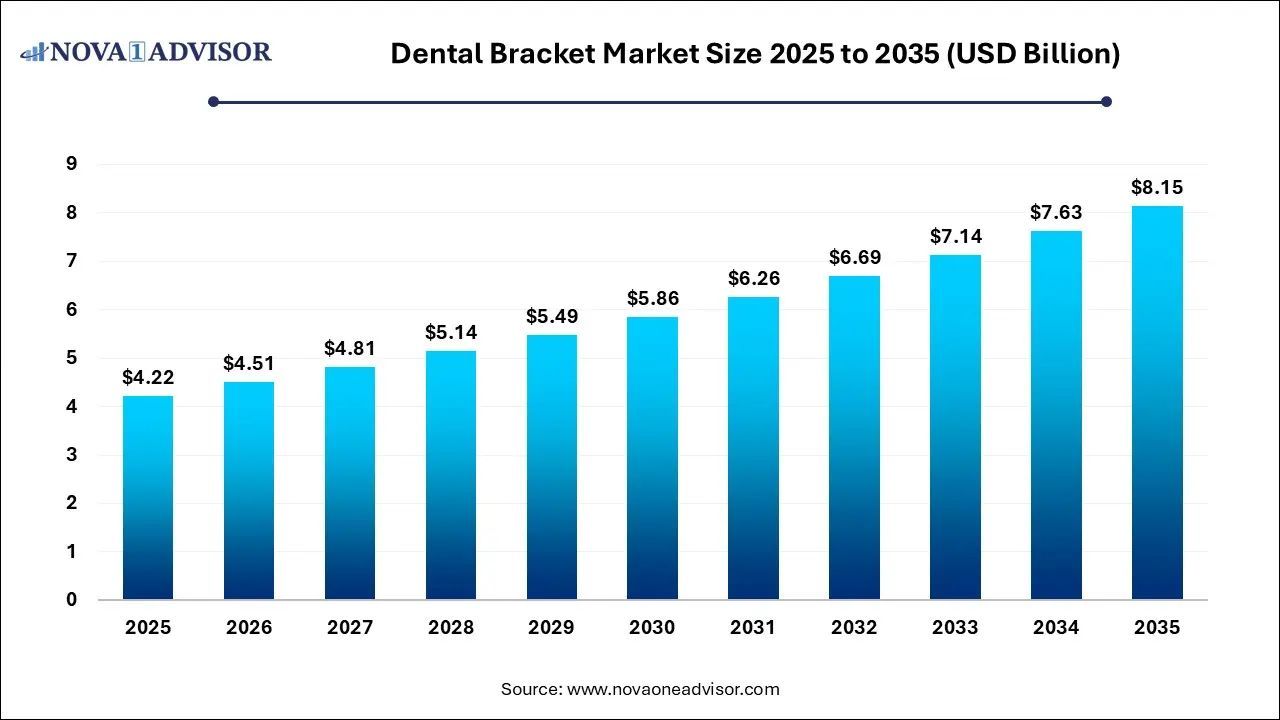
The dental bracket market size was estimated at USD 4.22 billion in 2025 and is projected to increase from USD 4.51 billion in 2026 to approximately USD 8.15 billion by 2035, growing at a CAGR of 6.8% from 2026 to 2035. The dental bracket market is driven by the rising demand for aesthetic dentistry, integration of 3D printing, AI-assisted imaging, and customized digital treatment planning, and the increasing prevalence of dental issues.
Key Takeaways
- By material type, the metallic brackets segment held a dominant position in the market with a share of 55% in 2025.
- By material type, the ceramic/aesthetic segment is the fastest growing between 2026 and 2035.
- By ligation type, the conventional ligation segment held a dominant position in the market with a share of 65% in 2025.
- By ligation type, the self-ligating brackets segment is the fastest growing between 2026 and 2035.
- By demographics, the Adolescent segment held a dominant position in the market with a share of 55% in 2025.
- By demographics, the adult segment is the fastest-growing between 2026 and 2035.
- By aesthetic performance, the non-aesthetic brackets segment held a dominant position in the market with a share of 60% in 2025.
- By region, the North America region held a dominant position in the market with a share of 30% in 2025.
Innovation Driving Transformation in the Dental Bracket Market
Dental brackets comprise essential orthodontic hardware used to apply pressure, correct malocclusions, and align teeth for improved oral health and facial aesthetics. By correcting bite issues across various applications, these brackets offer functional and psychological benefits like better digestion, easier hygiene, and boosted self-esteem. The industry is experiencing rapid growth, driven by escalating cosmetic awareness, rising disposable incomes, and widespread advancements in digital orthodontics.
Dental Bracket Market Trends
- Surging Commercial Demand for Aesthetic Solutions
Patients are increasingly prioritizing discreet orthodontic solutions to maintain a professional and natural look during treatment. This has led to a massive spike in the adoption of tooth-colored ceramic brackets and lingual brackets over traditional metal options.
- Operational Superiority of Self-Ligating Brackets
Self-lighting brackets are traditional non-ligating systems because they utilize built-in clips to hold the arch wire instead of elastic ties. This reduces friction, accelerates tooth movement, and requires fewer adjustments, making it a highly required option by patients and orthodontists.
- Proliferation of Digital Orthodontics and Additive Manufacturing
Orthodontic technology now relies heavily on computer-aided design and Manufacturing (CAD/CAM) and 3D imaging. This allows dentists to create custom-made, patient-specific brackets and trays that guarantee higher precision and significantly reduce chairside fitting time.
Key AI Integration in the Dental Bracket Market
AI and ML are revolutionizing the orthodontic bracket industry by enabling unprecedented personalization and precision in treatment planning. Machine learning algorithms can analyze a patient's unique anatomical 3D scans and X-rays to compute the optimal positioning for individual brackets, drastically reducing human error during direct or indirect bonding. This level of automation significantly shortens overall treatment timelines while maximizing the biomechanical efficiency of the corrective forces applied by the braces. AI-driven 3D printing technologies to produce fully customized brackets and wires that precisely match a patient's specific tooth morphology.
Dental Bracket Market Report Scope
| Report Coverage | Details |
| Market Size in 2026 | USD 4.51 Billion |
| Market Size by 2035 | USD 8.15 Billion |
| Growth Rate From 2026 to 2035 | CAGR of 6.8% |
| Base Year | 2025 |
| Forecast Period | 2026 to 2035 |
| Segments Covered | Material Type, Ligation Type, Demographics, Aesthetic Preference, Region |
| Market Analysis (Terms Used) | Value (USD Million/Billion) or (Volume/Units) |
| Regional Scope | North America; Europe; Asia Pacific; Central and South America; the Middle East and Africa |
| Key Companies Profiled | 3M; Ormco Corporation; Dentsply Sirona; FORESTADENT Bernhard Förster GmbH; G&H Orthodontics; DENTAURUM GmbH & Co. KG; TP Orthodontics, Inc.; OrthoAmerica Holdings, LLC.; GC Orthodontics; ADENTA GMBH; HANGZHOU SHINYE ORTHODONTIC PRODUCTS CO., LTD.; Zhejiang Yahong Medical Apparatus Co., Ltd. |
Market Dynamics
Driver
Rising Anesthetic Awareness
Significantly reducing patient anxiety and overcoming the fear of painful orthodontic procedures. As patients become more educated on the availability of advanced, pain-free sedation and local anesthesia options, they are more willing to undergo lengthy treatments like traditional braces. This increased willingness to visit orthodontists boosts the overall volume of dental procedures performed. There is a higher clinical demand for the installation of both metal and aesthetic dental brackets required for teeth alignment.
Restraint
High Treatment Cost
The market growth is hindered by the bracket manufacturing, installation, and regular clinic adjustments, which act as a primary barrier to market expansion. Because dental insurance frequently provides limited coverage for these procedures, many patients are deterred by the out-of-pocket expenses. This financial burden limits overall procedure volumes and prompts price-sensitive consumers to either delay care or opt for more affordable alternative solutions.
Opportunity
Customization and Digitalization
The enabling the precise, patient-specific design of dental brackets. Through advancements in 3D printing, CAD/CAM technology, and artificial intelligence, orthodontists can fabricate brackets tailored to an individual’s unique tooth anatomy. This bespoke approach minimizes clinical chair time, reduces the need for frequent arch wire adjustments, and significantly enhances overall patient comfort and aesthetic outcomes.
Segment Insights
By Material Type Insights
Why Did the Metallic Brackets Segment Hold a 55% Share for the Dental Bracket Market?
The metallic brackets segment held a dominant position in the market with a share of 55% in 2025. Owing to the affordability and widespread clinical use, lower price points drive mass adoption in niche-sensitive and emerging markets. The metal braces have experienced a resurgence in popularity, and social media trends, Gen Z, and younger adults frequently customize them with colored elastics.
The ceramic/aesthetic segment held a 30% share of the market in 2025, with the gaining dominance as patients prefer less visible options. An increasing number of adults are seeking orthodontic treatments. Because metal braces are often associated with adolescence, adults and working professionals gravitate toward aesthetic ceramics to maintain a professional appearance.
The polycarbonate segment held a 10% share of the market in 2025, due to offering a highly aesthetic, translucent alternative that satisfies the cosmetic demands of image-conscious and adult patients. They provide a strategic, cost-effective mid-tier solution, widening consumer access to clear braces for price-sensitive demographics without the premium expense of ceramic systems.
The hybrid brackets segment held a 5% share of the market in 2025, due to retaining low-friction metal slots on posterior teeth, which preserves traditional treatment mechanics, minimizing operational friction and reducing total chairside processing times. Orthodontists gain exceptional biomechanical flexibility, enabling them to mix prescriptions and slot sizes to resolve complex malocclusions without sacrificing structural integrity during mastication.
By Ligation Type Insights
Why Did the Conventional Ligation Segment Hold a 65% Share for the Dental Bracket Market?
The conventional ligation segment held a dominant position in the market with a share of 65% in 2025. Owing to the offering of a distinctly affordable price point that expands consumer access within cost-sensitive and emerging healthcare demographics. The use of traditional elastomeric or wire ligatures grants orthodontists precise, three-dimensional control over complex tooth rotation and severe malocclusions.
The self-ligating brackets segment held a 35% share of the market in 2025, with the rising consumer demand for premium, comfortable, and aesthetically pleasing orthodontic solutions. The critical efficiency and practical benefits of self-ligating systems have made them a highly preferred choice, fueling consistent market growth. The self-closing doors require less chairside assistance for wire adjustments and replacements, reducing the frequency and duration of necessary clinic appointments.
By Demography Insights
Why Did the Adult Segment Lead the Dental Bracket Market?
The adult segment registered its dominance over the market with a share of 25% in 2025, owing to the rising adult cosmetic orthodontic treatments. Accelerating income levels and improved access to dental insurance have made it easier for adults to invest in premium, cosmetic dental solutions.
The pediatric segment held the 20% share of the market in 2025, with the high prevalence of early-stage malocclusions and a widespread clinical shift toward early interceptive phase I orthodontics. The institutional support and mandatory school screening programs that successfully channel millions of younger patients into clinical pathways. The rising middle-class disposable incomes have enabled proactive parents to prioritize early structural treatments to secure long-term physiological and social benefits for their children.
The adolescent segment held the 55% share of the market in 2025, due to strong peer group normalization among teenagers, which minimizes the social stigma of orthodontic applications and lowers physiological resistance. The parents strategically leverage favorable insurance frameworks and dependent healthcare vouchers before children cross the age threshold of eighteen.
By Aesthetic Preference Insights
Why Did the Non-Aesthetic Brackets Segment Lead the Dental Bracket Market?
The non-aesthetic brackets segment registered its dominance over the market with a share of 60% in 2025, owing to its unmatched stainless-steel durability, which effortlessly withstands heavy masticatory forces and eliminates bracket breakage. This superior mechanical strength provides orthodontists with maximum biomechanical control, making metallic appliances the gold standard for correcting severe dental crowding and complex malocclusions.
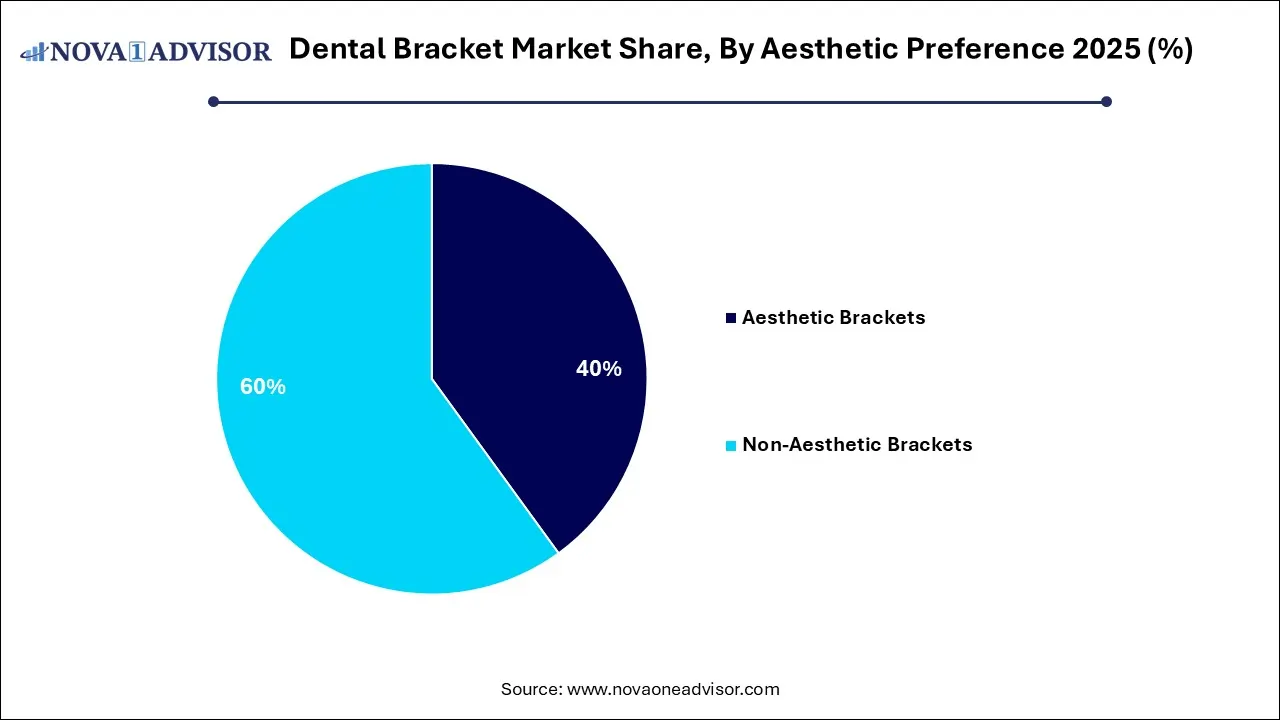
The aesthetic brackets segment held the 40% share of the market in 2025, due to the expanding demographic of adult professionals who deliberately choose tooth-colored or clear appliances over legacy metallic systems. The rising middle-class disposable incomes paired with image-conscious lifestyles amplified by social media presence continue to turn these premium, subtle braces into a high-growth revenue driver globally.
By Regional Insights
Why Did the North America Region Lead the Dental Bracket Market?
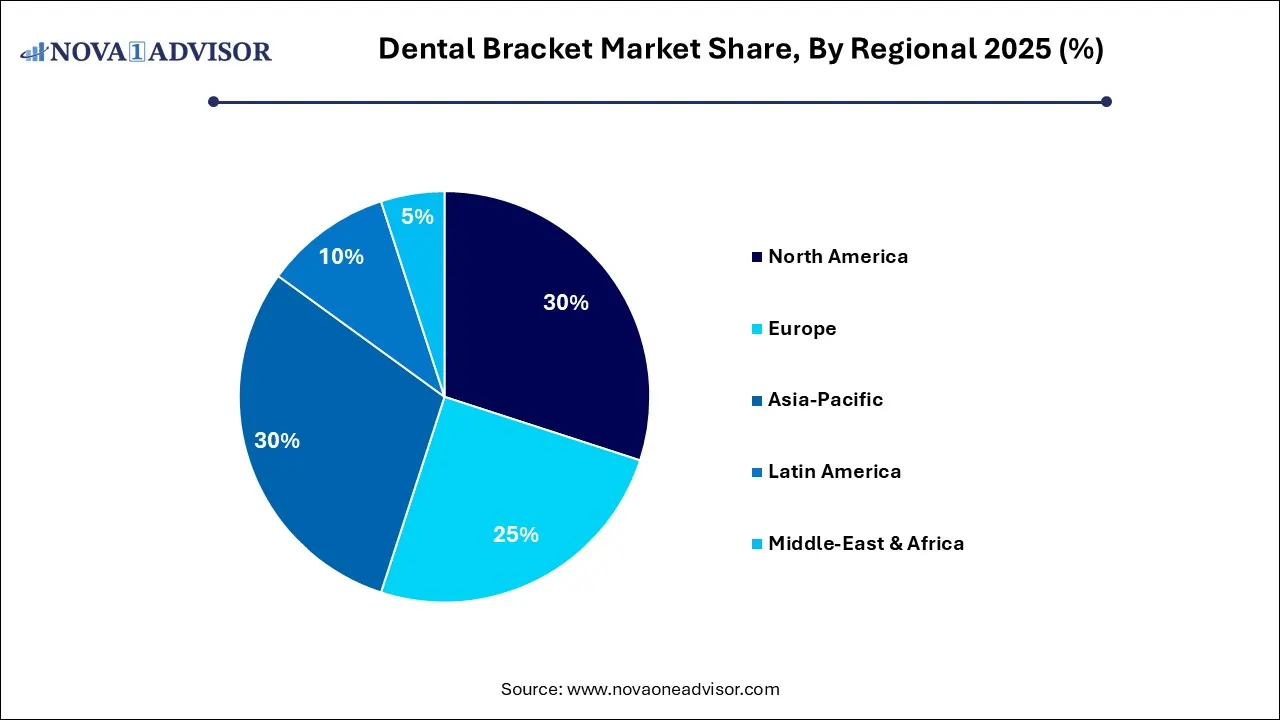
The North America region registered its dominance over the market with a share of 30% in 2025, owing to the growing focus on dental anesthetics and preventative care anchors, rising population of adults presuming premium orthodontic procedures. The region serves as a major hub for industry giants, such as 3M and Envista, whose heavy research and development investments ensure an advanced clinical infrastructure equipped with immediate access to cutting-edge, self-ligating, and ceramic technologies.
U.S. Surgical Suture Market Trends
The U.S. combat surgical-site infection manufacturers are aggressively integrating antimicrobial and bioactive coatings, such as triclosan, to block bacterial colonization directly within the incision. The rapid adoption of knotless, barbed designs optimizes operating room efficiency by eliminating manual knot-tying and ensuring even tension distribution across the tissue.
The Europe region held the 25% share of the market in 2025, due to the established practices and moderate innovation adoption. The strong and rising cultural shift towards discreet, cosmetic orthodontic treatments, which fuels the demand for premium aesthetic brackets.
U.K. Surgical Suture Market Trends
The U. K’s escalating clinical focus on advanced materials, such as antibacterial-coated and barbed sutures, which drastically mitigate surgical site infections while improving tissue approximation. The rapid rise of precision-driven minimally invasive surgeries across cardiovascular and orthopaedic disciplines has bolstered the need for specialized suture needles and automated suturing devices.
The Asia Pacific segment held 30% share of the market in 2025, due to the large population and increasing disposable income. A high prevalence of dental caries and malocclusion, especially among adolescents, has necessitated increased orthodontic interventions. The rapid proliferation of private dental clinics, modern healthcare infrastructure, and 3D-printing technologies has made dental bracket treatments more accessible to the general public.
China Surgical Suture Market Trends
China’s shift toward absorbable synthetic polymers and specialized knotless, antibacterial sutures that optimize operating room efficiency and drastically lower post-operative infection risks. The expansion of advanced healthcare facilities and minimally invasive outpatient surgeries drives high-volume demand for specialized, smaller-gauge suturing devices.
The Latin America region held 10% share of the market in 2025, with the expanding middle class, rising disposable income, and a naturally high prevalence of malocclusion across the region’s large youthful demographic. The rapid integration of digital density workflows like CAD/CAM and 3D printing, combined with an increasing consumer shift toward premium ceramic and lingual brackets, is accelerating aesthetic revenue growth across the region.
The MEA region held 5% share of the market in 2025, due to the shifting consumer preferences toward cosmetic dentistry among an expanding middle class, significantly boosting the adoption of both traditional metallic and premium aesthetic ceramic brackets. Concurrently, aggressive public health campaigns like the Healthy Saudi Smile initiative have vastly improved public oral health awareness and fueled a strong baseline demand for preventive care.
Recent Developments
- In April 2026, at the American Association of Orthodontists (AAO) Annual Session, LightForce Orthodontics officially unveiled LightBracket Metal™, the industry’s first patient-specific, 3D-printed metal bracket system. Built natively from an orthodontist's customized digital treatment plan, this milestone marks a massive expansion of the company’s "generative braces" ecosystem.
- In May 2026, the dental manufacturing giant DynaFlex officially announced the commercial rollout of the Norris Clear SL passive self-ligating (PSL) bracket system. Built upon the clinically proven mechanical principles of the original Norris 20/26 Metal Bracket System, this new aesthetic variant marries sub-obtrusive visual appeal with high-precision biomechanics.
- In November 2025, Clove Dental launched its first specialized Orthodontic Centre of Excellence in Gurugram, featuring full-time orthodontists and in-house digital scanners for braces and aligner treatments. This facility addresses specialized care needs by offering immediate, on-site support to overcome traditional orthodontic treatment delays and barriers.
Dental Bracket Market Companies
- 3M
- Dentsply Sirona
- Ormco Corporation
- FORESTADENT Bernhard Förster GmbH
- DENTAURUM GmbH & Co. KG
- G&H Orthodontics
- TP Orthodontics, Inc.
- GC Orthodontics
- OrthoAmerica Holdings, LLC.
- ADENTA GMBH
- Zhejiang Yahong Medical Apparatus Co., Ltd.
- HANGZHOU SHINYE ORTHODONTIC PRODUCTS CO., LTD.
Segments Covered in the Report
This report forecasts revenue growth at country levels and provides an analysis of the latest industry trends in each of the sub-segments from 2021 to 2035. For this study, Nova one advisor, Inc. has dental bracket market.
By Material Type
- Metallic Brackets
- Ceramic / Aesthetic
- Polycarbonate
- Hybrid Brackets
By Ligation Type
- Conventional Ligation
- Self-Ligating Brackets
By Demographics
- Adult
- Pediatric
- Adolescent
By Aesthetic Preference
- Aesthetic Brackets
- Non-Aesthetic Brackets
By Region
- North America
- Europe
- Asia Pacific
- Latin America
- Middle East and Africa (MEA)
FAQ's

Proceed to Buy
Instant PDF delivery on confirmation

 Request Customization
 Download Sample

Get a Sample of this Report
Dental Bracket Market