

Depth Filtration Market Analysis (By Media type; By Product; By End-use) - Industry Analysis, Share, Growth, Regional Outlook and Forecasts, 2026-2035
 Status Published
 Category Healthcare


Content
Depth Filtration Market Size and Trends 2026 to 2035
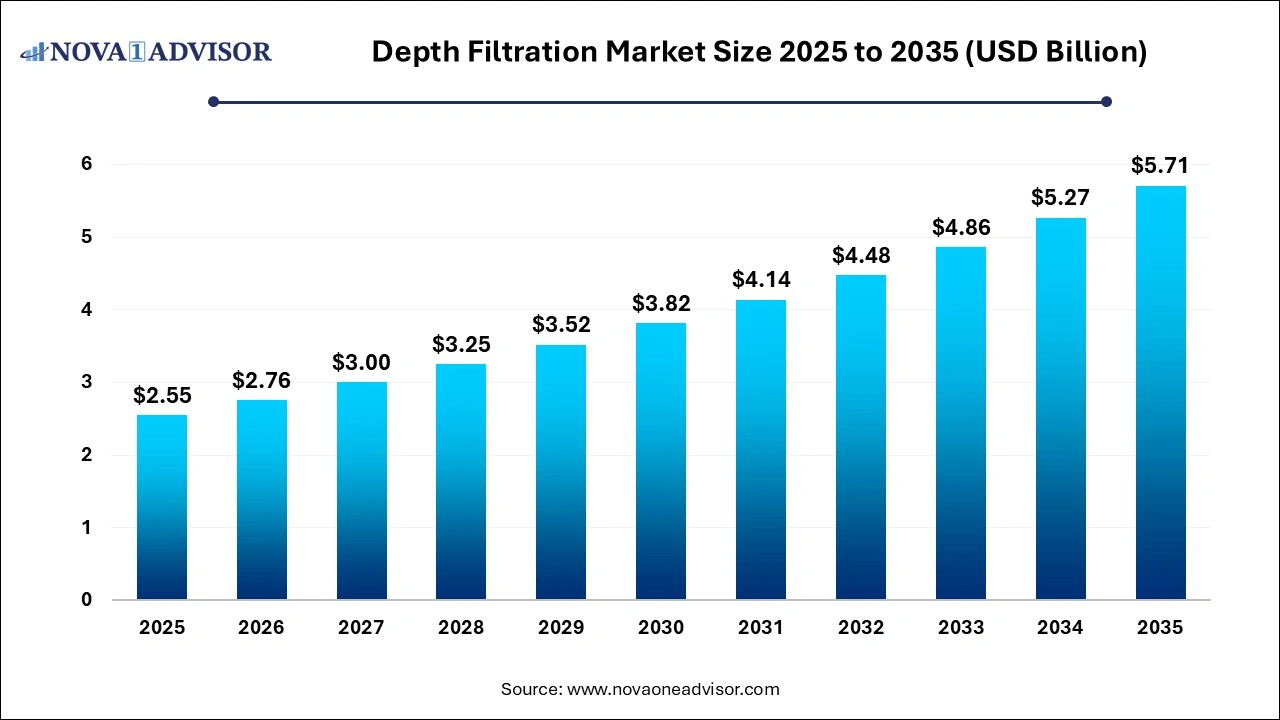
The depth filtration market size was exhibited at USD 2.55 billion in 2025 and is projected to hit around USD 5.71 billion by 2035, growing at a CAGR of 8.4% during the forecast period 2026 to 2035.
Depth Filtration Market Key Takeaways
- Cartridge filters was the largest product segment and accounted for over 50.0% of the total market revenue in 2025.
- Healthcare was the largest end-use segment and accounted for over 37% of the total revenue share in 2025.
- North American region dominated the market with a share of around 40% in 2025.
Depth Filtration Market Outlook
- Market Growth Overview: The depth filtration market is expected to grow significantly between 2026 and 2035, driven by the adoption of single-use technologies, the growing expansion of biopharmaceutical and biotechnology, and the growing demand for food, beverage, and environmental applications.
- Sustainability Trends: Sustainability trends involve eco-friendly filter media, single-use technology, and sustainable manufacturing.
- Major Investors: Major investors in the market include Merck KGaA (MilliporeSigma), Danaher Corporation (Pall Corporation), Sartorius AG, 3M Company, and Parker Hannifin Corporation.
Depth Filtration Market Overview
The depth filtration market forms a critical segment of the global filtration industry, providing versatile and effective solutions for removing particles, contaminants, and impurities from liquids across a variety of sectors. Depth filtration systems capture particles within the entire thickness of the filter medium, unlike surface filtration, where contaminants accumulate only on the surface. This structural advantage allows for greater dirt-holding capacity, longer operational life, and better efficiency in handling high particulate loads.
Traditionally used in water purification, food & beverage processing, pharmaceuticals, and industrial applications, depth filtration has evolved with advancements in material science and manufacturing technology. Depth filters constructed from materials like cellulose, diatomaceous earth, activated carbon, and perlite are tailored for specific contaminant profiles and flow conditions.
The healthcare sector, particularly the biopharmaceutical and vaccine production industries, has emerged as a major growth engine for depth filtration. Increasing regulatory demands for product purity, coupled with the complexity of biologics manufacturing, have made depth filters indispensable in clarification and pre-filtration processes.
Moreover, sustainability initiatives are encouraging the development of depth filtration media with lower environmental impact and higher reusability. As industries continue to prioritize operational efficiency, quality assurance, and environmental stewardship, the depth filtration market is expected to witness robust growth globally.
How AI is Impacting the Depth Filtration Market
AI and ML are transforming the depth filtration industry by enabling real-time monitoring and predictive maintenance, significantly reducing downtime and operational costs in industries such as pharmaceuticals and water treatment. By utilizing ML algorithms to analyze complex process data, manufacturers can optimize filter lifespan, enhance consistency, and predict performance bottlenecks before they occur. AI facilitates smarter, self-optimizing filtration systems that adapt to changing input parameters, improving product yield and ensuring compliance with stringent regulatory standards. As the industry shifts toward automation and digital twins, AI is also accelerating R&D, leading to the development of tailored, high-performance filter media and modular filtration solutions
Supply Chain Analysis of the Depth Filtration Market
- Raw Material Sourcing: This stage involves the procurement of filter media components, including cellulose fibers, diatomaceous earth (DE), perlite, activated carbon, and synthetic polymers.
Key Players: Ahlstrom-Munksjö, JNC Filter Co. Ltd. - Filter Media Fabrication & Component Manufacturing: Raw materials are transformed into various depth filter formats, including sheets, modules, cartridge filters, and capsule filters. Key activities include the design and manufacturing of multi-layer structures that offer high dirt-holding capacity, with a growing trend towards single-use (disposable) filter technologies.
Key Players: Pall Corporation, 3M Company, Merck KGaA, Sartorius AG, Filtrox AG, Graver Technologies, Meissner Filtration Products, and Eaton Corporation. - Distribution & Logistics: Filter products are distributed to end-users via direct sales, distributors, or through partnerships with bioprocessing system integrators. Manufacturers are increasingly expanding their digital platforms and regional distribution networks to reach fast-growing markets like the Asia-Pacific.
Key Players: Merck, 3M
Major Trends in the Depth Filtration Market
-
Growing Adoption of Single-use Depth Filtration Systems: Driven by the biopharma industry's need for flexibility and contamination control.
-
Technological Innovations in Filter Media: Development of advanced multi-layer depth filters for enhanced capacity and selectivity.
-
Expansion of Application in Bioprocessing: Increasing use in vaccine, antibody, and viral vector production workflows.
-
Focus on Eco-friendly and Recyclable Materials: Introduction of sustainable depth filtration solutions.
-
Rise of Automation and Smart Monitoring: Integration of depth filtration systems into automated, digitally controlled process lines.
-
Customized Depth Filtration Solutions: Demand for application-specific cartridge and capsule designs.
-
Increased Usage in Food and Beverage Industry: Ensuring safety and quality in beverage clarification and ingredient filtration.
-
Growing Penetration into Emerging Markets: Driven by industrialization and water treatment initiatives
Report Scope of Depth Filtration Market
| Report Coverage | Details |
| Market Size in 2026 | USD 2.76 Billion |
| Market Size by 2035 | USD 5.71 Billion |
| Growth Rate From 2026 to 2035 | CAGR of 8.4% |
| Base Year | 2025 |
| Forecast Period | 2026 to 2035 |
| Segments Covered | By Media type, By Product, By End-Use |
| Market Analysis (Terms Used) | Value (USD Million/Billion) or (Volume/Units) |
| Regional Covered | North America; Europe; Asia Pacific; Latin America; MEA |
| Key Companies Profiled | Merck KGaA, 3M Company, Parker-Hannifin Corporation, Amazon Filters Ltd., Pall Corporation, Eaton Corporation PLC, Sartorius AG, Filtrox AG, Graver Technologies, LLC, and Donaldson Company, Inc. |
Depth Filtration Market Dynamics
Driver
Rising Demand from the Biopharmaceutical Industry
A major driver boosting the depth filtration market is the rising demand from the biopharmaceutical industry, particularly for monoclonal antibody production, cell and gene Therapy, and vaccine manufacturing.
Depth filtration plays a vital role in critical bioprocessing stages such as harvest clarification, removal of cell debris, and pre-filtration before final sterilizing filtration. Its high particle-retention capacity and ability to handle high turbidity streams without clogging make it ideal for complex biological feed streams.
The COVID-19 pandemic spotlighted the importance of efficient, scalable filtration technologies during vaccine production campaigns. Even in the post-pandemic period, investments in biologics manufacturing capacity continue globally, ensuring sustained demand for advanced depth filtration solutions customized for high-throughput, high-purity operations.
Restraint
Limitations in Handling Very Fine Particles
Despite its versatility, the depth filtration market faces a constraint: limitations in handling very fine or submicron particles without requiring subsequent finer filtration stages.
While depth filters are excellent for high-load particle removal, they often cannot achieve the sterility assurance levels required in certain applications, such as final drug product filtration or ultrapure water systems. This necessitates additional stages of microfiltration or ultrafiltration, increasing process complexity and costs.
Furthermore, inconsistency in pore size distribution in traditional depth filters can lead to variability in performance. Although technological improvements are mitigating these limitations, user preference for membrane-based filters in certain critical operations acts as a limiting factor for depth filtration market growth.
Opportunity
Technological Advancement in Multi-layer and Hybrid Depth Filters
A promising opportunity lies in the development of multi-layer and hybrid depth filters that combine coarse and fine filtration layers within a single unit.
These next-generation depth filters enhance contaminant retention across a broader size range while maintaining low pressure drop and high throughput. Innovations such as gradient density media, charged filter media, and depth filters embedded with adsorptive materials (like activated carbon) are expanding applications into finer particle removal and endotoxin reduction.
Such advancements allow depth filtration to compete more directly with membrane filtration systems, offering simplified workflows, reduced total cost of ownership, and expanded utility across food & beverage, biopharma, and water treatment sectors.
Depth Filtration Market Segmental Insights
By Media Type Insights
Diatomaceous earth dominates the media type segment, historically favored for its exceptional filtration efficiency, low cost, and high surface area. Derived from fossilized aquatic organisms, diatomaceous earth provides excellent particulate retention for beverage clarification (especially beer and wine), water treatment, and industrial applications. Its widespread availability and proven performance ensure its continued dominance.
Activated carbon is growing fastest, fueled by increasing demand for adsorptive depth filtration in pharmaceuticals, water purification, and food safety. Activated carbon depth filters offer unique capabilities in removing organic impurities, color bodies, odors, and trace contaminants, making them increasingly valuable for sensitive processes requiring both particulate and chemical purification.
By Product Insights
Cartridge filters dominate the product segment, widely used in diverse industries due to their versatility, ease of replacement, and compatibility with various filter housings. Available in standard sizes and a variety of materials, cartridge filters are employed extensively in beverage bottling plants, biopharma production facilities, and chemical manufacturing units.
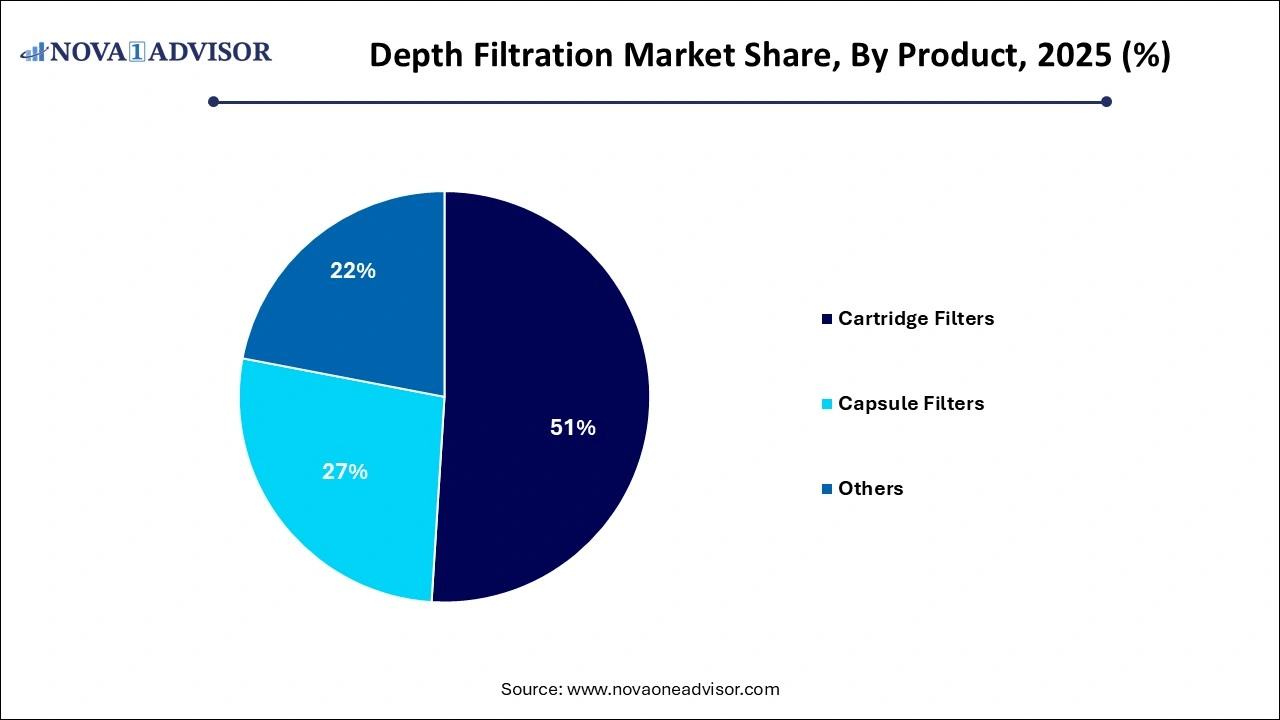
Capsule filters are expanding rapidly, driven by the growing shift toward single-use technologies in biopharma and food industries. Capsule filters self-contained, pre-sterilized units offer significant advantages in reducing cleaning validation burdens, minimizing contamination risks, and supporting flexible, small-batch production workflows. Their adoption is particularly strong in cell therapy and high-value biologics manufacturing.
By End-use Insights
Water filtration dominates the end-use segment, with depth filtration being critical in municipal water treatment, industrial process water conditioning, and wastewater management. Depth filters provide cost-effective pretreatment for reverse osmosis plants, ensuring longer membrane life and higher operational efficiency.
Healthcare is growing fastest, reflecting the expanding biopharma pipeline, increased vaccine production, and heightened regulatory scrutiny on sterile manufacturing processes. Depth filters are increasingly applied in media preparation, harvest clarification, and raw material filtration in GMP-compliant healthcare and life sciences manufacturing facilities.
Depth Filtration Market By Regional Insights
North America holds the largest market share, underpinned by its strong pharmaceutical and biotechnology sectors, advanced food and beverage industries, and high regulatory standards.
The United States, in particular, remains a hub for innovation in filtration technologies, with extensive adoption of depth filtration across biomanufacturing, brewery, and municipal water sectors. Presence of leading players like 3M, Pall Corporation (Danaher), and Parker Hannifin further consolidates the region’s leadership.
Continuous investments in healthcare infrastructure, R&D funding, and food safety regulations ensure North America’s dominance in the depth filtration market landscape.
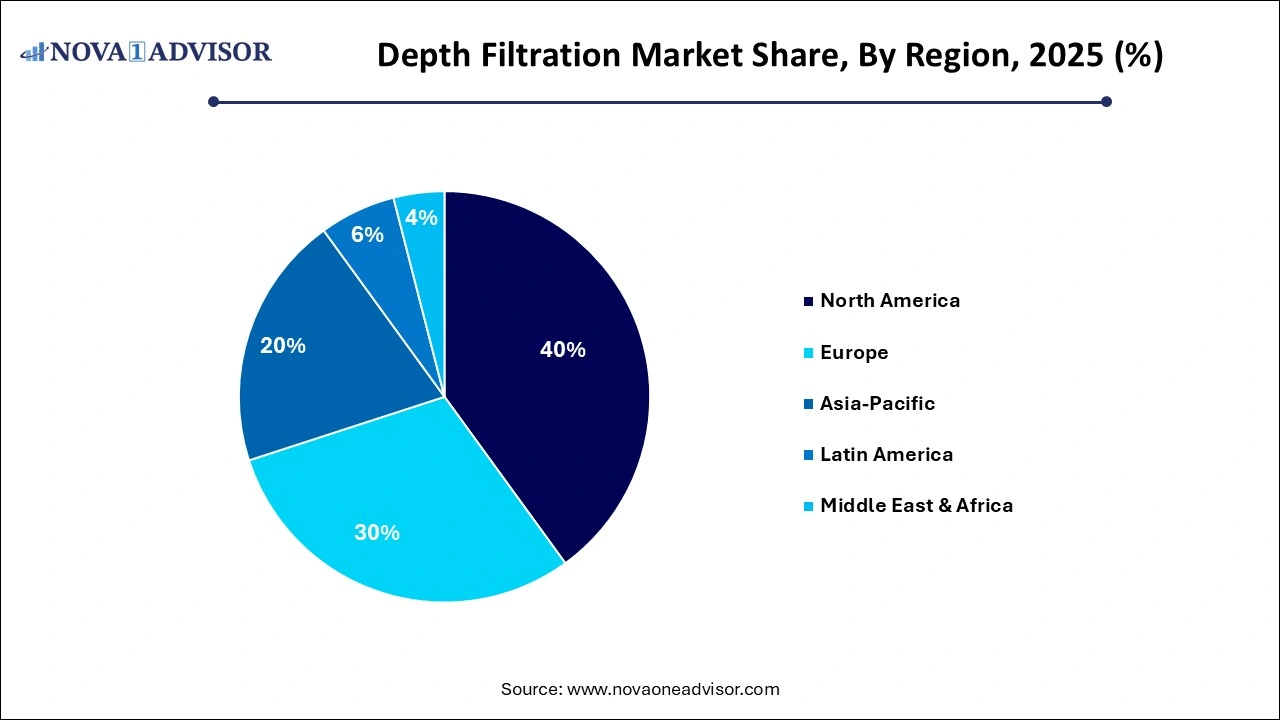
Asia-Pacific is witnessing the fastest growth, driven by rapid industrialization, urbanization, and healthcare expansion in countries like China, India, South Korea, and Japan.
The region’s booming biopharma manufacturing sector, combined with increasing environmental regulations and a rising middle-class demand for safe food and beverages, is creating massive opportunities for depth filtration providers. Local government initiatives to improve access to clean water and safe healthcare also stimulate regional market growth.
Furthermore, as global pharmaceutical companies shift manufacturing bases and research hubs to Asia-Pacific, the adoption of advanced depth filtration systems is accelerating at a remarkable pace.
U.S. Depth Filtration Market Trends
The U.S.’s adoption of single-use capsules is accelerating, providing operational flexibility and reducing contamination risks in drug manufacturing. Rising innovation in filter media is increasing contaminant retention efficiency and flow rates, and strict regulations in the pharmaceutical and food and beverage sectors drive the demand for advanced, reliable filtration systems.
China Depth Filtration Market Trends
China’s prioritising flexibility and sterility in drug manufacturing. Simultaneously, Industry 4.0 integration and material innovation are enhancing process efficiency through real-time monitoring and advanced filtration media. As stringent regulations demand higher safety standards, the industry is pivotally shifting toward sustainable practices and eco-friendly materials to meet global compliance goals.
Key Players in the Depth Filtration Market
- KGaA: Merck KGaA provides high-performance depth filters, such as the Millistak+® portfolio, designed for purification in biopharmaceutical processing. They focus on specialized cell harvesting and clarification, offering both synthetic and cellulose-based options to improve yield.
- 3M Company: 3M produces innovative depth filtration media, such as Zeta Plus, that leverage electrokinetic adsorption for biopharmaceutical clarification and industrial water purification. They offer 90 years of expertise, providing high-efficiency filters designed for challenging filtration applications.
- Parker-Hannifin Corporation: Parker-Hannifin (including Dominic Hunter) delivers durable depth filtration solutions essential for oil and gas, industrial, and marine applications. Their filters are critical for removing particles in harsh environments to maintain hydraulic component longevity.
- Amazon Filters Ltd.: Amazon Filters manufactures a wide range of depth filters, including melt-blown and wound cartridges designed for diverse industrial applications. They are known for providing custom, high-capacity filtration solutions tailored to specific fluid characteristics.
- Pall Corporation: Pall Corporation specializes in high-performance depth filtration technologies, including SupraCap, tailored for biotechnology and pharmaceutical manufacturing. They focus on advanced particle removal and purification, including specialized solutions for microelectronics and wastewater.
- Eaton Corporation PLC: Eaton provides advanced depth filter sheets and modules optimized for chemical, food, and beverage processing. Their solutions focus on high-efficiency, sustainable filtration that minimizes operational energy costs.
Recent Developments
-
March 2025: Pall Corporation launched an advanced single-use depth filtration capsule system optimized for viral vector and mRNA production processes.
-
February 2025: Sartorius announced a new hybrid depth filter media combining cellulose fibers and charged polymers for enhanced endotoxin removal.
-
January 2025: 3M introduced a sustainable depth filter cartridge series made with biodegradable polymer matrices aimed at water treatment applications.
-
December 2024: Amazon Filters Ltd expanded its high-capacity depth filter range for beer and wine clarification with a new multi-layer configuration.
-
November 2024: Parker Hannifin completed the acquisition of a membrane filtration company to strengthen its integrated depth and membrane filtration solutions portfolio.
Segments Covered in the Report
This report forecasts revenue growth at country levels and provides an analysis of the latest industry trends in each of the sub-segments from 2021 to 2034. For this study, Nova one advisor, Inc. has segmented the depth filtration market
By Media type
- Diatomaceous Earth
- Activated Carbon
- Cellulose
- Perlite
By Product
- Cartridge Filters
- Capsule Filters
- Others
By End-Use
- Water filtration
- Food & beverages
- Healthcare
- Others
By Regional
- North America
- Europe
- Asia Pacific
- Latin America
- Middle East and Africa (MEA)

Proceed to Buy
Instant PDF delivery on confirmation

Depth Filtration Market Size to Worth Around USD 5.71 Bn by 2035
 Request Customization
 Download Sample

Get a Sample of this Report
Depth Filtration Market