

Desalting and Buffer Exchange Market Size, Share, Forecast Report, 2020-2035
 Status Published
 Category Healthcare


Content
Desalting and Buffer Exchange Market Size and Growth 2026 to 2035
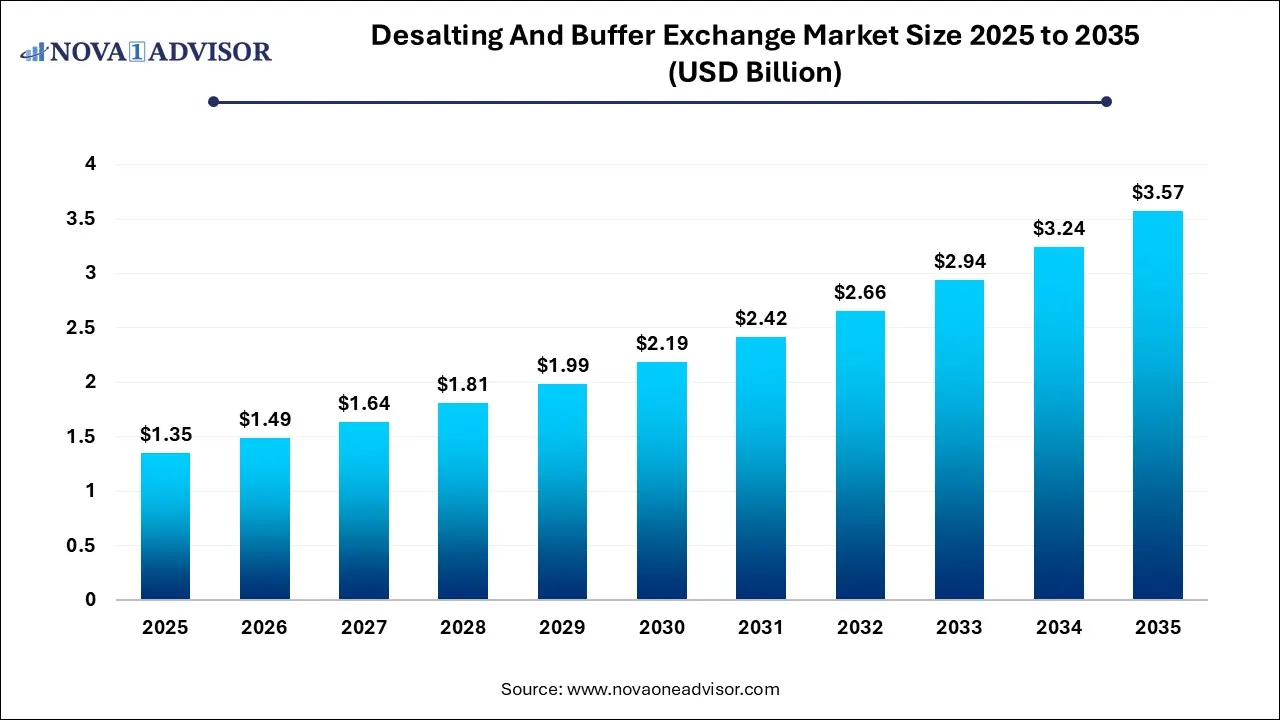
The global desalting and buffer exchange market size was estimated at USD 1.35 billion in 2025 and is projected to hit around USD 3.57 billion by 2035, growing at a CAGR of 10.2% during the forecast period from 2026 to 2035.
Market Key Takeaways
- The desalting and buffer exchange market is witnessing strong growth driven by the expansion of biopharmaceutical manufacturing and protein-based therapeutics.
- Filtration-based techniques, especially ultrafiltration, dominate due to scalability and efficiency in industrial workflows.
Chromatography-based methods are gaining traction in precision purification applications. - Kits and spin columns are widely adopted in research and small-scale laboratory applications.
- Bioprocess applications hold the largest share, while diagnostic applications are emerging rapidly.
- North America leads the market, but Asia Pacific is the fastest-growing region due to rising biotech investments.
- Integration of automation and AI-driven process optimization is reshaping workflow efficiency.
Market Overview
The desalting and buffer exchange market plays a critical role in life sciences, particularly in protein purification, drug development, and diagnostics. These processes are essential for removing unwanted salts or small molecules and replacing them with suitable buffers, ensuring the stability and functionality of biomolecules. As biologics, monoclonal antibodies, and gene therapies gain prominence, the demand for efficient purification and buffer management technologies has surged significantly.
The market is deeply intertwined with the growth of biopharmaceutical manufacturing, where downstream processing efficiency directly impacts production yield and product quality. Desalting and buffer exchange are essential steps in preparing proteins for storage, analysis, or therapeutic use. For example, during monoclonal antibody production, buffer exchange is crucial for transitioning from purification buffers to formulation buffers that maintain drug stability.
Additionally, the increasing focus on personalized medicine and cell & gene therapies has intensified the need for precise and scalable purification techniques. These therapies often involve delicate biomolecules that require careful buffer conditions, making desalting technologies indispensable. The market also benefits from academic research expansion, contract research organizations (CROs), and contract development and manufacturing organizations (CDMOs), which rely heavily on these technologies.
Market Outlook
- Market Growth Overview: The global desalting and buffer exchange market is expected to grow significantly between 2025 and 2035, driven by the rising biopharmaceutical research and developments and production, expansion of high-purity requirements, and growth in proteomic and genomic research.
- Sustainability Trends: Sustainability trends involve buffer recycling and water reduction, energy-efficient process, and green manufacturing and waste management.
- Major Investors: Major investors in the market include Thermo Fisher Scientific Inc., Danaher Corporation, Merck KGaA, Sartorius AG, and GE Healthcare.
How is AI Transforming the Desalting and Buffer Exchange Market?
Artificial Intelligence (AI) is gradually transforming the desalting and buffer exchange market by optimizing process efficiency, reducing manual intervention, and improving reproducibility.
AI-driven process modeling allows researchers to predict optimal buffer conditions, filtration parameters, and exchange cycles. Traditionally, determining the ideal buffer system required extensive trial-and-error experimentation. With AI, predictive algorithms can analyze molecular characteristics, pH stability, and ionic strength requirements to recommend optimal conditions, saving both time and resources.
In bioprocessing facilities, AI-enabled automation systems are being integrated with filtration and chromatography equipment. These systems monitor parameters such as pressure, flow rate, and solute concentration in real time. For instance, during ultrafiltration, AI can dynamically adjust pressure to prevent membrane fouling while maximizing throughput. This reduces downtime and enhances membrane lifespan.
Another key transformation is in quality control. AI-powered analytics can detect anomalies in desalting processes, such as incomplete salt removal or protein aggregation risks. This ensures higher consistency in biologics manufacturing, which is critical for regulatory compliance.
Furthermore, AI supports digital twins—virtual replicas of purification processes—allowing companies to simulate desalting and buffer exchange workflows before implementation. This is particularly valuable in scaling up from laboratory to industrial production.
Major Trends in the Market
- Increasing adoption of single-use technologies in bioprocessing
- Shift toward automated and high-throughput purification systems
- Rising demand for continuous bioprocessing workflows
- Growing use of membrane-based filtration technologies
- Expansion of biologics and biosimilars production
- Integration of AI and digital monitoring systems
- Development of ready-to-use desalting kits for research applications
- Increased outsourcing to CROs and CDMOs
- Advancements in nanofiltration and selective membranes
- Rising focus on cost-effective and scalable purification solutions
Desalting and Buffer Exchange Market Report Scope
| Report Coverage | Details |
| Market Size in 2026 | USD 1.49 Billion |
| Market Size by 2035 | USD 3.57 Billion |
| Growth Rate From 2026 to 2035 | CAGR of 10.2% |
| Base Year | 2025 |
| Forecast Period | 2026 to 2035 |
| Segments Covered | Technique, Product, Application, Region |
| Market Analysis (Terms Used) | Value (USD Million/Billion) or (Volume/Units) |
| Regional Scope | North America; Europe; Asia Pacific; Central and South America; the Middle East and Africa |
| Key Companies Profiled | Merck KGaA, GE Healthcare, Sartorius AG, Thermo Fisher Scientific, Danaher Corporation, Agilent Technologies, Inc., Bio-Rad Laboratories, Avantor, Repligen Corporation, Bio-works Technologies Ab, Phynexus, Inc., and Norgen Biotek Corp. |
Segmental Insights
By Technique
How did the filtration segment dominate the Global Desalting and Buffer Exchange market?
The filtration segment is driven by the massive transition toward advanced filtration technologies, such as ultrafiltration and TFF to ensure high-purity downstream processing. The intimation of single-use systems has eliminating contamination risks. The superior scalability and speed of modern membrane technology make it the indispensable standard for meeting global biomanufacturing demands.
How did the chromatography segment expect to hold the fastest-growing Global Desalting and Buffer Exchange market in the coming years?
The chromatography segment is driven by the escalating demand for high-purity biologics and vaccines has established chromatography as a vital standard for precise, large-scale protein purification. Continuous innovation in resin chemistry and automation are significantly enhancing selectivity and operational speed, effectively minimizing human error in complex bioprocessing. The rapid growth of CDMO and CRO sector is accelerating the global adoption of these high-throughput techniques to meet rigorous manufacturing deadlines.
By Product
How did the cassettes and cartridges segment account for the largest share in the Global Desalting and Buffer Exchange market?
The cassettes and cartridges segment is driven by the increasing demand for biologics and monoclonal antibodies has established cassettes and cartridges as essential tools for high-throughput, scalable purification. Their pre-packed, single-use design significantly reduces contamination risks while streamlining complex laboratory workflows by eliminating manual column packing. By enabling inline processing and minimizing hold volumes, these modules provide a versatile solution for efficient, large-scale biopharmaceutical production.
How did the membrane filters segment expect to hold the fastest-growing Global Desalting and Buffer Exchange market in the coming years?
The membrane filters segment is driven by the global surge in biologics and biosimilars is mandating the use of advanced membrane systems to ensure rapid, high-purity downstream purification. Innovations in automated, polymer-based membranes are significantly lowering operational costs and pressure drops compared to traditional resin methods. These scalable solutions are now essential for manufacturers looking to expand production capacity while maintaining rigorous process consistency.
By Application
How did the bioprocess applications segment account for the largest share in the Global Desalting and Buffer Exchange market?
The bioprocess applications segment is driven by the rapid expansion of biologics and monoclonal antibodies has made high-volume desalting and buffer exchange a critical necessity in modern bioproduction. Massive research and developments investment is driving the transition toward high-throughput technologies, such as ultrafiltration to meet rigorous production scaling and efficiency requirements. The stringent regulatory standards for therapeutic purity favour these validated, large-scale bioprocessing techniques to ensure consistent patient safety and product quality.
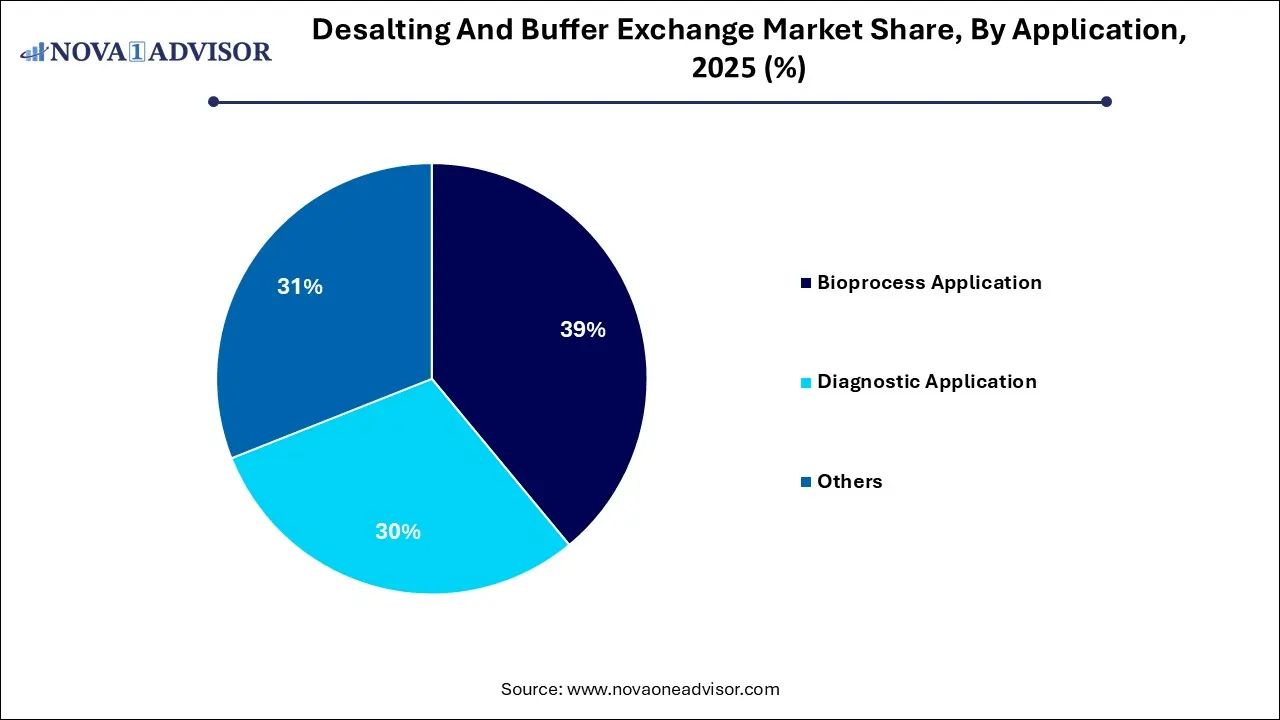
How did the diagnostic applications segment expect to hold the fastest-growing Global Desalting and Buffer Exchange market in the coming years?
The diagnostic applications segment is driven by the surge in RNA-based therapeutics and genomic research is driving a critical need for high-purity sample preparation through efficient buffer exchange. Technological breakthroughs in spin column designs and buffer chemistry are significantly accelerating the precision of nucleic acid amplification and clinical diagnostics. The global emphasis on infectious disease surveillance has solidified the demand for consistent, high-throughput purification methods to ensure accurate pathogen identification.
Key Players in the Global Desalting and Buffer Exchange Market
- Merck KGaA (MilliporeSigma) : Merck KGaA contributes to the market by providing advanced tangential flow filtration (TFF) systems, ultrafiltration cassettes, and chromatography hardware designed for high-quality purification and buffer exchange in biopharmaceutical manufacturing.
- GE Healthcare (Cytiva) : GE Healthcare (a Danaher company) is a leading provider offering a wide range of desalting and buffer exchange technologies, including Sephadex chromatography resins and pre-packed columns crucial for protein purification.
- Sartorius AG : Sartorius specializes in membrane filtration systems and single-use technologies like Sartobind® membrane chromatography and Vivaflow SU, which offer high-speed, scalable, and low-waste buffer exchange.
- Thermo Fisher Scientific: Thermo Fisher Scientific provides a comprehensive portfolio spanning spin columns, dialysis cassettes, and large-scale filtration systems like Zebaspin and Slide-A-Lyzer, catering to both research and commercial bioprocessing.
Segments Covered in the Report
This report forecasts revenue growth at country levels and provides an analysis of the latest industry trends in each of the sub-segments from 2021 to 2035. For this study, Nova one advisor, Inc. has segmented the desalting and buffer exchange market.
By Technique
- Filtration
-
- Ultrafiltration
- Dialysis
- Chromatography
-
- Size-Exclusion Chromatography
- Others
- Precipitation
By Product
- Cassettes & Cartridges
- Kits
- Filter Plates
- Spin Columns
- Membrane Filters
- Others
By Application
- Bioprocess Applications
- Diagnostic Applications
By Region
- North America
- Europe
- Asia Pacific
- Latin America
- Middle East and Africa (MEA)
FAQ's

Proceed to Buy
Instant PDF delivery on confirmation

Desalting and Buffer Exchange Market Size to Hit USD 3.57 Billion by 2035
 Request Customization
 Download Sample

Get a Sample of this Report
Desalting and Buffer Exchange Market