

Diabetes Care Drugs Market Size, Share, and Trends 2026 to 2035
 Status Published
 Category Healthcare


Content
Diabetes Care Drugs Market Size and Growth 2026 to 2035
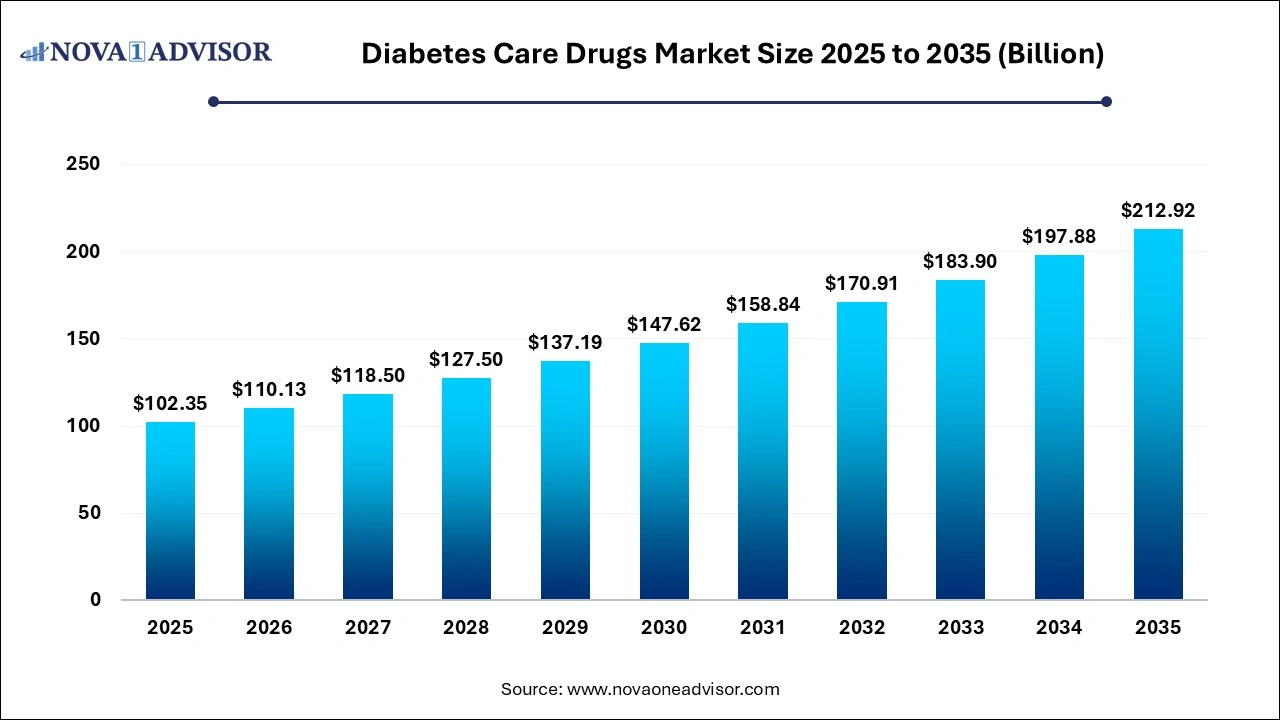
The global diabetes care drugs market size was estimated at USD 102.35 billion in 2025 and is projected to hit around USD 212.92 billion by 2035, growing at a CAGR of 7.6% during the forecast period from 2026 to 2035.
Key Takeaway
- By drug class, the insulin segment dominated the market with the largest share in 2025.
- By drug class, the injectable drugs segment dominated the market with the largest share in 2025.
- By route of administration, the injectable drugs segment dominated the market with the largest share in 2025.
- By end user, the home care settings segment dominated the market with the largest share in 2025.
- By region, North America dominated the market with the largest share in 2025.
Market Overview
The Diabetes Care Drugs Market includes insulin, GLP-1 receptor agonists, SGLT-2 inhibitors, DPP-4 inhibitors, oral antidiabetic medicines, amylin analogues, and other therapies used to manage diabetes and reduce related health risks.
The market is shifting beyond traditional glucose control toward broader cardiometabolic management. Modern therapies are increasingly assessed based on their effects on blood sugar, body weight, cardiovascular outcomes, kidney health, hypoglycemia risk, and quality of life.
Insulin remains essential for type 1 diabetes and continues to play an important role in advanced type 2 diabetes. However, incretin-based therapies, particularly GLP-1 and dual GIP/GLP-1 medicines, are increasingly influencing market growth because of their combined glucose-lowering and weight-management benefits.
Another important trend is the development of more convenient treatment formats, including once-weekly injections and oral therapies. The emergence of oral incretin medicines could further expand treatment access among patients who prefer to avoid injectable therapies.
The competitive landscape includes major pharmaceutical companies such as Novo Nordisk, Eli Lilly, Sanofi, AstraZeneca, Merck, Boehringer Ingelheim, Bayer, Takeda, and Johnson & Johnson, alongside biotechnology and regional pharmaceutical players.
Overall, the market is evolving from a glucose-focused treatment category toward a broader metabolic-health ecosystem, where glycemic control, weight management, cardiovascular and kidney protection, treatment convenience, and long-term adherence increasingly shape prescribing and purchasing decisions.
Market Outlook
- Market Growth Overview: The global diabetes care drugs Market is expected to grow significantly between 2025 and 2035, driven by the growing diabetes prevalence across the globe.
- Sustainability Trends: Sustainability trends involve growing adoption of sustainable manufacturing and minimizing single-use plastic packaging.
- Major Investors: Major investors in the market include Sanofi, AstraZeneca, Boehringer Ingelheim, Merck & Co., Johnson & Johnson, and Takeda Pharmaceutical.
How is AI Impacting The Global Diabetes Care Drugs Market?
Artificial intelligence (AI) is reshaping the market by transitioning the market from generalized treatments to precision medicine. AI also optimizes therapeutic choices by processing patient data to forecast individual drug responses. Furthermore, pharmaceutical developers leverage artificial intelligence to identify novel therapeutic targets, optimize clinical trial recruitment processes, and simulate therapeutic efficacy for next-generation diabetes treatments.
Major Trends in the Market
- Rapid expansion of GLP-1-based therapies: GLP-1 medicines are moving from conventional glucose management toward broader cardiometabolic treatment.
- Increasing convergence of diabetes and obesity care: Pharmaceutical companies increasingly develop and commercialize therapies that address both hyperglycemia and excess body weight.
- Growth of multi-pathway therapies: Dual and multi-receptor approaches are becoming important in the development pipeline.
- Movement toward oral GLP-1 therapies: Oral formulations can reduce the administration barrier associated with injections.
- Longer-acting insulin formulations: Pharmaceutical companies continue to pursue dosing schedules that reduce treatment burden.
Diabetes Care Drugs Market Report Scope
| Report Coverage | Details |
| Market Size in 2026 | USD 110.13 Billion |
| Market Size by 2035 | USD 212.92 Billion |
| Growth Rate From 2026 to 2035 | CAGR of 7.6% |
| Base Year | 2025 |
| Forecast Period | 2026 to 2035 |
| Segments Covered | By Drug Class, By Route of Administration, By End Use, By Region |
| Market Analysis (Terms Used) | Value (USD Million/Billion) or (Volume/Units) |
| Regional Scope | North America; Europe; Asia Pacific; Central and South America; the Middle East and Africa |
| Key Companies Profiled | Novo Nordisk A/S, Eli Lilly and Company, Sanofi S.A., Merck & Co., Inc., AstraZeneca PLC, Boehringer Ingelheim GmbH, Novartis AG, Pfizer Inc., Abbott Laboratories, Johnson & Johnson, Sun Pharmaceutical Industries Ltd., Dr. Reddy’s Laboratories Ltd., Lupin Limited, Biocon Limited, Mankind Pharma Ltd., Other Key Players |
Market Driver
The increasing global burden of diabetes and demand for long-term disease management is the primary growth driver. Diabetes requires sustained treatment, creating recurring demand for insulin, oral antidiabetic medicines, GLP-1 therapies, SGLT-2 inhibitors, and other drug classes. Earlier diagnosis, growing awareness of diabetes-related complications, aging populations, obesity, and increasing demand for therapies that address both glucose control and broader cardiometabolic risks are further supporting market expansion.
Market Restraint
High treatment costs and unequal access to advanced therapies remain major restraints. Newer GLP-1 and multi-pathway medicines can be considerably more expensive than established therapies, making reimbursement policies, insurance coverage, healthcare budgets, and patient affordability important adoption factors. Supply constraints, regulatory requirements, and concerns surrounding unauthorized or non-approved alternatives can further complicate access and market development.
Market Opportunity
Next-generation oral and multi-pathway diabetes therapies represent a significant opportunity. Oral incretin medicines can improve convenience for patients who prefer tablets over injections, while multi-pathway therapies may provide combined benefits for glucose control, weight management, and cardiometabolic health. Emerging markets across Asia-Pacific, Latin America, and the Middle East also offer substantial potential through affordable formulations, local manufacturing, simplified dosing, and patient-support programs.
Segmental Insights
By Drug Class
Why did the insulin segment dominate the global diabetes care drugs Market?
The insulin segment dominated the market with the largest share in 2025. The dominance of the segment can be attributed to the increasing diabetes prevalence across the globe and its surge in use in advanced Type 2 cases. In addition, improved distribution networks, broader market penetration, and the introduction of biosimilar alternatives significantly enhance healthcare accessibility in high-density urban areas.
How did the GLP-1 receptor agonist segment expected to hold the significantly growing global diabetes care drugs Market in the coming years?
The GLP-1 receptor agonist segment is expected to grow at the fastest CAGR over the forecast period. The growth of the segment can be credited to their benefits in weight management and glycaemic control along with the favourable cardiovascular outcomes. Also, the transition toward convenient, once-weekly injectable formulations significantly enhances long-term patient adherence, leading to segment growth soon.
By Route of Administration
Why did the injectable drugs segment dominate the global diabetes care drugs Market?
The injectable drugs segment dominated the market with the largest share in 2025. The dominance of the segment can be linked to the growing global diabetes incidence and increasing demand for advanced GLP-1 receptor agonists. The transition toward patient self-administration and home-based healthcare settings has significantly boosted the market demand for convenient, portable, and secure injectable medical devices.
How did the oral drugs segment expected to hold the significantly growing global diabetes care drugs Market in the coming years?
The oral drugs segment is expected to grow at the fastest CAGR over the forecast period. The growth of the segment can be driven by the growing prevalence of type 2 diabetes cases and high treatment compliance with other medications. The large-scale, economical manufacturing of standard pharmaceutical formulations, such as metformin, substantially broadens healthcare accessibility within developing regions.
By End User
Why did the home care settings segment dominate the global diabetes care drugs Market?
The home care settings segment dominated the market with the largest share in 2025. The dominance of the segment is owing to the growing focus on self-management and innovations in self-injection pens. Furthermore, due to the chronic nature of diabetes, management requires a continuous daily routine, which requires the home administration of oral medications and insulin, the most viable and efficient approach.
How did the hospitality segment expected to hold the significantly growing global diabetes care drugs Market in the coming years?
The hospitality segment is expected to grow at the fastest CAGR over the forecast period. The growth of the segment is due to growing admissions for acute complications such as ketoacidosis and growing inpatient critical care infrastructure. Moreover, the administration of specialized intravenous insulin infusions, continuous physiological monitoring, and intricate combination therapeutic regimens is strictly tied closely to supervised clinical environments.
By Region
Why did the North American region account for the largest share of the global diabetes care drugs Market?
North America dominated the market with the largest share in 2025. The dominance of the region can be attributed to the growing adoption of advanced GLP-1 receptor agonists and preferred pharmaceutical reimbursement policies. In addition; comprehensive diagnostic initiatives facilitate increased rates of early intervention and the sustained administration of therapeutic programs.
U.S. Global Diabetes Care Drugs Market Trends
The growth of the market in the country can be driven by the growing incidence of type 2 diabetes, sedentary lifestyles, and the geriatric population. Also, major industry participants consistently allocate capital toward clinical development pipelines to enhance patient compliance, focusing significantly on the advancement of once-weekly injectable therapies.
Why did the Asia-Pacific region become the fastest-growing global diabetes care drugs Market during the forecast period?
Asia Pacific is expected to grow at the fastest CAGR over the forecast period. The growth of the region can be credited to the rapid urbanization, increasing obesity rates, and lifestyle changes across developing economies such as China and India. Furthermore, the establishment of cost-effective domestic manufacturing facilities by leading pharmaceutical companies within the region enhances medicine affordability and fortifies supply chain resilience.
- In March 2026, NATCO Pharma Limited launched a generic semaglutide injection in India, marking a significant step toward making advanced type 2 diabetes treatment more accessible. Offered at a substantially lower price point than existing alternatives, this initiative is expected to offer extensive financial and therapeutic benefits to a large patient population.
China Global Diabetes Care Drugs Market Trends
The market in the country is growing due to the smooth clinical adoption of advanced injectable therapies such as GLP-1 receptor agonists and the presence of an extensive aging patient population. Moreover, the proliferation of digital pharmaceutical services and telehealth platforms significantly enhances pharmaceutical accessibility beyond major metropolitan areas.
Key Players in the Global Diabetes Care Drugs Market
- Eli Lilly and Company: A primary competitor known for advanced GLP-1/GIP receptor dual-agonists and a robust comprehensive insulin and oral anti-diabetic catalog.
- Boehringer Ingelheim: Focuses on cardiorenal metabolic protection with major SGLT2 and DPP-4 inhibitor blockbusters developed in alliance with global partners.
- Novo Nordisk: It leads the global market via dominant positions in the insulin and high-demand GLP-1 segments (such as semaglutide formulations for diabetes and weight management).
Recent Developments
- In April 2026, Lupin Limited has formally introduced Dapagliflozin and Metformin Hydrochloride Extended-Release Tablets in the United States, following the receipt of Abbreviated New Drug Application (ANDA) authorization from the United States Food and Drug Administration (U.S. FDA).
Segments Covered in the Report
This report forecasts revenue growth at country levels and provides an analysis of the latest industry trends in each of the sub-segments from 2021 to 2035. For this study, Nova one advisor, Inc. has diabetes care drugs market.
By Drug Class
- Insulin
- GLP-1 Receptor Agonists
- Oral Antidiabetic Drugs (OADs)
- SGLT-2 Inhibitors
- Others (DPP-4, Amylin Analogues, etc.)
By Route of Administration
- Injectable Drugs
- Oral Drugs
By End User
- Homecare Settings
- Hospitals
- Clinics & Diabetes Centres
By Region
- North America
- Europe
- Asia-Pacific
- Latin America
- Middle East & Africa (MEA)
FAQ's

Proceed to Buy
Instant PDF delivery on confirmation

Diabetes Care Drugs Market Size to Exceed USD 212.92 Billion by 2035
 Request Customization
 Download Sample

Get a Sample of this Report
Diabetes Care Drugs Market