

Digital Wound Measurement Devices Market Size, Share, and Trends 2026 to 2035
 Status Published
 Category Healthcare


Content
Digital Wound Measurement Devices Market Size and Growth 2026 to 2035
The global digital wound measurement devices market size was valued at USD 413.35 million in 2025 and is projected to grow from USD 433.81 million in 2026 to USD 670.10 million by 2035, at a CAGR of 5.95% from 2026 to 2035.
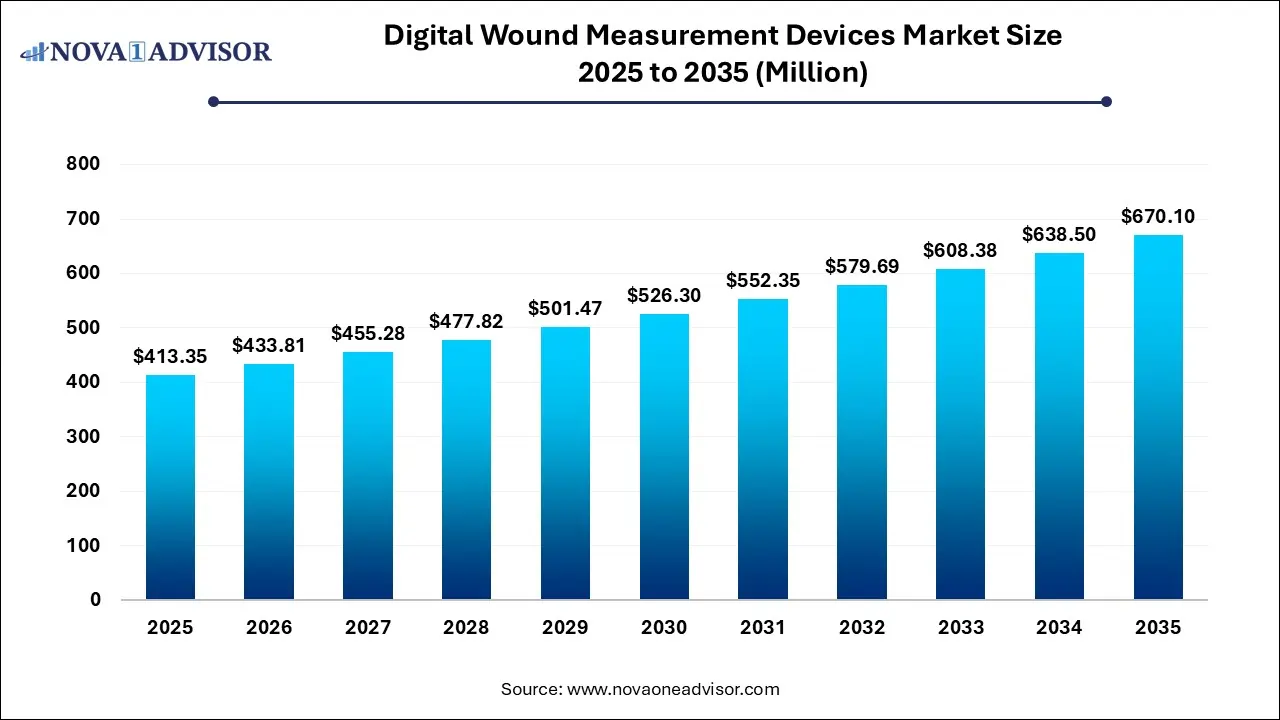
Key Takeaway:
- By product, the non-contact wound measuring devices segment dominated the market and accounted for the largest revenue share in 2025.
- By wound type, the chronic wounds segment dominated the market and accounted for the largest revenue share in 2025.
- By end use, the hospitals segment dominated the market and accounted for the largest revenue share in 2025.
- By region, North America accounted for the largest revenue share in 2025.
Market Overview
The global Digital Wound Measurement Devices Market is experiencing robust growth as healthcare providers increasingly adopt advanced digital technologies to improve wound assessment accuracy, streamline clinical documentation, and enhance patient outcomes. Digital wound measurement devices leverage high-resolution imaging, three-dimensional (3D) scanning, artificial intelligence (AI), and cloud-based software to accurately measure wound dimensions, monitor healing progression, and support data-driven treatment decisions. The rising prevalence of chronic wounds, diabetic foot ulcers, burns, traumatic injuries, and an aging population is significantly driving demand for these innovative solutions across hospitals, clinics, ambulatory surgical centers, and home healthcare settings.
Artificial intelligence is transforming the market by enabling automated wound boundary detection, tissue classification, predictive healing analytics, and remote wound monitoring, thereby improving clinical efficiency and reducing subjective assessment errors. Key market trends include the growing adoption of non-contact wound imaging systems, integration with electronic health records (EHRs), expansion of smartphone-based wound assessment applications, increasing use of cloud-connected platforms, and rising demand for telemedicine-enabled wound care. With continued technological advancements and increasing healthcare digitalization, the Digital Wound Measurement Devices Market is expected to witness sustained growth, offering significant opportunities for manufacturers developing intelligent, connected, and patient-centric wound management solutions.
Market Outlook
- Market Growth Overview: The global digital wound measurement devices market is expected to grow significantly between 2025 and 2035, driven by the rising burden of chronic wounds, technological innovation in 3D imaging, and growing demand for objective measurement.
- Sustainability Trends: Sustainability trends involve energy-efficient green manufacturing, resource and graft minimization, and eco-friendly hardware and consumables.
- Major Investors: Major investors in the market include Smith & Nephew, Swift Medical, ARANZ Medical, MolecuLight, and 3M.
How AI is Impacting the Global Digital Wound Measurement Devices Market?
AI and ML are revolutionizing the global digital wound measurement devices industry by automating imaging, tissue classification, and healing progression tracking. By replacing error-prone manual measurements with objective, smartphone-based digital analysis, these technologies streamline clinical documentation and reduce hospital visits. Machine learning algorithms process complex wound metrics to predict healing trajectories, enabling clinicians to tailor personalized treatments that ultimately improve patient outcomes.
Segmental Insights
Major Trends in the Digital Wound Measurement Devices Market
- Growing adoption of non-contact wound imaging technologies
Healthcare providers increasingly prefer non-contact imaging systems because they minimize infection risk while providing highly accurate wound measurements. These technologies are particularly beneficial for patients with burns, diabetic ulcers, and highly sensitive wounds where physical contact should be minimized.
- Integration with electronic health records (EHR)
Modern wound measurement devices are increasingly designed to integrate seamlessly with hospital information systems and electronic health records, enabling centralized documentation, improved clinical workflow, and better continuity of patient care.
- Expansion of smartphone-based wound assessment solutions
Manufacturers are introducing smartphone-compatible wound imaging applications that allow clinicians to capture high-quality wound images using mobile devices while automatically calculating wound dimensions through AI-powered software.
- Increased use of cloud-based wound management platforms
Cloud connectivity enables secure storage of wound images, remote specialist consultations, longitudinal healing analysis, and collaboration among multidisciplinary healthcare teams across different care settings.
- Growing demand for home healthcare monitoring
The expansion of home healthcare services is increasing demand for portable digital wound measurement devices that enable nurses and caregivers to monitor chronic wounds outside traditional clinical environments.
Digital Wound Measurement Devices Market Report Scope
| Report Coverage | Details |
| Market Size in 2026 | USD 433.81 Million |
| Market Size by 2035 | USD 670.10 Million |
| Growth Rate From 2026 to 2035 | CAGR of 7.12% |
| Base Year | 2025 |
| Forecast Period | 2026 to 2035 |
| Segments Covered | By Wound Type, By Product, By End-User, By Region |
| Market Analysis (Terms Used) | Value (USD Million/Billion) or (Volume/Units) |
| Regional Scope | North America; Europe; Asia Pacific; Central and South America; the Middle East and Africa |
| Key Companies Profiled | WoundRight Technologies Tissue Analytics, Parable Health, ARANZ Medical Limited, eKare, Inc, KCI, an Acelity Company, WoundMatrix, Inc., WoundZoom Inc., Kent Imaging Inc., WoundRight Technologies, LLC, WoundVision, LLC, Hitachi Healthcare Americas, and Smith & Nephew plc. |
By Product
Dominating Segment: Non-contact Wound Measuring Devices
Non-contact wound measuring devices dominated the market because they provide accurate wound assessment without requiring direct contact with injured tissue. These systems typically utilize high-resolution cameras, laser scanning, structured light, infrared sensors, or three-dimensional imaging technologies to measure wound dimensions, depth, and surface characteristics. By eliminating physical contact, these devices significantly reduce the risk of cross-contamination and secondary infections, making them especially valuable for burns, diabetic ulcers, and highly sensitive wounds.
Healthcare providers increasingly favor non-contact technologies because they improve patient comfort while reducing measurement variability between clinicians. Modern systems automatically generate wound reports, maintain longitudinal healing records, and integrate directly with hospital information systems. Advances in AI-powered wound recognition and cloud connectivity have further enhanced the capabilities of non-contact devices, making them the preferred solution for hospitals and specialized wound care centers. Their ability to support telemedicine and remote wound assessment also strengthens long-term market leadership.
Fastest Growing Segment: Contact Wound Measuring Devices
Contact wound measuring devices are projected to witness the fastest growth in specific clinical settings where cost-effective and portable solutions remain important. Although these devices involve direct placement on or near the wound, technological improvements have enhanced their precision, ease of sterilization, and compatibility with digital documentation systems. Smaller healthcare facilities and outpatient clinics often select these systems because they offer affordable entry points into digital wound assessment.
Manufacturers are developing improved contact measurement devices featuring disposable measurement components, antimicrobial materials, wireless data transfer, and integrated digital imaging. These enhancements increase measurement reliability while maintaining affordability. Emerging markets continue to adopt contact-based digital wound measurement technologies due to budget constraints and expanding healthcare infrastructure. As digital healthcare penetration increases globally, this segment is expected to grow steadily by balancing performance with cost efficiency.
By Wound Type
How did the chronic wounds segment dominate the Global Digital Wound Measurement Devices market?
The chronic wounds segment is driven by the rising global prevalence of chronic ulcers across aging populations, which creates an urgent demand for frequent, standardized medical documentation. The technological integration drastically improves clinical outcomes through precise healing tracking, which optimizes treatment plans and lowers overall healthcare costs.
How did the acute wounds segment expect to hold the fastest-growing Global Digital Wound Measurement Devices market in the coming years?
The acute wounds segment is driven by the rapid rise in emergency room visits, sporting injuries, and traffic accidents, which drive the immediate deployment of digital measurement devices to accurately assess trauma and burns. Hospitals and ambulatory surgical centers are aggressively utilizing these tools to track post-surgical incisions, a practice that drastically lowers infection rates and shortens inpatient hospital stays.
By End-Use
How did the hospitals segment dominate the Global Digital Wound Measurement Devices market?
The hospitals segment is driven by advanced IT infrastructure, and dedicated budgets enable seamless integration of 3D imaging. AI analytics and automated documentation directly into clinical workflows. By replacing manual, error-prone measuring tapes with these devices, medical facilities optimize staff resources, save valuable time, and significantly improve cost efficiency.
How did the community centers segment expected to hold the fastest-growing Global Digital Wound Measurement Devices market in the coming years?
The community centers segment is driven by rapid advances in AI-enabled, software-only platforms that empower caregivers to utilize ordinary mobile smartphones for precise, highly scalable wound mapping across community networks. The community clinics and home care settings serve as the ideal environment for these serial evaluations, optimizing long-term chronic disease management while lowering overall healthcare costs.
By Regional
How did the North America region account for the largest share in the Global Digital Wound Measurement Devices market?
North America is driven by the concentrated presence of key players, which ensures a steady supply of cutting-edge devices, positioning the region as the dominant leader in the global market. The widespread adoption is further accelerated by supportive federal reimbursement frameworks, established telehealth billing codes, and robust venture capital funding that fuels continuous AI innovation.
U.S. Global Digital Wound Measurement Devices Market Trends
The U.S. is eliminating cross-contamination risks and simplifying clinical measurements of wound depth, area, and volume. The massive clinical burden of chronic conditions, such as diabetic foot ulcers, pressure injuries, and venous leg ulcers, requires continuous monitoring.
How did the Asia-Pacific region become the fastest-growing Global Digital Wound Measurement Devices Market during the forecast period?
Asia Pacific is driven by the presence of cost-effective regional manufacturing hubs, making advanced wound care solutions increasingly affordable, positioning the region as the fastest-growing. Aggressive government initiatives for digital health, combined with widespread regional smartphone adoption among a diverse population.
China Global Digital Wound Measurement Devices Market Trends
China’s government-backed digital health policies aggressively promote remote monitoring, enabling clinicians to accurately track wound progression without requiring in-person visits. The cost savings allow hospitals and clinics to reinvest capital into digital software platforms that objectively prove healing efficacy and optimize resource allocation.
How Did Europe Hold A Notable Share in the Global Digital Wound Measurement Devices Market?
Europe’s integrated networks secure steady market growth and establish Europe as a highly structured, digitally mature region for advanced wound management. European healthcare systems heavily emphasize standardized treatment protocols and digital integration across hospitals and community care network frameworks.
Germany Global Digital Wound Measurement Devices Market Trends
Germany’s adoption of portable, non-contact 2D camera devices and AI-enabled software that allow community nurses to securely transmit wound dimensions to specialists, cutting down on in-person visits. In terms of hardware, non-contact 2D planimetry cameras are the most utilized technology, accounting for more than 56% of the market share.
Key Players in the Global Digital Wound Measurement Devices Market
- Tissue Analytics
Tissue Analytics provides an AI-powered smartphone application that uses machine learning to automatically generate 3D renderings of wounds, capturing volume and depth with sub-millimeter precision. The software seamlessly integrates these precise digital measurements directly into electronic health records, drastically improving clinical documentation and telehealth workflows.
- ARANZ Medical Limited
ARANZ Medical develops the Silhouette system, an advanced 3D scanning and software platform utilized in hospitals to capture precise, real-time wound geometry and healing progression. By providing highly standardized and accurate visual data, their technology supports both clinical treatment planning and complex, multi-site clinical trials.
- Parable Health
Parable Health offers a digital platform that connects patients, home care providers, and clinics to standardize wound tracking and clinical outcomes.
Segments Covered in the Report
This report forecasts revenue growth at country levels and provides an analysis of the latest industry trends in each of the sub-segments from 2021 to 2035. For this study, Nova one advisor, Inc. has digital wound measurement devices market.
By Wound Type
- Diabetic ulcer
- Chronic wounds
- Burns
- Incisional
- Traumatic
By Product
- Contact Wound Measuring Devices
- Non-contact Wound Measuring Devices
By End-User
- Hospitals
- Clinics
- Ambulatory Surgical Centers
By Region
- North America
- Europe
- Asia-Pacific
- Latin America
- Middle East & Africa (MEA)
FAQ's

Proceed to Buy
Instant PDF delivery on confirmation

Digital Wound Measurement Devices Market Size to Hit USD 670.10 Million by 2035
 Request Customization
 Download Sample

Get a Sample of this Report
Digital Wound Measurement Devices Market