

Drug Delivery Systems Market (By Delivery System; By Route of Administration; By Application) - Global Industry Analysis, Share, Growth, Regional Outlook and Forecasts, 2026-2035
 Status Published
 Category Healthcare


Content
Drug Delivery Systems Market Size, Growth and Trends 2026 to 2035
The global drug delivery systems market size was reached at USD 47.07 billion in 2025 and is expected to be worth around USD 95.05 billion by 2035 with a CAGR of 7.28% from 2026 to 2035.
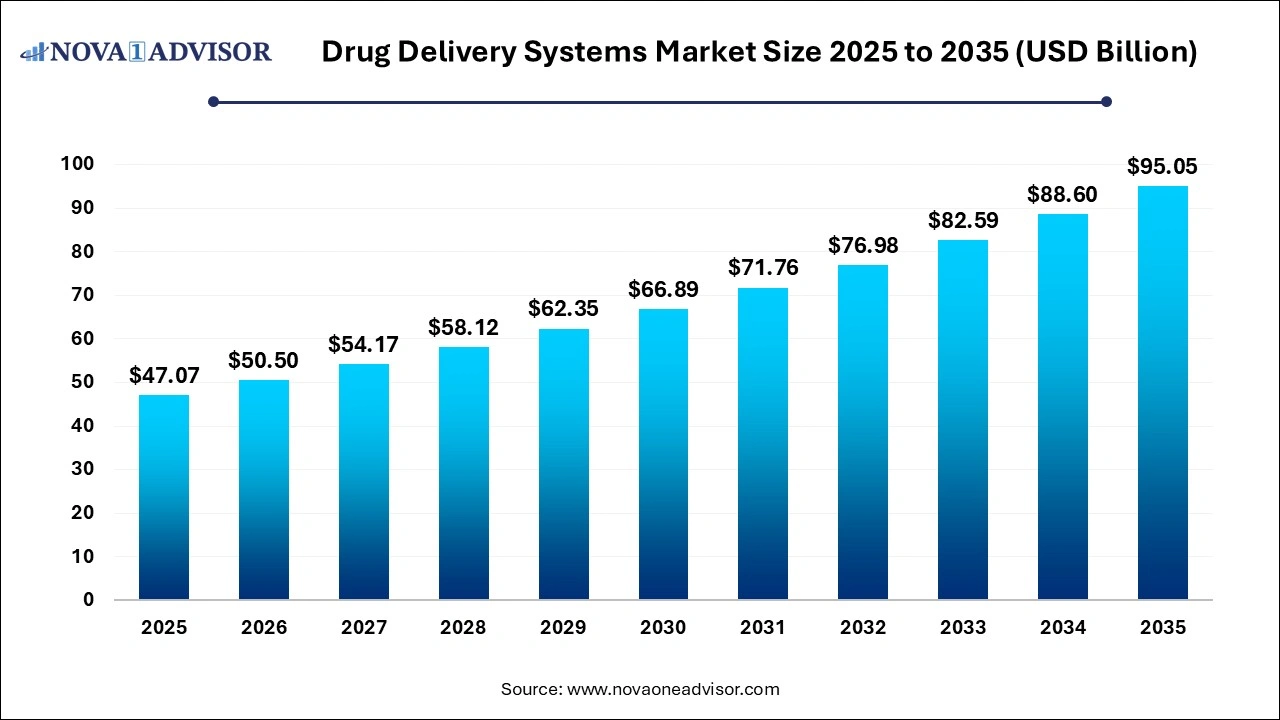
Drug Delivery Systems Market Outlook
- Market Growth Overview: The drug delivery systems market is expected to grow significantly between 2025 and 2034, driven by rising prevalence of chronic diseases, technological advancement and innovation, and shift towards targeted therapies and biologics.
- Sustainability Trends: Sustainability trends involve green manufacturing and logistics, smart & connected devices, and reusable and durable devices.
- Major Investors: Major investors in the market include Johnson 7Johnson, Pfizer Inc., Novartis AG, Roche Holding AG, Becton Dickinson, 3M Company, Merck Group, and Bayer AG.
How AI is Impacting the Drug Delivery System Market
AI and ML are transforming the drug delivery systems industry by enabling the design of personalized, targeted therapies that significantly improve therapeutic outcomes and patient compliance. These technologies analyse vast, complex biological datasets to optimize nanoparticle-based drug carriers, enhancing their stability, bioavailability, and targeting accuracy to reduce systemic side effects. AI-driven models and real-time data from wearables facilitate adaptive, controlled drug release tailored to individual patient needs.
Supply Chain Analysis of the Drug Delivery Systems Market
- Research & Development (R&D) and Formulation Development: This initial stage focuses on the conception of novel delivery mechanisms, such as nanoparticle carriers, liposomes, and biodegradable polymers, to enhance drug efficacy.
Key Players: Johnson & Johnson, Pfizer Inc., Novartis AG, Roche Holding AG, AstraZeneca PLC, and specialized firms like Nanobiotix. - Contract Research and Development: Specialized CROs provide critical services, including pre-clinical testing, clinical trial management, and bioequivalence studies to validate new delivery technologies.
Key Players: Catalent Inc., Kindeva Drug Delivery L.P. - Distribution and Logistics: This stage involves the logistical handling of products from manufacturers to end-users, ensuring that sensitive, temperature-controlled, or advanced systems are delivered securely.
Key Players: Cardinal Health, McKesson Corporation, and AmerisourceBergen.
Report Scope of the Drug Delivery Systems Market
| Report Coverage | Details |
| Market Size in 2026 | USD 50.50 Billion |
| Market Size by 2035 | USD 95.05 Billion |
| Growth Rate From 2026 to 2035 | CAGR of 7.28% |
| Base Year | 2025 |
| Forecast Period | 2026 to 2035 |
| Segments Covered | By Delivery System, By Route of Administration, By Application |
| Market Analysis (Terms Used) | Value (USD Million/Billion) or (Volume/Units) |
| Regional Scope | North America; Europe; Asia Pacific; Central and South America; the Middle East and Africa |
| Key Companies Profiled | Boston Scientific Corporation, Johnson and Johnson Services, Inc, Pfizer, Inc., Baxter International, Inc., Amgen, Inc. |
Prominent Drug Delivery Systems Industry Growth Drivers
Development of Innovative Medications and Biologics to Upscale the Market Growth
Progress in various biology-related activities has created an once-in-a-lifetime chance to better understand the molecular consequences of human illnesses and develop innovative medications and biologics based on these variables.
Lipid, protein, and polymer technologies with improved lipid distribution in the body, limiting drug degradation owing to the external environment, and lowering the pace of drug clearance are among the recently identified enhanced drug delivery methods. Because modern pharmaceuticals and biologics are more efficient with a lower dosage of medications, they must be supported by sophisticated drug delivery methods to get optimum efficacy from the drug.
Advanced Drug Delivery Technologies to Widen Drug Delivery Systems Deployment
Some of the controlled and targeted oral drug delivery systems are duocap (capsule-in-a-capsule), electro capsule, and light up delivery monitoring technology (LDMT), which give a novel means of manufacturing poorly soluble chemicals and monitoring medication release rate. Advanced drug delivery technologies are being developed in order to solve solubility issues and make medications more lipid-soluble.
As a result, they may readily penetrate lipid barriers in the body, avoiding external environment concerns like photo degradation and pH fluctuations from impacting the medicine and obtaining the optimal concentration at the desired site to deliver the best therapeutic benefit. As a result, these advancements are projected to boost market growth.
Increased Acceptance of Enhanced Drug Delivery Solutions widening Growth Opportunities
According to nova one advisor, North America held the largest share of the global drug delivery system market during the past years. This pattern is likely to continue throughout the projection period, with the company maintaining its market share while increasing at a CAGR of 7.2%. However, the surge in R&D costs for sophisticated medication delivery systems in the United States is a major source of worry among important stakeholders.
Drug Delivery Systems Market Segment Insights
By Delivery System Insights
How did the Intrauterine Implants Segment Dominate the Drug Delivery Systems Market?
The intrauterine implants segment is driven by ensuring multi-year compliance that traditional daily pills cannot match. The shift toward biodegradable polymers further drives growth by allowing devices to dissolve safely, eliminating the need for invasive removal surgeries. Beyond contraception, these systems are increasingly utilized for therapeutic benefits, such as managing heavy menstrual bleeding with minimal systemic side effects.
How did the Polymeric Drug Delivery Segment Expect to Hold the Fastest-Growing Drug Delivery Systems Market in the Coming Years?
The polymeric drug delivery segment is driven by its ability to provide stable, trigger-responsive release over long periods, which dramatically improves patient compliance and treatment efficacy for chronic conditions. The advancing formulation science is positioning polymeric nanoparticles as the premier high-growth engine for next-generation cancer and neurodegenerative therapies.
By Route of Administration Insights
How did the Oral Segment Account for the Largest Share in the Drug Delivery Systems Market?
The oral segment is driven by the safest, most cost-effective, and most convenient method, according to the total pharmaceutical market. Its unmatched patient compliance makes it the gold standard for chronic disease management, especially as innovations in enteric-coated and rapid-dissolving tablets enhance bioavailability. With solid dosages capturing units globally, this segment remains the primary choice for both established small-molecule drugs and emerging long-term therapies. The technological advancements in controlled release ensure that oral delivery remains the most practical and widely penetrated administration route worldwide.
How did the Injectable Segment Expect to Hold the Fastest-Growing Drug Delivery Systems Market in the Coming Years?
The injectable segment is driven by the increasing need for biologics and chronic disease management. The shift toward self-administration via user-friendly auto-injectors and wearable pens is significantly enhancing patient compliance while reducing the burden on hospital infrastructure. The integration of smart, IoT-enabled technologies allows for real-time dose tracking and remote monitoring, ensuring higher safety and precision.
By Application Insights
How did the Oncology Segment Account for the Notable Share in the Drug Delivery Systems Market?
The oncology segment is driven by the growing demand for precision drug delivery systems like antibody-drug conjugates (ADCs) and nanocarriers. These targeted technologies significantly improve patient outcomes by concentrating treatment on malignant cells while minimizing debilitating side effects on healthy tissue. Supported by a robust pipeline of biologics and immunotherapies, the segment is further accelerated by innovations such as 3D-printed drug depots and streamlined regulatory pathways.
How did the Diabetes Segment Expect to Hold the Fastest-Growing Drug Delivery Systems Market in the Coming Years?
The diabetes segment is driven by smart, connected technologies, such as automated insulin pump and long-lasting wearable infusion sets that simplify and personalize chronic disease management. While North America currently leads in revenue, the Asia-Pacific region is set for the fastest growth due to skyrocketing healthcare expenditure and R&D. The strategic focus on next-generation CGMs and automated systems by leaders like Medtronic and Abbott is transforming diabetes care into a proactive, high-tech standard.
Key drivers for the North American drug delivery systems market are the growing preference for self-administration of pharmaceuticals, increasing advancements in injectable drug delivery systems, the high acceptance rate of new healthcare technologies, and the high incidence of chronic illnesses. Chronic illnesses and disorders are becoming more common. Heart disease is a primary cause of mortality, imposing a massive cost on individuals, communities, healthcare professionals, and systems.
Almost half of all individuals in the United States suffer from some form of cardiovascular disease. According to the American Cancer Society, approximately 2 million new instances of cancer are predicted to be identified in the United States in 2022, with 609,000 people expected to die from cancer. Greater incidence of chronic diseases, government attempts to raise awareness about such conditions, increased R&D operations, and the launch of improved drug delivery technologies will all help to boost the United States market during the forecast period.
Key Players in the Drug Delivery Systems Market
- Boston Scientific Corporation: Boston Scientific contributes to the drug delivery market by developing and manufacturing advanced interventional medical devices, such as drug-eluting stents and catheter-based systems, designed to deliver therapeutic agents directly to targeted areas within the cardiovascular and peripheral vascular systems.
- Johnson and Johnson Services, Inc.: Johnson & Johnson drives the market through its Janssen pharmaceutical division by developing advanced drug delivery technologies, including long-acting injectable depot formulations and, through MedTech, smart, connected devices that enhance patient adherence.
- Pfizer, Inc.: Pfizer contributes to the drug delivery systems market by pioneering advanced, large-scale manufacturing of lipid nanoparticles (LNPs) crucial for delivering mRNA-based vaccines and therapies into cells.
- Baxter International, Inc.: Baxter International specializes in advancing medication delivery systems, providing a comprehensive portfolio of infusion pumps, IV fluids, and premixed medications designed to minimize errors and enhance patient safety in hospitals.
- Amgen, Inc.: Amgen contributes to the market by developing innovative, patient-friendly, self-injection devices, such as prefilled syringes and autoinjectors designed for chronic disease management.
Segments Covered in the Report
This report forecasts revenue growth at global, regional, and country levels and provides an analysis of the latest industry trends in each of the sub-segments from 2026 to 2035. For this study, Nova one advisor, Inc. has segmented the global Drug Delivery Systems market
By Delivery System
- Intra Uterine Implants
- Pro-drug Implants
- Polymeric Drug Delivery
- Targeted Drug Delivery
By Route of Administration
- Oral
- Injectable
- Inhalation
- Transdermal
- Ocular
- Nasal
- Topical
By Application
- Infectious Disease
- Oncology
- Ophthalmology
- Urology
- Diabetes
- CNS
- Others
By Region
- North America
- U.S.
- Canada
- Europe
- Germany
- France
- United Kingdom
- Rest of Europe
- Asia Pacific
- China
- Japan
- India
- Southeast Asia
- Rest of Asia Pacific
- Latin America
- Brazil
- Rest of Latin America
- Middle East & Africa (MEA)
- GCC
- North Africa
- South Africa
- Rest of Middle East & Africa

Proceed to Buy
Instant PDF delivery on confirmation

 Request Customization
 Download Sample

Get a Sample of this Report
Drug Delivery Systems Market