

Drug Infusion System Market Size, Share, and Trends 2026 to 2035
 Status Published
 Category Healthcare


Content
Drug Infusion System Market Size and Growth 2026 to 2035
The global drug infusion system market size was valued at USD 10.25 billion in 2025 and is projected to grow from USD 10.79 billion in 2026 to USD 17.20 billion by 2035, at a CAGR of 5.31% from 2026 to 2035.
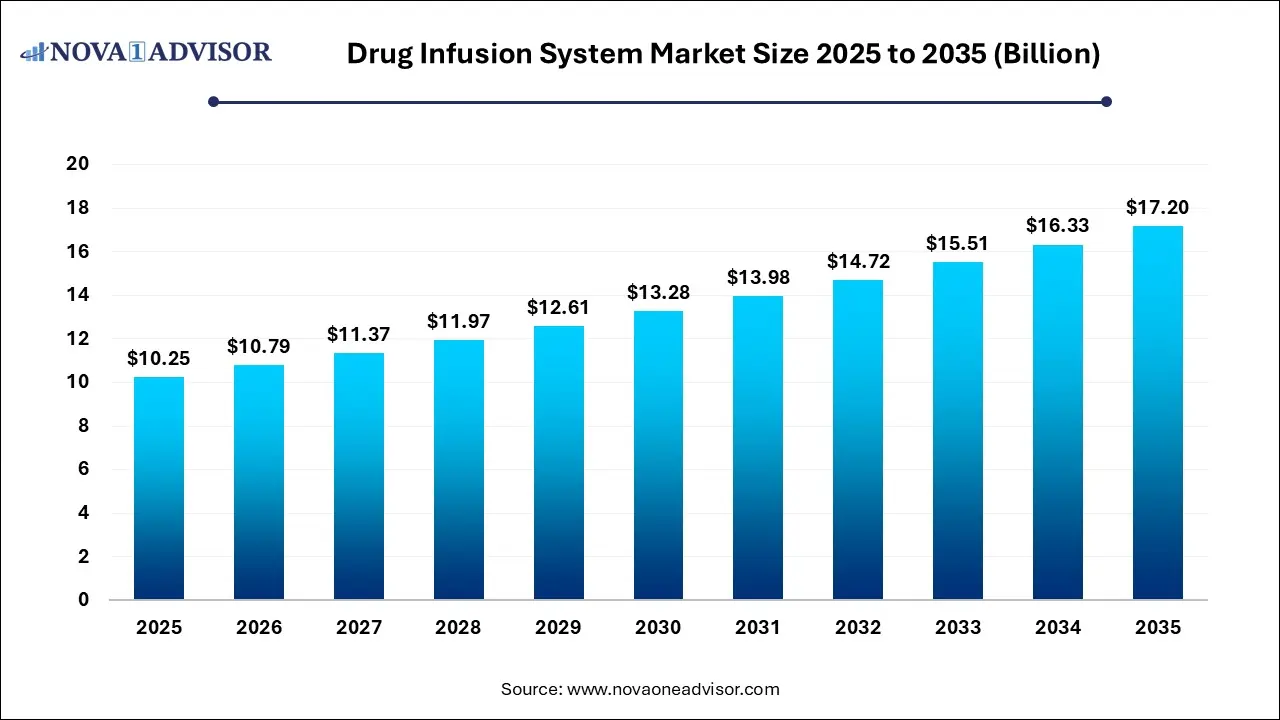
Key Takeaway:
- By product type, the peristaltic pumps segment dominated the market and accounted for the largest revenue share in 2025.
- By product type, the insulin pumps segment fastest growing in the market in 2025.
- By application, the oncology segment dominated the market and accounted for the largest revenue share in 2025.
- By mode of administration, the intravenous segment dominated the market and accounted for the largest revenue share in 2025.
- By end user, the hospitals segment dominated the market and accounted for the largest revenue share in 2025.
- By region, North America accounted for the largest revenue share in 2025.
Market Overview
The drug infusion system market is growing steadily due to the increasing demand for accurate and controlled drug delivery in the treatment of chronic diseases such as cancer, diabetes, cardiovascular disorders, and chronic pain. Technological advancements, including smart infusion pumps, wireless connectivity, dose error reduction systems, and wearable devices, are improving patient safety and treatment efficiency. The expanding use of biologics, personalized medicine, and home-based healthcare is further driving the adoption of advanced infusion systems across hospitals and outpatient settings.
Market Outlook
- Market Growth Overview: The global drug infusion system market is expected to grow significantly between 2025 and 2035, driven by the rising chronic disease burden, shift toward home healthcare, and expanding use of complex biologic therapies.
- Sustainability Trends: Sustainability trends involve eco-friendly materials and circular economy, modular and upgradeable designs, and reduction of drug wastage and over-treatment.
- Major Investors: Major investors in the market include Becton Dickinson and Company (BD), Baxter International, B. Braun Melsungen AG, Fresenius Kabi, ICU Medical, Medtronic, and Terumo Corporation.
How AI is Impacting the Global Drug Infusion System Market?
AI and ML are revolutionizing the global drug infusion system industry by transforming traditional devices into smart, connected therapeutic platforms. These technologies enable automated and real-time dose adjustments based on a patient's specific physiological data, significantly minimizing human error. Machine learning algorithms facilitate predictive maintenance of pumps and optimize clinical workflows within infusion centers. These intelligent systems ensure precise drug delivery and enhance overall patient safety across both hospital and home care environments.
Drug Infusion System Market Report Scope
| Report Coverage | Details |
| Market Size in 2026 | USD 10.79 Billion |
| Market Size by 2035 | USD 17.20 Billion |
| Growth Rate From 2026 to 2035 | CAGR of 5.31% |
| Base Year | 2025 |
| Forecast Period | 2026 to 2035 |
| Segments Covered | By Product Type, By Application , By Mode of administration, By End-user, By Region |
| Market Analysis (Terms Used) | Value (USD Million/Billion) or (Volume/Units) |
| Regional Scope | North America; Europe; Asia Pacific; Central and South America; the Middle East and Africa |
| Key Companies Profiled | Medtronic, Arcomed AG, Braun Melsungen AG, Baxter, Becton Dickinson and Company, Debiotech S.A., Fresenius SE & Co. KGaA, Halyard Health, Inc, ICU Medical Inc, IRadimed Corporation, Insulet Corporation, Terumo Corporation, Smiths Group plc, Tandem Diabetes Care, MOOG INC., Others |
Market Driver
Rising Prevalence of Chronic Diseases
The increasing incidence of chronic diseases, including cancer, diabetes, and cardiovascular disorders, is driving demand for drug infusion systems. These devices enable precise and continuous medication delivery, improving treatment outcomes while reducing medication errors in both hospital and home healthcare settings.
Market Restraint
High Device Costs and Regulatory Challenges
The high cost of advanced infusion systems and stringent regulatory requirements for safety, software validation, and product quality limit market adoption, particularly among smaller healthcare facilities and in developing regions. Product recalls and cybersecurity concerns also remain key challenges.
Market Opportunity
Growth of Home Healthcare and Connected Infusion Devices
The expansion of home healthcare is creating significant opportunities for the market. Portable and wearable infusion systems, combined with remote patient monitoring, cloud connectivity, and AI-enabled management platforms, are enabling safe and efficient drug delivery outside traditional healthcare facilities while supporting personalized, patient-centric care.
Segmental Insights
By Product Type
How did the peristaltic pumps segment dominate the Global Drug Infusion System market?
The peristaltic pumps segment is driven by the complete absence of internal valves or seals, streamlining sterilization routines and fast tube replacement, drastically reducing mechanical failures to maintain continuous clinical operation. The non-contact, roller-based mechanism exerts a gentle pumping action that successfully prevents shear damage to delicate blood cells and complex protein-based therapeutics.
How did the insulin pumps segment expect to hold the fastest-growing Global Drug Infusion System market in the coming years?
The insulin pumps segment is driven by the growing clinical preference for lightweight, tubeless, and wearable pump designs that drastically improve user convenience and lifestyle flexibility. The continuous global increase in both Type 1 and Type 2 diabetes cases expands the addressable patient pool requiring these automated glycemic controls.
By Application
How did the oncology segment dominate the Global Drug Infusion System market?
The oncology segment is driven by the continuous research and development investments by leading pharmaceutical firms into specialized drug delivery platforms, ensuring a sustained, long-term expansion for oncology infusion systems. The accelerating clinical shift toward portable ambulatory pumps allows patients to safely receive complex chemotherapy regimens in outpatient and home care settings.
How did the diabetes segment expect to hold the fastest-growing Global Drug Infusion System market in the coming years?
The diabetes segment is driven by the significant rise in patch pump popularity, as wearable, tubeless designs provide a highly discreet, affordable, and accessible option for self-administration. To capitalize on this shift, manufacturers are launching next-generation systems significantly optimized to simplify type diabetes workflows and expand the addressable clinical market.
By Mode of Administration
How did the intravenous segment dominate the Global Drug Infusion System market?
The intravenous segment is driven by rising global chronic disease burden and surging surgical volumes, necessitating continuous, ultra-precise hydration and automated blood transfusions. To optimize patient safety, modern intravenous systems integrate advanced smart pumps featuring dose error reduction software and wireless electronic health record connectivity to eliminate dangerous human programming errors.
How did the subcutaneous segment expect to hold the fastest-growing Global Drug Infusion System market in the coming years?
The subcutaneous segment is driven by the biochemical breakthrough that supports a growing reliance on large-volume, motor-driven on-body injectors and disposable patches that deliver medication automatically over extended periods. The subcutaneous delivery allows patients to easily self-administer treatments at home, which vastly improves compliance while significantly lowering facility costs for payers.
By End-User
How did the hospitals segment dominate the Global Drug Infusion System market?
The hospitals segment is driven by a massive, continuous influx of critical patients across intensive care units, surgical suites, and oncology wards who require high-capacity, versatile, and precise infusion pumps. To minimize dangerous medication errors, these institutions heavily invest in central infusion devices equipped with dose error reduction systems that link directly to electronic health records.
How did the ambulatory surgical centers segment expect to hold the fastest-growing Global Drug Infusion System market in the coming years?
The ambulatory surgical centers segment is driven by the ongoing technological advancements that yield lightweight, portable ambulatory infusion pumps with long-lasting batteries and simplified patient interfaces. The massive rise in outpatient procedures like joint replacements and advanced pain management fuels the continuous clinical adoption of these portable delivery systems.
By Regional
How did the North America region account for the largest share in the Global Drug Infusion System market?
North America is driven by the widespread hospital penetration, and a dense concentration of medical device manufacturers ensures a continuous, safety-focused deployment of state-of-the-art medical systems. This advanced infrastructure directly addresses an escalating regional chronic disease burden, which necessitates precise, continuous infusion therapies to safely manage complex cancer and diabetes treatments.
U.S. Global Drug Infusion System Market Trends
The U.S. is making a strong shift toward wireless smart infusion pumps equipped with DERS software to cross-check medication dosages against pre-established hospital formularies and eliminate programming errors. This technological integration supports a growing clinical transition toward home care, where patients utilize wearable, elastomeric, and ambulatory pumps to receive complex chemotherapy or pain management outside traditional hospital walls.
How did the Asia-Pacific region become the fastest-growing Global Drug Infusion System Market during the forecast period?
Asia Pacific is driven by the region’s growing geriatric population, and high rates of lifestyle-related diseases have driven demand for contunious, precise medication delivery, particularly insulin and pain management pumps. The significant healthcare infrastructure spending and facility developments across emerging economies, such as China, India, and Indonesia, are dramatically improving patient access to advanced medical technologies.
China Global Drug Infusion System Market Trends
China is providing connected management platforms that deliver predictive analysis to reduce medication errors in hospitals. The rising demand for biologics, biosimilars, and innovative cancer drugs is pushing the need for precision syringes and volumetric delivery systems.
How Did Europe Hold A Notable Share in the Global Drug Infusion System Market?
Europe’s stringent safety guidelines and government policies prioritizing home-based care are expanding the market, accelerating a strong structural shift toward ambulatory pumps and specialized closed-system outpatient devices. The rising regional incidence of chronic illnesses such as cancer and diabetes necessitates continuous or prolonged medication administration across Western Europe's advanced healthcare systems.
Germany Global Drug Infusion System Market Trends
Germany’s widespread clinical adoption of portable, ambulatory, and wearable insulin pumps. To optimize clinical safety, hospitals are investing heavily in network-compatible smart pumps equipped with integrated dose error reduction systems and IoT-enabled remote monitoring.
Key Players in the Global Drug Infusion System Market
- Medtronic
Medtronic contributes through highly advanced, programmable implantable drug infusion systems designed to deliver precise medication directly to specific sites in the body, such as the spinal fluid, for chronic pain. Their innovative smart pumps allow for continuous, automated dosing that significantly reduces the need for oral medications and improves overall patient quality of life.
- arcomed AG
arcomed AG is recognized for its high-precision, "Swiss Made" volumetric infusion and syringe pumps used in critical environments like intensive care units and anesthesia. They advance the market through specialized, intuitive software solutions, such as the UniQueCONCEPT and visual MedMarker technology, which connect pumps directly to hospital networks to prevent medication errors.
- Braun Melsungen AG
Braun Melsungen AG drives the global market with holistic, connected infusion ecosystems, such as the Spaceplus system, that seamlessly integrate smart pumps with hospital IT and electronic medical records.
Segments Covered in the Report
This report forecasts revenue growth at country levels and provides an analysis of the latest industry trends in each of the sub-segments from 2021 to 2035. For this study, Nova one advisor, Inc. has drug infusion system market.
By Product Type
- Elastomeric infusion system
- Disposable infusion system
- Syringe infusion system
- Peristaltic pump
- Multi-channel pump
- Patient-controlled analgesia (PCA) pump
- Insulin pump
- Implantable infusion system
By Application
- Oncology/Chemotherapy
- Diabetes
- Analgesia
- Nutrition
- Hematology
- Pediatrics
- Others
By Mode of administration
- Intravenous
- Subcutaneous
- Arterial
- Epidural
- Others
By End-user
- Hospitals
- Ambulatory Surgical Centers
- Diagnostic centers
- Others
By Region
- North America
- Europe
- Asia-Pacific
- Latin America
- Middle East & Africa (MEA)
FAQ's

Proceed to Buy
Instant PDF delivery on confirmation

Drug Infusion System Market Size to Hit USD 17.20 Billion by 2035
 Request Customization
 Download Sample

Get a Sample of this Report
Drug Infusion System Market