

Dystrophic Epidermolysis Bullosa Treatment Market Size, Share, and Trends 2026 to 2035
 Status Published
 Category Healthcare


Content
Dystrophic Epidermolysis Bullosa Treatment Market Size and Growth 2026 to 2035
The global dystrophic epidermolysis bullosa treatment market size was estimated at USD 212.85 billion in 2025 and is projected to hit around USD 424.22 billion by 2035, growing at a CAGR of 7.14% during the forecast period from 2026 to 2035.
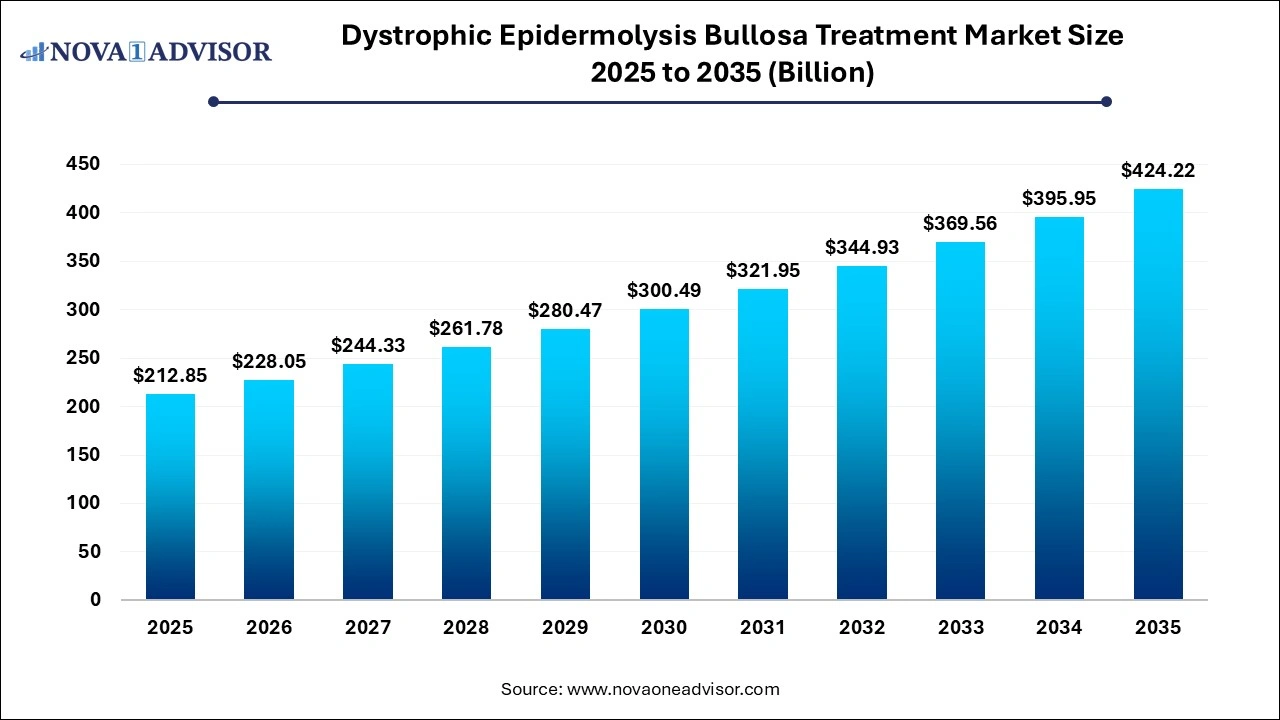
Key Takeaway:
- By type, the initial treatment segment dominated the market with the largest share in 2025.
- By type, the surgical treatment segment is expected to grow at the fastest CAGR over the forecast period.
- By route of administration, the topical segment dominated the market with the largest share in 2025.
- By end user, the hospital segment dominated the market with the largest share in 2025.
- By region, North America dominated the market with the largest share in 2025.
Market Overview
The global Dystrophic Epidermolysis Bullosa (DEB) Treatment Market includes gene and cell therapies, wound-care products, dressings, infection management, pain control, nutritional support, and other interventions used to manage this rare inherited skin disorder. DEB is associated with COL7A1 mutations, which impair type VII collagen and cause severe skin fragility, blistering, chronic wounds, scarring, and potentially serious complications.
Historically, treatment centered on supportive wound care, infection prevention, pain management, nutritional support, and complication management. The market is now evolving with the emergence of disease-modifying therapies. The FDA approved VYJUVEK (beremagene geperpavec) in 2023 as a topical gene therapy for wounds associated with COL7A1-mutated DEB, followed by ZEVASKYN (prademagene zamikeracel), an autologous cell-sheet gene therapy approved in 2025 for recessive DEB.
Wound-healing therapies such as FILSUVEZ continue to complement advanced treatments by supporting routine wound management. Consequently, the market is developing into a multi-layered treatment ecosystem in which gene and cell therapies coexist with long-term wound care, infection control, pain management, and multidisciplinary supportive services.
Market Outlook
- Market Growth Overview: The global dystrophic epidermolysis bullosa treatment market is expected to grow significantly between 2025 and 2035, driven by the growing transition towards personalized and technologically combined treatment solutions.
- Sustainability Trends: Sustainability trends involve growing emphasis on long-term health economic value and sustainable patient support models.
- Major Investors: Major investors in the market include Krystal Biotech, Abeona Therapeutics, and Castle Creek Biosciences.
How is AI Impacting The Global Dystrophic Epidermolysis Bullosa Treatment Market?
Artificial intelligence (AI) is reshaping the market by propelling gene-and-cell therapy research, allowing automated remote wound tracking, and fuelling repurposing. In addition, predictive algorithms are used by platforms to identify and map the critical factors and inducer pathways required for the manufacturing of healthy, genetically corrected skin and tissue cells.
Major Trends in the Dystrophic Epidermolysis Bullosa Treatment Market
- Shift toward disease-modifying treatment: Gene and cell therapies are changing the market beyond conventional supportive wound care.
- Growth of topical genetic medicine: VYJUVEK demonstrates the potential of repeatable topical gene delivery for DEB wounds.
- Expansion of regenerative medicine: Cell-based approaches such as ZEVASKYN are creating additional therapeutic pathways for recessive DEB.
- Greater emphasis on wound closure: Clinical development increasingly focuses on measurable healing outcomes rather than symptom control alone.
- Increasing home-based treatment: Therapies that can be administered during routine wound care can reduce the need for repeated hospital visits.
Dystrophic Epidermolysis Bullosa Treatment Market Report Scope
| Report Coverage | Details |
| Market Size in 2026 | USD 228.05 Billion |
| Market Size by 2035 | USD 424.22 Billion |
| Growth Rate From 2026 to 2035 | CAGR of 7.14% |
| Base Year | 2025 |
| Forecast Period | 2026 to 2035 |
| Segments Covered | By Type, By Route of Administration, By End User, By Region |
| Market Analysis (Terms Used) | Value (USD Million/Billion) or (Volume/Units) |
| Regional Scope | North America; Europe; Asia Pacific; Central and South America; the Middle East and Africa |
| Key Companies Profiled | Krystal Biotech, Castle Creek Biosciences, Inc., Abeona Therapeutics, Inc., Amryt Pharma plc, Wings Therapeutics, Phoenix Tissue Repair, InMed Pharmaceuticals, Inc., RegeneRx, and Holostem Terapie Avanzate S.r.l. |
Segmental Insights
By Type
Why did the initial treatment segment dominate the global dystrophic epidermolysis bullosa treatment market?
The initial treatment segment dominated the market with the largest share in 2025. The dominance of the segment can be attributed to the growing prevalence of early genetic diagnosis and sugar in the consumption of specialized wound dressings. In addition, governmental incentives, preferential tax frameworks, and smooth regulatory pathways for rare disease treatments incentivize strategic corporate investment in foundational healthcare infrastructure.
How did the surgical treatment segment expected to hold the significantly growing global dystrophic epidermolysis bullosa treatment market in the coming years?
The surgical treatment segment is expected to grow at the fastest CAGR over the forecast period. The growth of the segment can be credited to the growing demand to manage harsh physical deformities and anatomical blockages. Also, the integration of specialized surgical interventions with comprehensive, long-term systemic and supportive care protocols within dedicated medical facilities can fuel market growth further.
By Route of Administration
Why did the topical segment dominate the global dystrophic epidermolysis bullosa treatment market?
The topical segment dominated the market with the largest share in 2025. The dominance of the segment can be linked to the surge in funding for rare diseases and benefits such as non-invasive home applications that enhance patient compliance. Advanced topical agents specifically target the restoration of type VII collagen expression or the suppression of local inflammatory pathways and pruritus.
- In May 2026, the Medicines and Healthcare Products Regulatory Agency (MHRA) authorized beremagene geperpavec (Vyjuvek) for treating cutaneous wounds in patients with dystrophic epidermolysis bullosa (DEB) across all age groups, including neonates.
How did the injectables segment expected to hold the significantly growing global dystrophic epidermolysis bullosa treatment market in the coming years?
The injectables segment is expected to grow at the fastest CAGR over the forecast period. The growth of the segment can be driven by a surge in innovative systemic, gene, and cell-based therapies along with the growing regulatory incentives. Injectable biologics are increasingly seen as a therapeutic approach for reducing severe internal and external fibrosis, systemic manifestations, and chronic inflammatory processes associated with recessive dystrophic epidermolysis bullosa.
By End User
Why did the hospital segment dominate the global dystrophic epidermolysis bullosa treatment market?
The hospital segment dominated the market with the largest share in 2025. The dominance of the segment is owing to the growing adoption of novel interventions and the presence of cutting-edge hospital-exclusive therapies. Furthermore, enhanced institutional funding coupled with government incentives for orphan drugs boosts major healthcare facilities to maintain inventories of high-cost, specialized therapeutics.
How did the homecare setting segment expected to hold the significantly growing global dystrophic epidermolysis bullosa treatment market in the coming years?
The homecare setting is expected to grow at the fastest CAGR over the forecast period. The growth of the segment is due to the transition towards managing chronic blistering and non-invasive wound care in an at-home environment. Moreover, manufacturers are now developing specialized non-adhesive dressings, topical gels, and supportive care products specifically cleared or formulated for safe, supervised application in outpatient or home care settings.
By Region
Why did the North American region account for the largest share of th global dystrophic epidermolysis bullosa treatment market?
North America dominated the market with the largest share in 2025. The dominance of the region can be attributed to the presence of innovative healthcare infrastructure and a surge in healthcare spending across medical facilities. In addition, routine implementation of advanced diagnostic screening methodologies, including whole-exome sequencing and targeted gene panels, facilitates earlier and more precise identification of disease subtypes.
U.S. Global Dystrophic Epidermolysis Bullosa Treatment Market Trends
The growth of the market in the country can be driven by the growing investments in innovative gene and cell therapies and favorable FDA regulatory policies. Also, FDA fast-track and priority review designations significantly accelerate the commercialization timeline for innovative topical and systemic genetic therapies.
Why did the Asia-Pacific region become the fastest-growing global dystrophic epidermolysis bullosa treatment market during the forecast period?
Asia Pacific is expected to grow at the fastest CAGR over the forecast period. The growth of the region can be credited to the surge in healthcare expenditure and growing healthcare infrastructure in developing economies such as China and India. Furthermore, the increasing adoption of specialized, advanced wound dressings and infection-prevention management solutions significantly reduces chronic complications, driving overall market growth soon.
China Global Dystrophic Epidermolysis Bullosa Treatment Market Trends
The market in the country is growing due to the growing diagnosis rates via genetic sequencing and a surge in domestic research into rare diseases. Moreover, China's large population creates a high absolute number of diagnosed rare disease cases. This patient volume generates significant commercial interest among both domestic and international pharmaceutical developers.
Key Players in the Global Dystrophic Epidermolysis Bullosa Treatment Market
- Abeona Therapeutics: Abeona Therapeutics focuses on advanced cell and gene therapies, notably developing EB-101, an autologous cell therapy engineered to correct the underlying collagen defect in recessive DEB patients.
- Castle Creek Biosciences: Castle Creek Biosciences develops localized gene therapies, utilizing fibroblast-based platforms to target the root structural weaknesses seen in severe forms of the disease.
- Mölnlycke Health Care / Smith+Nephew: Specialized advanced wound care giants provide the necessary specialized dressings, silicon layers, and supportive management materials critical for daily DEB skin protection.
Recent Developments
- In March 2026, Abeona Therapeutics Inc. has issued a corporate update highlighting the positive commercial trajectory of ZEVASKYN (prademagene zamikeracel). ZEVASKYN is an FDA-approved, first-in-class autologous gene therapy engineered specifically for the management and treatment of chronic wounds in both pediatric and adult patients suffering from recessive dystrophic epidermolysis bullosa (RDEB).
Segments Covered in the Report
This report forecasts revenue growth at country levels and provides an analysis of the latest industry trends in each of the sub-segments from 2021 to 2035. For this study, Nova one advisor, Inc. has dystrophic epidermolysis bullosa treatment market.
By Type
- Initial Treatment
- Palliative Treatment
- Surgical Treatment
By Route of Administration
- Oral
- Topical
- Injectables
By End User
- Hospitals
- Clinics
- Homecare Settings
By Region
- North America
- Europe
- Asia-Pacific
- Latin America
- Middle East & Africa (MEA)

Proceed to Buy
Instant PDF delivery on confirmation

Dystrophic Epidermolysis Bullosa Treatment Market Size to Hit USD 424.22 Billi...
 Request Customization
 Download Sample

Get a Sample of this Report
Dystrophic Epidermolysis Bullosa Treatment Market