

Electroceuticals/Bioelectric Medicine Market Size, Share, and Trends 2026 to 2035
 Status Published
 Category Healthcare


Content
Electroceuticals/Bioelectric Medicine Market Size and Growth 2026 to 2035
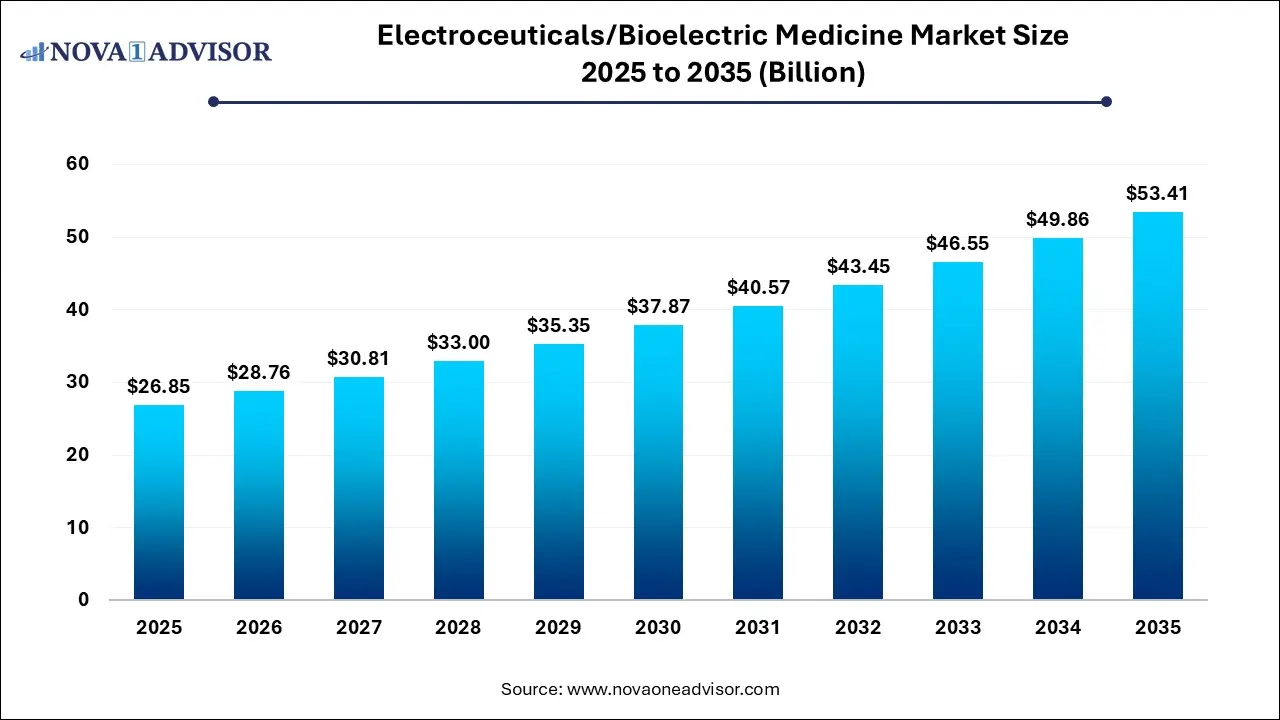
The global electroceuticals/bioelectric medicine market size was valued at USD 26.85 billion in 2025 and is projected to grow from USD 28.76 billion in 2026 to USD 53.41 billion by 2035, at a CAGR of 7.12% from 2026 to 2035.
Key Takeaway:
- By product, the cardiac pacemakers & implantable cardioverter defibrillators segment dominated the market and accounted for the largest revenue share in 2025.
- By product, the deep brain stimulators segment fastest growing in the market in 2025.
- By type, the implantable electroceutical devices segment dominated the market and accounted for the largest revenue share in 2025.
- By end user, the hospitals segment dominated the market and accounted for the largest revenue share in 2025.
- By region, North America accounted for the largest revenue share in 2025.
Market Overview
The global Electroceuticals/Bioelectric Medicine Market is witnessing strong growth as healthcare increasingly adopts bioelectronic therapies for the treatment of chronic neurological, cardiovascular, and inflammatory diseases. Unlike conventional drug-based treatments, electroceuticals use targeted electrical stimulation to regulate nerve activity, offering precise, minimally invasive, and personalized treatment with fewer systemic side effects. Rising prevalence of conditions such as Parkinson's disease, chronic pain, epilepsy, cardiac arrhythmias, and depression is driving demand for implantable and wearable neurostimulation devices.
Technological advancements—including AI-enabled therapy optimization, rechargeable implants, wireless programming, remote patient monitoring, and cloud-connected healthcare platforms—are enhancing treatment outcomes and improving patient care. Growing investments in research, expanding clinical applications, supportive regulatory frameworks, and the global shift toward value-based and precision medicine are further accelerating market expansion. As innovation continues to broaden the scope of bioelectronic therapies, the electroceuticals/bioelectric medicine market is expected to remain one of the fastest-growing segments within the medical device industry over the forecast period.
Market Outlook
- Market Growth Overview: The electroceuticals/bioelectric medicine market is expected to grow significantly between 2025 and 2035, driven by the rising chronic illnesses and aging population, minimally invasive preference, favorable reimbursement, and infrastructure.
- Sustainability Trends: Sustainability trends involve battery-free and energy harvesting implants, biodegradable and eco-friendly biomaterials, and long-term patient lifecycle efficiency.
- Major Investors: Major investors in the market include Medtronic, Boston Scientific Corporation, Abbott Laboratories, LivaNova, Cochlear Ltd., and GlaxoSmithKline.
How AI is Impacting the Electroceuticals/Bioelectric Medicine Market?
AI and ML are revolutionizing the electroceuticals/bioelectric medicine industry by upgrading traditional, passive devices into intelligent, closed-loop therapeutic platforms. By continuously analyzing vast amounts of real-time neural and physiological data, these smart algorithms allow pacemakers, neurostimulators, and other implants to dynamically fine-tune treatments without human intervention. This leap in precision enables highly personalized interventions that adapt to fluctuating disease biomarkers for conditions like cardiac arrhythmias and neurological disorders.
Electroceuticals/Bioelectric Medicine Market Report Scope
| Report Coverage | Details |
| Market Size in 2026 | USD 28.76 Billion |
| Market Size by 2035 | USD 53.41 Billion |
| Growth Rate From 2026 to 2035 | CAGR of 7.12% |
| Base Year | 2025 |
| Forecast Period | 2026 to 2035 |
| Segments Covered | By Product, By Type, By End-User, By Region |
| Market Analysis (Terms Used) | Value (USD Million/Billion) or (Volume/Units) |
| Regional Scope | North America; Europe; Asia Pacific; Central and South America; the Middle East and Africa |
| Key Companies Profiled | Medtronic plc (Ireland), Boston Scientific Corporation (US), Abbott Laboratories, Inc. (US), LivaNova PLC (UK), Cochlear Ltd. (Australia), MicroPort Scientific Corporation (China), Sonova Group (Switzerland), Nevro Corp. (US), Axonics Modulation Technologies, Inc. (US), Neuronetics, Inc. (US), Second Sight Medical Products, Inc. (US), NeuroPace, Inc. (US), BIOTRONIK (Germany), Medico S.p.A. (Italy), Nurotron Biotechnology Co. Ltd. (US), MED-EL (Austria), Aleva Neurotherapeutics SA (Switzerland), NeuroSigma, Inc. (US), BioWave Corporation (US), Soterix Medical Inc. (US), Bioinduction Ltd. (UK), GiMer Medical (Taiwan), Cefaly (Belgium), BioControl Medical (Israel), and tVNS Technologies GmbH (Germany). |
Segmental Insights
By Product
How did the cardiac pacemakers & implantable cardioverter defibrillators segment dominate the Electroceuticals/Bioelectric Medicine market?
The cardiac pacemakers & implantable cardioverter defibrillators segment is driven by established healthcare infrastructures and robust reimbursement frameworks across major economies, ensuring the steady, high-volume adoption of these high-value cardiac implants. The implantable cardioverter defibrillators have become essential, life-saving interventions to combat high sudden cardiac arrest mortality rates worldwide.
How did the deep brain stimulators segment expect to hold the fastest-growing Electroceuticals/Bioelectric Medicine market in the coming years?
The deep-brain stimulator segment is driven by the development of advanced flexible electronics and highly biocompatible materials minimizes adverse tissue reactions to significantly extend the operational lifespan of these implanted generators. The extensive clinical trials are broadening disease indications, successfully expanding DBS approvals from Parkinson's to treatment-resistant depression and epilepsy.
By Type
How did the implantable electroceutical devices segment dominate the Electroceuticals/Bioelectric Medicine market?
The implantable electroceutical devices segment is driven by the high global prevalence of arrhythmias and sudden cardiac arrests, which heavily positions cardiac implantable electronic devices as the market's largest revenue generators. The rapid technological innovations, such as leadless pacing, injectable electrodes, and extreme miniaturization, have reduced infection risks and incision sizes to significantly broaden patient acceptance.
How did the noninvasive electroceutical devices segment expect to hold the fastest-growing Electroceuticals/Bioelectric Medicine market in the coming years?
The noninvasive electroceutical devices segment is driven by the increased R&D investments, yielding highly effective, AI-enabled stimulation platforms with miniaturized batteries and wireless connectivity. The non-invasive therapies like TENS and TMS are seeing surging adoption to combat chronic pain, depression, and migraines without requiring surgery.
By End User
How did the hospitals segment dominate the Electroceuticals/Bioelectric Medicine market?
The hospitals, Clinics, and ASCs segment is driven by its unique clinical capabilities, which allow hospitals to dominate the early adoption of investigational protocols, serving as central hubs for critical clinical trials and medical research. To manage these complex chronic conditions, hospitals provide crucial, immediate access to multidisciplinary care teams composed of cardiologists, neurologists, and specialized technicians.
How did the other end-user segments expect to hold the fastest-growing Electroceuticals/Bioelectric Medicine market in the coming years?
The other end-user segment is driven by the combined outpatient and research channels are successfully decentralizing advanced bioelectric care away from traditional hospital settings. By offering highly cost-effective, minimally invasive surgeries with shorter recovery times and increased patient convenience.
By Regional
How did the North America region account for the largest share in the Electroceuticals/Bioelectric Medicine market?
North America is driven by the high regional incidence rate of cardiovascular disorders, neurological diseases, and chronic pain, which drives consistent, long-term demand for these minimally invasive therapeutic solutions. The favorable reimbursement frameworks and well-established clinical infrastructures promote the rapid adoption of advanced, device-based disease management.
U.S. Electroceuticals/Bioelectric Medicine Market Trends
The U.S. is integrating these devices with telehealth platforms and mobile apps allows physicians to continuously track efficacy and adjust therapies without requiring in-person clinical visits. The closed-loop sensing and on-board artificial intelligence that monitor bodily signals to fine-tune therapeutic stimulation in real-time.
How did the Asia-Pacific region become the fastest-growing Electroceuticals/Bioelectric Medicine Market during the forecast period?
Asia Pacific is driven by the dramatic rise in chronic cardiovascular and neurological illnesses, accelerating the immediate regional demand for pacemakers, defibrillators, and advanced neuromodulation devices. The expanding private and public hospital networks, coupled with rising disposable incomes, have made these complex, once-costly therapeutic technologies significantly more accessible to developing populations.
China Electroceuticals/Bioelectric Medicine Market Trends
China’s intersecting demographic and regulatory factors allow domestic Chinese medical device companies to introduce highly cost-effective alternatives that drastically increase patient accessibility nationwide.
How Did Europe Hold A Notable Share in the Electroceuticals/Bioelectric Medicine Market?
Europe’s robust regional manufacturing cluster, paired with expansive clinical infrastructures, ensures a highly integrated supply network capable of meeting Europe's accelerating demand for complex medical technologies.
Germany Electroceuticals/Bioelectric Medicine Market Trends
Germany’s advanced, interconnected systems allow European healthcare providers to significantly improve long-term treatment outcomes for complex chronic conditions. The distinct shift toward non-invasive electroceutical devices, which are registering high growth due to increased patient convenience and technological breakthroughs in wearable neuromodulation.
Key Players in the Electroceuticals/Bioelectric Medicine Market
- Medtronic plc: Medtronic leads by developing advanced neuromodulation systems, such as the Percept RC Deep Brain Stimulation (DBS) system, which treat neurological disorders. They also specialize in sacral and spinal cord stimulation to manage chronic pain and restore bodily functions without relying strictly on pharmaceuticals.
- Boston Scientific Corporation: Boston Scientific contributes through highly targeted neurostimulation platforms, such as the Vercise Genus Deep Brain Stimulation System, which utilizes advanced software to map and treat symptoms of Parkinson's disease. Their technology directly uses electrical impulses to modulate the nervous system, providing an alternative to traditional drug-based remedies.
- Abbott Laboratories, Inc.: Abbott develops cutting-edge Spinal Cord Stimulation (SCS) devices and proprietary technologies (like BurstDR stimulation) designed to alter pain signals before they reach the brain.
Segments Covered in the Report
This report forecasts revenue growth at country levels and provides an analysis of the latest industry trends in each of the sub-segments from 2021 to 2035. For this study, Nova one advisor, Inc. has electroceuticals/bioelectric medicine market.
By Product
- Cardiac Pacemakers & Implantable Cardioverter Defibrillators
- Spinal Cord Stimulators
- Chronic Pain
- Failed Back Surgery Syndrome
- Cerebral Ischemia
- Cochlear Implants
- Deep Brain Stimulators
- Parkinson’s Disease
- Tremors
- Depression
- Other DBS Applications
- Sacral Nerve Stimulators & Gastric Electrical Stimulators
- Urinary Incontinence
- Fecal Incontinence
- Gastroparesis
- Transcutaneous Electrical Nerve Stimulators
- Treatment-resistant Depression
- Other TENS Applications
- Vagus Nerve Stimulators
- Epilepsy
- Other VNS Applications
- Other Electrical Stimulators
By Type
- Implantable Electroceutical Devices
- Noninvasive Electroceutical Devices
By End User
- Hospitals, Clinics, and ASCs
- Other End Users
By Region
North America
- U.S.
- Canada
Europe
- Germany
- France
- United Kingdom
- Rest of Europe
Asia Pacific
- China
- Japan
- India
- Southeast Asia
- Rest of Asia Pacific
Latin America
- Brazil
- Rest of Latin America
Middle East & Africa (MEA)
- GCC
- North Africa
- South Africa
- Rest of Middle East & Africa
FAQ's

Proceed to Buy
Instant PDF delivery on confirmation

Electroceuticals/Bioelectric Medicine Market Size to Hit USD 53.41 Billion by ...
 Request Customization
 Download Sample

Get a Sample of this Report
Electroceuticals/Bioelectric Medicine Market