

Endometrial Cancer Market Size, Share, Growth, Report 2026 to 2035
 Status Published
 Category Healthcare


Content
Endometrial Cancer Market Size and Growth 2026 to 2035
The global endometrial cancer market size was valued at USD 30.75 billion in 2025 and is projected to grow from USD 32.24 billion in 2026 to USD 49.33 billion by 2035, at a CAGR of 4.84% from 2026 to 2035.
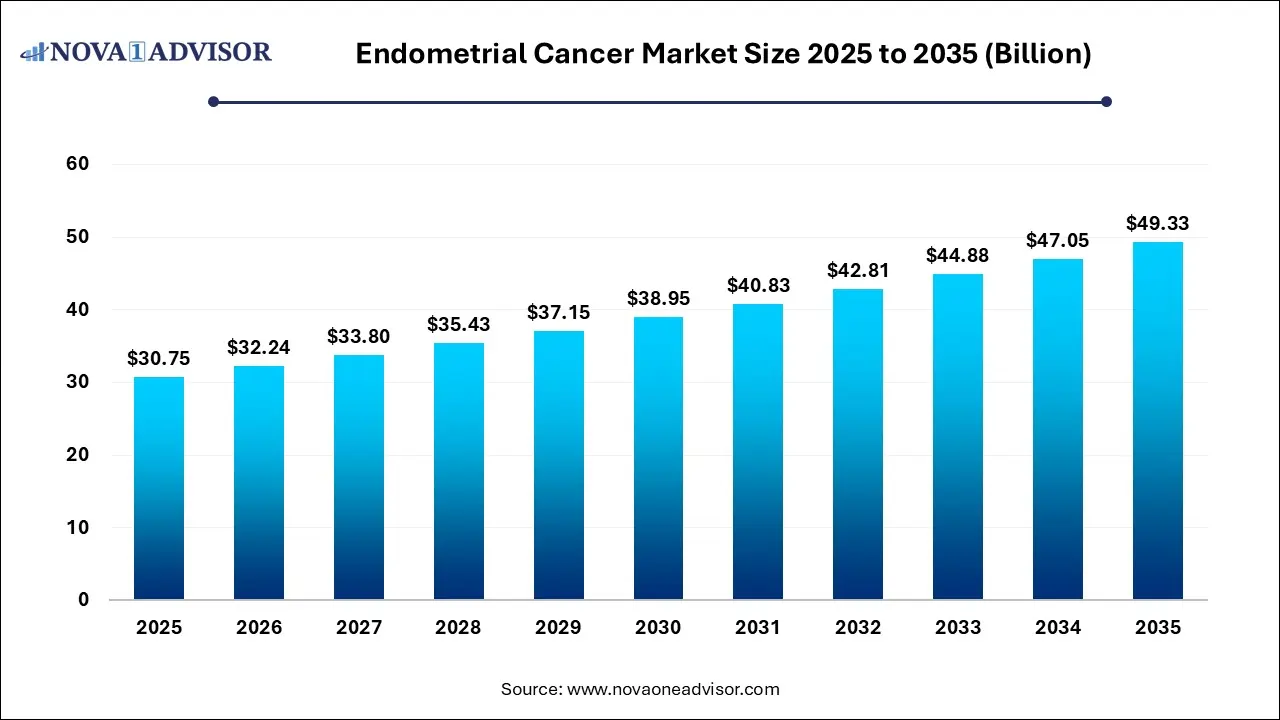
Key Takeaway:
- By diagnosis, the endometrial biopsy segment dominated the market and accounted for the largest revenue share in 2025.
- By diagnosis, the transvaginal ultrasound segment fastest growing in the market in 2025.
- By treatment, the hysterectomy techniques segment dominated the market and accounted for the largest revenue share in 2025.
- By end user, the hospitals and clinics segment dominated the market and accounted for the largest revenue share in 2025.
- By region, North America accounted for the largest revenue share in 2025.
Market Overview
The endometrial cancer market is expanding steadily due to the rising incidence of uterine cancer, increasing awareness of early diagnosis, and continuous advancements in diagnostic and treatment technologies. Improved screening methods, minimally invasive surgical procedures, molecular diagnostics, targeted therapies, and immunotherapies are enhancing patient outcomes and driving market growth. Growing investments in oncology research, precision medicine, and healthcare infrastructure, particularly in emerging economies, are further supporting the adoption of advanced endometrial cancer management solutions.
Market Outlook
- Market Growth Overview: The global endometrial cancer market is expected to grow significantly between 2025 and 2035, driven by the increasing disease prevalence, advancements in targeted and immunotherapies, and strong clinical pipeline and investments.
- Sustainability Trends: Sustainability trends involve supply chain resilience and radioisotope security, precision medicine and minimally invasive care, and sustainable patient management and survivorship.
- Major Investors: Major investors in the market include GSK, Merck & Co., AstraZeneca, Eisai, and Hoffmann-La Roche.
How AI is Impacting the Global Endometrial Cancer Market?
AI and ML are revolutionizing the global endometrial cancer industry by enhancing early detection, diagnostic accuracy, and personalized treatment. Advanced deep learning algorithms analyse histopathological whole-slide images and medical scans to identify malignancies, often outperforming traditional diagnostic methods. Predictive machine learning models integrate multi-source clinical data to stratify patient risk and predict cancer recurrence. This shift toward precision medicine reduces interpretive variability and allows clinicians to tailor therapies, ultimately improving overall patient survival rates.
Endometrial Cancer Market Report Scope
| Report Coverage | Details |
| Market Size in 2026 | USD 32.24 Billion |
| Market Size by 2035 | USD 49.33 Billion |
| Growth Rate From 2026 to 2035 | CAGR of 4.84% |
| Base Year | 2025 |
| Forecast Period | 2026 to 2035 |
| Segments Covered | By Diagnosis, By Treatment, By End-User, By Region |
| Market Analysis (Terms Used) | Value (USD Million/Billion) or (Volume/Units) |
| Regional Scope | North America; Europe; Asia Pacific; Central and South America; the Middle East and Africa |
| Key Companies Profiled | Pfizer Inc., General Electric Company, Koninklijke Philips N.V., LUPIN, PHYTON, Bayer AG, Celgene Corporation, Johnson & Johnson, CooperSurgical Inc., LiNA Medical USA, Conceptus Inc., Hologic Inc., Karl Storz GmbH & Co. Kg, and Boston Scientific Corporation. |
Market Driver
Rising Incidence of Obesity and Aging Population
The increasing prevalence of obesity, diabetes, and an aging female population is significantly driving the endometrial cancer market. These factors elevate the risk of developing endometrial cancer, resulting in higher demand for early diagnostic procedures, surgical interventions, radiation therapy, hormone therapy, and innovative targeted treatments.
Market Restraint
High Treatment Costs and Limited Access to Advanced Care
The high cost of comprehensive cancer diagnosis and treatment, including molecular testing, robotic surgery, immunotherapy, and targeted therapies, remains a major market restraint. Limited access to specialized oncology facilities and reimbursement challenges in developing regions further restrict the widespread adoption of advanced treatment options.
Market Opportunity
Advancements in Precision Oncology and Biomarker-Based Therapies
The growing adoption of precision medicine presents a significant opportunity for the market. Advances in genomic profiling and biomarker testing are enabling personalized treatment strategies, while the development of targeted therapies and immunotherapies is improving clinical outcomes and expanding therapeutic options for patients with advanced or recurrent endometrial cancer.
Segmental Insights
By Diagnosis
How did the endometrial biopsy segment dominate the Global Endometrial Cancer market?
The endometrial biopsy segment is driven by the strong clinical guidelines from bodies, such as the ACOG and NCCN, which mandate endometrial biopsy as the definitive first-line confirmatory test, securing its dominant position in the global diagnostic landscape. The rising global incidence of the disease, fueled by increasing obesity rates and longer life expectancies, generates widespread demand for accurate diagnostic tools.
How did the transvaginal ultrasound segment expect to hold the fastest-growing Global Endometrial Cancer market in the coming years?
The transvaginal ultrasound segment is driven by the accessible, non-invasive nature of modern ultrasound imaging, which establishes it as an invaluable first-line triage test, particularly across regions with developing medical infrastructures. AI-enhanced screening capability dramatically reduces false positives, lowering overarching healthcare costs by successfully preventing unnecessary, invasive endometrial biopsies.
By Treatment
How did the hysterectomy techniques segment dominate the Global Endometrial Cancer market?
The hysterectomy techniques segment is driven by the rapid shift toward advanced laparoscopic tools and robotic-assisted technologies, which significantly reduce recovery times and lower postoperative complication risks. The combined clinical and economic advantages secure hysterectomy techniques as the definitive bedrock of global endometrial cancer treatment.
How did the robotic hysterectomy segment expect to hold the fastest-growing Global Endometrial Cancer market in the coming years?
The robotic hysterectomy segment is driven by the enhanced control, which significantly lowers the rate of conversion to open surgery, establishing robotic hysterectomies as the fastest-growing surgical segment. The patients experience substantially reduced blood loss, shorter hospital stays, and a lower risk of perioperative complications, which strongly fuels patient and physician demand.
By End User
How did the hospitals and clinics segment dominate the Global Endometrial Cancer market?
The hospitals and clinics segment is driven by attracting a high concentration of board-certified gynecologic oncologists and multidisciplinary specialists. Hospitals provide a coordinated team approach that successfully manages advanced and high-risk patient profiles. The leading cancer centers integrate precision oncology by providing molecular profiling, biomarker testing, and advanced immunotherapies under strict clinical oversight.
How did the ambulatory surgical centers segment expect to hold the fastest-growing Global Endometrial Cancer market in the coming years?
The ambulatory surgical centers segment is driven by the clinical shift toward lower healthcare costs, allowing outpatient centers to offer patients and insurers more economical treatments without compromising surgical quality. The favourable insurance reimbursement policies that incentivize non-hospital gynaecological oncology procedures are driving higher patient volumes toward these highly convenient, specialized centers.
By Regional
How did the North America region account for the largest share in the Global Endometrial Cancer market?
North America is driven by the high healthcare expenditure and favourable reimbursement policies, which streamline the rollout of novel targeted therapies, while a heavy concentration of major pharmaceutical companies fuels the robust research and development pipelines necessary to accelerate clinical trials and new drug approvals.
U.S. Global Endometrial Cancer Market Trends
The U.S. is shifting away from one-size-fits-all chemotherapy toward biomarker testing, genomic profiling, and targeted therapies. Clinical trials and pipeline developments are highly focused on ADCs, bispecific antibodies, and immunotherapy combinations to improve efficiency for advanced and recurrent cases.
How did the Asia-Pacific region become the fastest-growing Global Endometrial Cancer Market during the forecast period?
Asia Pacific is driven by the region's large and aging female population, which creates a substantial patient pool since endometrial cancer predominantly affects postmenopausal women. The increasing sedentary lifestyles, hormonal disorders, and rising obesity rates in emerging economies have directly fueled higher regional endometrial cancer incidences.
China Global Endometrial Cancer Market Trends
China’s increasing prevalence of high body mass index and metabolic syndromes has substantially increased deaths and disability-adjusted life years among senior women. The broadening insurance coverage, paired with heavy government investments in specialized screening and early diagnosis infrastructure, is significantly improving patient access to these advanced therapies nationwide.
How Did Europe Hold A Notable Share in the Global Endometrial Cancer Market?
Europe’s well-established oncology ecosystems in countries such as Germany, France, and the UK leverage favorable reimbursement policies and cross-border clinical trials to ensure broad patient access to these cutting-edge therapies.
Germany Global Endometrial Cancer Market Trends
Germany’s treatment evolution is accelerating the local demand for specialized biomarker testing to precisely tailor treatments for advanced or recurrent oncological cases. The platinum-based chemotherapy remains a standard baseline; the market is rapidly advancing toward high-value immunotherapies like dostarlimab.
Key Players in the Global Endometrial Cancer Market
- Pfizer Inc.: Pfizer actively advances the endometrial cancer therapeutic market through the discovery and development of next-generation oncology drugs, including targeted therapies and immunotherapies. Their ongoing clinical trials and robust pipeline of precision medicines aim to redefine treatment for advanced and recurrent cases of the disease.
- General Electric Company: General Electric (via GE HealthCare) contributes to this market by providing advanced diagnostic imaging systems, such as high-resolution MRI and AI-powered ultrasound, that enable the early detection and molecular staging of uterine cancers. Their comprehensive oncology platforms help clinicians seamlessly integrate screening workflows with precision image-guided therapies to improve patient outcomes.
- Koninklijke Philips N.V. : Philips supports the endometrial cancer treatment sector by manufacturing cutting-edge image-guided therapy hardware and the innovative Sonalleve MR-HIFU (Magnetic Resonance High-Intensity Focused Ultrasound) system.
Segments Covered in the Report
This report forecasts revenue growth at country levels and provides an analysis of the latest industry trends in each of the sub-segments from 2021 to 2035. For this study, Nova one advisor, Inc. has endometrial cancer market.
By Diagnosis
- Pelvic examination
- Transvaginal ultrasound
- Endometrial biopsy
- Dilation and curettage (D&C)
- Diagnostic laparoscopy
By Treatment
- Hysterectomy Techniques
- Open abdominal hysterectomy
- Total vaginal hysterectomy
- Total laparoscopic hysterectomy
- Robotic hysterectomy
- Radiation
- External radiation
- Internal radiation (brachytherapy)
- Hormone therapy
- Progestins
- Tamoxifen
- Luteinizing hormone-releasing hormone agonists
- Aromatase inhibitors
- Chemotherapy
- Paclitaxel
- Carboplatin
- Doxorubicin
- Cisplatin
- Palliative care
By End-User
- Hospitals & Clinics
- Ambulatory Surgical Centers
- Diagnostic Centers
- Gynecology Centers
- Feminist Health Centers
By Region
- North America
- Europe
- Asia-Pacific
- Latin America
- Middle East & Africa (MEA)
FAQ's

Proceed to Buy
Instant PDF delivery on confirmation

Endometrial Cancer Market Size to Hit USD 49.33 Billion by 2035
 Request Customization
 Download Sample

Get a Sample of this Report
Endometrial Cancer Market