

Endovascular Aneurysm Repair Devices Market Size, Share, and Trends 2026 to 2035
 Status Published
 Category Healthcare


Content
Endovascular Aneurysm Repair Devices Market Size and Growth 2026 to 2035
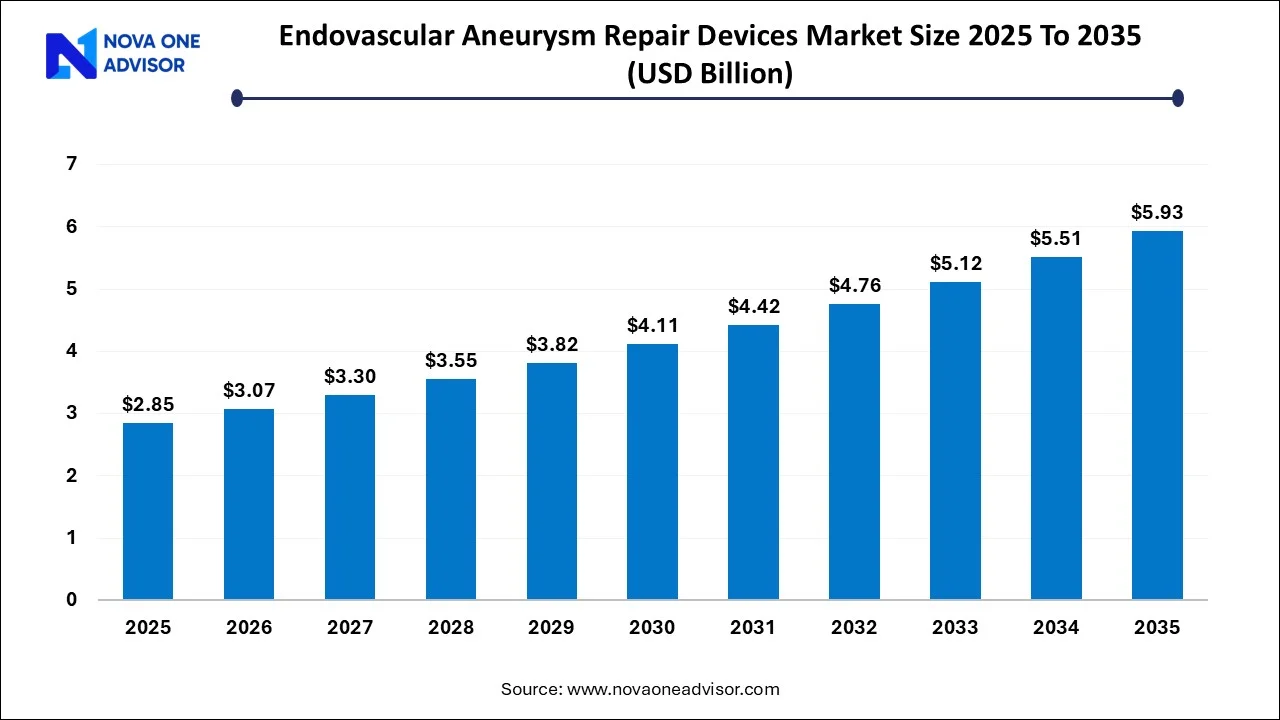
The global endovascular aneurysm repair devices market size was valued at USD 3.07 billion in 2026 and is projected to grow from USD 3.3 billion in 2027 to USD 5.93 billion by 2035, at a CAGR of 7.6% from 2026 to 2035.
Key Takeaway
- By indication, the abdominal aortic aneurysm (AAA) segment dominated the market and accounted for the largest revenue share in 2025.
- By indication, the thoracoabdominal aortic aneurysm (TAAA) segment is anticipated to witness the fastest CAGR over the forecast period.
- By site, the infrarenal segment dominated the market and accounted for the largest revenue share in 2025.
- By anatomy, the traditional segment dominated the market and accounted for the largest revenue share in 2025.
- By product, the aortic stents and TAA Grafts segment dominated the market and accounted for the largest revenue share in 2025.
- By region, North America accounted for the largest revenue share in 2025.
Market Overview
The global endovascular aneurysm repair devices market represents a critical segment of the vascular intervention industry, focused on treating aneurysms through minimally invasive catheter-based techniques. Endovascular aneurysm repair (EVAR) involves the placement of specialized stent grafts within weakened sections of the aorta to exclude aneurysms from blood circulation, thereby reducing the risk of rupture and associated mortality.
Aortic aneurysms are among the most serious cardiovascular conditions, characterized by abnormal dilatation of the aortic wall. If left untreated, aneurysms can enlarge over time and ultimately rupture, leading to life-threatening internal bleeding. Historically, open surgical repair served as the standard treatment approach. However, advancements in endovascular technologies have dramatically altered treatment paradigms over the past two decades.
Modern EVAR procedures allow physicians to repair aneurysms through small incisions, typically in the groin, by guiding stent graft systems through blood vessels to the affected site. This minimally invasive approach has transformed patient outcomes by reducing surgical trauma, shortening hospital stays, minimizing intensive care requirements, and accelerating recovery periods.
The growing burden of cardiovascular diseases worldwide is creating a favorable environment for market growth. Increasing prevalence of hypertension, smoking, obesity, hyperlipidemia, and aging populations are contributing to rising aneurysm incidence. Healthcare providers are increasingly emphasizing early diagnosis and preventive intervention to reduce aneurysm-related mortality.
Technological innovation remains a major catalyst in the market. Device manufacturers are developing increasingly sophisticated graft systems capable of treating anatomically challenging aneurysms. Fenestrated, branched, and customized endografts have expanded treatment options for patients who were previously considered unsuitable candidates for standard EVAR procedures.
Additionally, improvements in imaging technologies, including three-dimensional reconstruction, fusion imaging, intravascular ultrasound, and advanced computed tomography angiography, have enhanced procedural precision and treatment planning capabilities.
Healthcare systems worldwide are also supporting greater adoption of minimally invasive procedures due to their potential to reduce overall treatment costs. Shorter hospitalization periods and lower complication rates contribute to improved resource utilization and economic efficiency.
The market continues to evolve as physicians gain greater experience with complex aneurysm repair techniques and as new generations of endovascular devices receive regulatory approvals. Consequently, the endovascular aneurysm repair devices market is expected to maintain strong momentum throughout the forecast period.
Market Outlook
- Market Growth Overview: The global endovascular aneurysm repair devices market is expected to grow significantly between 2025 and 2035, driven by the increasing geriatric population and high prevalence of lifestyle diseases, and shift toward minimally invasive surgeries.
- Sustainability Trends: Sustainability trends involve environmental sustainability and waste reduction, clinical and financial sustainability, and technological enhancements.
- Major Investors: Major investors in the market include Medtronic, W.L. Gore & Associates, Cook Medical, Terumo Corporation, and Endologix.
How AI is Impacting the Global Endovascular Aneurysm Repair Devices Market?
AI and ML are transforming the global endovascular aneurysm repair devices industry by enabling more precise preventative planning and personalized treatment strategies. Machine learning algorithms analyse multidimensional data and medical imaging to predict post-operative complications and optimize device sizing. These technologies enhance intraoperative navigation and support long-term patient surveillance by accurately tracking aneurysm sac volume. By shifting the focus toward predictive and precision-based care, AI is helping to reduce procedural risks and improve overall clinical outcomes.
Endovascular Aneurysm Repair Devices Market Report Scope
| Report Coverage | Details |
| Market Size in 2026 | USD 3.07 Billion |
| Market Size by 2035 | USD 5.93 Billion |
| Growth Rate From 2026 to 2035 | CAGR of 7.6% |
| Forecast Period | 2026 to 2035 |
| Segments Covered | By Indication, By Site, By Anatomy, By Products, By Region |
| Market Analysis (Terms Used) | Value (USD Million/Billion) or (Volume/Units) |
| Regional Scope | North America; Europe; Asia Pacific; Central and South America; the Middle East and Africa |
| Key Companies Profiled | Cardiatis SA, Cardinal Health, Cook Medical LLC, Endologix, INC., Jotec GmbH, Medtronic plc, Terumo Corporation, W. L. Gore & Associates, Inc., BiFlow Medical Ltd, Boston Scientific Corporation, Braile Biomédica, Endoluminal Sciences Pty Ltd, Endospan Ltd., Getinge AB, and Lemaitre Vascular Inc. |
Segmental Insights
By Indication
How did the abdominal aortic aneurysm (AAA) segment dominate the Global Endovascular Aneurysm Repair Devices market?
The abdominal aortic aneurysm (AAA) segment is driven by the rising geriatric population, which drives widespread adoption of elective interventions, which is heavily accelerated by routine diagnostic imaging and early screening programs. Minimally invasive EVAR procedures address demand by utilizing advanced delivery catheters to implant endografts, avoiding the high cardiovascular stress and extended recovery times associated with traditional open surgeries.
How did the thoracoabdominal aortic aneurysm (TAAA) segment expected to hold the fastest-growing Global Endovascular Aneurysm Repair Devices market in the coming years?
The thoracoabdominal aortic aneurysm (TAAA) segment is driven by the immediate availability of standardized off-the-shelf devices, which eliminates lengthy preoperative manufacturing wait times for urgent and elective surgeries. These advanced endovascular techniques significantly improve patient outcomes by lowering mortality rates, reducing complications, and shortening hospital recovery stays for high-risk geriatric demographics.
By Site
How did the infrarenal segment dominate the Global Endovascular Aneurysm Repair Devices market?
The infrarenal segment is driven by a mature device ecosystem featuring standardized bifurcated stent grafts and delivery systems optimized for a minimally invasive profile that ensures fast recovery times. Decades of successful long-term survival data have built deep clinical familiarity, establishing infrarenal EVAR as the universally recognized first-line treatment for eligible patients.
How did the pararenal segment expected to hold the fastest-growing Global Endovascular Aneurysm Repair Devices market in the coming years?
The pararenal segment is driven by the clinical shift toward minimally invasive procedures, satisfying patient demand and lowering overall perioperative morbidity. The advancements in 3D imaging, specialized surgical planning software, and precise catheterization tools make these complex placements significantly safer and more accessible for clinical teams.
By Anatomy
How did the traditional segment dominate the Global Endovascular Aneurysm Repair Devices market?
The traditional segment is driven by long-standing safety profiles and exceptionally high technical success rates, offering a minimally invasive alternative that drastically reduces perioperative trauma, hospitalization costs, and recovery periods compared to open surgeries. By mature reimbursement frameworks across North America and Europe, which heavily incentivize hospitals to utilize these established, standardized devices.
How did the complex segment expect to hold the fastest-growing Global Endovascular Aneurysm Repair Devices market in the coming years?
The complex segment is driven by the integration of personalized vascular devices that allow for custom-made fenestrated and branched grafts tailored to patient-specific arterial configurations, significantly lowering perioperative mortality. Advanced 3D imaging, robotics, and AI-augmented software enhance this precision by streamlining surgical planning and enabling the highly accurate deployment of complex grafts.
By Product
How did the aortic stents and TAA Grafts segment dominate the Global Endovascular Aneurysm Repair Devices market?
The aortic stents and TAA Grafts segment is driven by widespread adoption of endovascular techniques, such as EVAR and TEVAR, has established stent grafts as the standard of care for aortic aneurysms, offering superior patient outcomes including lower mortality and shorter recovery times compared to open surgery. Advancements in device technology, including durable nitinol frames and patient-specific fenestrated grafts, combined with an aging population, are driving significant market growth and clinical adoption.
How did the fenestrated EVAR (FEVAR) segment expected to hold the fastest-growing Global Endovascular Aneurysm Repair Devices market in the coming years?
The complex segment is driven by effectively treating complex, high-risk aneurysms by utilizing customized grafts to maintain blood flow while reducing mortality rates compared to open surgery. The approach offers superior sac regression and safety, accelerating adoption through improved training and favourable reimbursement policies.
By Regional
How did the North America region account for the largest share in the Global Endovascular Aneurysm Repair Devices market?
North America is driven by a high preference for minimally invasive procedures, offers faster recovery times, a high prevalence of lifestyle-related cardiovascular risk factors, and robust, specialized infrastructure. Favourable reimbursement frameworks enable the adoption of these technologies, while the regional presence of industry leaders, such as Medtronic, Cook Medical, and Gore Medical, accelerates the deployment of innovative stent grafts.
U.S. Global Endovascular Aneurysm Repair Devices Market Trends
The U.S. is aging population, and increased screening for abdominal aortic aneurysms has significantly expanded the target patient pool across the region. The region strongly prefers minimally invasive EVAR procedures over open surgeries due to lower mortality rates, fewer complications, and drastically shorter hospital recovery times. The technological advancements in highly customized, ultra-low profile, and fenestrated stent grafts that allow surgeons to treat complex cases with pinpoint accuracy.
How did the Asia-Pacific region become the fastest-growing Global Endovascular Aneurysm Repair Devices Market during the forecast period?
Asia Pacific is driven by the increase in the patient pool for aortic aneurysm treatments, favouring minimally invasive EVAR procedures over traditional surgery. Rapid hospital modernization, improved diagnostic capabilities, and rising disposable income bolster the demand for advanced, premium stent grafts.
China Global Endovascular Aneurysm Repair Devices Market Trends
China’s shift toward advanced endovascular procedures has accelerated innovation in complex thoracic segments, highlighted by the commercial deployment of branched systems, such as MicroPort Endovasc’s Cratos device. The expanded national insurance coverage helps alleviate pricing pressures and drives broader device adoption, high manufacturing costs and regional screening limitations remain key hurdles across the market.
How Did Europe Hold A Notable Share in the Global Endovascular Aneurysm Repair Devices Market?
Europe’s stringent yet standardized regulatory framework ensures high clinical safety, fostering long-term trust and continuous device adoption among vascular surgeons. Europe’s large, aging demographic and a robust healthcare infrastructure provide wide patient access to specialized stent grafts through favorable public reimbursement structures.
Germany Global Endovascular Aneurysm Repair Devices Market Trends
Germany’s clinical transition from open surgeries to minimally invasive techniques has established endovascular repair as the aortic treatment across Germany. This shift is accelerated by technological advancements in patient-specific devices and favourable reimbursement frameworks, strengthening the market position of key players, such as Medtronic, W.L. Gore, Cook Medical, and Terumo.
Key Players in the Global Endovascular Aneurysm Repair Devices Market
- Cardiatis SA
Cardiatis contributes to the market by producing the Multilayer Flow Modulator (MFM), an innovative, self-expanding stent that redirects blood flow to promote natural healing of the aneurysm while preserving branches. This unique technology provides a minimally invasive alternative for treating complex aneurysms where traditional exclusion stent grafts may not be suitable.
- Cardinal Health
Cardinal Health offers a broad portfolio of access, delivery, and closure devices that streamline endovascular aneurysm repair procedures. Their supply solutions and medical technologies ensure vascular specialists have the precise tools needed for the successful navigation and deployment of stent grafts.
- Cook Medical LLC
Cook Medical is a pioneer in the market, widely known for designing custom and standard endovascular grafts like the Zenith series used to treat both abdominal and thoracic aortic aneurysms.
Segments Covered in the Report
This report forecasts revenue growth at country levels and provides an analysis of the latest industry trends in each of the sub-segments from 2026 to 2035. For this study, Nova one advisor, Inc. has endovascular aneurysm repair devices market.
By Indication
- Abdominal aortic aneurysm
- Thoracic aortic aneurysm
- Ascending Aortic Aneurysm
- Descending Aortic Aneurysm
- Thoracoabdominal Aortic Aneurysm
- Thoracic Arch Aortic Aneurysm
- Others
By Site
- Infrarenal
- Pararenal
- Juxtarenal
- Suprarenal
By Anatomy
- Traditional
- Complex
By Products
- Percutaneous EVAR
- Fenestrated EVAR
- Aortic Stents & TAA Grafts
- Others
By Region
- North America
- Europe
- Asia-Pacific
- Latin America
- Middle East & Africa (MEA)
FAQ's

Proceed to Buy
Instant PDF delivery on confirmation

Endovascular Aneurysm Repair Devices Market Size to Hit USD 5.93 Billion by 2035
 Request Customization
 Download Sample

Get a Sample of this Report
Endovascular Aneurysm Repair Devices Market