

Europe Business-to-Business E-commerce Market Size, Share, and Trends 2026 to 2035
 Status Published
 Category Healthcare


Content
Europe Business-to-Business E-commerce Market Size and Growth 2026 to 2035
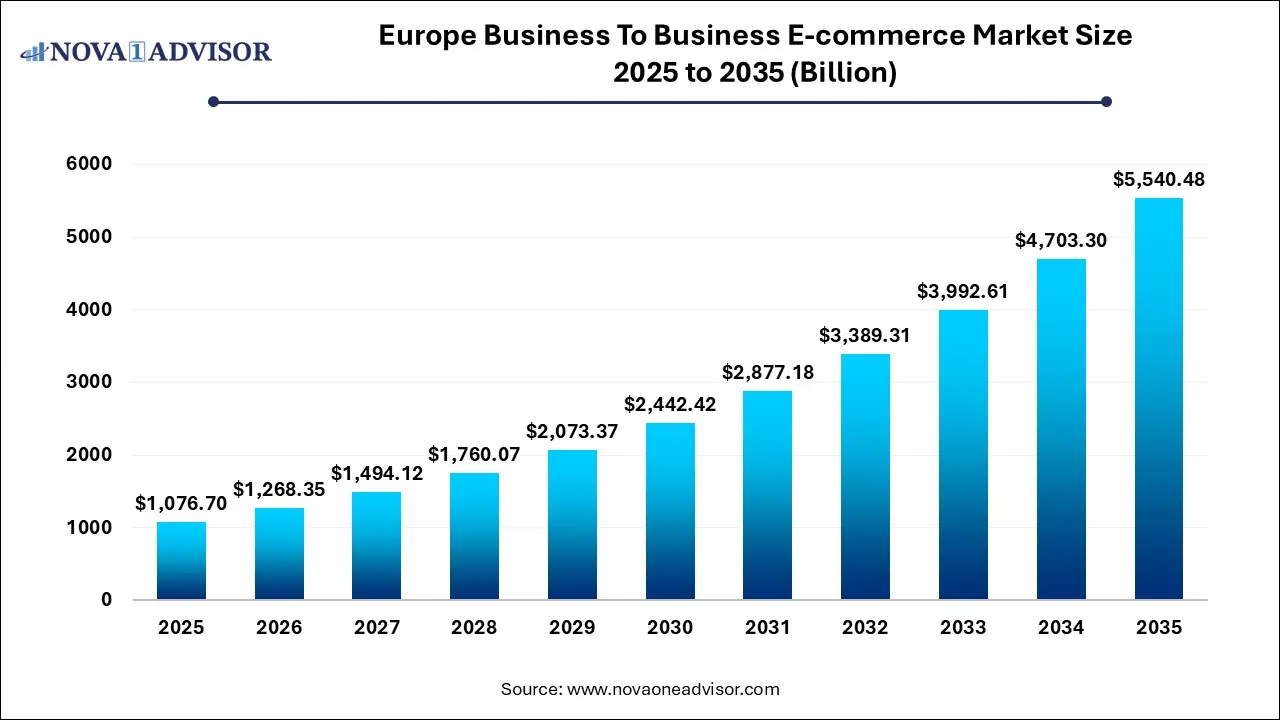
The Europe business-to-business e-commerce market size was estimated at USD 1,076.70 billion in 2025 and is projected to increase from USD 1,268.35 billion in 2026 to approximately USD 5,540.48 billion by 2035, growing at a CAGR of 17.8% from 2026 to 2035. The Europe business-to-business e-commerce market is driven by efficiency and e-procurement adoption, regulatory and sustainability mandates, and increasing demand for automation and industry.
Key Takeaways
- By product, the insurance and science segment held a dominant position in the market with a share of 13% in 2025.
- By product, the consumer electronics segment is the fastest-growing between 2026 and 2035.
- By deployment, the supplier-oriented segment held a dominant position in the market with a share of 44% in 2025.
- By deployment, the buyer-oriented segment is the fastest-growing between 2026 and 2035.
Innovation Driving Transformation in the Europe Business-to-Business E-commerce Market
Europe business-to-business e-commerce comprises the digital buying, selling, and exchange of goods and services directly between commercial enterprises. This model allows businesses in sectors such as manufacturing and distribution to benefit from automated procurement, reduced overhead, and faster supply chain management. Furthermore, it enables companies to expand their geographical reach and build scalable, long-term international trade connections. The market growth is driven by growing digitalization of supply chains, the need for transparent e-procurement solutions, and widespread demand for consumer-centric solutions, such as seamless digital purchasing experiences by corporate buyers.
Europe Business-to-Business E-commerce Market Trends
- Proliferation of Cloud-Native and Vertical B2B Marketplace
More companies are bypassing traditional distributor models by launching their own cloud-based digital ecosystem and vertical marketplaces. This allows businesses to seamlessly control their supply chains, interact directly with regional buyers, and scale their sales outreach without maintaining a physical footprint in every country.
- Deployment of Omnichannel and Hybrid Commercial Models
Modern B2B customers frequently switch between self-service portals and human sales reps throughout their purchase journeys. Companies are now using hybrid models where AI handles routine reorders and research, while account managers step in to provide complex, consultative support when closing deals.
- Advanced International via ERP and iPaaS Ecosystems
A modern B2B web store is only as powerful as its backend connectivity. Seamless real-time integration with Enterprise Resource Planning (ERP) and Product Information Management (PIM) systems is essential for accurate inventory tracking, contract-specific pricing, and automated order routing.
Key AI Integration in the Europe Business-to-Business E-commerce Market
AI and ML are transforming the Europe B2B e-commerce industry by accelerating order automation and enabling hyper-personalized buying journeys. Machine learning algorithms optimize complex supply chains and predict purchasing trends to minimize stockouts and manage inventory more effectively. Smart chatbots and dynamic pricing tools are streamlining negotiations and handling customized quotes, allowing European distributors to meet rising buyer expectations. These technologies drive operational efficiency and digital transformation across the region.
Europe Business-to-Business E-commerce Market Report Scope
| Report Coverage | Details |
| Market Size in 2026 | USD 1,268.35 Billion |
| Market Size by 2035 | USD 5,540.48 Billion |
| Growth Rate From 2026 to 2035 | CAGR of 17.8% |
| Base Year | 2025 |
| Forecast Period | 2026 to 2035 |
| Segments Covered | By Product, By Deployment |
| Market Analysis (Terms Used) | Value (USD Million/Billion) or (Volume/Units) |
| Key Companies Profiled | Amazon.com, Inc., Alibaba Group Holding Ltd. (AliExpress), eBay Inc., Zalando SE, Otto GmbH and Co. KG, ASOS Plc, Allegro.eu SA, Emag Group SRL, Cdiscount SA, Carrefour SA, Tesco Plc, IKEA Systems BV, HandM Hennes and Mauritz AB |
Driver
Digital Procurement Modernization
By integrating real-time catalogs, personalized pricing, and standardized APIs directly into e-procurement platforms, companies eliminate inefficiencies and reduce process costs. This digital shift enables businesses to easily navigate complex cross-border trade and comply with localized regulations across the EU. As organizations prioritize supply chain resilience and transparency, these technological advancements spur widespread platform adoption and accelerate overall market growth.
Restraint
Fragmented Regulatory and Tax Environment
The market growth is hindered by the imposing heavy compliance burden, particularly regarding varying VAT rates and duplicate reporting obligations across member states. Navigating these differing national legislations creates severe legal uncertainty, delaying cross-border supply chains and increasing administrative overhead. The inconsistent labor laws, invoicing mandates, and localized corporate taxes prevent businesses from scaling their operations seamlessly.
Opportunity
Digital Invoicing and Compliance Mandates
Accelerating the shift away from manual, paper-heavy transactions. By enforcing structured data exchange and real-time tax compliance, governments are compelling companies to integrate and real-time tax compliance, government are compelling companies to integrate digital, automated billing systems directly into their e-commerce storefronts. This compulsory digitalization enables seamless cross-border trade, dramatically lowers administrative costs, and drastically reduces processing errors.
Segment Insights
By Product Insights
Why Did the Industrial & Science Segment Lead the Europe Business-to-Business E-commerce Market?
The industrial & science segment registered its dominance over the market with a share of 13.0% in 2025, owing to the specialized intermediary platforms removing the traditional tech-expertise barrier, making complex international trade seamless and accessible for legacy manufacturers. The strategic integration of advanced tools, such as 3D visualizations, enables high-ticket capital investments to be executed online.
The consumer electronics segment held the 17.0% share of the market in 2025, and the integration of real-time supply chain transparency and price comparisons allows companies to effortlessly optimize their sourcing strategies while minimizing operational friction. Digital marketplaces provide the speed and agility required for retailers to constantly refresh their catalogs in response to fast-paced tech innovations.
The home and kitchen appliance segment held a 14.0% share of the market in 2025, due to the booming food services demand and strict European Union environmental policies. B2B portals have become essential for organizations to efficiently source the smart, energy-efficient LoT appliances required to upgrade modern facilities.
The clothing segment held the12.0% share of the market in 2025. Due to the compliant digital portals that provide the deep supply chain traceability required to easily meet the European Union’s rigorous new circular economy regulations. Fashion brands leverage centralized marketplaces to source global materials in real-time, solving complex matching and inventory balance issues across both physical and digital retail channels.
The healthcare segment held the 10.0% share of the market in 2025 because it heavily relies on centralized online marketplaces to automate inventory replenishment, access corporate discounts, and eliminate costly administrative ordering errors. These designed supply chains ensure the continuous, uninterrupted distribution of vital medical supplies and lifesaving pharmaceuticals across the continent.
The automotive segment held the 9.0% share of the market in 2025, due to the necessary distribution flexibility to successfully navigate the industry overhaul required for electric and autonomous vehicles. Automotive manufacturers, dealerships, and workshops utilize online marketplaces to streamline bulk parts procurement, optimize supply chains, and maintain leaner inventories.
The beauty and personal care segment held the 8.0% share of the market in 2025, due to the automated inventory management tools that allow brands to dramatically accelerate fulfilment times and navigate complex, multi-channel distribution logistics. These digital portals act as essential launchpads for agile indie brands, allowing them to instantly bypass traditional barriers, control wholesale pricing, and seamlessly expand into international Markets.
The others segment held the 6.0% share of the market in 2025, due to the strategic transition that allows manufacturers to secure direct buyer relationships, protect profit margins, and provide tailored pricing structures. These agile, specialized networks provide the structural flexibility required to ensure strict cross-border regulatory compliance and build a highly resilient supply chain.
The sports apparel segment held the 6.0% share of the market in 2025, due to the advanced digital portals to streamline bulk retail ordering, optimize complex supply chains, and quickly distribute continuous fabric innovations. This electronic procurement model allows wholesale suppliers to instantly match the growing consumer shift toward casual workwear, remote comfort, and active outdoor recreation.
The books and stationery segment held the 5.0% share of the market in 2025, due to the digitalized e-procurement workflows giving modern organizations the agility needed to efficiently upgrade facility operations with eco-friendly goods and smart digital writing innovations. Educational institutions and corporate offices heavily rely on centralized platforms to implement bulk purchasing models, easily manage catalogs, and significantly slash administration costs.
By Deployment Insights
Why Did the Supplier-Oriented Segment Hold a 44.0% Share for the Europe Business-to-Business E-commerce Market?
The supplier-oriented segment held a dominant position in the market with a share of 44.0% in 2025. Owing to bypassing third-party intermediaries, suppliers successfully protect their profit margins and eliminate costly commissions while delivering highly customized product catalogs and tailored purchasing experiences. The direct-to-buyer framework optimizes overall supply chain efficiency by removing the communication delays and operational bottlenecks typically caused by external brokers.
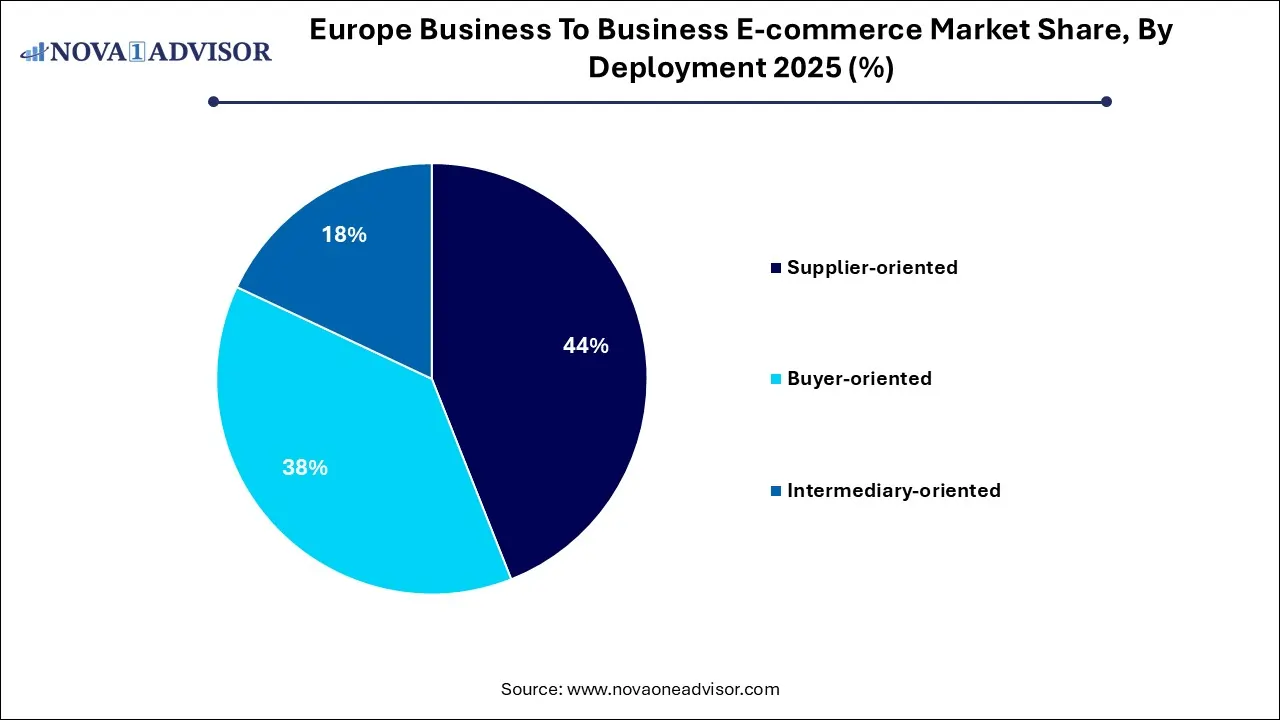
The buyer-oriented segment held a 38.0% share of the market in 2025, with the centralized portals seamlessly handling complex, cross-border European Union VAT systems and localized trade restrictions within a single, unified interface. This structural agility allows modern businesses to satisfy strict national digital transformation mandates while easily tracking and achieving mandatory corporate sustainability goals.
The intermediary-oriented segment held a 18.0% share of the market in 2025, as they accelerate complex transactions by embedding essential value-added services, such as corporate financing, warranty management, and automated sales negotiations directly into the purchasing flow. Ultimately, both buyers and sellers rely on these established third-party networks to provide a highly secure, trusted environment for scalable international trade.
Recent Developments
- In March 2026, Chinese e-commerce giant JD.com officially launched its online marketplace, Joybuy, across six major European markets: the United Kingdom, Germany, France, the Netherlands, Belgium, and Luxembourg. This aggressive international expansion marks a significant escalation in the global e-commerce wars, positioning JD.com as a direct competitor to long-time market leader Amazon.
Europe Business-to-Business E-commerce Market Companies
- Amazon.com, Inc.
- Alibaba Group Holding Ltd. (AliExpress)
- eBay Inc.
- Zalando SE
- Otto GmbH and Co. KG
- ASOS Plc
- Allegro.eu SA
- Emag Group SRL
- Cdiscount SA
- Carrefour SA
- Tesco Plc
- IKEA Systems BV
- HandM Hennes and Mauritz AB
Segments Covered in the Report
This report forecasts revenue growth at country levels and provides an analysis of the latest industry trends in each of the sub-segments from 2021 to 2035. For this study, Nova one advisor, Inc. has Europe Business-to-Business E-commerce Market.
By Product
- Home & Kitchen Application
- Consumer Electronics
- Industrial & Science
- Healthcare
- Clothing
- Beauty & Personal Care
- Sports Apparels
- Books & Stationery
- Automotive
- Others
By Deployment
- Supplier-oriented
- Buyer-oriented
- Intermediary-oriented
FAQ's

Proceed to Buy
Instant PDF delivery on confirmation

Europe Business-to-Business E-commerce Market Size to Hit USD 5,540.48 Billion...
 Request Customization
 Download Sample

Get a Sample of this Report
Europe Business-to-Business E-commerce Market