

Generative AI Market Size, Share & Trends Analysis (Report By Component; By Technology; By End-use; By Region)n- Global Industry Analysis, Share, Growth, Regional Outlook and Forecasts, 2026-2035
 Status Published
 Category Healthcare


Content
Generative AI Market Size, Growth and Trends 2026 to 2035
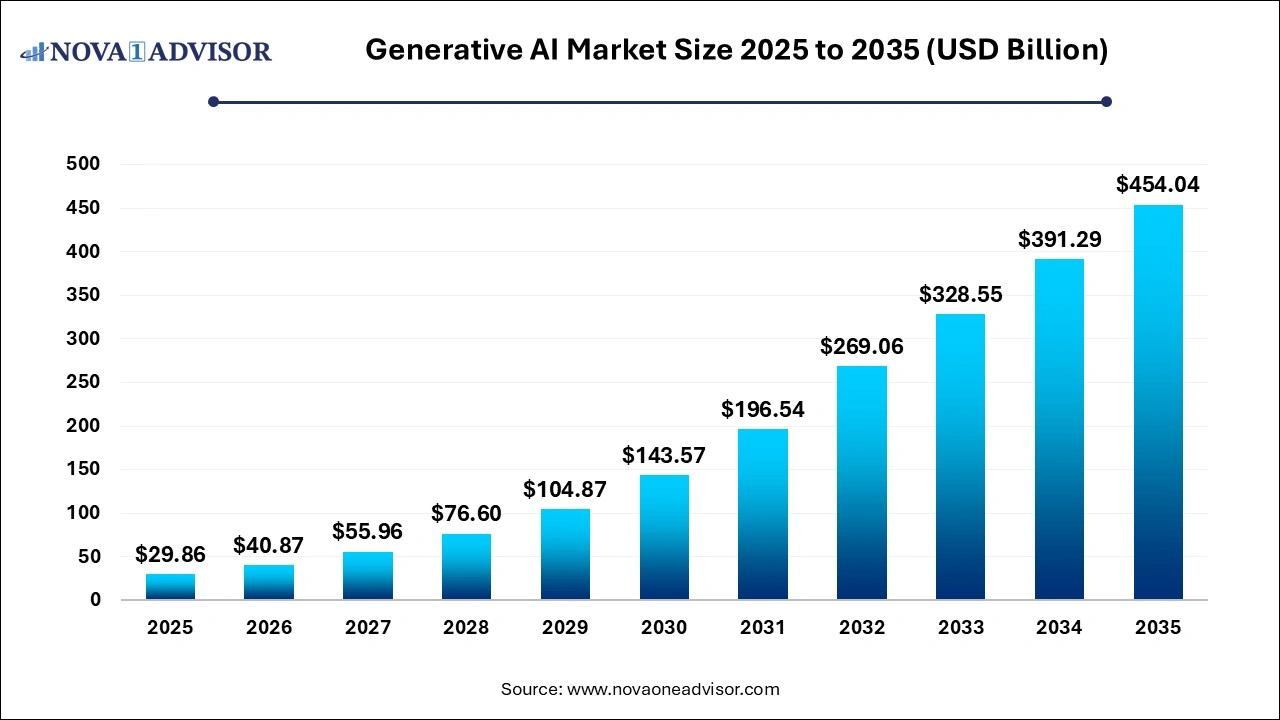
The global generative AI market size was exhibited at USD 29.86 billion in 2025 and is projected to hit around USD 454.04 billion by 2035, growing at a CAGR of 36.9% during the forecast period 2026 to 2035
Key Pointers:
- The market is further bifurcated into software and services. The software segment accounted for the largest revenue share of 66.9% in 2025.
- The service segment is anticipated to witness the fastest growth rate of 36.7% during the forecast period.
- The software segment accounted for the largest revenue share of 66.4% in 2025
- The transformers segment held the largest revenue share of 42.7% in 2025.
- The diffusion networks segment is expected to witness the fastest growth rate of 38.2% during the forecast period.
- The other sub-segment further comprises security, aerospace & defense. The media & entertainment segment accounted for the largest revenue of USD 1,625.6 million in 2025 and is projected to grow at a CAGR of 33.9% over the forecast period.
- The BFSI segment is expected to witness the fastest growth rate of 35.4% during the forecast period.
- North America dominated the market with a share of 41.2% in 2025 and is projected to grow at a CAGR of 34.9% over the forecast period.
- Asia Pacific is anticipated to grow at the fastest CAGR of 35.9% during the forecast period.
Generative AI Market Outlook
- Market Growth Overview: The generative AI market is expected to grow significantly between 2026 and 2035, driven by the growing enterprise productivity and automation, the rising need for customized content, and significant investment in GP technology and cloud compounding infrastructure.
- Sustainability Trends: Sustainability trends involve a push for green AI and energy efficiency, increased regulatory and reporting pressure, and sustainable AI lifecycle management.
- Major Investors: Major investors in the market include NVIDIA, Alphabet, Microsoft, Amazon, SoftBank Vision Fund, and Salesforce.
Report Scope of the Generative AI Market
| Report Coverage | Details |
| Market Size in 2026 | USD 40.87 Billion |
| Market Size in 2035 | USD 454.04 Billion |
| Growth Rate From 2025 to 2035 | CAGR of 31.28% |
| Base Year | 2025 |
| Forecast Period | 2025 to 2035 |
| Segments Covered | By Component, By Technology, By End-use |
| Market Analysis (Terms Used) | Value (USD Million/Billion) or (Volume/Units) |
| Regional Scope | North America, Europe, Asia Pacific, Latin America, Middle East & Africa |
Generative AI Market Segmental Insights
By Component Insights
The software segment growth is driven by transitioning from generic tools to specialized SaaS and API-first platforms that facilitate rapid enterprise scaling. Major brands like H&M and Adidas are leveraging these cloud-native solutions to automate complex design and marketing workflows, while the BFSI and healthcare sectors utilize foundation models for high-stakes analytics.
The services segment is driven by the mainstream adoption of AI-as-a-Service (AIaaS) models, which necessitate specialized managed services for seamless integration, ongoing training, and data security protocols. Consequently, the services component has become indispensable for businesses seeking to operationalize AI effectively and bridge the critical skill gap in the rapidly evolving landscape of advanced automation.
By Technology Insights
The AI transformers segment growth is driven by the transformation of specialized services into a strategic necessity, as firms leverage external expertise to navigate the complexities of model integration and data governance. By outsourcing the continuous training and security protocols required for advanced automation, organizations can effectively bridge internal skill gaps and accelerate time-to-value.
The diffusion network segment is driven by delivering superior output diversity and high-fidelity content without the training instabilities of GANs. This rapid expansion is fueled by a pivot into multi-modal video synthesis and specialized scientific applications, such as 3D pharmaceutical drug design and high-resolution medical imaging.
By End-use Insights
The media and entertainment segmentation growth is fueled by the total integration of AI into the end-to-end content lifecycle. Organizations that successfully operationalize AI as foundational infrastructure are achieving exponential content velocity and deeper audience relevance, while those relying on legacy processes face increasing competitive disadvantages.
The BFSI segment is driven by automating high-stakes compliance and document processing. By leveraging synthetic data generation, institutions are effectively bypassing traditional privacy bottlenecks to train fraud detection models and algorithmic trading strategies that now outpace legacy systems.
Regional Insights
North America dominated the market with a share of 42.2% in 2025 and is projected to grow at a CAGR of 34.9% over the forecast period due to factors such as rising pseudo-imagination & medical care and increasing banking frauds. Also, the presence of prominent market players such as U.S.-based Meta, Microsoft, and Google LLC, developed technology organizations, and the presence of experts are likely to drive the growth generative AI market in the region.
Asia Pacific is anticipated to grow at the fastest CAGR of 35.9% during the forecast period. Increasing government initiatives in Artificial Intelligence (AI) in Asia Pacific and the increasing adoption of AI applications are driving the growth of generative AI in the region.
Key Players in the Generative AI Market
- Synthesia: Synthesia is an AI video platform. It creates videos from text using AI avatars. This reduces costs and time, enabling scalable communications and training.
- MOSTLY AI Inc.: MOSTLY AI provides a platform that creates synthetic data using generative AI. This allows organizations to work with sensitive information while ensuring privacy.
- Genie AI Ltd.: Genie AI offers an open-source framework called GENIE.AI. This helps design, deploy, and manage generative AI solutions.
- Amazon Web Services, Inc. (AWS): AWS provides infrastructure and services like Amazon Bedrock. Companies can use these to build generative AI applications.
- IBM: IBM contributes through WatsonX, a platform for AI models. It helps automate workflows and gain insights from data.
Google LLC: Google uses Gemini models and AI-powered tools. These enhance productivity, content creation, and search capabilities.
FAQ's

Proceed to Buy
Instant PDF delivery on confirmation

 Request Customization
 Download Sample

Get a Sample of this Report
Generative AI Market