

Cardiac Pacemakers Market Size, Share, and Trends 2026 to 2035
 Status Published
 Category Healthcare


Content
Cardiac Pacemakers Market Size and Growth 2026 to 2035
The global cardiac pacemakers market size was valued at USD 4.95 billion in 2025 and is projected to grow from USD 5.12 billion in 2026 to USD 6.99 billion by 2035, at a CAGR of 3.51% from 2026 to 2035.
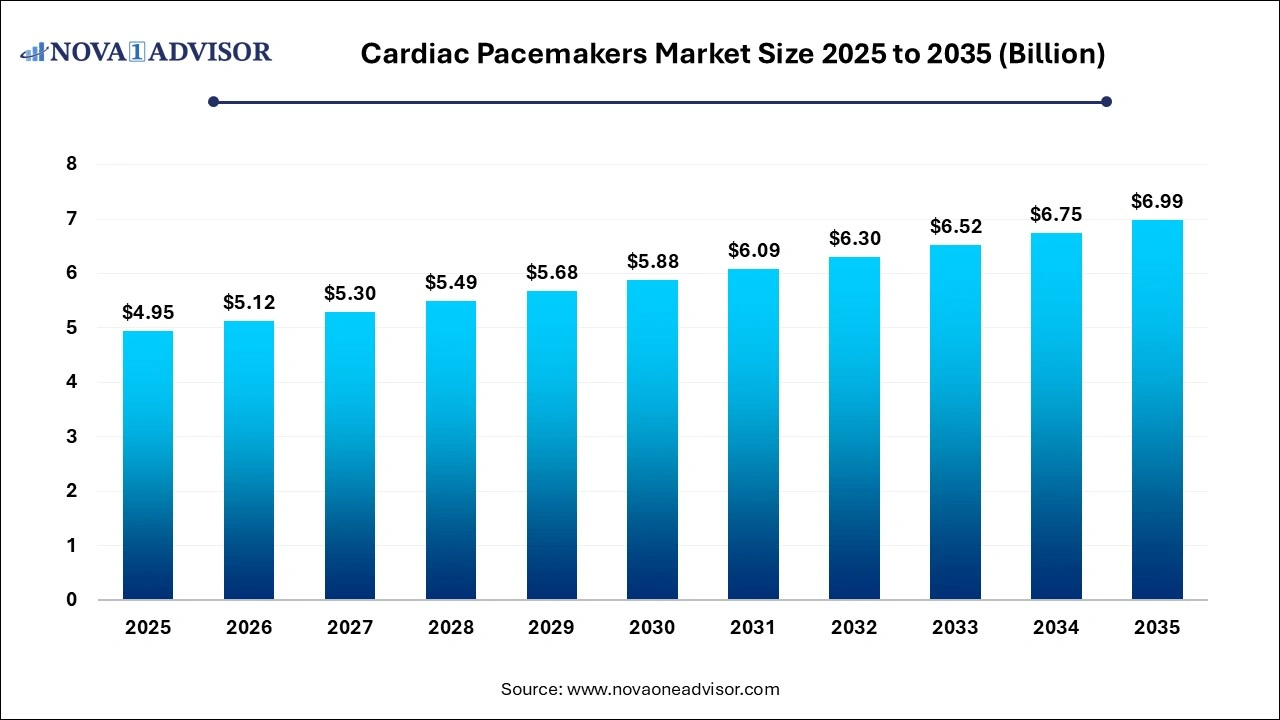
Key Takeaway:
- By product type, the implantable pacemaker segment dominated the market with the largest share in 2025.
- By product type, the leadless device segment is expected to grow at the fastest CAGR over the forecast period.
- By technology, the dual-chamber platforms segment dominated the market with the largest share in 2025.
- By end use, the hospital and cardiac centers segment dominated the market with the largest share in 2025.
- By region, North America dominated the market with the largest share in 2025.
Market Overview
The global Cardiac Pacemakers Market includes implantable and external devices used to regulate abnormal heart rhythms, particularly in patients with symptomatic bradycardia, conduction disorders, and selected heart-failure conditions. The technology has evolved from conventional fixed-rate systems toward advanced devices offering physiological sensing, adaptive pacing, wireless connectivity, MRI compatibility, and remote monitoring.
Traditional pacemakers typically use a pulse generator connected to one or more cardiac leads, with single-chamber, dual-chamber, and biventricular systems serving different clinical requirements. At the same time, leadless pacemakers are gaining importance because they eliminate conventional transvenous leads and the surgical generator pocket. Abbott’s AVEIR DR represents a major development, providing dual-chamber leadless pacing through communication between atrial and ventricular devices.
Another emerging direction is conduction-system and physiologic pacing, including His-bundle and left bundle branch area pacing, which aim to achieve more natural electrical activation of the heart. Advances in battery longevity, retrieval capabilities, remote monitoring, device connectivity, and software-assisted clinical management are further reshaping competition.
Market demand is also supported by aging populations, rising diagnosis of cardiac rhythm disorders, improvements in cardiovascular care, and expanding electrophysiology infrastructure in emerging economies. Major participants include Medtronic, Abbott, Boston Scientific, MicroPort CRM, BIOTRONIK, and LivaNova, with competition increasingly centered on clinical performance, reliability, implantation efficiency, connectivity, and next-generation pacing technologies.
Market Outlook
- Market Growth Overview: The global cardiac pacemakers market is expected to grow significantly between 2025 and 2035, driven by the growing prevalence of bradycardia and heart block.
- Sustainability Trends: Sustainability trends involve growing emphasis on reducing overall ecological footprints and optimizing device longevity.
- Major Investors: Major investors in the market include Medtronic, Abbott Laboratories, and Boston Scientific Corporation.
How is AI Impacting The Global Cardiac Pacemakers Market?
AI is becoming an important supporting technology in cardiac rhythm management, particularly in device diagnostics, remote monitoring, arrhythmia analysis, risk assessment, and therapy optimization. Modern pacemakers generate large amounts of information on heart rate, pacing activity, arrhythmia events, lead performance, and battery status. AI can analyze these datasets to identify abnormal patterns and help clinicians prioritize clinically significant events.
A major application is predictive remote monitoring, where AI can help distinguish routine device transmissions from signals that may require clinical attention. This can improve monitoring efficiency and allow healthcare teams to focus on patients showing changes in pacing behavior, lead performance, battery condition, or arrhythmia burden.
AI may also support personalized pacing strategies by analyzing patient-specific characteristics such as cardiac conduction patterns, activity levels, underlying conditions, and responses to therapy. Data analytics can further support the development of physiologic and conduction-system pacing by identifying patient profiles that may benefit from particular approaches.
However, because pacemakers are life-sustaining devices, AI implementation requires rigorous clinical validation, cybersecurity, explainability, and regulatory oversight. In the near term, AI is most likely to function as clinical decision-support technology, helping physicians interpret device data and optimize care rather than independently controlling pacing therapy.
Evolution Toward Leadless and Physiologic Pacing
The Cardiac Pacemakers Market is shifting toward leadless and physiologic pacing technologies alongside established transvenous systems. Conventional pacemakers remain widely used, but lead-related complications, infection risks, venous access challenges, and generator-pocket concerns are encouraging innovation in alternative device architectures.
Leadless pacemakers position the device directly inside the heart, eliminating traditional transvenous leads and the need for a subcutaneous generator pocket. Abbott’s AVEIR DR represents an important advancement, using separate atrial and ventricular devices that communicate with each other to provide coordinated dual-chamber pacing. Medtronic’s Micra platform is another major example of the expanding leadless-pacing approach.
Meanwhile, conduction-system pacing, including His-bundle and left bundle branch area pacing, is gaining attention because it aims to produce more natural ventricular activation. These developments are shifting product evaluation beyond basic heart-rate regulation toward cardiac synchrony, physiological activation, implantation efficiency, device longevity, and long-term patient outcomes.
Cardiac Pacemakers Market Report Scope
| Report Coverage | Details |
| Market Size in 2026 | USD 5.12 Billion |
| Market Size by 2035 | USD 6.99 Billion |
| Growth Rate From 2026 to 2035 | CAGR of 3.51% |
| Base Year | 2025 |
| Forecast Period | 2026 to 2035 |
| Segments Covered | By Product Type, By Technology, By End User, By Region |
| Market Analysis (Terms Used) | Value (USD Million/Billion) or (Volume/Units) |
| Regional Scope | North America; Europe; Asia Pacific; Central and South America; the Middle East and Africa |
| Key Companies Profiled | BIOTRONIK, Boston Scientific Corporation, Cook, MEDICO S.p.A., Medtronic, LivaNova PLC, Abbott, among others |
Market Driver – Rising Burden of Cardiovascular Disease and Aging Population
The growing burden of cardiovascular disease and global population aging is a major driver of the Cardiac Pacemakers Market. Age-related changes in the cardiac conduction system can increase the risk of bradyarrhythmias and conduction disorders requiring pacing. Improved diagnosis through ECGs, ambulatory monitoring, wearables, and advanced cardiac technologies is also helping identify patients earlier. Emerging economies are contributing to demand as cardiovascular risk factors rise alongside expanding cardiology and electrophysiology services. Advancements across conventional, CRT-P, leadless, and physiologic pacing systems are further expanding treatment options.
Market Restraint – High Procedure Costs and Complex Implantation Infrastructure
High device and procedure costs remain an important market restraint. Total expenditure can include the pacemaker, hospital facilities, specialist fees, diagnostic procedures, implantation, follow-up, remote monitoring, replacement, and complication management. Advanced technologies such as leadless and CRT-P systems may require specialized expertise and infrastructure, limiting adoption where reimbursement or electrophysiology capacity is constrained. Patient affordability, insurance coverage, and geographic access to specialist centers can create additional barriers, particularly in emerging markets.
Market Opportunity – Expansion of Leadless, Connected, and Personalized Pacing
The integration of leadless devices, physiologic pacing, remote monitoring, and AI-enabled analytics presents a significant growth opportunity. Dual-chamber leadless systems such as Abbott’s AVEIR DR can broaden the applications of leadless pacing, while connected monitoring can enable clinicians to manage patients remotely and reduce unnecessary hospital visits. Asia-Pacific also offers substantial potential due to large patient populations, improving healthcare infrastructure, and expanding cardiac-care capabilities. Combining connected pacemakers with predictive analytics could further support more personalized and continuous rhythm management.
Segmental Insights
By Product Type
Why did the implantable pacemaker segment dominate the global cardiac pacemakers market?
The implantable pacemaker segment dominated the market with the largest share in 2025. The dominance of the segment can be attributed to the growing prevalence of cardiovascular diseases and the surge in the elderly population across the globe. In addition, wireless, Bluetooth-enabled smart medical devices facilitate the remote home monitoring of cardiac activity by healthcare professionals.
How did the leadless device segment expected to hold the significantly growing global cardiac pacemakers market in the coming years?
The leadless device segment is expected to grow at the fastest CAGR over the forecast period. The growth of the segment can be credited to its ability to completely eliminate transvenous leads and minimally invasive delivery options. Also, traditional cardiac pacing systems are subject to significant hardware-related complications, including lead fractures, insulation degradation, and venous thrombosis.
By Technology
Why did the dual-chamber platforms segment dominate the global cardiac pacemakers market?
The dual-chamber platforms segment dominated the market with the largest share in 2025. The dominance of the segment can be linked to the growing bradycardia and AV-block prevalence and ongoing advancements such as MRI-safe engineering. Dual-chamber pacemakers use two separate leads, positioned in the right atrium and the right ventricle, to replicate the heart's intrinsic electrical conduction and substantially reduce the incidence of pacemaker syndrome.
How did the leadless technology segment expected to hold the significantly growing global cardiac pacemakers market in the coming years?
The leadless technology segment is expected to grow at the fastest CAGR over the forecast period. The growth of the segment can be driven by a surge in arrhythmia and bradycardia cases in geriatric populations and the use of minimally invasive catheter-based delivery. Advanced micro-electromechanical systems (MEMS) and optimized power cell architectures significantly prolong operational lifespan.
By End Use
Why did the hospital and cardiac center segment dominate the global cardiac pacemakers market?
The hospital and cardiac center segment dominated the market with the largest share in 2025. The dominance of the segment is owing to the presence of cutting-edge surgical infrastructure and skilled electrophysiologists. Furthermore, specialized catheterization laboratories and hybrid operating suites facilitate the deployment of advanced therapeutic devices.
How did the ambulatory surgical centers (ASCs) segment expected to hold the significantly growing global cardiac pacemakers market in the coming years?
The ambulatory surgical centers (ASCs) segment is expected to grow at fastest CAGR during the study period. The growth of the segment is due to its lower operational costs and reduce post-operative complications. Moreover, stringent hospital budgets and revised insurance frameworks increasingly direct low-risk device implantations to outpatient facilities to maximize inpatient bed availability.
By Region
Why did the North American region account for the largest share of the global cardiac pacemakers market?
North America dominated the market with the largest share in 2025. The dominance of the region can be attributed to the growing prevalence of cardiovascular disorders among the majority of the aging population along with the favorable healthcare reimbursement policies. In addition, robust public and private healthcare financing frameworks across North America significantly reduce the economic impact of high-cost surgical interventions.
U.S. Global Cardiac Pacemakers Market Trends
The growth of the market in the country can be driven by the growing adoption of innovative technologies such as MRI-compatible devices. Also, substantial domestic capital expenditure in clinical research is anchored by prominent local medical technology manufacturers, notably Medtronic and Abbott, leading to market growth further.
Why did the Asia-Pacific region become the fastest-growing global cardiac pacemakers market during the forecast period?
Asia Pacific is expected to grow at the fastest CAGR over the forecast period. The growth of the region can be credited to the growing healthcare infrastructure in prime hubs such as Japan, China, and India, along with the technological innovations in leadless pacemakers. Furthermore, enhanced hospital infrastructure and broadened cardiac care capabilities are driven by supportive government health initiatives and increasing disposable incomes within developing economies.
China Global Cardiac Pacemakers Market Trends
The market in the country is growing due to the presence of supportive government healthcare reforms and the advent of localized domestic manufacturing. Moreover, upgraded hospital networks across tier-one and tier-two cities significantly broaden patient access to advanced interventional cardiology services.
Key Players in the Global Cardiac Pacemakers Market
- Medtronic plc (US): The company secured key CE marks for its Micra AV2 and Micra VR2 devices. These are the world's smallest wire-free pacemakers, offering enhanced battery longevity.
- Abbott Laboratories (US): A dominant force following its historic acquisition of St. Jude Medical. Abbott received critical FDA approval and a European CE Mark for its AVEIR DR, the world's first dual-chamber leadless pacemaker system.
- Boston Scientific Corporation (US): A top-tier market shareholder specializing in high-performance structural pacing. Acquired expanded FDA indications for its INGEVITY+ pacing leads, capturing market share specifically tailored for left bundle branch area pacing (LBBAP).
Recent Developments
- In October 2025, Abbott India Ltd. (NSE: ABBOTINDIA) has introduced its dual-chamber leadless pacemaker system in India. This medical innovation advances cardiac rhythm management by utilizing wireless synchronization between two miniaturized pacemakers implanted directly within the heart chambers.
Segments Covered in the Report
This report forecasts revenue growth at country levels and provides an analysis of the latest industry trends in each of the sub-segments from 2021 to 2035. For this study, Nova one advisor, Inc. has cardiac pacemakers market.
By Product Type
- Implantable Pacemakers
- Single Chamber Implantable
- Dual Chamber Implantable
- Biventricular / CRT-P
- Leadless Pacemakers
- Leadless PacemakersExternal / Temporary Pacemakers
- External / Temporary Pacemakers
By Technology
- Single Chamber Technology
- Dual Chamber Technology
- Cardiac Resynchronization Therapy (CRT-P)
- Leadless Technology
- Rate-Responsive Pacemakers
By End User
- Hospitals & Cardiac Centers
- Ambulatory Surgical Centers
- Homecare Settings
- Academic & Research Institutes
By Region
- North America
- Europe
- Asia-Pacific
- Latin America
- Middle East & Africa (MEA)
FAQ's

Proceed to Buy
Instant PDF delivery on confirmation

Cardiac Pacemakers Market Size to Hit USD 6.99 Billion by 2035
 Request Customization
 Download Sample

Get a Sample of this Report
Cardiac Pacemakers Market