

Learning Disabilities Treatment Market Size, Share, Forecast Report, 2026-2035
 Status Published
 Category Healthcare


Content
Learning Disabilities Treatment Market Size, Growth and Trends 2026 to 2035
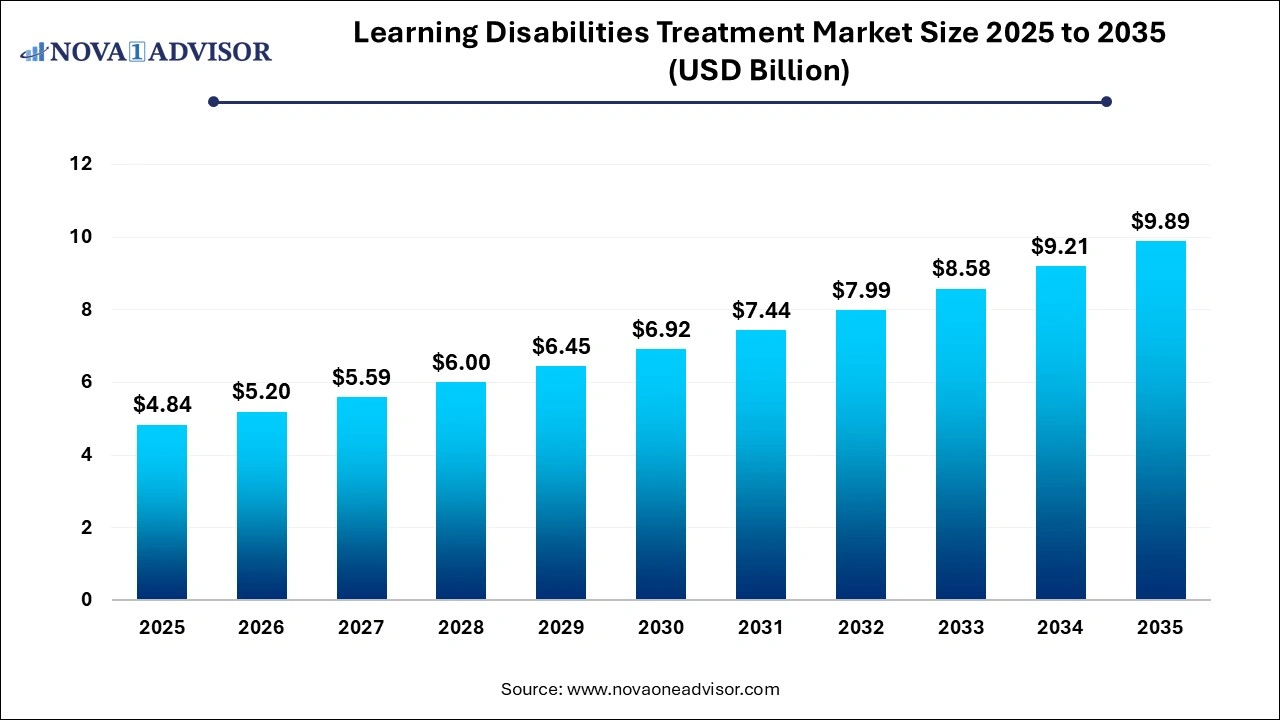
The global learning disabilities treatment market size was estimated at USD 4.84 billion in 2025 and is expected to be worth around USD 9.89 billion by 2035 with a CAGR of 7.4% from 2026 to 2035.
Learning Disabilities Treatment Market Outlook
- Market Growth Overview: The learning disabilities treatment market is expected to grow significantly between 2025 and 2034, driven by the rising prevalence and early diagnosis, shift towards technological advancement in therapeutics, and increasing investment in supportive government initiatives and funding.
- Sustainability Trends: Sustainability trends involve eco-sensory learning pathways, green therapy, and sustainable infrastructure in treatment centers.
- Major Investors: Major investors in the market include Sonova, Ginger Software, CogniFit, Kurzweil Education, Lindamood-Bell, and OrCam.
Report Scope of Learning Disabilities Treatment Market
| Report Coverage | Details |
| Market Size in 2026 | USD 5.20 Billion |
| Market Size by 2035 | USD 9.89 Billion |
| Growth Rate From 2026 to 2035 | CAGR of 7.4% |
| Base Year | 2025 |
| Forecast Period | 2026 to 2035 |
| Segments Covered | By Disease Type, By Treatment, By End-User |
| Market Analysis (Terms Used) | Value (USD Million/Billion) or (Volume/Units) |
| Regional scope | North America; Europe; Asia Pacific; Latin America; MEA |
| Key Companies Profiled | Sonova Group, Sensory, Inc., Vocalect Biometric Solutions, LLC, Ginger Software, Inc |
Learning Disabilities Treatment Market Segment Insights
By Disease Type Insights
How did the Dyslexia Segment Dominate the Learning Disabilities Treatment Market?
The dyslexia segment is driven by leveraging its position as the most prevalent learning disability, accounting for all cases. The integration of AI-powered assistive technologies and the expansion of specialized occupational therapy. The educational mandates for early screening and the rapid adoption of teletherapy which has democratised access beyond traditional clinical settings. Ultimately, the segment defines the broader market's trajectory by shifting toward personalised, tech-enabled interventions that bridge the gap between classroom support and clinical care.
How did the language processing disorders segment expect to hold the fastest-growing Learning Disabilities Treatment market in the coming years?
The language processing disorders segment is driven by the rapid adoption of teletherapy and specialized mobile apps has dismantled geographical barriers, allowing for high-frequency, personalized interventions that significantly improve communication outcomes. Through inclusive education policies and increased funding, particularly in the Asia-Pacific region, the LPD market is transitioning from general support to highly targeted, technology-enabled clinical care. This growth reflects a global shift toward addressing specific communicative barriers through digital innovation and data-backed therapeutic models.
By Treatment Insights
How did the Therapy (occupational therapy) Segment Account for the largest share in the Learning Disabilities Treatment Market?
The Therapy (occupational therapy) segment is driven by a massive demand in paediatrics, where cases involve multifaceted developmental needs, and the successful adoption of virtual reality and tele-health to increase patient engagement. As the primary intervention for widespread conditions like dyslexia, which affects the population, its proven efficacy makes it the first choice for both clinical specialty centers and school-based programs. The evolution from traditional physical exercises into a data-driven, technology-enhanced field that prioritises long-term patient independence.
How did the handwriting training tools segment expect to hold the fastest-growing Learning Disabilities Treatment market in the coming years?
The handwriting training tools segment is driven by the integration of AI that transforms tablets into diagnostics device capable of analysing real-time pressure and speed. The shift toward "at-home" therapy, where apps like Kaligo and Handwriting Without Tears provide immediate feedback to students. By bridging the gap between clinical occupational therapy and daily classroom practice, these digital platforms have moved from niche aids to essential educational standards.
By End-User Insights
How did the specialty centres segment account for the largest share in the Learning Disabilities Treatment Market?
The specialty centres segment is driven by the high demand for early, precise diagnosis and the integration of specialized technologies, such as AI-driven cognitive tools, that general healthcare settings lack. By offering a supportive ecosystem that bridges the gap between clinical therapy and educational support, these centers have become the preferred choice for parents seeking expert-driven, personalized interventions. The segment thrives by centralizing specialized talent and advanced diagnostic infrastructure, ensuring it captures the largest share of global treatment revenue.
How did the home care segment expect to hold the fastest-growing Learning Disabilities Treatment market in the coming years?
The home care segment is driven by the shift toward comfort, cost-effectiveness, and digital accessibility. By eliminating clinical overhead and infection risks, families are adopting "hospital-at-home" models that utilize Telehealth Platforms and wearable monitors to deliver high-frequency, personalized therapy. This transition is supported by a surge in Educational Apps that allow for real-time data syncing between parents and remote specialists, ensuring consistent intervention outside of traditional school hours.
Key Players in the Learning Disabilities Treatment Market
Sonova Group: Sonova contributes to the learning disabilities treatment market by developing advanced hearing solutions through Phonak and advanced bionics that improve auditory processing and speech intelligibility for individuals with hearing-related learning difficulties.
Sensory, Inc.: Sensory, Inc. contributes to the market through its expertise in AI, speech recognition, and voice-activated interfaces, which can be integrated into assistive devices for better user interaction.
Vocalect Biometric Solutions, LLC: Vocalect Biometric Solutions offers advanced voice recognition and biometric authentication technologies that can secure and personalize assistive, technology-based tools for learning disabilities.
• Ginger Software, Inc.
Ginger Software contributes by providing AI-driven assistive technology tools, such as spellcheckers and grammar checkers, designed to aid individuals with dyslexia and other writing-related learning disabilities.
Global Learning Disabilities Treatment Market: Segmentation
- Learning Disabilities Treatment Market, by Disease Type
- Dyslexia
- Dysgraphia
- Auditory Processing Disorder (APD)
- Dyscalculia
- Language Processing Disorder
- Others
- Learning Disabilities Treatment Market, by Treatment
- Assistive Technology Tools (ATT)
- Personal Listening Devices
- Sound Field Systems
- Others
- Handwriting Training Tools
- Portable Word Processors
- Proofreading Software
- Others
- Therapy
- Occupational Therapy
- Speech Therapy
- Others
- Others
- Assistive Technology Tools (ATT)
- Learning Disabilities Treatment Market, by End User
- Specialty Centers
- Home Care
- Others
Regional Analysis and Forecast
Further, this research study analyses market size, production, consumption and its advancement trends at global, regional, and country level for period 2016 to 2027 and covers following region in its scope:
- North America
- United States
- Canada
- Europe
- Germany
- United Kingdom
- Italy
- France
- Rest of EU
- Asia Pacific
- China
- India
- Japan
- Southeast Asia
- Rest of APAC
- Central & South America
- Brazil
- Argentina
- Rest of Central & South America
- Middle East and Africa
- UAE
- Saudi Arabia
- Rest of MEA

Proceed to Buy
Instant PDF delivery on confirmation

Learning Disabilities Treatment Market Size to Worth Around USD 9.89 Bn by 2035
 Request Customization
 Download Sample
Warning: Trying to access array offset on value of type null in /home/multiwpmr/public_html/report-details.php on line 1145

Get a Sample of this Report
Learning Disabilities Treatment Market