

Microtome Market Size, Share, and Trends 2026 to 2035
 Status Published
 Category Healthcare


Content
Microtome Market Size and Growth 2026 to 2035
The global microtome market size was valued at USD 170.53 million in 2025 and is projected to grow from USD 181.10 million in 2026 to USD 311.20 million by 2035, at a CAGR of 6.2% from 2026 to 2035.

Key Takeaway
- By product, the microtome devices segment dominated the market and accounted for the largest revenue share in 2025.
- By product, the accessories segment is the fastest-growing in the market in 2025.
- By technology, the fully automated segment dominated the market and accounted for the fastest-growing share of 52.0% in 2025.
- By region, North America accounted for the largest revenue share of 44.0% in 2025.
Market Overview
The global microtome market represents a crucial segment of the pathology and histology equipment industry. Microtomes are precision instruments designed to cut extremely thin sections of biological tissues and industrial materials for microscopic examination. These instruments are indispensable in hospitals, pathology laboratories, pharmaceutical companies, biotechnology firms, forensic laboratories, veterinary diagnostics, academic institutions, and research organizations. As precision medicine becomes increasingly important, demand for accurate tissue preparation has grown substantially, positioning microtomes as fundamental instruments in diagnostic and research workflows.
Histopathological diagnosis remains the gold standard for identifying numerous diseases, particularly cancers, autoimmune disorders, infectious diseases, neurological conditions, and rare genetic disorders. Every tissue biopsy collected from patients typically undergoes processing, embedding, sectioning, staining, and microscopic evaluation. Microtomes are responsible for producing tissue sections that maintain structural integrity, allowing pathologists to accurately identify cellular abnormalities. As global cancer incidence continues to rise and biopsy volumes increase, laboratories require high-performance microtomes capable of producing consistent ultra-thin sections with minimal operator intervention.
Technological advancement has transformed modern microtomes from manually operated devices into sophisticated automated systems equipped with programmable cutting speeds, electronic specimen positioning, touchscreen interfaces, motorized sectioning, anti-roll mechanisms, ergonomic controls, and enhanced safety features. These improvements not only reduce operator fatigue but also improve section quality, reproducibility, and laboratory efficiency. Modern laboratories increasingly prioritize automation to address workforce shortages while maintaining diagnostic accuracy.
Beyond healthcare, microtomes are widely utilized in materials science, polymer research, semiconductor inspection, wood science, nanotechnology, and electron microscopy. Ultramicrotomes capable of producing sections measuring only tens of nanometers enable researchers to investigate cellular ultrastructure and advanced materials using transmission electron microscopy . Growing investments in nanotechnology and advanced materials research continue to expand the market beyond traditional pathology applications.
Pharmaceutical and biotechnology companies also represent important customers. Drug discovery programs routinely employ histological analysis to evaluate tissue toxicity, treatment efficacy, biomarker expression, and disease progression during preclinical and clinical studies. The increasing number of biologics, cell therapies, and personalized medicines has accelerated demand for reliable tissue preparation instruments.
Government investments in healthcare modernization, laboratory accreditation, and cancer screening initiatives further stimulate market expansion. Many countries are establishing centralized pathology laboratories equipped with automated histology workflows to improve diagnostic capacity and reduce turnaround time. As laboratory automation continues to evolve, microtomes are increasingly integrated with digital pathology platforms, automated staining systems, barcode tracking, and laboratory information management systems (LIMS), creating more streamlined diagnostic workflows.
Market Outlook
- Market Growth Overview: The global microtome market is expected to grow significantly between 2025 and 2035, driven by the rise in chronic disease and cancer prevalence, the expanding geriatric population, and advancements in digital pathology.
- Sustainability Trends: Sustainability trends include energy-efficient cryostats, eco-friendly consumables, material sourcing, and durability.
- Major Investors: Major investors in the market include Thermo Fisher Scientific Inc., Danaher Corporation (owner of Leica Biosystems), Sakura Finetek, Cardinal Health, and SLEE medical GmbH.
How is AI Impacting the Global Microtome Market?
AI and ML are rapidly revolutionizing the global microtome industry by driving a shift toward fully automated and smart tissue sectioning. Integrated AI algorithms enable adaptive slicing, defect detection, and predictive maintenance, reducing reliance on scarce skilled technicians and minimizing sample waste. Machine learning enhances workflow efficiency and standardization, while seamlessly integrating with digital pathology and clinical decision systems accelerates precise diagnostics. These technologies are transforming laboratory microtomy to meet the rigorous demands of high-throughput research and modern precision medicine.
Segmental Insights
Major Trends in the Microtome Market
- Growing adoption of fully automated microtomes in high-volume pathology laboratories.
- Increasing integration of microtomes with digital pathology and whole-slide imaging workflows.
- Rising use of disposable low-profile blades for enhanced laboratory safety.
- Expansion of cancer screening programs increasing biopsy volumes globally.
- Growing demand for ultramicrotomes in nanotechnology and electron microscopy research.
- Increased adoption of ergonomic instrument designs to reduce operator fatigue.
- Development of programmable touchscreen-controlled sectioning systems.
- Rising investment in laboratory automation across hospitals and diagnostic centers.
- Growing application of vibrating microtomes in neuroscience and live tissue research.
- Expansion of precision medicine driving demand for standardized tissue preparation.
- Integration of predictive maintenance and smart monitoring technologies into laboratory equipment.
- Increasing research funding for life sciences and biomedical investigations.
- Growing replacement of aging manual microtomes with automated platforms.
- Higher demand for premium accessories including precision blades, specimen clamps, and anti-roll devices.
- Increasing adoption of standardized pathology workflows across emerging economies.
Microtome Market Report Scope
| Report Coverage | Details |
| Market Size in 2026 | USD 181.10 Million |
| Market Size by 2035 | USD 311.20 Million |
| Growth Rate From 2026 to 2035 | CAGR of 6.2% |
| Base Year | 2025 |
| Forecast Period | 2026 to 2035 |
| Segments Covered | Product, Technology, Region |
| Market Analysis (Terms Used) | Value (USD Million/Billion) or (Volume/Units) |
| Regional Scope | North America; Europe; Asia Pacific; Central and South America; the Middle East and Africa |
| Key Companies Profiled | Diapath S.P.A.; Leica Biosystems Nussloch GmbH; Sakura Finetek Europe B.V.; MEDITE GmbH; SLEE medical GmbH; Boeckeler Instruments; Nanolytik; S.M. Scientific Instruments Pvt. Ltd.; AGD Biomedicals; Alltion; Amos Scientific Pvt. Ltd.; Thermo Fisher Scientific |
Market Driver
Rising Global Burden of Cancer and Increasing Histopathology Testing
The primary driver of the global microtome market is the continuous increase in cancer incidence and the corresponding growth in histopathological examinations. Tissue biopsy remains the definitive diagnostic approach for identifying most malignant tumors, requiring precise sectioning before microscopic evaluation. Every cancer diagnosis typically depends upon obtaining high-quality tissue slices with consistent thickness, making microtomes indispensable instruments within pathology laboratories.
According to international healthcare organizations, millions of tissue biopsies are performed annually for diagnosing breast cancer, colorectal cancer, lung cancer, prostate cancer, liver cancer, skin cancer, and numerous other diseases. As healthcare systems expand screening initiatives and early diagnosis programs, biopsy volumes continue increasing worldwide. For example, national breast cancer screening programs across North America and Europe have substantially increased pathology workloads, prompting laboratories to invest in automated microtomes capable of maintaining high throughput without compromising section quality. Similar trends are observed in gastrointestinal screening programs, cervical cancer screening, and liver disease diagnostics. The rising prevalence of chronic diseases requiring tissue analysis further strengthens sustained market demand.
Market Restraint
High Cost of Automated Systems and Maintenance Requirements
Despite technological progress, the high acquisition cost associated with advanced automated microtomes remains a significant challenge for market expansion. Fully automated systems require sophisticated motors, precision mechanics, electronic controls, programmable interfaces, and integrated safety features, making them substantially more expensive than conventional manual instruments. Small hospitals, independent pathology laboratories, academic institutions, and healthcare facilities in developing countries often face budget constraints that delay equipment upgrades.
Additionally, automated microtomes require periodic calibration, preventive maintenance, blade replacement, software updates, and operator training to maintain optimal performance. Laboratories must also invest in compatible accessories and consumables that increase total ownership costs. Limited availability of trained biomedical engineers in several developing regions further complicates maintenance activities, resulting in longer equipment downtime. Consequently, many resource-constrained laboratories continue using older manual microtomes despite the productivity advantages offered by automated systems.
Market Opportunity
Expansion of Digital Pathology and Laboratory Automation
The rapid expansion of digital pathology presents one of the most promising opportunities for the microtome market. Healthcare providers worldwide are digitizing pathology workflows by integrating automated tissue processors, embedding stations, microtomes, slide scanners, AI-assisted image analysis software, and laboratory information systems into unified diagnostic ecosystems. This transformation requires exceptionally consistent tissue section quality to ensure accurate digital image interpretation.
As precision medicine continues expanding, pathology laboratories increasingly prioritize standardized tissue preparation protocols that minimize artifacts and improve reproducibility. Automated microtomes capable of programmable section thickness, motorized specimen positioning, anti-roll technology, and intelligent quality control are becoming essential components of next-generation digital laboratories.
Emerging economies also represent significant opportunities as governments modernize healthcare infrastructure and establish centralized pathology networks. Investments in cancer centers, biotechnology parks, pharmaceutical research facilities, and academic laboratories are increasing procurement of advanced histology equipment. Manufacturers that develop affordable automated systems with enhanced connectivity, AI-assisted maintenance, ergonomic operation, and cloud-enabled service capabilities are expected to capitalize on these expanding opportunities in both developed and emerging healthcare markets.
Segmental Insights
By Product
Microtome Devices Dominated the Market
Microtome devices dominated the global microtome market due to their indispensable role in tissue sectioning across diagnostic pathology laboratories, hospitals, pharmaceutical research facilities, biotechnology companies, forensic science laboratories, and academic research institutions. These instruments serve as the primary equipment for preparing ultra-thin tissue sections required for microscopic evaluation, making them essential for disease diagnosis and biomedical research. Continuous technological improvements, including motorized specimen advancement, programmable cutting thickness, anti-roll mechanisms, touchscreen interfaces, and enhanced operator safety features, have significantly improved laboratory productivity. The growing prevalence of cancer, neurological disorders, infectious diseases, and chronic illnesses has resulted in increasing biopsy procedures worldwide, directly contributing to higher procurement of advanced microtome devices.
Within this segment, Rotary Microtomes accounted for the largest market share because they represent the industry standard for routine histopathology applications. Rotary microtomes provide exceptional cutting precision, operational reliability, and compatibility with paraffin-embedded tissue samples, making them the preferred choice in hospitals and diagnostic laboratories. Their ability to produce uniform tissue sections with minimal compression artifacts supports accurate pathological diagnoses. Increasing investments in pathology automation and replacement of aging laboratory infrastructure continue to strengthen demand for technologically advanced rotary microtomes equipped with automated sectioning capabilities, ergonomic operation, and digital workflow compatibility.
Accessories are the Fastest-Growing Segment
The accessories segment is expected to register the fastest growth during the forecast period owing to the recurring consumption of blades, specimen clamps, blade holders, anti-roll plates, knife carriers, waste collection systems, and maintenance components. Unlike capital equipment purchases, accessories require frequent replacement due to regular laboratory use, creating a continuous revenue stream for manufacturers. High-throughput pathology laboratories process thousands of tissue specimens annually, resulting in consistent demand for premium disposable blades and precision accessories that ensure optimal section quality.
Manufacturers are increasingly introducing high-performance consumables featuring improved blade coatings, enhanced corrosion resistance, superior durability, and compatibility with multiple microtome platforms. Growing emphasis on laboratory safety has also accelerated the adoption of disposable accessories that reduce contamination risks and minimize operator exposure to sharp instruments. Furthermore, expanding pathology services across emerging economies are increasing routine procurement of consumables, supporting sustained growth of the accessories segment. As digital pathology workflows continue to expand, laboratories are expected to prioritize premium accessories capable of maintaining section consistency for high-resolution slide imaging and AI-assisted diagnostics.
By Technology
Fully Automated Technology Dominated the Market
Fully automated microtomes dominated the technology segment owing to their ability to improve laboratory efficiency, enhance reproducibility, reduce operator fatigue, and support standardized tissue preparation. Large hospitals, centralized pathology laboratories, pharmaceutical companies, and academic research institutions increasingly favor automated systems to manage rising biopsy volumes while maintaining consistent diagnostic quality. Automated microtomes integrate programmable cutting thickness, electronic specimen positioning, automated trimming, memory functions, safety sensors, and touchscreen interfaces that significantly reduce manual intervention. These capabilities enable laboratories to improve productivity, shorten turnaround times, and minimize variability between operators.
The growing implementation of digital pathology and laboratory automation has further strengthened demand for fully automated systems. Digital image analysis platforms require highly consistent tissue sections to ensure accurate AI-assisted diagnosis. Consequently, pathology laboratories upgrading to digital workflows frequently invest in automated microtomes that deliver repeatable section quality with minimal artifacts. Continuous product innovations, improved ergonomics, enhanced safety mechanisms, and integration with laboratory information management systems have reinforced the leadership position of fully automated technology across developed healthcare markets.
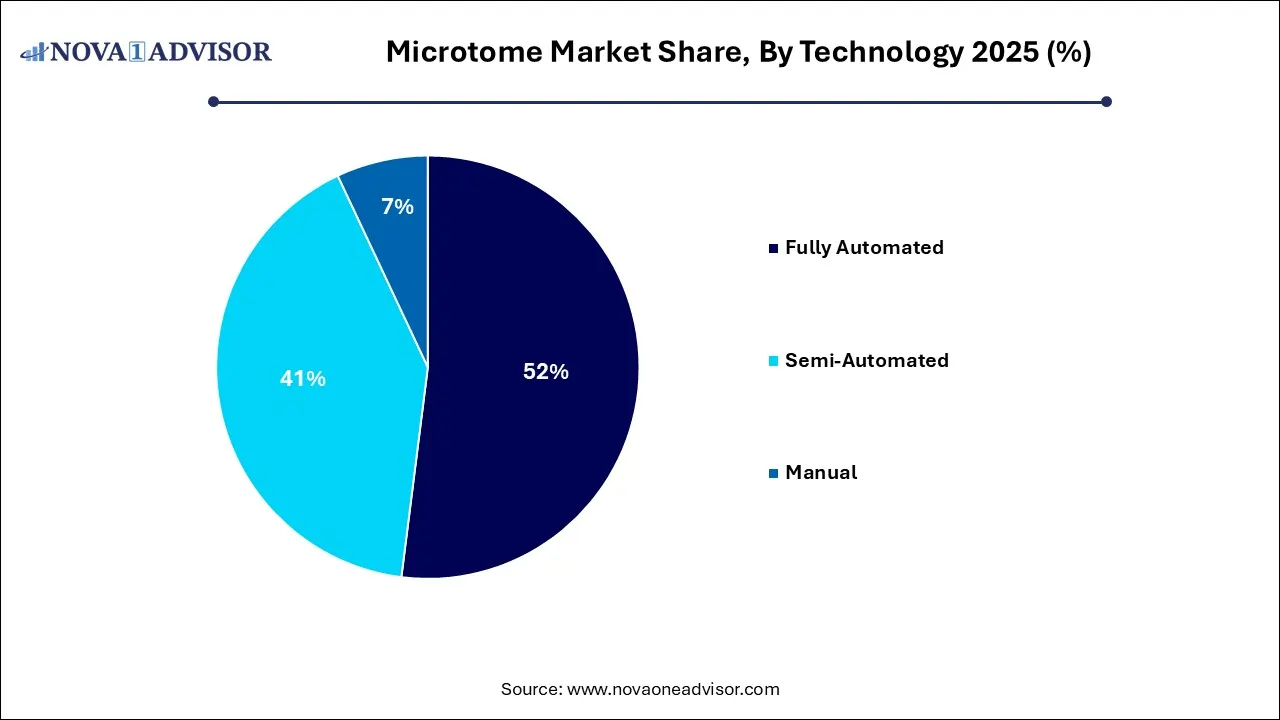
Semi-Automated Technology is the Fastest-Growing Segment
Semi-automated microtomes are projected to witness the fastest growth due to their balance between affordability and automation. These systems provide several advanced features such as motorized specimen feed, programmable section thickness, and electronic controls while retaining certain manual operations. This combination enables laboratories with moderate workloads to improve efficiency without incurring the higher acquisition costs associated with fully automated systems.
Healthcare providers in developing countries are increasingly adopting semi-automated instruments as they modernize laboratory infrastructure while operating under budget constraints. These systems offer improved precision, enhanced operator safety, and greater productivity compared with conventional manual microtomes, making them particularly attractive for regional hospitals, diagnostic laboratories, and academic institutions. Rising government investments in pathology services, increasing biopsy procedures, and gradual laboratory automation across emerging economies are expected to accelerate adoption of semi-automated technologies throughout the forecast period.
By Regional
North America Dominated the Global Microtome Market
North America held the largest share of the global microtome market due to its advanced healthcare infrastructure, widespread adoption of laboratory automation, high healthcare expenditure, and strong presence of leading medical device manufacturers. The United States performs millions of histopathological examinations annually, supported by extensive cancer screening programs, sophisticated hospital networks, academic medical centers, and specialized pathology laboratories. Growing demand for precision diagnostics, personalized medicine, and digital pathology has accelerated investments in advanced automated microtomes capable of delivering standardized tissue sections suitable for AI-assisted analysis.
The region also benefits from continuous research funding, technological innovation, and favorable reimbursement frameworks that encourage modernization of pathology laboratories. Pharmaceutical companies, biotechnology firms, and contract research organizations extensively utilize microtomes during drug discovery, toxicology studies, and biomarker research. Furthermore, increasing adoption of digital pathology by healthcare providers has stimulated demand for premium microtome systems integrated with automated laboratory workflows. Continuous product launches by major manufacturers and strong regulatory standards further support regional market leadership.
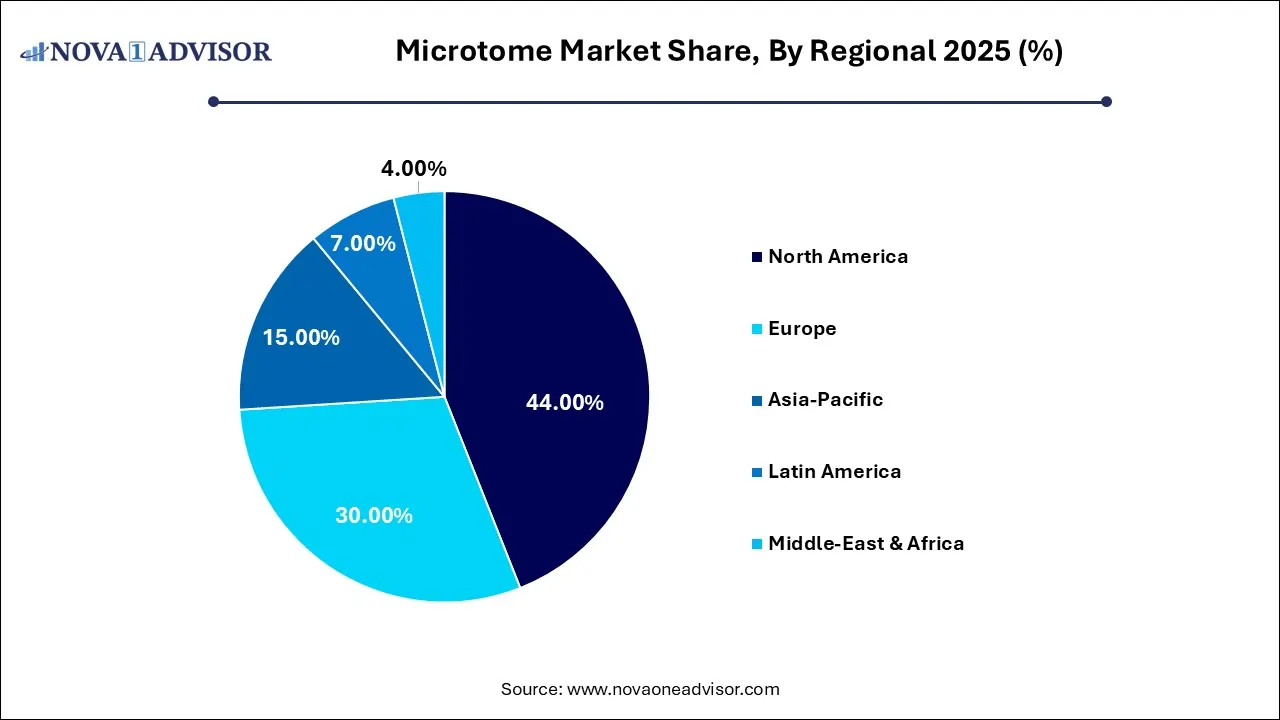
Asia Pacific is the Fastest-Growing Regional Market
Asia Pacific is anticipated to register the highest growth throughout the forecast period owing to rapidly expanding healthcare infrastructure, rising investments in diagnostic laboratories, increasing cancer prevalence, and growing government support for healthcare modernization. Countries including China, India, Japan, South Korea, and Australia are significantly strengthening pathology capabilities by establishing new diagnostic centers, research institutions, and biotechnology facilities. Increasing healthcare awareness and improving access to specialized diagnostic services have substantially increased biopsy volumes across the region.
Rapid expansion of pharmaceutical manufacturing, clinical research activities, and biomedical innovation is also generating strong demand for advanced histology equipment. Governments are investing heavily in cancer screening initiatives, precision medicine programs, and laboratory accreditation to improve healthcare quality. Additionally, international manufacturers are expanding regional distribution networks and introducing cost-effective automated microtomes tailored to emerging markets. Rising adoption of digital pathology, improving medical education, and increasing private healthcare investments are expected to sustain robust market growth across Asia Pacific during the coming years.
Key Players in the Global Microtome Market
- Diapath S.P.A.
- Leica Biosystems Nussloch GmbH
- Sakura Finetek Europe B.V.
- MEDITE GmbH
- SLEE medical GmbH
- Boeckeler Instruments
- Nanolytik
- S.M. Scientific Instruments Pvt. Ltd.
- AGD Biomedicals
- Alltion
- Amos Scientific Pvt. Ltd.
- Thermo Fisher Scientific
Recent Developments
- In March 2026, Leica Biosystems signed a global reseller agreement with Mindpeak. This collaboration connects physical tissue preparation with advanced AI, using digital pathology tools to extract automated clinical insights from the H&E and IHC tissue images sliced by high-precision microtomes.
Segments Covered in the Report
This report forecasts revenue growth at country levels and provides an analysis of the latest industry trends in each of the sub-segments from 2021 to 2035. For this study, Nova one advisor, Inc. has microtome market.
By Product
- Microtome Devices
- Rotary Microtome
- Vibrating Microtome
- Other Microtome
- Accessories
By Technology
- Fully Automated
- Semi-Automated
- Manual
By Regional
- North America
- Europe
- Asia Pacific
- Latin America
- MEA

Proceed to Buy
Instant PDF delivery on confirmation

 Request Customization
 Download Sample

Get a Sample of this Report
Microtome Market