

Revenue Cycle Management Market Size, Share & Trends Analysis Report By Product (Software, Services), By Type (Integrated, Standalone), By Delivery Mode, By End-use, By Region,- Industry Analysis, Share, Growth, Regional Outlook and Forecasts, 2026-2035
 Status Published
 Category Healthcare


Content
Revenue Cycle Management Market Size and Growth
The global revenue cycle management market was valued at USD 383.42 billion in 2025 and is projected to reach USD 1,129.58 billion by 2035, registering a CAGR of 11.41% from 2026 to 2035. The global revenue cycle management market growth is attributed to increasing demand for advanced revenue cycle management solutions.
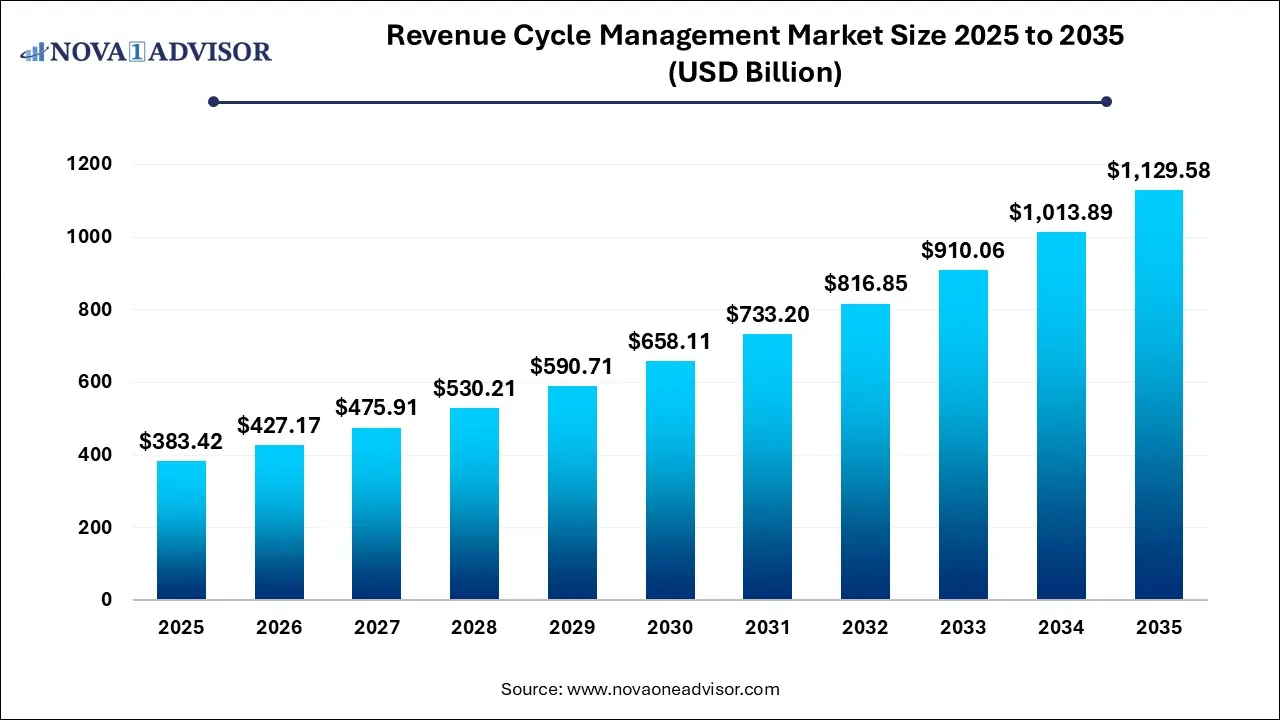
Revenue Cycle Management Market Key Takeaways
- By region, North America dominated the revenue cycle management market in 2025.
- By region, Asia Pacific is expected to grow fastest during the forecast period.
- By product insights, the services segment dominated the market share in 2025.
- By product insights, the software segment is expected to grow fastest during the forecast period.
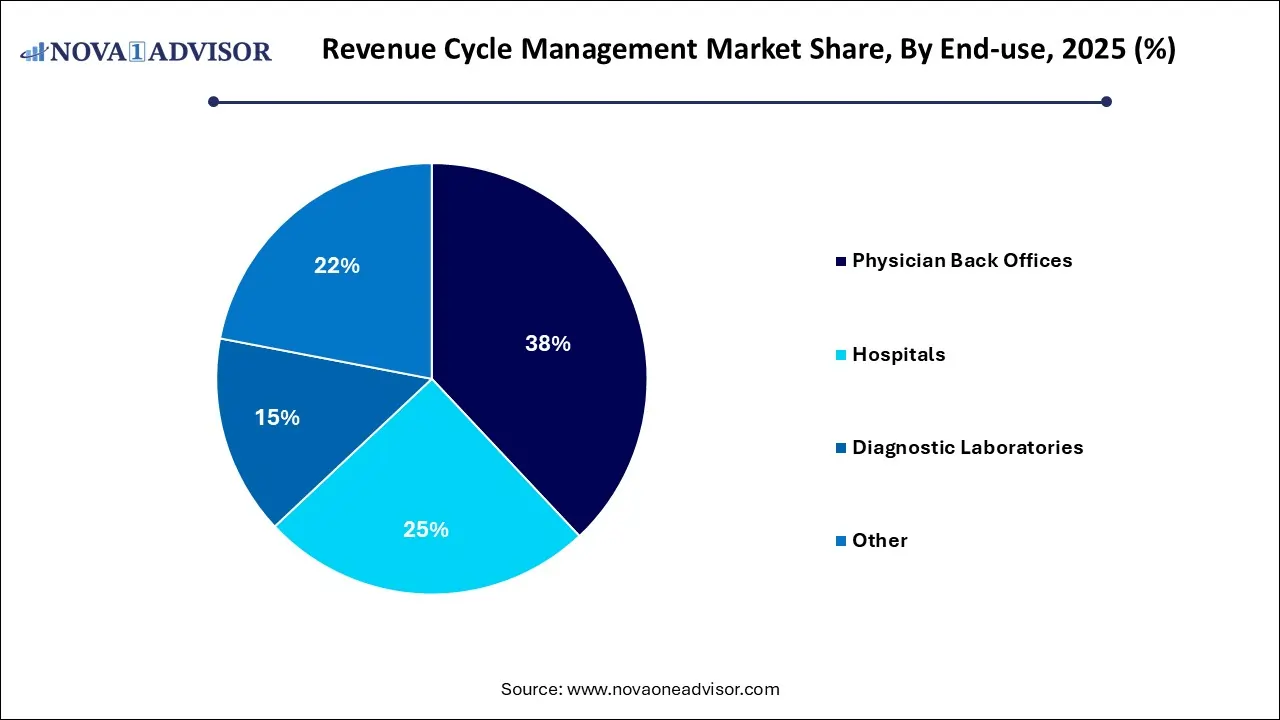
- By end-use insights, the physician back-office segment dominated the revenue cycle management market in 2025.
- By end-use insights, the hospitals segment is expected to grow fastest during the forecast period.
- By delivery mode insights, the web-based segment dominated the market growth in 2025.
- By delivery mode insights, the cloud-deployed segment is expected to grow fastest during the forecast period.
- By type insights, the integrated segment dominated the market share in 2025.
- By type insights, the standalone segment is expected to grow fastest during the forecast period.
Revenue Cycle Management Market Overview
The revenue cycle management market is experiencing transformative growth, propelled by government support for the adoption of revenue cycle management solutions, the need to manage unstructured healthcare data, and the growing patient volume. Revenue cycle management operates at the well-designed core of a healthcare association and plays an important role in the healthcare industry. The increasing trend towards digitalization and the increasing number of unorganized workflows and data silos in healthcare industries are expected to drive market growth during the forecast period.
The revenue cycle management market is further attributed to factors such as the increasing regulatory requirements for data management and growing approaches for patient-centric services. In addition, government initiatives in the adoption of cutting-edge technologies such as cloud-based solutions, medical coding, denial management, electric health records, and claims are leveraging support in the integration of revenue cycle management solutions.
Market Outlook
- Market Growth Overview: The revenue cycle management market is expected to grow significantly between 2026 and 2035, driven by the adoption of value-based care models, growing patient financial responsibility, and adoption of cloud-based and automated systems.
- Sustainability Trends: Sustainability trends involve the predictive analytics, shift to value-based care, and outsourcing and hybrid models.
- Major Investors: Major investors in the market include Ares Capital Corporation, TA Associates, WestView Capital Partners, General Capital Partners, Parthenon Capital, and EQT.
How AI Impaction the Revenue Cycle Management Market
AI and ML are profoundly transforming the revenue cycle management industry by shifting processes from manual, reactive workflows to automated, predictive systems. By leveraging natural language processing and advanced algorithms, AI optimizes medical coding accuracy and accelerates claim submissions, which significantly reduces denial rates and speeds up reimbursement timelines. These technologies also enable predictive analytics to identify potential claim rejections before submission and determine patient propensity-to-pay, allowing for proactive intervention and improved collections. AI-driven automation reduces administrative burdens and operational costs by handling repetitive tasks, such as eligibility verification and payment posting.
Key Trends Contributing to Revenue Cycle Management Market Demand
- Rising technological advancements: The increasing technological advancements such as artificial intelligence (AI), machine learning (ML) and automation enhance the usage of these technologies to expedite the medical billing process and improve efficiency.
- Healthcare expenditure: The burgeoning healthcare expenditure in developing and developed countries is expected to drive the growth of the revenue cycle management market during the forecast period.
- Increasing shift towards EHR: The increasing industry preference towards electronic health records with various organizations seeking to leverage RCM tools that can streamline claims submissions and improve data accuracy.
Report Scope of Revenue Cycle Management Market
| Report Coverage | Details |
| Market Size in 2026 | USD 427.17 Billion |
| Market Size by 2035 | USD 1,129.58 Billion |
| Growth Rate From 2026 to 2035 | CAGR of 11.41% |
| Base Year | 2025 |
| Forecast Period | 2026-2035 |
| Segments Covered | Product, Type, Delivery Mode, End-use, Region |
| Market Analysis (Terms Used) | Value (US$ Million/Billion) or (Volume/Units) |
| Regional scope | North America; Europe; Asia Pacific; Latin America; MEA |
| Key Companies Profiled | The SSI Group, Inc.; Veradigm LLC (AllScripts Healthcare, LLC); Experian Information Solutions, Inc.; R1 RCM Inc.; McKesson Corporation; athenahealth, Inc; Epic Systems Corporation; NXGN Management, LLC; CareCloud Corporation; Quest Diagnostics, Inc. and Oracle (Cerner Corporation) |
Cloud-based RCM Solutions for Scalability and Flexibility
Cloud-based RCM solutions can be utilized anytime and anywhere, making them highly scalable and flexible as they help medical practices address changing demands without making much effort to buy new systems. EHR software provides scalable and secure revenue cycle management services using advanced technology that can easily accommodate growth in patient services and volumes. To oversee and improve the revenue cycle effectively, practice EHR’s cloud-based storage solutions offer the necessary flexibility and scalability. In the healthcare industry, the all-in-one EHR software guarantees growth within preparation and practice for future changes, which may create significant growth opportunities in the revenue cycle management market.
High Cost of RCM May Hamper Market Growth
The high initial cost of implementing and purchasing a revenue cycle management system in medium and small-size healthcare organizations is the major challenge hindering market growth. High costs associated with the maintenance and implementation of a revenue share management system, such as training, software, and hardware further restraining the adoption of solutions, which may expected to hinder the growth of the revenue cycle management market.
Segment Insights
Revenue Cycle Management Market By Product
The services segment dominated the revenue cycle management market in 2025. The segment growth in the market is attributed to the rising advanced technologies to leverage with revenue cycle management facilities, increased adoption of revenue cycle management solutions, and increased demand for expertise in managing complex revenue cycle processes. Whereas the software segment is expected to grow fastest during the forecast period. The software integrates with various revenue cycle management functions such as collections, coding, billing, management, and claims. The increasing adoption of advanced software to streamline revenue cycle processes is expected to drive segment growth.
Revenue Cycle Management Market By Type Insights
The integrated segment dominated the revenue cycle management market in 2025. The segment growth in the market is attributed to the growing collections to planning reimbursement methodologies and alternative payment and increasing preference for volume-based payments over value-based payments. In addition, the standalone segment is expected to grow fastest during the forecast period. The segment growth in the market is driven by the growing need to minimize or eliminate human errors, growing healthcare costs, and increasing healthcare facilities.
Revenue Cycle Management Market By Delivery Mode Insights
The web-based segment dominated the revenue cycle management market in 2025. The increasing adoption of web-based solutions over on-premises solutions and the growing implementation of web-based solutions are expected to drive the segment growth. Furthermore, the cloud-deployed segment is expected to grow fastest during the forecast period. Cloud-based products have been established to strengthen operations, enhance infrastructure dependability, and improve resource procurement, which may drive segment growth.
Revenue Cycle Management Market By End-use Insights
The physician back-office segment held the largest revenue cycle management market in 2025. Private physician offices undergo various economic challenges such as patient content, increasing operating expenses, and physician reimbursement, which are driving the segment growth. Additionally, the hospitals segment is expected to grow fastest during the forecast period. The segment growth in the market is attributed to the growing demand for enhancing productivity and streamlining hospitals’ workflows and the rising number of guidelines and protocols introduced by regulatory bodies concerning patient safety.
Revenue Cycle Management Market By Regional Insights
North America dominated the revenue cycle management market in 2025. The market growth in the region is attributed to the increasing adoption of revenue cycle management in the region, well-developed digitalization and healthcare infrastructure, expanding healthcare expenditure, and a growing number of key vendors. The U.S. and Canada are dominating countries driven by the existence of strict regulatory requirements.
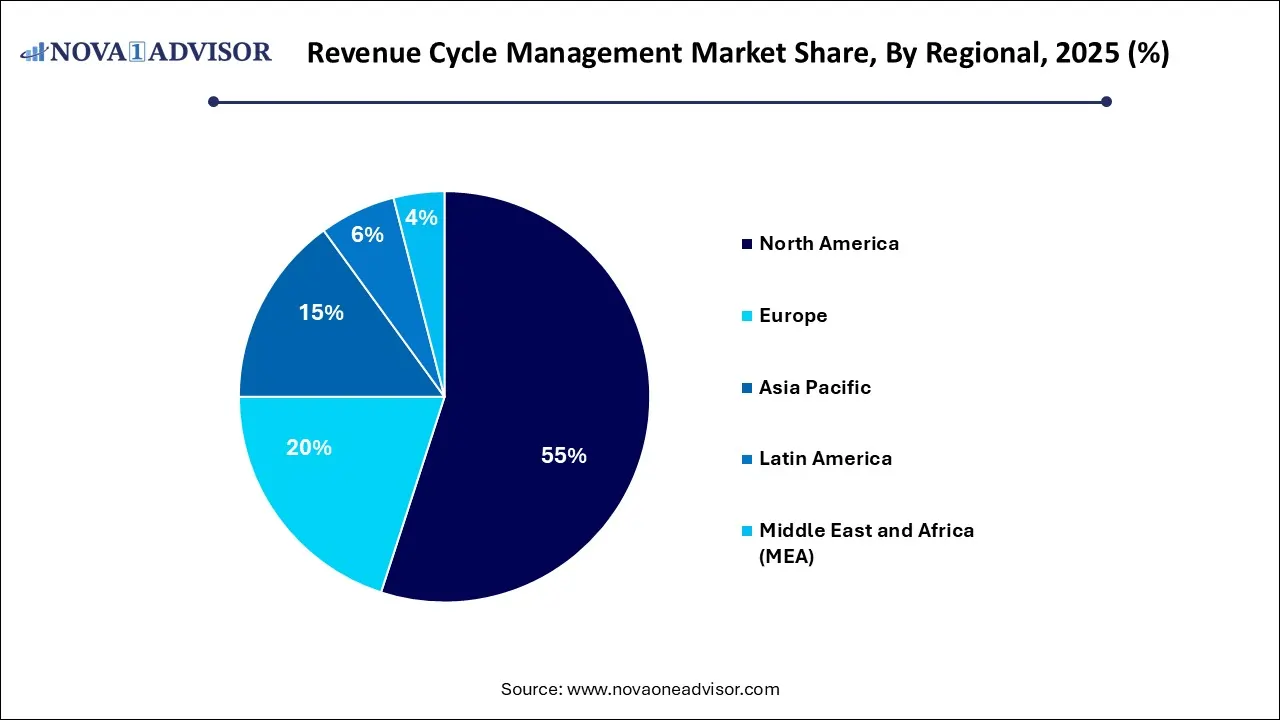
Asia Pacific is expected to grow fastest during the forecast period. The market growth in the region is driven by factors such as government initiatives for promoting the adoption of revenue cycle management solutions, increasing demand for efficient revenue cycle management solutions, growing medical tourism, rising adoption of telemedicine and electronic health records, the adoption of digital health technologies and expanding healthcare infrastructure. China, India, Japan, and South Korea are the fastest growing countries in the region.
U.S. Revenue Cycle Management Market Trends
U.S.’s aggressive adoption of agentic AI and robotic process automation (RPA) to automate complex medical coding and mitigate administrative burdens. This shift is increasingly hosted on cloud-based platforms, which offer the scalability and security necessary to manage the rising surge in claim denials and the transition toward value-based care models. The innovations are moving RCM beyond simple collections toward a strategic, data-driven framework that optimizes financial health while enhancing the overall patient journey.
China Revenue Cycle Management Market Trends
China’s rapid integration of AI and machine learning to automate coding and deliver predictive financial analytics. The increasing billing complexities and chronic staffing shortages, providers are aggressively pivoting toward outsourced RCM services to maintain operational stability. These advancements are being mandated by national healthcare reforms, forcing a transition toward highly efficient, data-driven systems capable of managing rising global patient volumes.
Supply Chain Analysis of the Revenue Cycle Management Market
Clinical Documentation & Coding
This stage involves documenting the care provided and translating medical services into standardized codes for billing. Accurate coding ensures proper reimbursement and reduces denials due to incomplete or incorrect documentation.
- Key Players: Solventum, Optum360, Conifer Health Solutions, GeBBS Healthcare Solutions, and Nym Technologies.
Claims Processing & Submission
This stage encompasses the generation of electronic claims, scrubbing for errors, and submitting them to payers to initiate payment. It is a critical stage for clean claim submission, which significantly speeds up cash flow and reduces administrative intervention.
- Key Players: Waystar Health, Cognizant, SSI Group, and Allscripts Healthcare.
Denial Management & Accounts Receivable (A/R) Follow-Up
This crucial phase involves investigating rejected or denied claims, submitting appeals, and managing patient balances for any remaining charges. Effective denial management identifies root causes to prevent future denials and maximizes revenue integrity.
- Key Players: R1 RCM Inc., Conifer Health Solutions, AGS Health, and Revecore Technologies.
Key Players in the Revenue Cycle Management Market
- The SSI Group, Inc.
SSI provides comprehensive clearinghouse services and AI-driven claims management solutions that help health systems and physician groups optimize clean claim rates.
- Veradigm LLC (AllScripts Healthcare, LLC)
Veradigm offers an end-to-end Revenue Cycle Services (RCS) solution that combines professional coding, billing, and accounts receivable management to optimize financial performance for medical practices. Their AI-enabled platform, Veradigm Payerpath, streamlines interaction with payers to improve clean claim rates and reduce administrative burdens.
- Athenahealth, Inc.
Athenahealth delivers a cloud-based, AI-native RCM platform that automates administrative tasks such as pre-registration, coding, and denial management to enhance efficiency across the entire patient visit.
- Experian Information Solutions, Inc. (Experian Health)
Experian Health provides automated RCM tools focusing on patient access, claim management, and collections to reduce errors at the front end.
- R1 RCM Inc.
R1 offers end-to-end technology-enabled RCM services, outsourcing the entire financial process for hospitals and health systems to improve net revenue and reduce operating costs.
Revenue Cycle Management Market Recent Developments
- In March 2025, a pioneer in high-performance revenue cycle management services, Titan Health announced the launch of its new Revenue Cycle Management as a Service (RCMaaS) offering.
- In January 2025, IntelligentDX Launches Smart AI-Powered Software. The aim behind this launch was to transform U.S. healthcare and RCM with Intelligent EHR/EMR.
- In May 2024, Panda Health launched revenue cycle automation. The aim behind this launch was to manage financial transactions and interactions, from the initial appointment scheduling to the final payment collection.
Segments Covered in the Report
This report forecasts revenue growth at country levels and provides an analysis of the latest industry trends in each of the sub-segments from 2021 to 2035. For this study, Nova one advisor, Inc. has segmented the Revenue Cycle Management Market
By Product
- Software
- Services
By Type
- Integrated
- Standalone
By Delivery Mode
- Web-based
- Cloud-based
- On-premise
By End-use
- Physician Back Offices
- Hospitals
- Diagnostic Laboratories
- Other
By Regional
- North America
- Europe
- Asia Pacific
- Latin America
- Middle East and Africa (MEA)
FAQ's

Proceed to Buy
Instant PDF delivery on confirmation

Revenue Cycle Management Market Size to Reach USD 1,129.58 Billion by 2035
 Request Customization
 Download Sample

Get a Sample of this Report
Revenue Cycle Management Market