

Synthetic Absorbable Sutures Market Size, Share, Forecast Report, 2026-2035
 Status Published
 Category Healthcare


Content
Synthetic Absorbable Sutures Market Size Trends Analysis and Forecast till 2035
The global Synthetic Absorbable Sutures market garnered revenue around USD 3.15 billion in 2025 and projected to reach USD 7.54 billion in 2035, with at a compound annual growth rate (CAGR) 9.12% throughout the estimate period from 2026 to 2035.
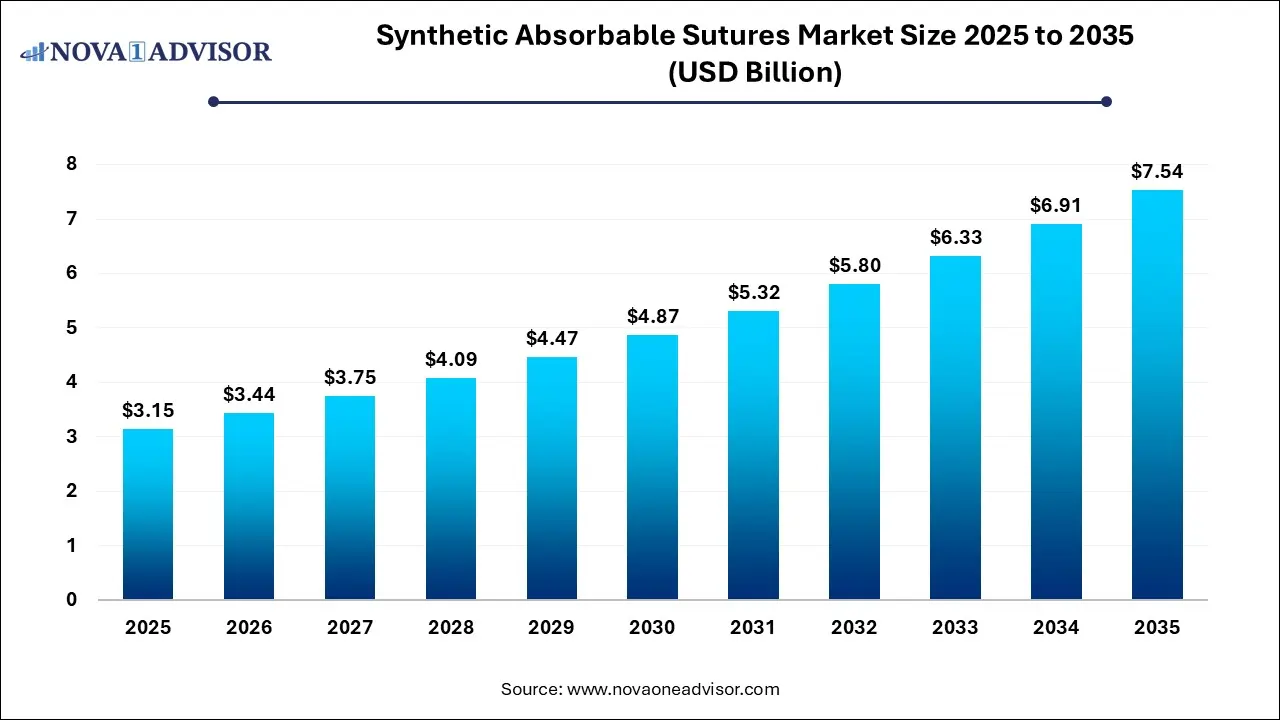
Market Key Takeaways
- Market Size and Growth: The synthetic absorbable sutures market is experiencing steady growth driven by advancements in medical technology, increasing surgical procedures, and the rise in the number of wound care needs globally.
- Key Drivers: An increasing number of surgeries, especially in the areas of cardiovascular, gynecology, and orthopedic fields, is driving the demand for synthetic absorbable sutures.
- Key Restraints: High costs of advanced sutures and the rising preference for non-absorbable sutures in specific applications could limit market growth.
- Opportunities: The rise of minimally invasive surgeries, which require advanced sutures, is opening up new opportunities for the growth of the synthetic absorbable sutures market.
- Regional Insights: North America and Europe dominate the market due to higher healthcare expenditures, while the Asia Pacific region is anticipated to experience the fastest growth due to expanding healthcare infrastructure and increased healthcare awareness.
Market Overview
Synthetic absorbable sutures are widely used in surgical procedures due to their ability to maintain wound closure without the need for removal. These sutures are made from synthetic polymers such as polyglactin, polyglycolic acid, and polydioxanone. They are gradually absorbed by the body over a period of time, which eliminates the need for a follow-up procedure to remove the sutures. These sutures are critical in various medical disciplines, including general surgery, ophthalmology, gynecology, orthopedic surgery, and more.
The synthetic absorbable sutures market has evolved with medical technology, with improvements in the materials used and their effectiveness in wound closure. The increasing incidence of surgical procedures, particularly in developed regions, coupled with growing healthcare access in emerging economies, has contributed significantly to the market’s expansion.
In addition to being cost-effective, synthetic absorbable sutures reduce the risk of infection, as their absorption reduces the likelihood of foreign body reactions compared to non-absorbable sutures. This market is witnessing advancements driven by the need for better performance, stronger knots, and reduced tissue reactions, thus enhancing the post-operative recovery process.
Major Trends in the Market
The synthetic absorbable sutures market is being shaped by several key trends:
- Technological Advancements: Continuous improvements in the polymer compositions used in synthetic absorbable sutures are increasing their strength, flexibility, and biocompatibility.
- Minimally Invasive Surgery: The growing preference for minimally invasive procedures, which require advanced sutures for wound closure, is boosting demand.
- Growth in Ambulatory Surgical Centers (ASCs): The rise of ASCs as alternatives to traditional hospital settings is contributing to the increased use of synthetic absorbable sutures, particularly in outpatient procedures.
- Aging Population: With an aging population globally, there is an increase in age-related surgical procedures, especially in cardiovascular and orthopedic surgeries, driving the demand for absorbable sutures.
- Increasing Acceptance of Advanced Materials: Surgeons are increasingly adopting sutures made from newer and more advanced materials that offer enhanced performance and faster recovery times.
- Focus on Biocompatibility and Safety: There is an ongoing focus on ensuring that synthetic absorbable sutures are biocompatible, minimizing adverse reactions and promoting faster healing.
Synthetic Absorbable Sutures Market Report Scope
| Report Coverage | Details |
| Market Size in 2026 | USD 3.44 Billion |
| Market Size by 2035 | USD 7.54 Billion |
| Growth Rate From 2026 to 2035 | CAGR of 9.12% |
| Base Year | 2025 |
| Forecast Period | 2026 to 2035 |
| Segments Covered | By Product Type, By Material, By Application, By End User, By Regional |
| Market Analysis (Terms Used) | Value (USD Million/Billion) or (Volume/Units) |
| Regional Scope | North America; Europe; Asia Pacific; Central and South America; the Middle East and Africa |
| Key Companies Profiled | Braun Melsungen AG,, Medtronic plc, Teleflex Incorporated, Johnson & Johnson, Smith & Nephew plc, Acelity L.P. Inc., Boston Scientific Corporation, Zimmer Biomet Holdings, Inc., ConMed Corporation, Integra LifeSciences Corporation |
Driver: Growth in Surgical Procedures
One of the key drivers propelling the growth of the synthetic absorbable sutures market is the increasing number of surgical procedures globally. The demand for surgeries, particularly in fields such as orthopedics, cardiovascular, and gynecology, has been growing due to an aging population and a rise in chronic diseases such as cardiovascular ailments, diabetes, and musculoskeletal disorders. According to the World Health Organization (WHO), the global burden of chronic diseases continues to rise, contributing to the demand for surgical interventions, thus driving the need for absorbable sutures.
Moreover, the global increase in cosmetic and reconstructive surgeries has created a greater demand for specialized sutures. With synthetic absorbable sutures offering various advantages like eliminating the need for removal and promoting better healing, their usage in both elective and emergency surgeries is expanding. This growing volume of surgeries creates a robust demand for advanced suturing solutions like synthetic absorbable sutures, thereby supporting market growth.
Restraint: High Costs of Advanced Sutures
While synthetic absorbable sutures offer numerous advantages, one of the key restraints is the high cost associated with advanced sutures, especially those made from premium materials. Compared to traditional non-absorbable sutures, synthetic absorbable sutures are generally more expensive. For hospitals and clinics, this added cost can be significant, particularly in cost-sensitive regions. The preference for more affordable options, especially in developing economies, has limited the adoption of high-end synthetic absorbable sutures.
Additionally, the longer shelf life of non-absorbable sutures, coupled with their relatively lower cost, can make them more appealing in certain surgeries where absorbable sutures are not strictly necessary. This cost disparity creates a barrier for wider adoption, particularly in price-sensitive markets, which could restrain market growth.
Opportunity: Rise of Minimally Invasive Surgeries
One of the most significant opportunities for the synthetic absorbable sutures market lies in the growing trend of minimally invasive surgeries (MIS). MIS techniques, including laparoscopy and arthroscopy, are gaining popularity as they offer reduced recovery times, less pain, and smaller incisions. The demand for sutures that support wound closure in these minimally invasive procedures is increasing.
Minimally invasive procedures require highly specialized sutures that can support the healing process while being absorbed by the body. Synthetic absorbable sutures meet these needs, providing secure closure without requiring a second procedure to remove the sutures. With the global shift toward less invasive treatment options, the demand for synthetic absorbable sutures is poised to grow.
Segmental Insights
By Product Type
How did the polyglactin sutures segment dominate the Global Synthetic Absorbable Sutures market?
The polyglactin sutures segment is driven by a superior performance profile, combining high tensile strength with a predictable absorption rate. Its exceptional versatility and clinical trust have established it as the standard of care across general, orthopaedic, and gynaecological surgeries. Its balanced reliability and safety ensure it remains the dominant choice for practitioners over specialized alternatives.
How did the polydioxanone (PDO) sutures segment expect to hold the fastest-growing Global Synthetic Absorbable Sutures market in the coming years?
The polydioxanone (PDO) sutures segment is driven by the rapid adoption of innovations, such as barbed technology and antimicrobial coatings that enhance surgical efficiency and patient safety. The surge in minimally invasive surgeries and aesthetic medicine continues to drive high demand for PDO’s reliable, monofilament performance. Its superior long-term tensile strength, which is essential for complex orthopedic and cardiovascular procedures in an aging population.
By Material
How did the braided sutures segment account for the largest share in the Global Synthetic Absorbable Sutures market?
The braided sutures segment is driven by offering superior handling flexibility and exceptional knot security compared to monofilament alternatives. Its high tensile strength and advanced coatings reduce tissue drag and infection risks, making it the primary choice for high-tension closures in general and cardiovascular surgeries.
How did the monofilament sutures segment expect to hold the fastest-growing Global Synthetic Absorbable Sutures market in the coming years?
The monofilament sutures segment is driven by its smooth, single-strand structure that minimizes tissue trauma and inflammation in delicate procedures. Their unique design reduces infection risk by eliminating capillary spaces where bacteria can harbour, a critical advantage for modern surgical safety. As minimally invasive surgery becomes the standard, the superior handling and innovative coatings of monofilaments, such as polydioxanone, ensure they meet the demands of high-precision clinical environments.
By Application
The cardiovascular sutures segment dominates the application segment, driven by the rising number of heart-related surgeries globally. Cardiovascular diseases continue to be a leading cause of mortality, particularly in developed regions, contributing to the strong demand for effective sutures.
At the same time, cosmetic surgery sutures are expected to be the fastest-growing segment, fueled by the increasing popularity of elective surgeries like facelifts, liposuction, and breast augmentation. The desire for enhanced aesthetics, particularly in developed markets, is pushing this growth, with patients seeking advanced, absorbable sutures for minimal scarring.
By End User
How did the hospitals segment account for the largest share in the Global Synthetic Absorbable Sutures market?
The hospitals segment is driven by the rising global volume of joint replacements, spinal surgeries, and critical heart procedures. The transition toward advanced synthetic polymers offers the superior tensile strength and predictable absorption required for internal tissue closure. The shift toward robotic-assisted and minimally invasive surgeries has made high-performance, bioabsorbable materials indispensable for modern recovery protocols.
How did the ambulatory surgical centers segment expect to hold the fastest-growing Global Synthetic Absorbable Sutures market in the coming years?
The ambulatory surgical centers segment is driven by the preference for high-performance synthetic materials like polyglactin 910 and polydioxanone, which offer the predictable absorption and superior tensile strength essential for same-day recovery. The expansion of Medicare-certified facilities and the adoption of minimally invasive techniques solidify ASCs as a primary engine for synthetic suture demand.
Supply Chain Analysis of the Global Synthetic Absorbable Sutures Market
Raw Material Procurement and Polymer Synthesis
This stage involves the production of synthetic polymers such as Polyglactin 910, Poliglecaprone 25, Polydioxanone (PDO), and Polyglycolic acid (PGA) through chemical synthesis, often utilizing ring-opening polymerization of dimers.
- Key Players: Evonik Industries, BASF SE, Corbion Purac, and Mitsui Chemicals.
Suture Manufacturing and Processing
Manufacturers take the raw polymers and convert them into suture threads through extrusion, drawing, stretching, and either braiding (multifilament) or monofilament formation.
- Key Players: Johnson & Johnson, Medtronic, B. Braun Melsungen AG, DemeTECH Corporation, Meril Life Sciences, and Teleflex Incorporated.
Distribution and Logistics
This stage involves the distribution of the finished sterile sutures to end-users, managed through direct sales forces, distributors, and logistics partners.
- Key Players: Medline Industries, Cardinal Health, Henry Schein, and Ethicon.
Key Players in the Global Synthetic Absorbable Sutures Market
- B. Braun Melsungen AG: B. Braun provides a high-quality portfolio of synthetic absorbable sutures such as Monosyn and Safil, focusing on biocompatibility, safety, and specialized wound care needs.
- Medtronic plc: Medtronic leverages its expertise in medical technology to provide advanced, high-performance absorbable sutures, such as the V-Lok and Caprosyn lines, designed for minimally invasive and robotic-assisted surgeries. The company strengthens its market position by integrating advanced suturing technology to improve patient healing outcomes and reduce operative times.
- Teleflex Incorporated: Teleflex contributes to the market by focusing on specialized, high-performance sutures, specifically with its Force Fiber® technology designed to provide superior strength for demanding surgical procedures.
- Johnson & Johnson (Ethicon): As a global leader in surgical solutions, Ethicon (a J&J company) dominates the market with an extensive portfolio, including Vicryl and PDS II, that emphasizes innovation, such as antibacterial coatings to reduce surgical site infections.
- Smith & Nephew plc: Smith & Nephew contributes to the market through specialized, absorbable sutures tailored for arthroscopic and orthopedic procedures, improving tissue management in sports medicine.
- Acelity L.P. Inc. (now part of 3M): Acelity (3M) contributes to the market by combining innovative wound healing technologies with specialized suture offerings to manage complex wounds.
Recent Developments
- May 2025: Ethicon, a subsidiary of Johnson & Johnson, launched a new line of polyglycolic acid-based sutures designed for faster absorption without compromising strength. This innovative product aims to meet the rising demand for suture options in both general and cosmetic surgeries.
- March 2025: Medtronic announced its partnership with a leading research institute to develop biodegradable sutures that offer enhanced flexibility and reduced infection rates, further strengthening its position in the absorbable sutures market.
Synthetic Absorbable Sutures Market Segmentation
By Product Type
- Polyglactin Sutures
- Polyglycolic Acid Sutures
- Poliglecaprone Sutures
- Poliglecaprone 25
- Polydioxanone Sutures
- Porcine
By Material
- Monofilament Sutures
- Braided Sutures
By Application
- Valve Sutures
- Cardiovascular Sutures
- Gynecology Sutures
- Orthopedic Sutures
- Dental Sutures
- Cosmetic Surgery Sutures
- Ophthalmic Sutures
- General Sutures
By End User
- Hospitals
- Specialty Clinics
- Ambulatory Surgical Centers
- Others
By Regional
- North America
- United States
- Canada
- Europe
- Germany
- United Kingdom
- Italy
- France
- Rest of EU
- Asia Pacific
- China
- India
- Japan
- Southeast Asia
- Rest of APAC
- Central & South America
- Brazil
- Argentina
- Rest of Central & South America
- Middle East and Africa
- UAE
- Saudi Arabia
- Rest of MEA

Proceed to Buy
Instant PDF delivery on confirmation

Synthetic Absorbable Sutures Market Size to Hit USD 7.54 Billion by 2035
 Request Customization
 Download Sample

Get a Sample of this Report
Synthetic Absorbable Sutures Market