

Hazmat Suits Market Size, Share, and Trends 2026 to 2035
 Status Published
 Category Healthcare


Content
Hazmat Suits Market Size and Growth 2026 to 2035
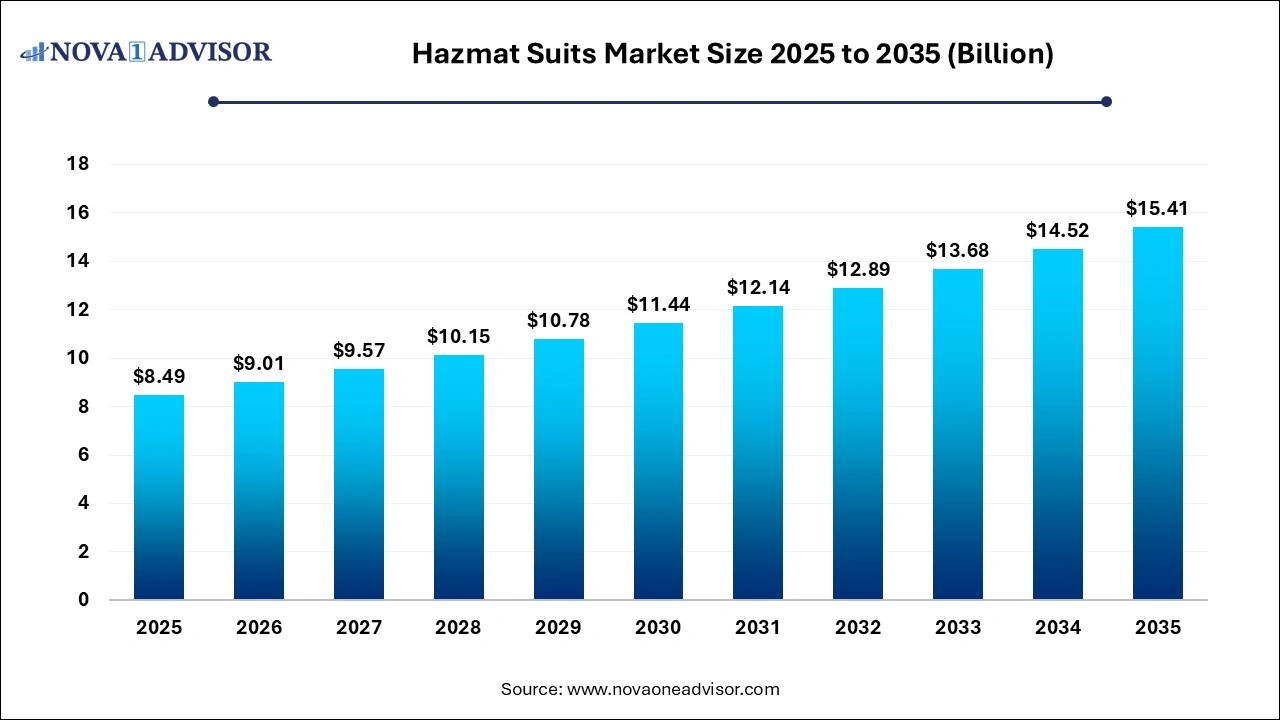
The global hazmat suits market size was valued at USD 8.49 billion in 2025 and is projected to grow from USD 9.01 billion in 2026 to USD 15.41 billion by 2035, at a CAGR of 6.14% from 2026 to 2035.
Key Takeaway
- By application, the infection control & biohazard segment dominated the market with the largest share in 2025.
- By application, the chemical waste segment is expected to grow at the fastest CAGR over the forecast period.
- By end use, the oil & gas segment dominated the market with the largest share in 2025.
- By safety standards, the level A segment dominated the market with the largest share in 2025.
- By region, North America dominated the market with the largest share in 2025.
Market Overview
The Hazmat Suits Market comprises protective garments designed to protect workers and emergency responders from chemicals, biological agents, toxic particles, contaminated materials, liquids, vapors, and other hazardous substances. Product categories range from disposable protective coveralls and biohazard garments to reusable systems and fully encapsulating suits for high-risk environments.
Product requirements vary significantly according to the type and concentration of the hazard, exposure route, duration of exposure, respiratory protection needs, mobility requirements, and decontamination procedures. Consequently, material performance, chemical permeation resistance, seam construction, certification, and compatibility with other PPE are important factors influencing purchasing decisions.
Demand spans chemical manufacturing, oil and gas, pharmaceuticals, healthcare, mining, utilities, waste management, industrial cleaning, transportation, laboratories, and emergency response. Healthcare and pharmaceutical applications remain important for infectious-disease protection, hazardous-drug handling, laboratory work, and contamination control, while industrial sectors require protection against chemicals, solvents, pesticides, hydrocarbons, and toxic substances.
The market is also increasingly focused on wearer comfort and ergonomics. Traditional hazmat garments can restrict movement and contribute to heat stress, encouraging manufacturers to develop lighter, more flexible, breathable, and ergonomically designed protective systems without compromising required protection levels.
Another emerging trend is the integration of hazmat suits with broader PPE technologies, including powered air-purifying respirators and specialized respiratory systems. Digital product-selection platforms and detailed chemical-permeation data are also helping users select protection according to specific hazard scenarios.
Overall, the market is evolving toward high-performance materials, specialized protection levels, improved wearer comfort, integrated PPE systems, digital selection tools, and stronger emergency-preparedness supply chains.
Market Outlook
- Market Growth Overview: The global HAZMAT suits market is expected to grow significantly between 2025 and 2035, driven by the growing safety regulations standards across the globe.
- Sustainability Trends: Sustainability trends involve reducing environmental footprints via sustainable materials and the use of durable and reusable designs.
- Major Investors: Major investors in the market include DuPont, 3M, Honeywell International Inc., Lakeland Industries, and Ansell Limited.
How is AI Impacting The Global HAZMAT Suits Market?
Artificial intelligence (AI) is reshaping the market by transitioning emphasis from passive personal protection to active threat prevention and using computer vision that ensures convenient suit compliance. Furthermore, smart garments and integrated sensors embedded within safety equipment continuously track worker physiological parameters, internal body temperature, and fatigue indicators.
Major Trends in the Market
- Growth of lightweight protective materials: Manufacturers are reducing garment weight while maintaining required chemical and biological protection.
- Increasing focus on wearer comfort: Breathability, mobility, ventilation, ergonomic fit, and heat-stress management are becoming important purchasing criteria.
- Expansion of multi-hazard protection: Customers increasingly prefer garments capable of addressing combinations of chemical, biological, particulate, and thermal hazards.
- Greater adoption of Level C protection: Level C provides a practical combination of chemical-resistant clothing and air-purifying respiratory protection for many known-hazard environments.
- Premium demand for Level A systems: Emergency responders and specialized industrial teams require fully encapsulating protection for severe vapor and unknown-hazard situations.
Hazmat Suits Market Report Scope
| Report Coverage | Details |
| Market Size in 2026 | USD 9.01 Billion |
| Market Size by 2035 | USD 15.41 Billion |
| Growth Rate From 2026 to 2035 | CAGR of 6.14% |
| Base Year | 2025 |
| Forecast Period | 2026 to 2035 |
| Segments Covered | By Application, By End Use, By Safety Standards, By Region |
| Market Analysis (Terms Used) | Value (USD Million/Billion) or (Volume/Units) |
| Regional Scope | North America; Europe; Asia Pacific; Central and South America; the Middle East and Africa |
| Key Companies Profiled | DuPont (US), 3M (US), Honeywell (US), Lakeland Industries (US), MSA Safety (US), Ansell (AU), Sioen Industries (BE), R.S. Hughes (US), Kimberly-Clark (US) |
Market Driver
Stricter occupational-safety requirements and increasing exposure to hazardous materials are driving the Hazmat Suits Market. Chemical manufacturing, oil and gas, pharmaceuticals, healthcare, mining, waste management, utilities, and emergency response operations face growing requirements to protect workers from chemical, biological, toxic, and contaminated environments. Stronger safety cultures, regulatory compliance, hazard assessments, and emergency preparedness are encouraging organizations to invest in certified protective garments.
Market Restraint
High costs and the physiological burden of advanced protective garments remain key restraints. High-performance suits require specialized barrier materials, seam technologies, closures, visors, and compatibility with respiratory protection, increasing acquisition and maintenance costs. Reusable systems also require cleaning, decontamination, inspection, and storage, while disposable garments create recurring costs and waste. Heat retention and restricted movement can further limit wearer comfort and working duration.
Market Opportunity
Smart, lightweight, and multi-hazard protective systems offer significant growth opportunities. Manufacturers can develop advanced materials that reduce weight while maintaining chemical and biological protection, improving mobility and thermal comfort. Multi-hazard garments can address combinations of chemical, vapor, splash, and contamination risks. Integration of environmental sensors, physiological monitoring, location tracking, and communication technologies could further transform hazmat suits into connected protective platforms, particularly across rapidly industrializing Asia-Pacific markets.
Segmental Insights
By Application
Why did the infection control & biohazard segment dominate the global HAZMAT suits market?
The infection control & biohazard segment dominated the market with the largest share in 2025. The dominance of the segment can be attributed to the surge in health crises globally and the surge in biomedical waste in healthcare along with stringent hospital safety guidelines. In addition, government regulations mandate the strict enforcement of personal protective equipment (PPE) protocols within clinical and research laboratory settings.
How did the chemical waste segment expected to hold the significantly growing global HAZMAT suits market in the coming years?
The chemical waste segment is expected to grow at the fastest CAGR over the forecast period. The growth of the segment can be credited to the growing chemical waste volumes from pharmaceuticals and manufacturing along with advancements in lightweight fabrics. Also, advanced, lightweight, and breathable fabrics enhance operational mobility while maintaining critical chemical resistance standards.
By End Use
Why did the oil & gas segment dominate the global HAZMAT suits market?
The oil & gas segment dominated the market with the largest share in 2025. The dominance of the segment can be linked to the growing exploration in harsh environments and growing risk of toxic gas and chemical exposure during extraction. Modern manufacturing techniques now use lightweight, ergonomically designed, and flame-retardant multi-layer materials that effectively reduce personnel fatigue during extended operational shifts.
How did the healthcare segment expected to hold the significantly growing global HAZMAT suits market in the coming years?
The healthcare segment is expected to grow at the fastest CAGR over the forecast period. The growth of the segment can be driven by a surge in the prevalence of infectious diseases and growing biosafety laboratory infrastructure. Healthcare institutions and emergency response facilities regularly procure hazardous materials (hazmat) suits in major volumes to protect frontline personnel managing severe epidemics involving unvaccinated populations.
By Safety Standards
Why did the level A segment dominate the global HAZMAT suits market?
The level A segment dominated the market with the largest share in 2025. The dominance of the segment is owing to the growing industrial accidents in oil and gas sectors along with the surge in threats from harmful biological and chemical materials. Furthermore, the expansion of the chemical processing, petrochemical manufacturing, and oil and gas extraction sectors elevates the risk of occupational exposure to lethal vapours.
How did the level B segment expected to hold the significantly growing global HAZMAT suits market in the coming years?
The level B segment is expected to grow at the fastest CAGR over the forecast period. The growth of the segment is due to growing demand for emergency response, chemical handling, and industrial safety compliance applications. Moreover, the expansion of cross-border commerce, combined with the increased management of hazardous industrial chemicals, requires the dependable deployment of mid-tier personal protective equipment (PPE).
By Region
Why did the North American region account for the largest share of the global HAZMAT suits market?
North America dominated the market with the largest share in 2025. The dominance of the region can be attributed to the growing industrial activities, surged awareness of workplace safety, and stringent safety regulations. In addition, market growth is further boosted by sustained public and private investment in domestic biosecurity, chemical threat management, and first-responder emergency readiness.
U.S. Global HAZMAT Suits Market Trends
The growth of the market in the country can be driven by the extensive investments in healthcare biohazard preparedness and growing adoption of breathable and lightweight materials. Also, continuous provisions of chemical-resistant protective suits are essential to support ongoing operations within United States chemical processing facilities, petroleum refineries, and heavy manufacturing sectors.
Why did the Asia-Pacific region become the fastest-growing global HAZMAT suits market during the forecast period?
Asia Pacific is expected to grow at the fastest CAGR over the forecast period. The growth of the region can be credited to the ongoing urbanization, strict workplace safety regulations, and a growing emphasis on biohazard control across developing economies such as China and India. Furthermore, advancements in textile engineering, specifically the development of lightweight, permeable, and high-tensile fabrics, enhance comfort during prolonged use.
China Global HAZMAT Suits Market Trends
The market in the country is growing due to the ongoing growth of healthcare and biotechnology operations and strict government regulation for workplace safety. Moreover, continuous investments in pharmaceutical research, clinical diagnostics, and disease control infrastructure maintain a high baseline of consumption.
Key Players in The Global HAZMAT Suits Market
- DuPont: It offers high-performance chemical protective suits like Tychem and Tyvek, setting industry standards for hazardous material response.
- 3M Company: Supplies disposable and reusable respiratory protection alongside specialized protective garments for industrial and medical applications.
- Ansell Limited: Focuses on barrier protection, offering chemically resistant gloves, sleeves, and specialized single-use or multi-use suits.
Recent Developments
- In February 2026, the University of Central Florida (UCF) officially initiated the public phase of "Go For Launch: The Campaign for UCF’s Next Mission." This comprehensive $3.5 billion fundraising initiative is strategically structured to foster academic innovation, broaden student accessibility, and establish the university as a prominent leader of regional and national progress.
Segments Covered in the Report
This report forecasts revenue growth at country levels and provides an analysis of the latest industry trends in each of the sub-segments from 2021 to 2035. For this study, Nova one advisor, Inc. has hazmat suits market.
By Application
- Infection Control & Biohazard
- Chemical Waste
- Haz-Mat
- Others
By End Use
- Oil & Gas
- Healthcare
- Manufacturing
- Mining & Metallurgy
- Construction
- Utilities
- Transportation
- Others
By Safety Standards
- Level A
- Level B
- Level C
- Others
By Region
- North America
- Europe
- Asia-Pacific
- Latin America
- Middle East & Africa (MEA)
FAQ's

Proceed to Buy
Instant PDF delivery on confirmation

 Request Customization
 Download Sample

Get a Sample of this Report
Hazmat Suits Market