

Healthcare Nanotechnology Market Size, Share, Growth, Report 2026 to 2035
 Status Published
 Category Healthcare


Content
Healthcare Nanotechnology Market Size and Growth 2026 to 2035
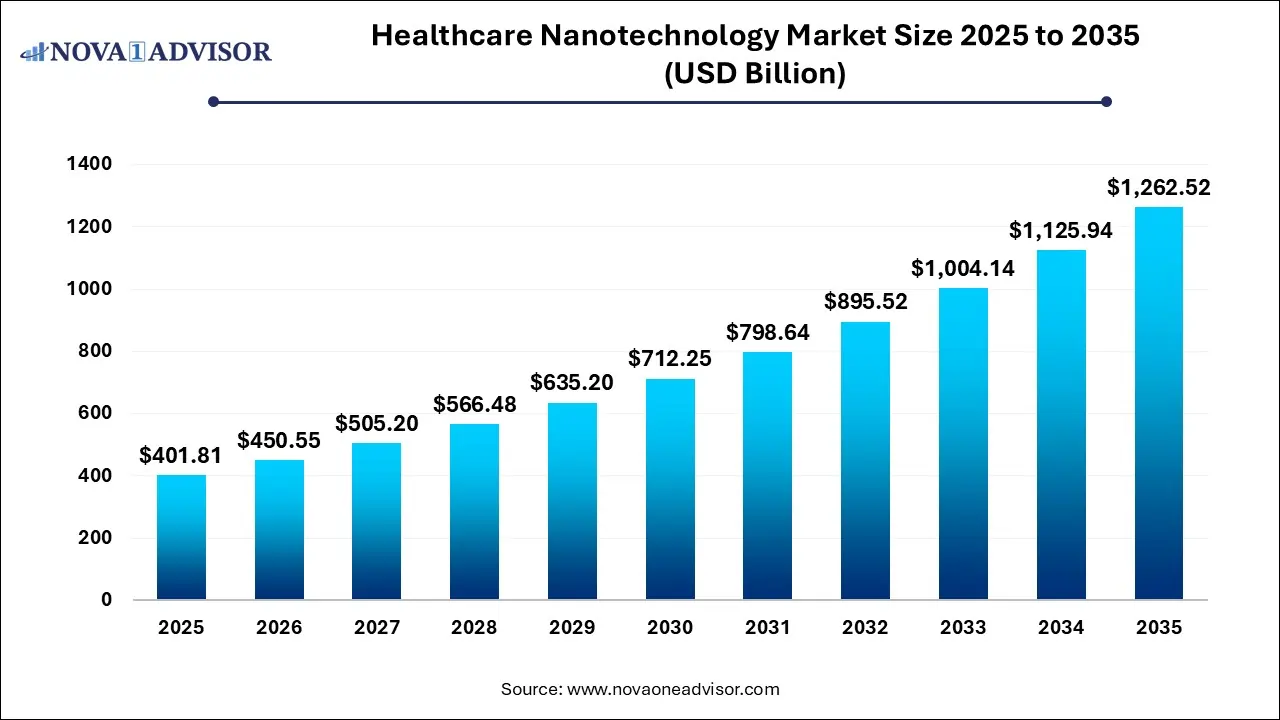
The healthcare nanotechnology market size was estimated at USD 401.81 billion in 2025 and is expected to hit around USD 1,262.52 billion by 2035, poised to reach at a notable CAGR of 12.13% during the forecast period 2026 to 2035.
Market Overview
The healthcare nanotechnology market represents one of the most transformative frontiers in modern medicine, driven by the convergence of materials science, molecular biology, engineering, and clinical research. Nanotechnology in healthcare involves the manipulation and application of materials at the nanoscale—typically below 100 nanometers—to diagnose, monitor, prevent, and treat diseases. At this scale, materials exhibit unique physical, chemical, and biological properties that differ significantly from their bulk counterparts, enabling unprecedented precision in medical interventions.
From a market research perspective, healthcare nanotechnology has evolved from a primarily research-driven domain into a commercially viable and strategically critical segment of the global healthcare industry. Early-stage applications were largely confined to academic laboratories and proof-of-concept studies. Over the last decade, however, the market has matured substantially, supported by rising clinical validation, regulatory approvals, and increasing adoption by pharmaceutical, biotechnology, and medical device companies. Nanoparticles, nanocarriers, nanoshells, nanofibers, and nanocoatings are now being integrated into mainstream healthcare products, ranging from advanced drug delivery systems to implantable medical devices.
One of the defining characteristics of this market is its cross-sectoral impact. Healthcare nanotechnology does not function as a standalone industry but rather acts as an enabling platform across pharmaceuticals, diagnostics, medical devices, and regenerative medicine. For instance, nanotechnology-based drug delivery systems enhance the therapeutic index of existing drugs, extending product life cycles and improving patient outcomes. Similarly, in diagnostics, nanomaterials enable earlier disease detection through higher sensitivity imaging agents and biosensors.
The market is also shaped by macro-level healthcare challenges, including the rising burden of chronic diseases, aging populations, antimicrobial resistance, and the demand for personalized medicine. Nanotechnology offers solutions aligned with these needs by enabling targeted therapies, minimally invasive diagnostics, and regenerative approaches that reduce long-term healthcare costs. As a result, healthcare nanotechnology is increasingly viewed not only as an innovation driver but also as a cost-containment and outcome-optimization tool within healthcare systems.
Despite its strong growth potential, the market remains complex and heterogeneous. Adoption rates vary significantly across applications, disease areas, and regions, influenced by regulatory frameworks, reimbursement policies, infrastructure readiness, and public perception of nanomaterials. From a strategic standpoint, companies operating in this market must balance high R&D intensity with long commercialization timelines, while navigating evolving safety and regulatory standards. Overall, the healthcare nanotechnology market stands at a critical inflection point, transitioning from early adoption to broader clinical and commercial integration.
Major Trends in the Healthcare Nanotechnology Market
- Increasing adoption of nanoparticle-based drug delivery systems to improve therapeutic efficacy and reduce systemic side effects
- Growing integration of nanotechnology in oncology for targeted cancer therapies and precision diagnostics
- Rising use of nanomaterials in diagnostic imaging to enable early and accurate disease detection
- Expansion of nanotechnology-enabled biomaterials for orthopedic and dental implants
- Growing interest in nanotechnology-driven tissue regeneration and regenerative medicine applications
- Increased collaboration between pharmaceutical companies, nanotech startups, and academic research institutions
- Advancements in nano-enabled active implants and smart medical devices
- Gradual shift toward personalized and precision medicine supported by nanoscale technologies
Healthcare Nanotechnology Market Report Scope
| Report Attribute | Details |
| Market Size in 2026 | USD 450.55 Billion |
| Market Size by 2035 | USD 1,262.52 Billion |
| Growth Rate From 2025 to 2035 | CAGR of 12.13% |
| Base Year | 2025 |
| Forecast Period | 2026 to 2035 |
| Segments Covered | Disease, Application |
| Market Analysis (Terms Used) | Value (US$ Million/Billion) or (Volume/Units) |
| Report Coverage | Revenue forecast, company ranking, competitive landscape, growth factors, and trends |
| Key Companies Profiled | Johnson & Johnson, Sanofi SA, Abbott Laboratories, Celgene Corporation, Pfizer Inc., Luminex Corporation, Leadiant Biosciences, Inc., Merck & Company, Inc., Taiwan Liposome Company Ltd., GE Healthcare, UCB (Union Chimique Belge) S.A., Teva Pharmaceutical Industries Ltd., and Mallinckrodt plc. |
Market Driver: Rising Demand for Targeted and Precision Therapies
The growing demand for targeted and precision therapies is a major driver accelerating the healthcare nanotechnology market. Conventional therapeutic approaches often lack specificity, leading to systemic drug distribution that can cause adverse side effects and limit treatment effectiveness. This challenge is particularly pronounced in chronic and life-threatening diseases such as cancer, cardiovascular disorders, and neurological conditions, where therapeutic windows are narrow and patient responses vary widely.
Nanotechnology directly addresses these limitations by enabling the design of targeted drug delivery systems that transport therapeutic agents precisely to diseased tissues or cells. Nanocarriers such as liposomes, polymeric nanoparticles, and dendrimers can be engineered to recognize specific biological markers, ensuring localized drug release. For example, nanoparticle-based chemotherapy formulations are designed to accumulate preferentially in tumor tissues, thereby reducing damage to healthy cells and improving patient tolerability. From a market perspective, this capability enhances clinical outcomes while also supporting premium pricing and differentiation for manufacturers, reinforcing the strong demand-side momentum for healthcare nanotechnology solutions.
Market Restraint: Regulatory and Safety Complexities
Regulatory and safety challenges remain a significant restraint on the growth of the healthcare nanotechnology market. Nanomaterials interact with biological systems in ways that are not always predictable using traditional toxicological models. Their small size allows them to cross biological barriers, raising concerns related to long-term accumulation, immunogenicity, and unintended biological effects. These uncertainties complicate regulatory assessments and slow down approval processes.
From a market research standpoint, inconsistent regulatory frameworks across regions further exacerbate this restraint. While some countries have developed preliminary guidelines for nanomedicine evaluation, others still rely on conventional pharmaceutical and medical device regulations that may not fully address nanoscale risks. This lack of harmonization increases development costs and time-to-market, particularly for small and mid-sized companies. As a result, regulatory uncertainty acts as a barrier to faster commercialization and broader market penetration.
Market Opportunity: Expansion of Nanotechnology in Regenerative Medicine
The expansion of nanotechnology in regenerative medicine represents a significant growth opportunity within the healthcare nanotechnology market. Regenerative medicine aims to repair or replace damaged tissues and organs, addressing unmet needs in conditions such as orthopedic injuries, neurological disorders, and cardiovascular damage. Nanotechnology enhances these approaches by enabling the development of nanostructured scaffolds, nanofibers, and bioactive nanomaterials that closely mimic the natural extracellular matrix.
From a market perspective, this opportunity is particularly compelling because regenerative therapies often target conditions with high treatment costs and limited existing solutions. Nanotechnology-based tissue regeneration products can improve cell adhesion, proliferation, and differentiation, leading to better clinical outcomes. As healthcare systems increasingly prioritize long-term functional recovery over symptomatic treatment, investment and adoption of nano-enabled regenerative solutions are expected to rise steadily.
Segmental Analysis
By Disease
Oncological diseases dominated the healthcare nanotechnology market by disease segment. The dominance of oncology is primarily attributed to the extensive application of nanotechnology in cancer drug delivery, diagnostics, and imaging. Cancer treatment demands high precision due to the toxicity of chemotherapeutic agents and the complexity of tumor biology. Nanotechnology enables targeted delivery of anticancer drugs, improved imaging contrast, and enhanced detection of malignant cells at early stages. From a market standpoint, the high global cancer burden and strong investment in oncology R&D have positioned this segment as the leading revenue contributor.
In addition, oncology-focused nanotechnology products benefit from strong clinical and commercial pipelines. Pharmaceutical companies increasingly incorporate nanocarriers into cancer therapeutics to improve efficacy and differentiate products. Diagnostic imaging agents based on nanomaterials also support early diagnosis and treatment monitoring, reinforcing the segment’s dominance.
Neurological diseases are expected to be the fastest growing disease segment. The growth of this segment is driven by the ability of nanotechnology to address challenges related to the blood–brain barrier, which limits the effectiveness of conventional therapies. Nanoparticles can be engineered to cross this barrier and deliver drugs directly to the central nervous system. From a market research perspective, rising prevalence of neurodegenerative disorders and increased focus on advanced therapies are accelerating growth in this segment.
By Application
Drug delivery dominated the healthcare nanotechnology market by application. Nanotechnology-based drug delivery systems offer improved bioavailability, controlled release, and targeted action, making them highly attractive across multiple therapeutic areas. These systems enhance the performance of existing drugs while reducing side effects, which drives widespread adoption by pharmaceutical manufacturers. The dominance of this segment is also supported by the relatively mature regulatory and commercialization landscape compared to other nanotechnology applications.
The drug delivery segment benefits from strong integration with existing pharmaceutical pipelines, enabling faster market entry and scalability. Liposomal formulations and polymeric nanoparticles have already demonstrated commercial success, reinforcing their leading position.
Tissue regeneration is the fastest growing application segment. Advances in nanofabrication techniques have enabled the development of innovative scaffolds and biomaterials for regenerative therapies. Market growth is driven by increasing demand for advanced treatments in orthopedics, wound healing, and organ repair. As clinical validation improves, this segment
Some of the prominent players in the Healthcare Nanotechnology Market include:
- Johnson & Johnson
- Sanofi SA
- Abbott Laboratories
- Celgene Corporation
- Pfizer Inc.
- Luminex Corporation
- Leadiant Biosciences, Inc.
- Merck & Company, Inc.
- Taiwan Liposome Company Ltd.
- GE Healthcare
- UCB (Union Chimique Belge) S.A.
- Teva Pharmaceutical Industries Ltd.
- Mallinckrodt plc.
Segments Covered in the Report
This report forecasts revenue growth at country levels and provides an analysis of the latest industry trends in each of the sub-segments from 2021 to 2035. For this study, Nova one advisor, Inc. has segmented the healthcare nanotechnology market.
By Disease
- Cardiovascular Diseases
- Oncological Diseases
- Neurological Diseases
- Orthopedic Diseases
- Infectious Diseases
- Other Diseases
By Application
- Drug Delivery
- Biomaterials
- Active Implants
- Diagnostic Imaging
- Tissue Regeneration
- Other Applications
By Region
- North America
- Europe
- Asia-Pacific
- Latin America
- Middle East & Africa (MEA)
FAQ's

Proceed to Buy
Instant PDF delivery on confirmation

Healthcare Nanotechnology Market Size to Hit USD 1,262.52 Billion by 2035
 Request Customization
 Download Sample

Get a Sample of this Report
Healthcare Nanotechnology Market